

You ran a free GEO audit last month. The score came back solid, structured data checks passed, and no AI bots were blocked. You moved on to the next fire. Then a colleague asks how your brand looks in ChatGPT this week, and you realize you have no idea if that score still holds. A single audit only tells you what was true on the day you ran it. The real question isn’t whether a free check is worth running. It’s whether one is enough, or whether you need to watch the number move.
What a Free GEO Audit Actually Tells You
A free GEO audit is a snapshot. It typically checks whether AI crawlers can access your site, whether your pages carry structured data like schema and JSON-LD, and whether your content signals (headings, meta description, word count) meet the baseline AI systems look for. Some free checks go a step further and show your current citation footprint across ChatGPT, Perplexity, or Google AI Overviews.
That snapshot is genuinely useful as a starting point. You can check your GEO score for free in under a minute and see exactly which category is dragging your number down.
What it doesn’t do is tell you anything about tomorrow. Free tools in this category are upfront about that limit. HubSpot’s AEO Grader is described as a genuinely free, uncapped diagnostic, but the same source notes it’s a one-time snapshot covering only three engines, with no ongoing monitoring built in. Paid one-time audits from agencies aren’t much different in structure, they just cost more. Typical pricing for a one-time GEO audit runs from $2,500 to $10,000, depending on how deep the analysis goes, and the deliverable is still a single point-in-time report.
None of this makes a free audit a waste of time. It just means the number you get back has a shelf life, and that shelf life is shorter than most teams assume.
Why AI Citations Don’t Stay Put
Here’s the part most audit reports skip. AI answers aren’t static, and neither is your visibility inside them.
Research from AirOps analyzing more than 45,000 citations found that only 30% of brands stay visible from one AI answer to the next. Just 20%, or one in five, hold that visibility across five consecutive runs of the same query. That’s not a rounding error. That’s most brands losing their spot within days of earning it.
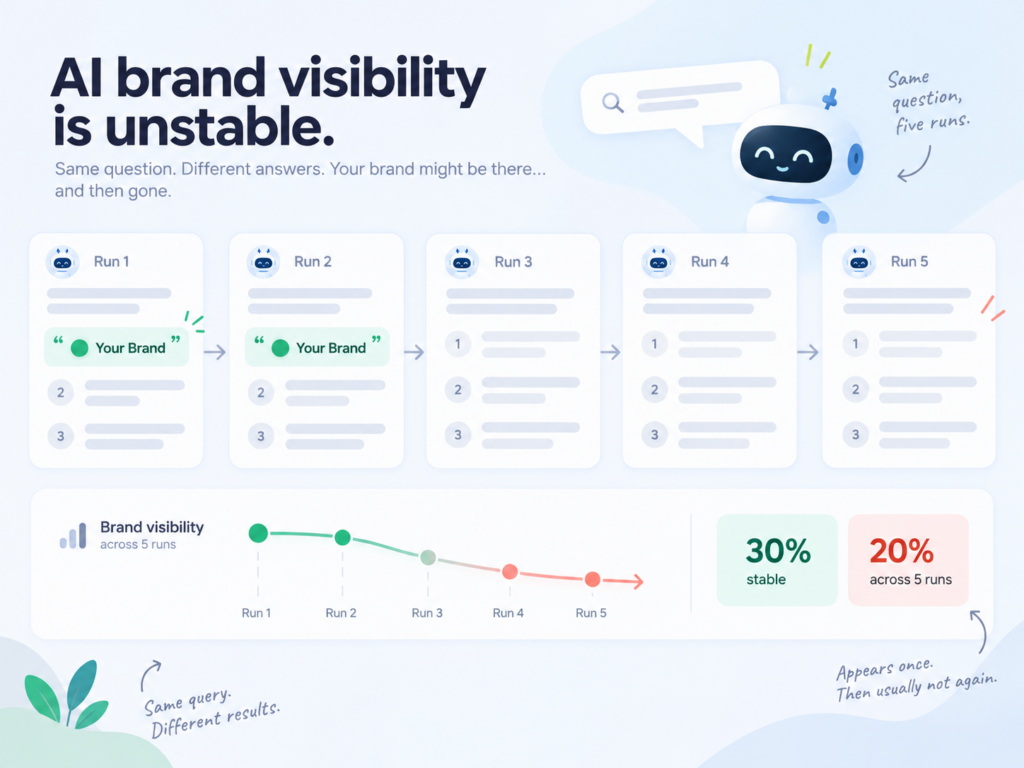
The pattern shows up at the domain level too. Citation tracking data cited in a longitudinal study of AI citation drift found that 40% to 60% of domains cited for identical queries change month to month. Stretch the window to six months, and 70% to 90% of the originally cited domains are gone, replaced by something else entirely.
Nothing on your site has to change for this to happen. A competitor publishes a new comparison page, a model refreshes its retrieval index, or a third-party review site gets more coverage, and your citation share moves without you touching a single line of content. One analysis of citation volatility found a brand’s AI answer presence can swing from 86% to 14% in a single period purely because competing sources improved, with no internal site changes involved. A snapshot taken in March tells you nothing reliable about June.
There’s a small silver lining in the same data. About 57% of brands that disappear from an AI answer resurface within two runs, so a dip isn’t always permanent. But you can only tell the difference between a temporary dip and a real loss if you’re actually watching the trend, not just holding onto whatever score you got the one time you checked.
When a One-Time Audit Is Actually Enough
This doesn’t mean every brand needs a monitoring subscription on day one.
A one-time audit tends to be enough when you’re early-stage and still building basic AI readiness, when budget genuinely doesn’t stretch to a tracking tool yet, or when your category sees little AI search activity and citation volatility barely touches you. If your goal is simply to confirm your site isn’t technically blocking AI crawlers, or to get a baseline before a bigger content push, a single check answers that question completely.
In practice, a quarterly manual re-check can cover these cases well enough. The trade-off is visibility gaps between checks, but if nothing in your category is moving fast, that gap is a manageable risk rather than a real cost.
Think of it as buying yourself information at the lowest possible cost. A pre-seed startup deciding whether to invest in AI-facing content at all doesn’t need a monitoring dashboard, it needs a yes-or-no answer on whether the basics are in place. A free audit gives exactly that, and re-running it every few months as the site grows is a perfectly reasonable cadence until the business itself changes.
When Continuous Tracking Becomes Non-Negotiable
The calculation changes once AI search is an actual acquisition channel for your business, or once your category is competitive enough that someone else is actively trying to take your spot.
Freshness plays a direct role here. Data from the same AirOps research found that pages updated on a regular cadence are about three times less likely to lose citations, and that more than 70% of pages currently cited by AI systems were updated within the past 12 months. If you’re not tracking which pages are losing ground, you can’t know which ones need that refresh, and you end up guessing at a schedule instead of reacting to actual drift.
That’s the gap a one-time report can’t close.
This is where a platform built for ongoing measurement, rather than a single grade, earns its keep. Topify tracks visibility, sentiment, and position across ChatGPT, Perplexity, and Google AI Overviews at the prompt level, so instead of a single composite score, you see which specific prompts you’re winning or losing and when the shift happened. Its competitor benchmarking shows who’s picking up the citations you just lost, and its source analysis traces which domains AI systems are pulling from instead of yours. That turns a vague sense that “things changed” into a specific, actionable finding.
Picture a mid-market SaaS brand that ran a free audit in January and scored well on every category. By April, a competitor launches a detailed comparison page that starts getting cited across three AI platforms, and the SaaS brand’s mentions quietly drop by half. Nobody notices, because the last data point anyone has is the January score, and January still looks fine on paper. Continuous tracking is what turns that invisible slide into a flagged alert the week it starts, not the quarter someone finally asks why leads slowed down.
A Simple Decision Framework
| Signal | Lean one-time audit | Lean continuous tracking |
|---|---|---|
| Budget | Very limited | Can support a monthly tool |
| Category competition | Low AI search activity | Competitors actively optimizing for AI |
| Content cadence | Rarely publish or update | Publish or refresh regularly |
| Business goal | Confirm technical baseline | Treat AI search as a growth channel |
If two or more rows point right, a single audit will likely leave you reacting to changes you never saw coming. Setting up ongoing tracking takes about the same effort as running the free check you already did, just with the visibility kept current.
Conclusion
A free GEO audit is the right first move for almost every brand. It’s fast, it costs nothing, and it tells you exactly where your technical baseline stands today. The mistake is treating that single number as a permanent grade. Citation data moves on a weekly, sometimes daily, cycle, and the brands that hold their AI visibility are the ones checking often enough to catch the drift before it costs them a customer. Start with the audit. Decide on tracking once you know how much your category actually moves.
FAQ
Q: How often should I re-run a free GEO audit?
A: If you’re not ready for continuous tracking, a monthly manual re-check is a reasonable minimum. Given that citation share can shift meaningfully within weeks, quarterly checks are often too infrequent for competitive categories.
Q: Is a free GEO audit accurate?
A: Free audits are generally accurate for what they measure: crawler access, structured data, and content signals at the moment you run them. They’re not inaccurate, they’re just time-limited. The score reflects that day, not the following month.
Q: What’s the difference between a GEO audit and AI visibility monitoring?
A: An audit is a one-time technical and citation snapshot. Monitoring tracks the same metrics continuously, showing trend lines, competitor movement, and which specific prompts your brand is gaining or losing over time.
Q: Do I need continuous tracking if I’m a small brand?
A: Not necessarily. If your category sees little AI search competition and you don’t rely on AI channels for growth, periodic manual checks can be enough until that changes.

