

A mid-market buyer opens ChatGPT and types “best project management tool for a 50-person remote team.” Three names come back. Yours isn’t one of them, even though your docs are thorough, your pricing page is clean, and your G2 reviews are solid.
That’s not a content problem. It’s a GEO problem, and it usually hides in places a marketing team never thinks to check.
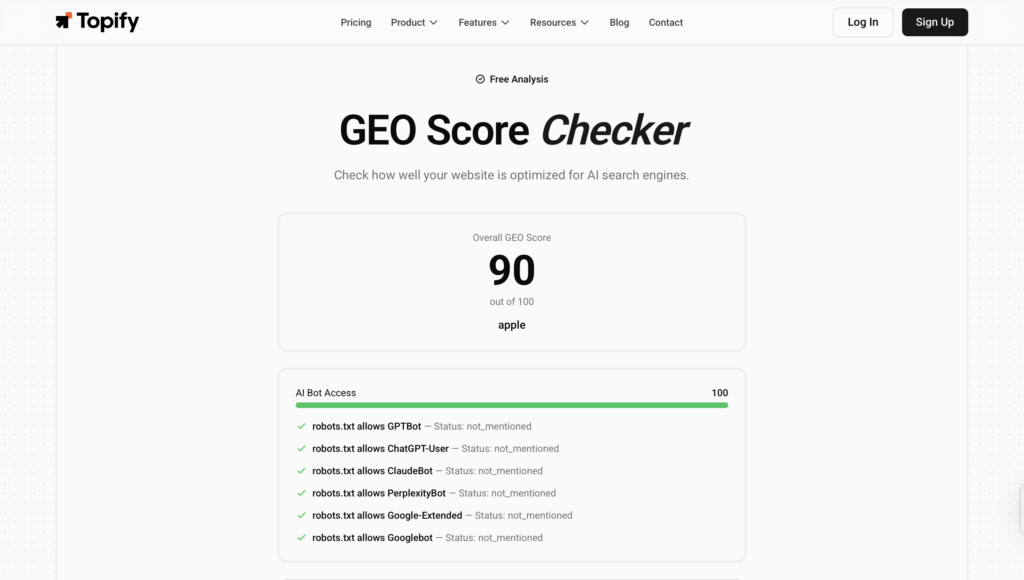
Run a free GEO audit on your domain and you’ll get four numbers back in under 60 seconds. ✅ Free ⚡ Results in 60 seconds 🔒 No signup required. Three of those numbers are usually fine. The fourth is where most SaaS brands lose the deal before anyone on your team even knows it happened.
GEO Score Checker
The Four Numbers That Decide If AI Recommends Your SaaS
Topify’s GEO Score Checker breaks AI visibility into four dimensions. Each one maps to a specific reason your brand does or doesn’t show up when a buyer asks an AI assistant for a recommendation.
| Score Dimension | What It Measures | SaaS Impact |
|---|---|---|
| Bot Access | Can AI crawlers reach your site at all? | CDN rules and firewall configs often block GPTBot or ClaudeBot without anyone noticing |
| Structured Data | Can AI parse what your pages mean? | Pricing tiers, feature comparisons, and integration lists need schema markup to be machine-readable |
| Content Signals | Does AI treat your content as authoritative? | Deep docs and whitepapers only count if they’re indexable and semantically clear |
| Visibility Score | How often do you actually appear in AI answers? | Reflects your real presence across ChatGPT, Perplexity, Gemini, and Google AI Overviews |
Here’s how to check where you stand:
- Open the free GEO Score Checker and enter your domain.
- Wait about 60 seconds for the four-dimension breakdown.
- Compare each score against the 0-40 (invisible), 41-60 (basic), 61-80 (solid), 81-100 (strong) bands.
- Note which single dimension is dragging the other three down. That’s usually where the real story is.
What SaaS Buyers Actually Ask AI Before They Talk to Sales
Buyer behavior has shifted faster than most GTM teams have adjusted for. Category-level AI discovery for B2B SaaS jumped from roughly 4% to 17% of all discovery activity in a single year, and separate research puts AI-influenced shortlisting even higher, with about a third of B2B SaaS buyers now building their vendor shortlist directly from AI search citations, a shift that started from a near-zero baseline back in 2024.
The more striking number comes from G2’s research on chatbot-influenced purchasing: 69% of buyers ended up choosing a different vendor than they originally planned because of AI chatbot guidance, and roughly a third bought from a vendor they’d never even heard of before the AI surfaced it. That’s not a marginal influence. That’s the AI rewriting the shortlist before your sales team gets a first call.
| AI Prompt Example | Platform | Search Intent | What It Reveals |
|---|---|---|---|
| “Best CRM for a mid-market sales team” | ChatGPT | Category comparison | Tests whether you rank for category, not just brand |
| “[Your competitor] alternatives with better onboarding” | Perplexity | Displacement search | Shows if buyers see you as a credible swap-in |
| “Is [your product] good for HIPAA-compliant workflows” | Gemini | Trust and compliance | Reveals if AI can find and verify your compliance claims |
| “Cheapest project management tool with SSO” | ChatGPT | Feature + price filter | Tests structured data on pricing and feature pages |
| “Which tools integrate natively with Salesforce” | Perplexity | Integration research | Depends on whether integration docs are crawlable and clear |
Most of these are category questions, not brand-name searches. That distinction matters more than it sounds like it should.
The Blind Spot Most SaaS Teams Miss
Here’s the thing. Teams that fail a GEO audit usually assume it’s a content quality problem. It typically isn’t.
Roughly 27% of B2B SaaS and ecommerce websites are unknowingly blocking major AI crawlers through CDN-level rules they never configured on purpose, according to research summarized by Mersel’s crawler-blocking guide. Separately, GPTBot blocking among the web’s most prominent sites has plateaued at around 25%, up from just 5% in early 2023, per the State of Robots.txt for AI tracker. Your docs can be excellent and still invisible if the crawler never gets past the front door.
That’s Bot Access. But there’s a second, quieter blind spot, and it’s the one that’s easy to miss even after you fix crawler access.
Platforms don’t source answers the same way. ChatGPT tends to cite a vendor’s own pages directly, doing so about 74.6% of the time, while Perplexity, Gemini, and Claude lean heavily on third-party sources, relying on them roughly 79% of the time. A SaaS brand can look strong on ChatGPT and be functionally invisible on Perplexity, purely because its authority signals live only on its own domain instead of in independent reviews, comparison sites, and analyst coverage.
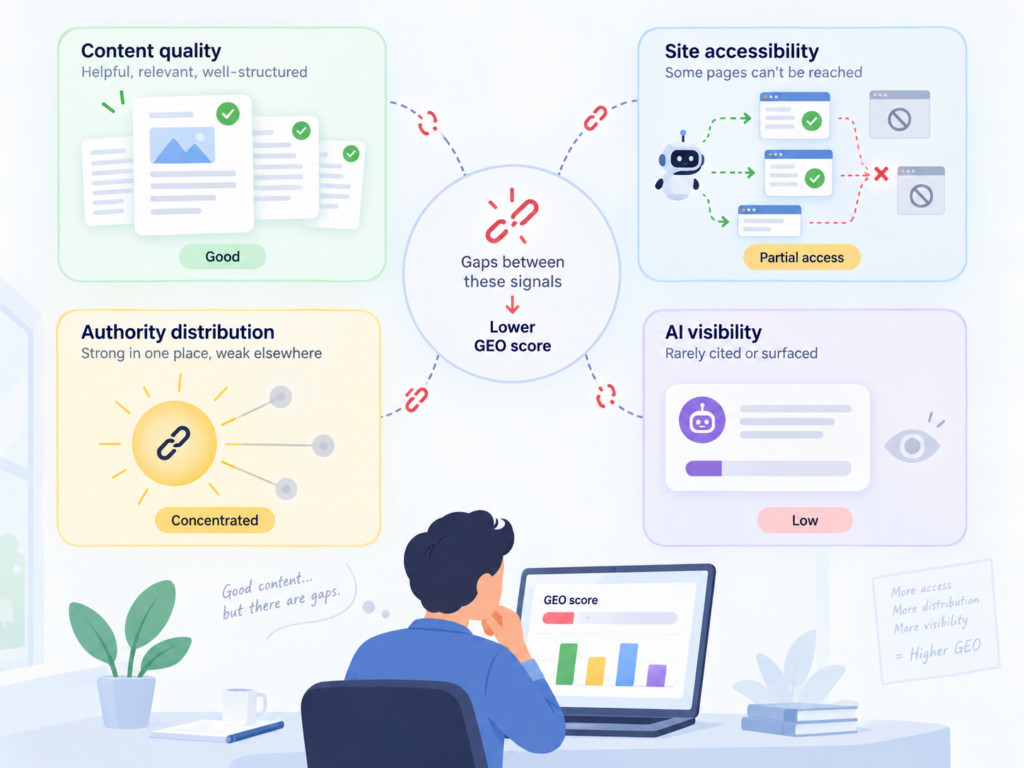
Put those two things together and you get the actual pattern behind a low GEO score in SaaS: content that’s good enough, on a site that’s partly unreachable, with authority that only exists in one place. None of the four numbers alone tells you that. The gap between them does.
From a One-Time Score to Continuous GEO Monitoring
A single audit tells you where you stand today. It doesn’t tell you what happens after your next product launch, a competitor’s PR push, or a crawler policy change on a platform you don’t control. GEO signals move. A one-time check doesn’t.
| Capability | Free GEO Score Checker | Topify Platform |
|---|---|---|
| Check frequency | One-time snapshot | Continuous monitoring |
| Dimensions tracked | 4 GEO scores | Full GEO analytics, sentiment, and citation tracking |
| Historical trends | None | Full trend history with alerts |
| Competitor benchmarking | Not included | Real-time competitor tracking |
| Platform breakdown | Aggregated | Per-platform view across ChatGPT, Perplexity, Gemini, AI Overviews |
| Optimization actions | Directional guidance | Specific, prioritized execution steps |
The checker gives you a snapshot. Comprehensive GEO Analytics tracks the trajectory, so you know whether last month’s fix actually moved the needle or whether a new crawler rule just undid it. If the four-number gap above sounds familiar, it’s worth starting a free trial to see the full picture, and the pricing page breaks down what’s included at each tier.
Conclusion
A low GEO score in SaaS is rarely a writing problem. It’s usually one specific gap, blocked crawlers, missing schema, or authority that lives in only one place, dragging three otherwise decent numbers down with it. Check your GEO score now and see which one it is for you.
For a deeper look at the mechanics behind this, The Complete Guide to Generative Engine Optimization walks through the fundamentals, and 7 Best Tools to Track AI Search Visibility in 2026 compares monitoring options if you’re evaluating what comes after the free check. If Bot Access turns out to be your weak spot, Topify’s AI Robots Checkerdigs into your robots.txt configuration in more detail.
Frequently Asked Questions
What’s a good GEO score for a SaaS company?
Anything above 61 is generally considered solid visibility, though the bar keeps rising as more competitors optimize. Scores under 40 usually mean AI can’t reliably find or verify your brand at all, not that your content is weak.
Why would a SaaS site with great content still score low?
Usually one dimension is broken, most often Bot Access from CDN-level crawler blocks, or Content Signals from a lack of third-party authority. The other three scores can be fine and still get pulled down by the one gap.
Is GEO the same thing as traditional SEO?
No. SEO optimizes for ranking in a list of links. GEO optimizes for being named and trusted inside an AI-generated answer, which depends more on crawler access, structured data, and independent validation than on keyword density.
What’s the difference between the free checker and the full platform?
The free tool gives you a one-time snapshot across four dimensions. The full platform tracks those same signals continuously, benchmarks you against competitors, and breaks results down by individual AI platform instead of one blended score.
Read More:
AI Search Visibility vs. Google Rankings: What’s the Difference?

