


Your team ranks on page one for every keyword that matters. Then someone asks ChatGPT the exact question a customer would type, and your brand doesn’t show up in the answer. No error message. No warning in Search Console. Just silence.
That gap is easy to miss because nothing in your existing SEO stack is built to catch it. Google rankings measure whether you show up in a list of links. AI answers measure whether a model decided your content was worth citing at all. Those are two different questions, and most brands have never checked the second one.
What a Free GEO Audit Actually Checks
A GEO audit looks at something a traditional SEO audit was never built to look at: whether AI systems can reach your content in the first place, and whether they trust what they find enough to cite it. That starts at the infrastructure level, with whether crawlers like GPTBot, ClaudeBot, and PerplexityBot can even access your pages.
Most sites haven’t made a deliberate choice here. A recent crawl of nearly 1,750 websites found that 84.2% have no AI crawler policy at all, and close to 14% block at least one AI bot without realizing what that costs them in citations. Bot access is often the first thing a GEO audit flags, simply because so few sites have looked at it.
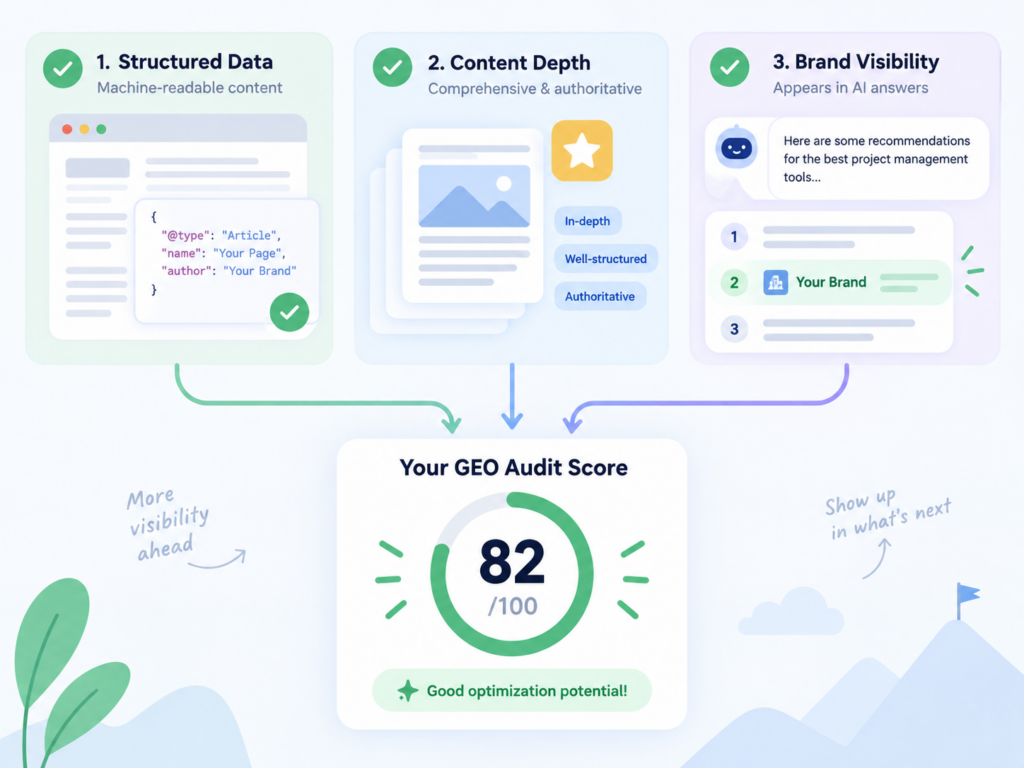
Beyond access, a free geo audit typically checks whether your structured data is machine-readable, whether your content carries the depth and authority signals a model looks for, and how often your brand actually appears when someone asks an AI platform a relevant question. Put those checks together and you get a single score out of 100.
Run the Free GEO Audit in 60 Seconds
Running one doesn’t require a developer or a login. Topify’s GEO Score Checker works in three steps: enter your domain, wait while it scans crawler access, schema, and content signals, then read a score broken into four parts.
No signup. No credit card. Results land in under a minute, which puts it in line with most of the free scoring tools that have shown up in this space over the past year.
That speed matters because it removes the only real excuse for not knowing your baseline. You don’t need a strategy meeting to justify a 60 second check.
Reading Your GEO Score: What Each Range Means
The total score is the headline number, but it’s a summary, not the full picture. Here’s roughly what each range tends to indicate:
| Score Range | What It Usually Means |
|---|---|
| 0-40 | AI systems rarely reach your site or largely ignore what they find. Near-total invisibility in AI answers |
| 41-60 | Some presence, but competitors are getting picked more often for the same queries |
| 61-80 | Solid visibility, with specific gaps still holding you back from top placement |
| 81-100 | A strong candidate for AI recommendations across most relevant prompts |
A score in the 41-60 range is the one that surprises people most. It’s high enough to feel fine on a dashboard, but low enough that a competitor with a cleaner technical setup is quietly winning most of the citations you’d expect to split evenly.
The Four Dimensions Behind the Number
Bot Access answers a simple question: can AI crawlers reach your pages at all. A block in robots.txt, an aggressive firewall rule, or content that only renders after JavaScript can all tank this dimension even when the content itself is strong.
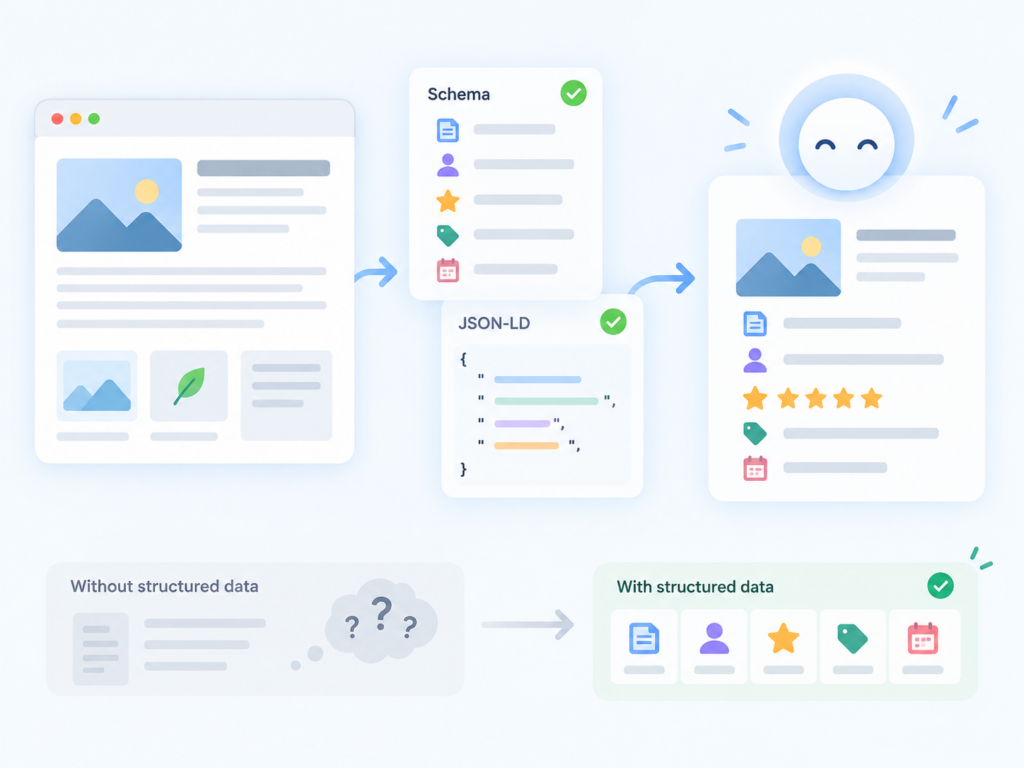
Structured Data checks whether your schema markup and JSON-LD are present and accurate. This is the layer that helps a model understand what your page is actually about, rather than guessing from raw text.
Content Signals looks at depth, specificity, and the kind of authority markers that make a model more confident citing you over a competitor. Thin, generic pages tend to score low here regardless of how well they rank in Google.
That gap between ranking well and being cited well is the whole reason GEO audits exist.
Visibility Score is the most direct dimension: how often your brand actually shows up across ChatGPT, Perplexity, Gemini, and Google AI Overviews when someone asks a relevant question. It’s the closest thing to a real-world outcome metric in the whole report.
Why a Good Score Today Doesn’t Guarantee One Next Month
AI citation patterns shift every few weeks, not every few quarters.
A single audit tells you where you stood the moment you ran it. It doesn’t tell you what changed after a competitor fixed their schema, after a platform updated how it weighs content freshness, or after your own site quietly picked up a new crawler block during a CDN migration. Those shifts happen constantly, and a one-time snapshot can’t catch them.
That’s the practical limit of any free tool, including this one. It’s built to answer “where do I stand right now,” not “where am I trending.” For teams that need the second answer, that’s usually where Comprehensive GEO Analytics comes in, tracking the same dimensions on an ongoing basis instead of a single pass.
| Capability | Free GEO Audit | Continuous GEO Monitoring |
|---|---|---|
| Check frequency | One-time snapshot | Ongoing tracking |
| Platform breakdown | Aggregated score | Per-platform data across ChatGPT, Perplexity, Gemini, AI Overviews |
| Competitor view | Not included | Real-time benchmarking |
| Alerts on score changes | None | Automatic |
The checker gives you a snapshot. Continuous monitoring tells you which direction you’re moving.
Conclusion
A GEO score isn’t a grade. It’s a diagnostic that tells you exactly where AI systems are losing track of your brand, whether that’s a crawler block, thin schema, or content that never earns a citation. The number matters less than what you do with the four dimensions behind it.
If you haven’t checked yours, that’s the first gap to close. It takes about as long as reading this article.
Frequently Asked Questions
How is a GEO audit different from an SEO audit?
An SEO audit checks how you rank in a list of search results. A GEO audit checks whether AI systems can access, understand, and cite your content directly in a generated answer. The two overlap on technical basics but measure different outcomes.
How often should I re-run a free GEO audit?
Most teams re-check monthly, since crawler policies, schema, and AI citation patterns can all shift within a few weeks. If you’ve just made technical changes to your site, it’s worth running one immediately after to confirm the fix worked.
Does a low score mean AI has never seen my site?
Not necessarily. A low score can mean AI crawlers were blocked entirely, or it can mean they reached your content but found nothing citable, like thin pages or missing schema. The four-dimension breakdown tells you which situation you’re actually in.
What’s the real difference between a free audit and a paid GEO platform?
A free audit gives you a one-time score. A paid platform tracks that same score over time, breaks it down by AI platform, and benchmarks it against named competitors, which matters once you’re past the “do I have a problem” stage and into “am I closing the gap.”

