

Your team spent the last two quarters building content, earning backlinks, and climbing Google rankings. Then someone asked ChatGPT what to buy in your category, and your brand wasn’t in the answer. 73% of B2B buyers now use tools like ChatGPT and Perplexity somewhere in their research process, which means a growing slice of your audience is making decisions in a place Google Analytics can’t see.
The metrics that told you SEO was working don’t answer a different question: can an AI model actually read, understand, and recommend you. That question has a name. It’s called a free GEO audit, and it breaks down into four specific signals.
Why Ranking Well on Google Doesn’t Mean AI Can See You
Search and AI answers run on different logic. Google indexes pages and ranks them against a query. An AI model reads a smaller set of sources, decides which ones it trusts, and writes an answer in its own words.
That gap is already showing up in the numbers. AI referral traffic to websites grew 16 times over from 2024 to 2026, and the sessions that do arrive convert differently than organic search ever did. ChatGPT-referred visits convert at roughly 15.9%, against 1.76% for Google organic.
Fewer visits, but a much higher-intent visitor. That’s the trade-off a GEO audit is built to measure.
A free geo audit exists to answer one question directly: not “do you rank,” but “can AI reach, parse, and trust what’s on your site.” Four signals make up that answer.
Signal 1: Whether AI Bots Can Even Reach Your Site
This is the most basic gate, and it’s the one teams check least often. If GPTBot, PerplexityBot, or ClaudeBot are disallowed in robots.txt, none of your content ever reaches the model in the first place. It doesn’t matter how good the page is.
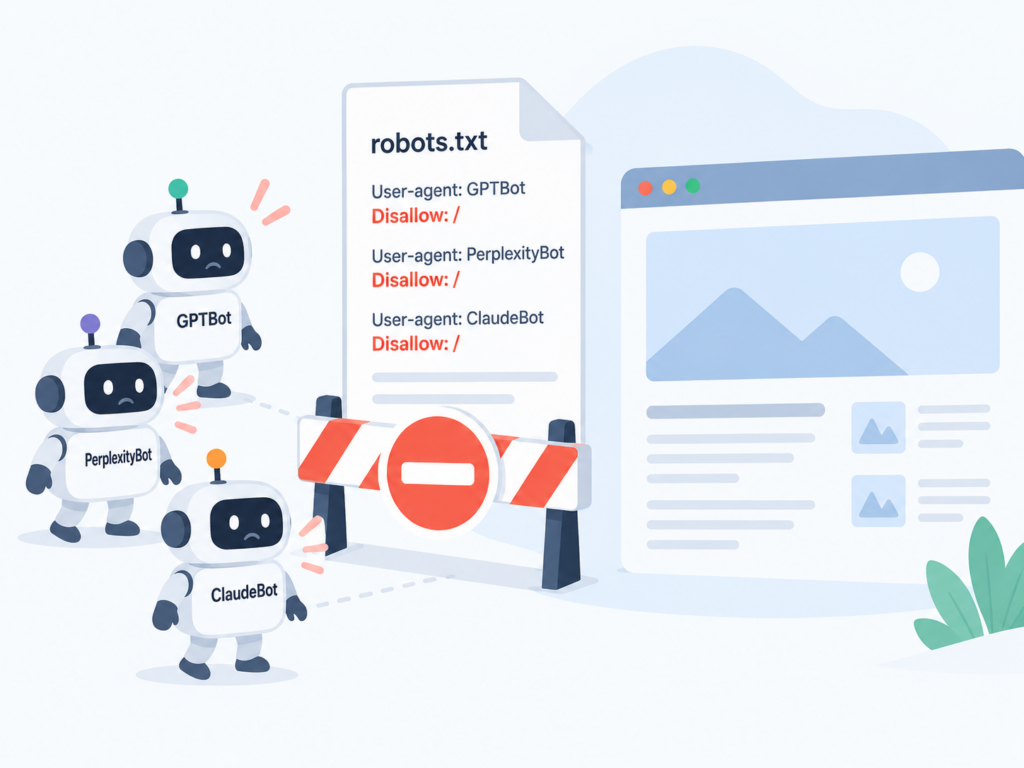
This happens more than most teams assume. One 2026 crawl of nearly 1,750 sites found 9.9% block GPTBot outright, and 84.2% have no AI crawler policy at all, often because a developer copied a blanket disallow rule years ago and nobody revisited it.
Blocking isn’t always accidental. A meaningful share of enterprise sites choose a hybrid setup on purpose, letting bots crawl public marketing pages while keeping account and admin paths closed. That’s a reasonable policy. An unreviewed one, inherited from an old CMS default, isn’t.
The fix is usually a single line change. Checking which specific bots are allowed or blocked, by name, is step one of any audit worth running.
Signal 2: Whether Your Content Has a Shape AI Can Parse
Structured data gets treated as a magic switch in a lot of SEO advice, and the reality is messier. A controlled test of 1,885 pages that added JSON-LD schema found close to zero lift in AI citations: +2.2% on ChatGPT, +2.4% on AI Mode, and a slight decline on Google AI Overviews. Adding FAQPage markup to a page that AI already ignores won’t suddenly get it cited.
That doesn’t mean schema is pointless. It just does a different job than most people assume.
Where structured data earns its keep is at the parsing stage, not the citation stage. It helps a model correctly identify what a page is, who wrote it, and how the pieces relate, especially on pages the model hasn’t seen before. Think of it as making your content legible, not persuasive.
Layering Organization, Article, and FAQPage schema on the same page gives a model several ways to extract the same information. That’s worth doing. Just don’t expect it to move a brand from invisible to recommended on its own.
Signal 3: Whether Your Content Signals Are Strong Enough to Get Picked
This is where the basics still carry weight: a clear page title, a real meta description, a proper H1, structured H2s underneath it, a canonical URL, and enough actual content depth to be worth citing.
None of this is exotic. It’s the same hygiene good SEO has rewarded for a decade. The difference is what it’s now being read by. A model deciding whether to cite a page is effectively asking the same question a skimming reader would: does this page clearly say what it’s about, and does it say enough to be useful.
Thin pages lose on both counts. So do pages where the heading structure doesn’t match the actual content, because a model that can’t map your H2s to your paragraphs has a harder time pulling a clean answer out of them.
Signal 4: Whether AI Actually Recognizes and Recommends You
The first three signals are technical: can a bot reach the page, can it be parsed, is it substantial enough to matter. The fourth signal is different. It asks whether the model, once it has read your content, actually thinks of your brand as a real answer.
This is the layer a purely technical crawl can’t reach, because it requires probing the model itself rather than the site. Does it recognize the brand name. Does it describe it accurately. Does it recommend it in the same breath as competitors, or leave it out entirely.

It’s also the layer with the most at stake. As AI referral sessions convert at multiples of organic search, being technically crawlable but never actually recommended is close to the worst outcome: fully visible to the bots, invisible in the answers that matter.
Run a Free GEO Audit in Under a Minute
Checking all four signals by hand means digging through robots.txt, running a schema validator, auditing on-page content, and somehow probing an LLM’s actual opinion of your brand. Most teams don’t have a spare afternoon for that.
You can run a free GEO audit from Topify, a platform built for AI search optimization, and get a composite score back in under a minute. No signup, no credit card.
The score breaks down by category, not just a single number. AI Bot Access, Structured Data, and Content Signals each get scored out of 100, with the specific pass and miss items listed underneath, so you can see exactly which bot is blocked or which schema type is missing rather than guessing.
What a Low GEO Audit Score Actually Means
A score under 50 usually means something structural is broken: a blocked crawler, missing structured data, or content too thin to cite. These are binary problems with binary fixes, and fixing even one can move the number fast.
A score between 50 and 74 means the fundamentals are mostly there, but the pass and miss list still has real gaps. Adding FAQ schema to your highest-traffic page or unblocking one crawler can often move the score 10 to 20 points on its own.
Above 75, you’re in reasonably good shape. At that point the main risk isn’t a broken signal, it’s a competitor closing the gap while you’re not watching.
That last part is the reason a one-time free geo audit isn’t the finish line. Scores change as sites update, as crawlers change policy, and as competitors fix their own gaps. Teams that want to track that Signal 4 layer over time, the part a technical scan can’t see on its own, typically move from the free check into ongoing AI visibility monitoring once they’ve cleared the first three signals.
Conclusion
A high Google ranking used to be proof that a brand was easy to find. It no longer covers the whole picture. AI Bot Access, Structured Data, Content Signals, and AI Visibility are four separate gates, and a brand can pass three of them while still being invisible in the answers that increasingly decide who a prospect calls first.
Running a free GEO audit doesn’t fix anything by itself. It tells you which of the four gates is actually closed, so you’re not guessing where to start.
FAQ
Q: What is a GEO audit, exactly?
A: It’s a check of how AI-ready a website is across a specific set of signals, typically whether AI crawlers can access the site, whether the content is structured clearly, whether it has enough depth to be worth citing, and whether AI models recognize the brand at all.
Q: Is a free GEO audit actually free, or is there a catch?
A: The technical layer, covering crawler access, structured data, and content signals, is genuinely free to run with no signup required. Deeper, ongoing tracking of how AI models talk about a brand over time is typically where paid monitoring comes in.
Q: How often should I run a GEO audit?
A: Monthly is reasonable for most brands, since crawler policies and content change often enough to shift a score. Anyone actively fixing issues from a first audit should re-run it after each fix to confirm it worked.
Q: Does a high GEO audit score guarantee AI will recommend my brand?
A: No. A high score on the technical signals means AI can reach and read your content, which is a precondition for being recommended, not a guarantee of it. Recognition and recommendation depend on the fourth signal, AI Visibility, which reflects how models actually talk about a brand rather than whether they can technically access it.

