

Most marketing teams run a technical SEO audit, get a clean bill of health, and assume that covers AI search too. It doesn’t. A site can rank on page one of Google and still be invisible when someone asks ChatGPT the exact same question, because a GEO audit checks a different set of signals than a crawler-and-keywords SEO tool ever did.
That gap is exactly what a free GEO audit is built to expose. Here’s what it actually measures, and why most brands come back with at least two failing scores.
The Four Things a Free GEO Audit Actually Checks
A GEO audit isn’t a single score. It’s four separate checks, each answering a different question about whether AI systems can find, read, and trust your content.
Bot Access asks whether AI crawlers can reach your site at all. GPTBot, ClaudeBot, and PerplexityBot all need explicit or implicit permission in robots.txt, and a surprising number of sites block them without realizing it, often through a CDN rule or a security plugin nobody remembers configuring.
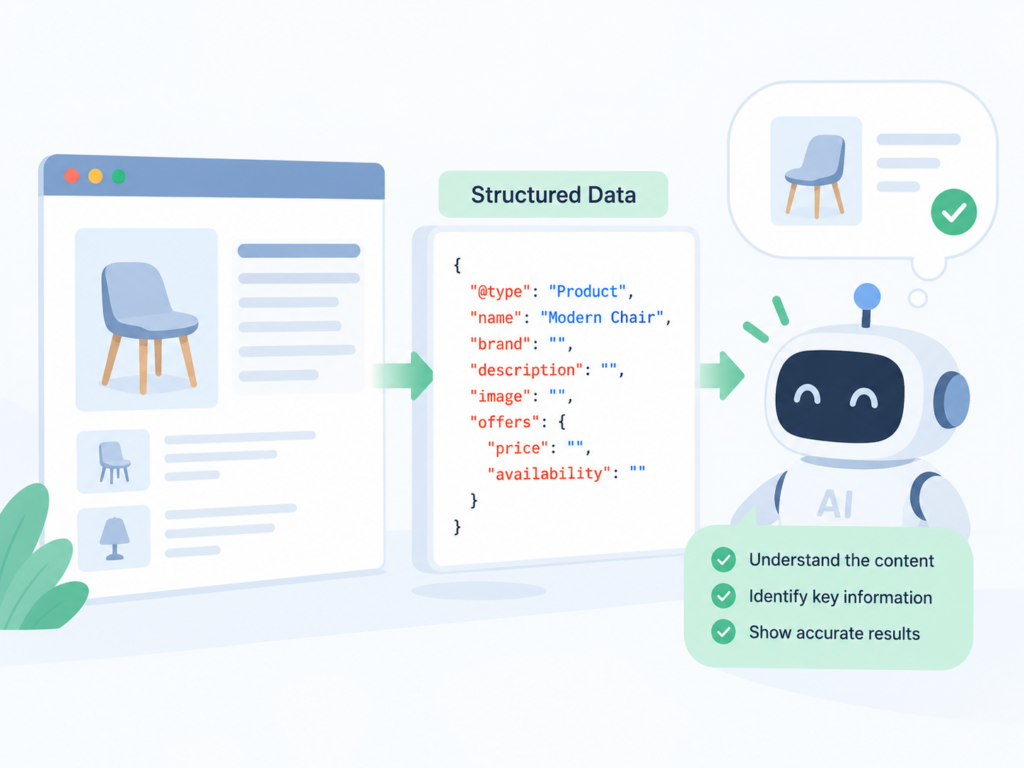
Structured Data asks whether AI systems can understand what your content means, not just that it exists. Schema markup, JSON-LD, and proper entity tagging tell a model what a page is actually about instead of leaving it to infer from prose.
Content Signals asks whether your content looks authoritative enough to cite. This covers depth, author credentials, freshness, and the kind of experience-based detail that separates a real answer from filler copy.
Visibility Score is the outcome metric. It tracks how often your brand actually shows up when AI platforms answer questions in your category, across ChatGPT, Perplexity, Gemini, and Google AI Overviews.
Running a free GEO audit checks all four in under a minute, with no signup required. The value isn’t the single number it produces. It’s seeing which of the four is dragging the others down.
Why Most Brands Fail Two of Four
Here’s the pattern that shows up again and again: brands rarely fail all four dimensions, and they rarely pass all four either. Most land somewhere in the middle, with two solid scores and two weak ones, and the two that fail are usually predictable.
Bot Access tends to be the one brands assume is a problem and usually isn’t. Recent robots.txt research found that 44.9% of prominent sites block at least one AI crawler outright, which sounds alarming until you notice that most blocks target training-only bots like CCBot rather than the answer-engine crawlers that actually drive citations. Fix the accidental blocks and this score often clears fast.
Structured Data is where things get harder. One audit of 5,000 production sites found that 71% deploy at least one schema type, but only 22% pass a clean validation check across every type they emit. That’s the gap that matters. A site can have schema markup and still fail this dimension, because deployed and valid are not the same thing.
Content Signals fails just as often, and for a less visible reason. Analysis of AI citation patterns shows E-E-A-T signals correlate at 0.81 with citation probability, while domain authority, the metric most teams still optimize for, correlates at only 0.18. Teams keep polishing the metric that stopped mattering.
That’s the gap most brands still can’t see.
Visibility Score is usually the symptom, not the cause. It’s downstream of the other three. Research tracking nearly 7,000 buyer-question checks across four AI platforms found that 53% of brands are invisible in AI answers for their own category. A separate SaaS-focused study found that 44% of brands ranking in Google’s top 10 get zero mentions from ChatGPT for the same keywords. Neither number is a Bot Access problem. Both are what happens when Structured Data or Content Signals is already broken upstream.
What a Low Score Actually Means for AI Recommendations
The four dimensions each score 0 to 100, and the bands translate directly into what happens when a buyer asks an AI platform about your category.
| Score Range | What It Means | AI Behavior |
|---|---|---|
| 0 to 40 | Severely invisible | AI can’t parse or find enough signal to consider recommending you |
| 41 to 60 | Basic visibility | You show up occasionally, competitors with stronger signals get named first |
| 61 to 80 | Good visibility | AI includes you regularly, still room to close the gap on the top performer |
| 81 to 100 | Strong visibility | AI treats you as a default answer in your category |
A brand sitting at 35 on Content Signals isn’t just “missing a few features.” It means AI models are actively choosing other sources because those sources answer the question more completely, and the model has no reason to guess in your favor.
Running the Audit in Under 60 Seconds
Getting your own numbers takes less time than reading this section.
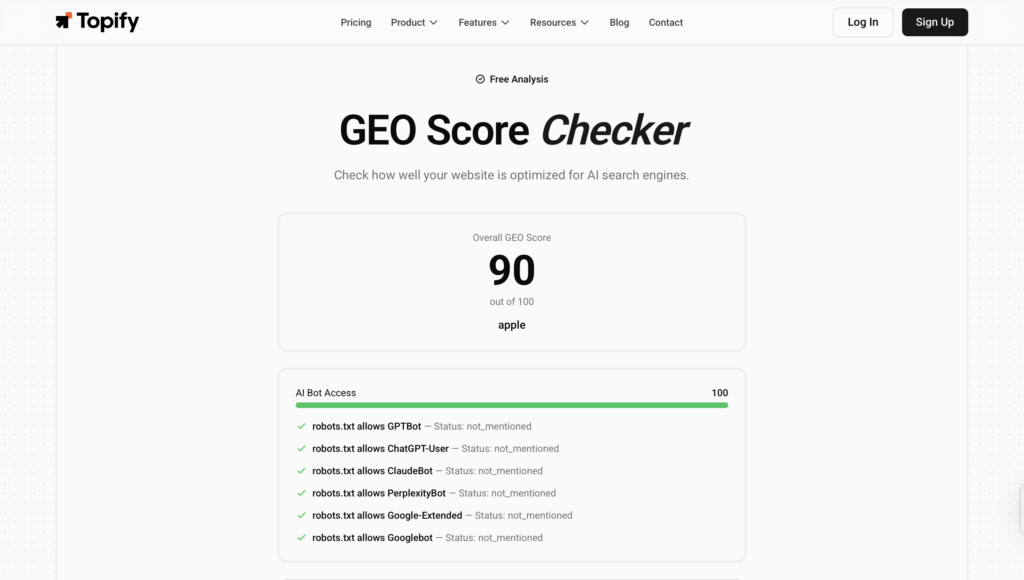
- Open the GEO Score Checker and enter your domain or brand name.
- Wait for the scan, which typically returns results in under 60 seconds.
- Review the four scores side by side rather than looking at an average.
- Note which two dimensions are lowest. That’s where the actual work starts.
Most teams expect Bot Access to be the problem. It’s usually Structured Data and Content Signals instead.
From a One-Time Score to Knowing What Changed
A free audit tells you where you stand right now. It doesn’t tell you what changed last week, or which competitor just closed the gap on Visibility Score while you weren’t looking.
That’s the limit of any one-time snapshot. AI platforms update how they crawl, cite, and weight sources on a rolling basis, not on a quarterly schedule. A score that’s accurate today can be stale in three weeks if a competitor ships new schema or an algorithm shift changes which E-E-A-T signals carry weight.
Comprehensive GEO Analytics exists for exactly that gap. Instead of a single scan, it tracks visibility, sentiment, and citation patterns continuously across ChatGPT, Perplexity, Gemini, and AI Overviews, so a drop in one dimension shows up as a trend line instead of a surprise. In practice, that means catching a Structured Data regression the week it happens, not the quarter you happen to remember to run another audit.
The checker gives you a snapshot. Continuous monitoring tells you which direction you’re moving.
For teams that want to move past a one-time check, starting a free trial takes the same amount of setup time as running the audit itself.
Conclusion
A free GEO audit isn’t a marketing gimmick dressed up as a diagnostic. It checks four real, measurable things, and the pattern of which two fail is remarkably consistent across brands: Bot Access usually clears, Structured Data and Content Signals usually don’t, and Visibility Score just reports the damage. Run the check, look at the two weakest scores instead of the average, and fix the root cause before it shows up as a competitor getting cited in your place.
FAQ
What’s the difference between a free GEO audit and a paid GEO platform?
A free audit gives you a one-time snapshot of four scores. A paid platform tracks those same signals continuously, adds competitor benchmarking, and shows you which specific pages or citations changed over time instead of just a number.
How often should I re-run a free GEO audit?
Monthly is a reasonable baseline for most brands, though anyone in a competitive category should check after any major content push or site migration, since schema and crawler access both break silently during redesigns.
What exactly does Bot Access check for?
It checks whether your robots.txt file and server-level rules allow major AI crawlers like GPTBot, ClaudeBot, and PerplexityBot to access your pages. A block here means AI models can’t read your content at all, regardless of how good it is.
Is a low score reversible, or does it take months to fix?
Bot Access fixes can take effect within days once crawlers recrawl the site. Structured Data and Content Signals typically take longer, since they involve actual markup and content changes rather than a single configuration switch.

