
Most SaaS marketing teams have already run their own version of a GEO audit. Someone opens ChatGPT, types in the product category, and checks whether the brand shows up. It usually does, once. Ask again with a slightly different prompt, and it doesn’t. That inconsistency gets written off as noise, but it’s actually the first real signal that something’s broken underneath. A single prompt test tells you what happened in one conversation. It doesn’t tell you whether your site can be crawled, parsed, or cited at all.
Why SaaS Buyers Are Asking AI Before They Ever Visit Your Site
The buying pattern has already shifted. 51% of B2B software buyers now start vendor research inside an AI chatbot, up from 29% a year earlier, and ChatGPT accounts for 63% of that behavior. For a SaaS company, that means the first real “visit” to your product often isn’t a page view. It’s a paragraph a model generated after deciding whether you were worth mentioning at all.
The stakes compound from there. 69% of B2B buyers end up choosing a different vendor than the one they originally planned to, based on what an AI chatbot told them during research. Ranking first on Google doesn’t move that needle. It says nothing about whether a large language model cites you when someone asks it to compare tools.
That’s the piece a free GEO audit for SaaS is built to check.
What a Free GEO Audit for SaaS Actually Checks
A free GEO audit for SaaS isn’t the same thing as manually prompting ChatGPT and hoping for a good answer. A real audit checks four separate layers: whether AI crawlers can access your pages, whether your markup carries the structured signals models rely on, whether your content is written for direct extraction, and whether any of it is currently showing up in AI-generated answers.
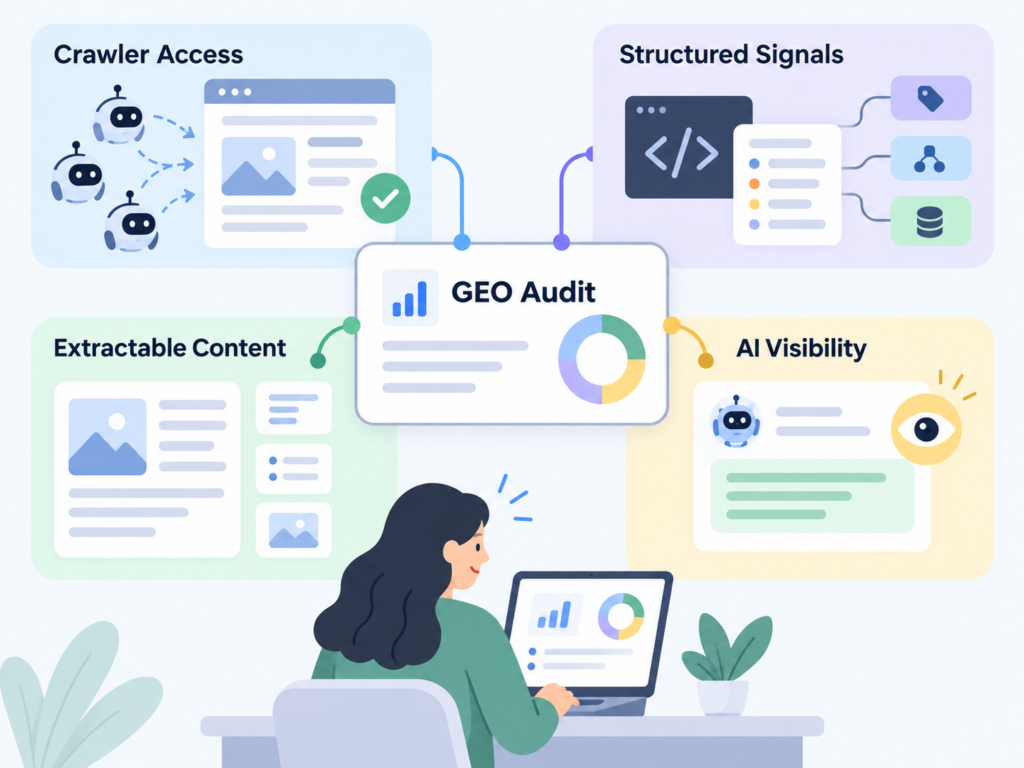
Each layer catches a different failure mode. A SaaS site can rank on page one of Google and still be invisible to GPTBot because of a single disallow rule. That’s the kind of gap a manual prompt check will never surface, because the model simply won’t have crawled the page in the first place.
The Four Places SaaS Sites Break Before AI Ever Sees Them
Most SaaS sites don’t fail because of one big problem. They fail in the same four small, fixable spots, repeatedly.
Robots.txt Blocking GPTBot and PerplexityBot
This is the most common blocker, and the easiest one to miss. A recent crawl of nearly 1,750 sites found that 9.9% block GPTBot outright in robots.txt, and 13.7% block at least one AI crawler. What makes this worse is that 84.2% of sites have no AI crawler policy at all, which means most teams have never actually checked their own file. If your product docs, pricing page, or comparison content sit behind a disallow rule left over from an old security review, nothing else below it matters.
Missing Schema and llms.txt Signals
Even when crawlers get in, they need structured signals to parse what they’re reading. Missing Organization, Product, or FAQ schema, combined with the absence of an llms.txt file, forces AI models to guess at what your product actually does and who it’s for. Guessing tends to favor the competitor with cleaner markup, not the one with the better product.
Content Written for Humans, Not Extraction
Blog posts and landing pages built for scrolling readers rarely work for extraction. AI models pull answer-first sections: clear definitions, short summaries, direct head-to-head comparisons. Content buried under a long narrative intro with no clear takeaway rarely gets quoted, even when it’s accurate and well-researched.
Zero Citations in AI-Generated Answers
This is where the first three problems collide. Blocked crawlers, missing schema, and unextractable content add up to the same outcome: your domain never appears when a model is asked to cite a source. And when a model does cite someone, it typically pulls from only 2 to 7 domains per response, so there’s very little room for a vague, half-optimized presence to sneak in anyway.
Running a Free GEO Audit for SaaS in Under a Minute
Checking for these four failure points doesn’t require a research team or a paid tool. Topify’s Free GEO Score Checkercrawls a URL the same way GPTBot, PerplexityBot, ClaudeBot, and Google-Extended do, then returns a 0-100 score with a prioritized fix list. No sign-up is required for the first scan.
Most SaaS sites that run the check recover 20 to 30 points just from unblocking crawlers and adding three core schema types. Each finding gets tagged P0, P1, or P2 based on its estimated point impact, so the output doubles as a priority order instead of a wall of unranked issues.
That’s the technical layer covered. It’s not the whole picture.
Technical Score Isn’t the Whole Story: Checking Brand Authority Too
A clean technical score answers whether AI can read your site. It doesn’t answer whether AI trusts your brand enough to recommend it over a competitor with a weaker product and better citations.
Topify’s AI Brand Authority Checker scores a brand across four separate dimensions: recognition, expertise depth, recommendation rate, and trust signals, based on how ChatGPT, Gemini, and Perplexity actually talk about it today. For SaaS brands specifically, a low recommendation-rate score often explains why a technically sound site still gets skipped in favor of a less optimized competitor that’s simply better known.
| Check | What It Measures | Time to Run | Sign-up |
|---|---|---|---|
| GEO Score Checker | AI crawler access, schema, content signals | 10 to 30 seconds | Not required |
| Brand Authority Checker | Recognition, expertise, recommendation rate, trust | 20 to 40 seconds | Not required |
| Comprehensive GEO Analytics | All of the above, tracked continuously with competitor benchmarking | Ongoing | Required |
Running both free checks together gives a more complete picture than either one alone. A site can pass the technical audit and still lose the recommendation to a more trusted brand, or have strong brand recognition and still be invisible because of a crawler block nobody noticed.
What Fixing the Biggest Gaps Actually Looks Like
One mid-market SaaS company selling project management software found that its help center, the section most likely to answer buyer comparison questions, had been fully blocked by a legacy robots.txt rule dating back to a 2019 security review. Nobody had touched it since.
Unblocking GPTBot and PerplexityBot, then adding FAQ schema to the twenty most-viewed help articles, moved the domain from zero citations to appearing in roughly one in five comparison-style AI prompts within a month.
The fix took an afternoon. Finding it took a proper audit, not another manual ChatGPT check.
From One-Time Audit to Continuous GEO Tracking
A free audit is a snapshot, and snapshots go stale. Models update, competitors publish new content, and citation patterns shift every few weeks. A score that looks solid this quarter can slide by the next one without any single dramatic cause.
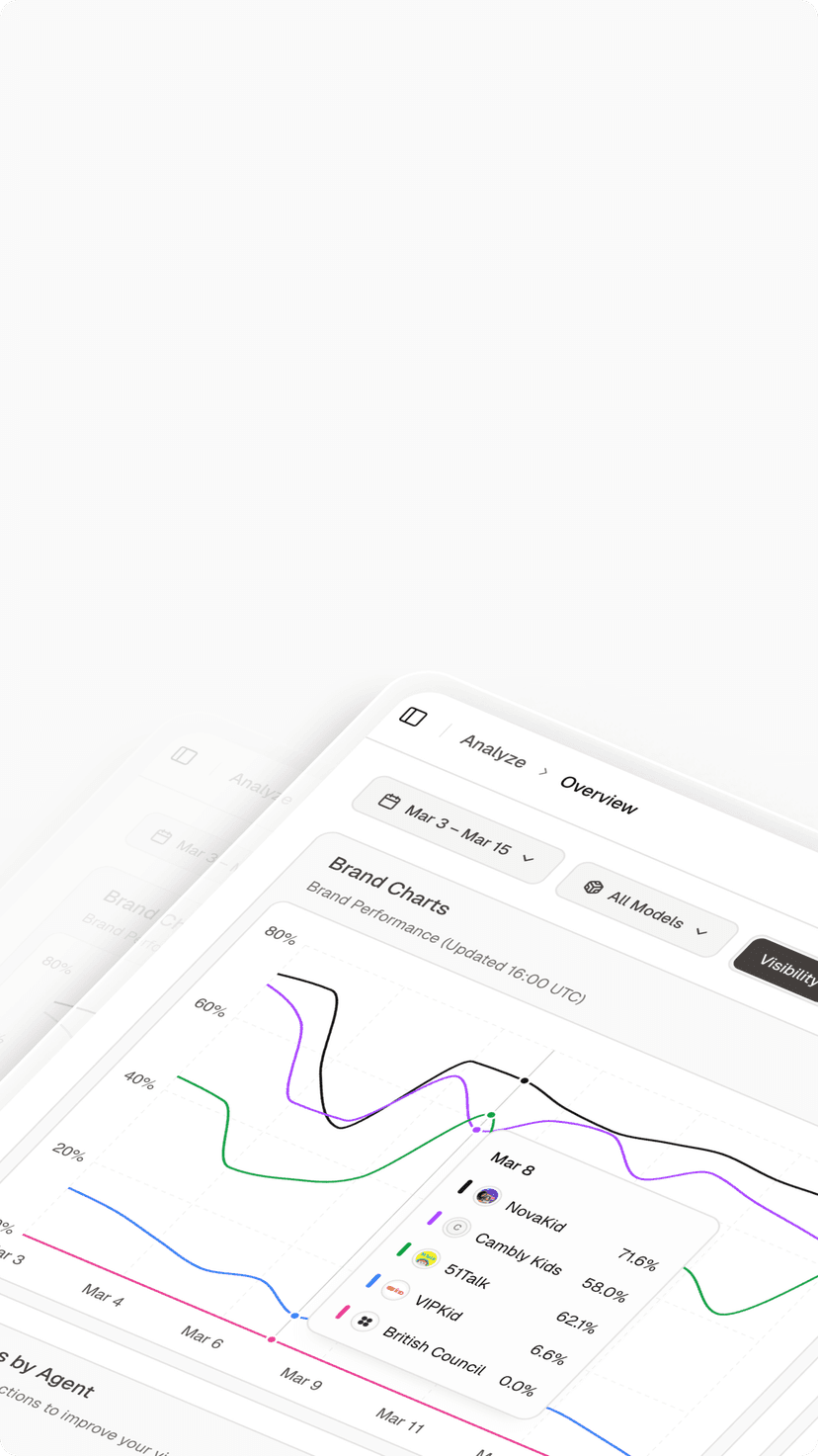
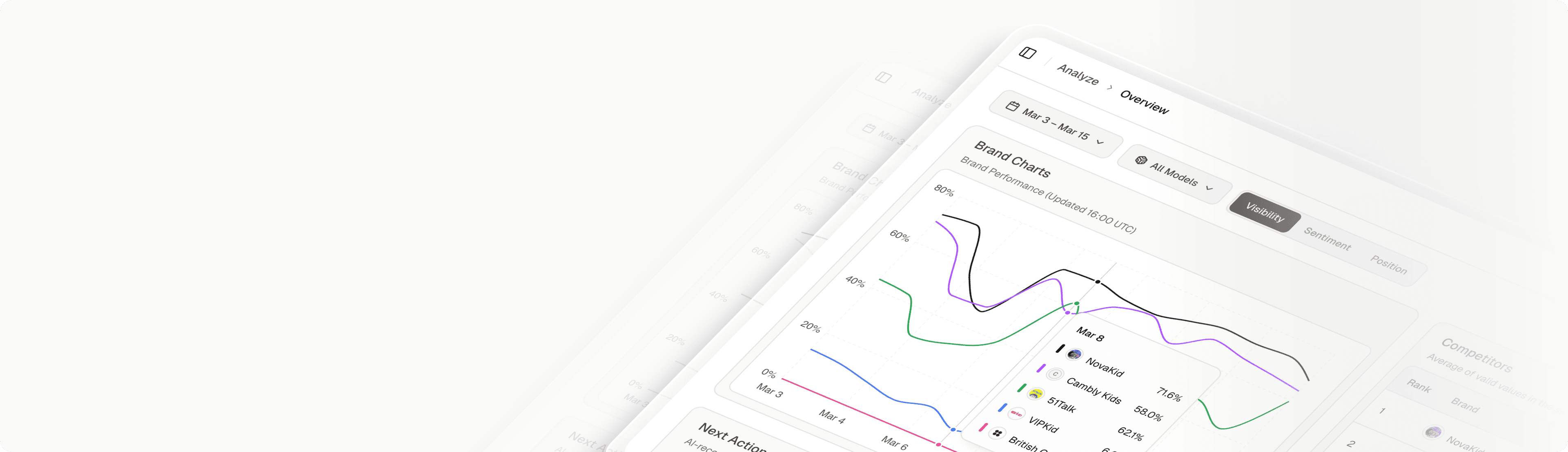
That’s the gap Topify’s Comprehensive GEO Analytics is built to close. It tracks visibility, sentiment, position, volume, mentions, intent, and CVR across ChatGPT, Gemini, Perplexity, and other major platforms continuously, instead of as a single check. When a fix moves the needle, or a competitor starts pulling ahead, the dashboard shows it before it turns into a quarter-over-quarter surprise. Teams ready to move past the free checks can get started with Topify directly from there.
Conclusion
The gap between guessing and knowing is a single afternoon of work. Most SaaS teams have relied on manually prompting ChatGPT as their only visibility check, which explains why so many are surprised by how little of their content actually gets cited.
Running a proper technical and authority audit turns that guesswork into a prioritized list, and turns the list into a fixable roadmap. Start with the free scans, fix the highest-impact issues first, then decide whether a one-time snapshot is enough or whether continuous tracking fits where your product is headed next.
FAQ
Q: What does a free GEO audit for SaaS actually measure?
A: It typically checks four things: whether AI crawlers like GPTBot and PerplexityBot can access your site, whether your pages carry structured data AI models can parse, whether your content is written for direct extraction, and whether your domain currently appears in AI-generated answers.
Q: Is a free GEO audit different from asking ChatGPT about my product?
A: Yes. Manually asking ChatGPT gives you one data point from one conversation. A structured audit checks the underlying technical and content factors that determine whether you show up consistently, across different prompts and platforms.
Q: How often should a SaaS company re-run a GEO audit?
A: Since AI models update regularly and citation patterns shift every few weeks, a one-time audit only shows where you stood at that moment. Most growing teams move from a single free check to continuous tracking once the initial technical issues are fixed.
Q: Does fixing robots.txt and schema guarantee AI will recommend my product?
A: No. Technical access is a prerequisite, not a guarantee. Brand authority factors like recognition and trust signals also shape whether a model recommends a product once it’s actually able to read the site.