

Most marketing teams find out their brand is invisible to AI search by accident. Someone asks ChatGPT for a recommendation in their category, gets back three competitor names, and starts wondering why. The instinct is to check Google Search Console next. That tells you almost nothing, because generative engines don’t rank pages the way Google does. They retrieve, evaluate, and cite a small fraction of what they crawl. A free GEO audit is the fastest way to see which side of that fraction your site is on, and why.
Why AI Search Skips Perfectly Good Websites
Google’s crawler and OpenAI’s crawler don’t behave the same way. Googlebot indexes a page once and ranks it against millions of competitors on hundreds of signals. GPTBot, ClaudeBot, and PerplexityBot work differently. They retrieve a handful of candidate pages for a single query, read them in full, and decide on the spot whether one is worth citing.
ChatGPT retrieves dozens of pages while researching a typical answer and ends up citing roughly 15% of them. The other 85% get evaluated and dropped, often for reasons that have nothing to do with domain authority or backlink count.
That’s the gap most SEO reports can’t see.
Some of that gap is self-inflicted before a single word of content even gets evaluated. A recent crawl of more than 1,700 live sites found that 9.9% block GPTBot outright in robots.txt, and 13.7% block at least one major AI crawler. Another 84.2% haven’t set any AI crawler policy at all, which means the door is technically open, but nobody checked what’s actually on the other side of it.
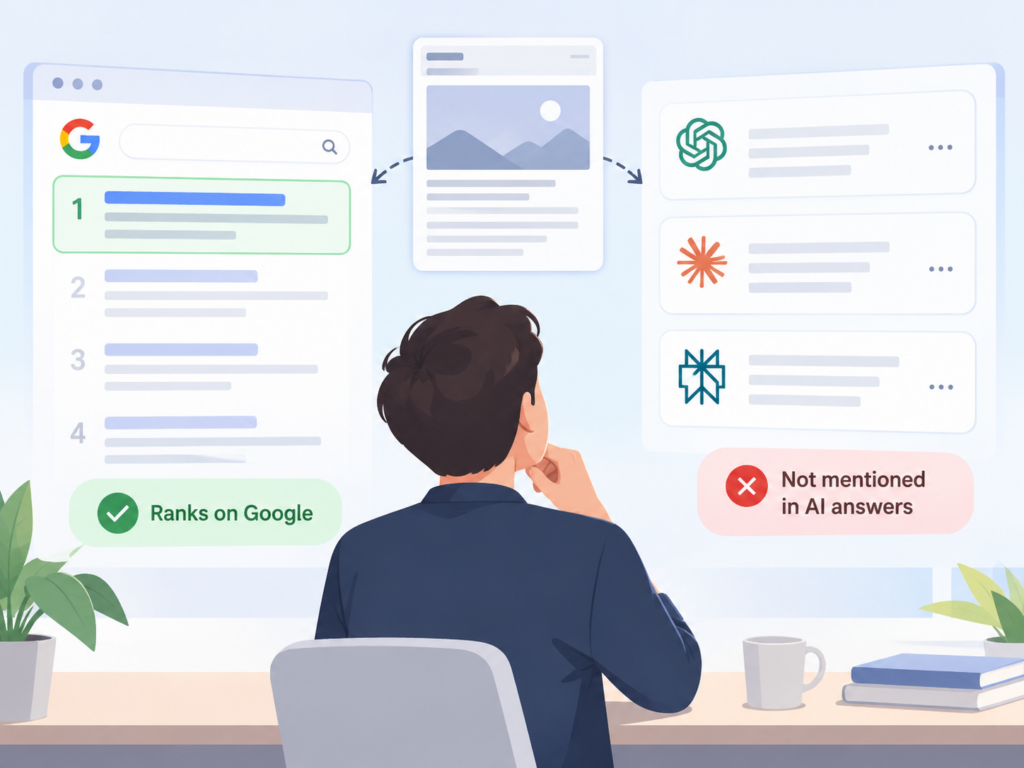
None of this shows up in a standard SEO audit. A page can rank on the first result of Google and still be functionally invisible to every AI answer engine, because the two systems are reading the same URL through completely different lenses. One is scoring authority. The other is deciding, in real time, whether the page answers the question well enough to quote.
Running a Free GEO Audit: What It Actually Checks
A GEO audit isn’t a rebrand of an SEO crawl with new labels on old metrics. It’s built specifically to check whether GPTBot, PerplexityBot, ClaudeBot, and Google-Extended can access, parse, and eventually cite a page. Topify‘s free GEO Score Checker runs that exact test on any URL, with results back in ten to thirty seconds and no signup required for the first scan.
It checks four things. First, AI bot access, meaning whether the major crawlers can actually reach your pages without hitting a robots.txt block or a firewall rule. Second, structured data, meaning whether your schema markup is present and valid rather than just present. Third, content signals, meaning whether pages are structured for answer-first extraction instead of long narrative blocks. Fourth, AI visibility, meaning whether your domain already surfaces in AI-generated answers for prompts in your category.
Each of those four areas rolls up into a single score from 0 to 100, with individual findings tagged by priority so a team can see what to fix first instead of a wall of undifferentiated warnings.
You get the diagnosis before you spend a cent on the fix.
Run the free GEO audit on your homepage first. That’s usually where the biggest structural problems concentrate, and it’s the page AI systems tend to check first when deciding whether a brand belongs in a category-level answer at all.
The Most Common Reasons Sites Get a Low Score
Most low scores come down to three problems, and they tend to compound rather than sit in isolation.
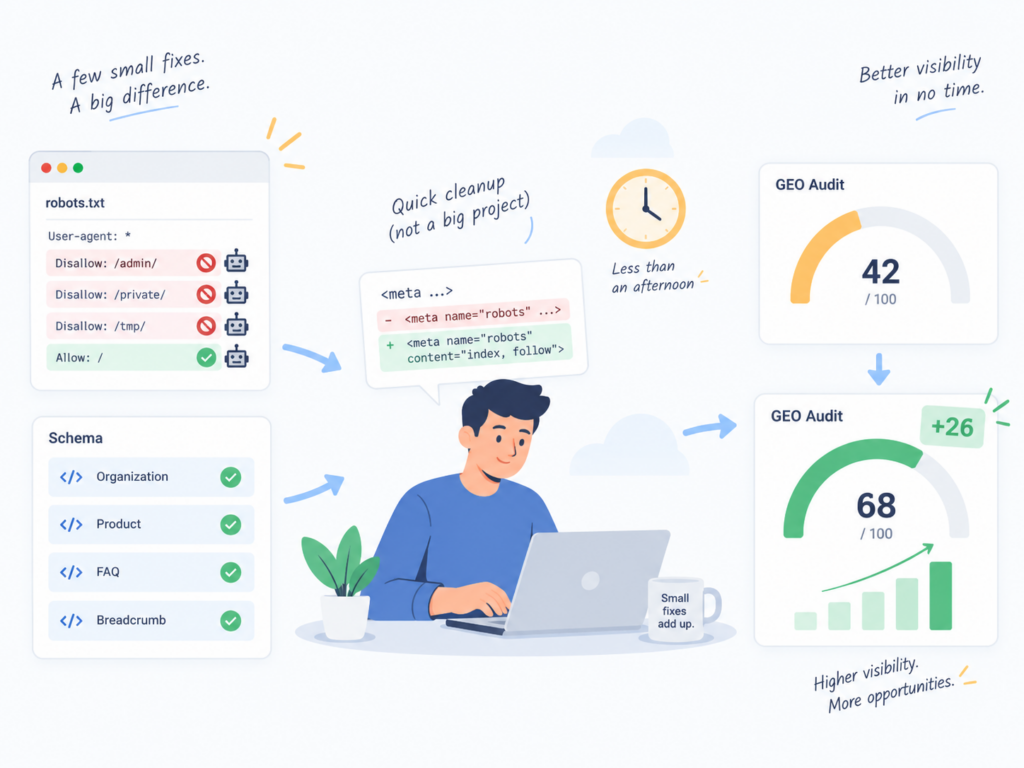
The first is access. If GPTBot or Google-Extended is blocked, nothing else on the audit really matters, because the crawler never gets past the front door to evaluate anything downstream. This is the single most common P0 finding on first-time audits, and it’s almost always accidental rather than a deliberate policy decision.
The second is schema that exists on paper but doesn’t actually work. 71% of sites deploy at least one schema type, but only 22% pass a clean validation check across every type they emit, and that 49-point gap correlates directly with whether AI search cites the page at all. Broken markup often looks completely normal to a human reading the page and is effectively invisible to the machine parser trying to extract it.
The third is content structure. Pages written as long, uninterrupted narrative blocks are harder for a generative engine to lift a clean, quotable answer from than pages built around direct, self-contained sections. Pages carrying FAQPage markup are roughly 3.2 times more likely to surface in AI Overviews than pages without it, largely because the question-and-answer format already matches how AI systems want to quote a source.
Fixing all three tends to move a score fast, because the improvements stack.
In practice, most sites that unblock the right crawlers and add three or four missing schema types see a 20 to 30 point jump on the next audit. That’s rarely a redesign. It’s usually a one-line robots.txt edit and an afternoon of schema cleanup with a developer, not a quarter-long project.
From One-Time Score to Ongoing Visibility
A GEO audit score is a snapshot, not a subscription. The catch is that AI citation patterns don’t hold still for long. Model providers update retrieval systems, competitors publish new content, and the third-party sources an AI platform pulls citations from rotate every few weeks.
That’s a different kind of miss than a blocked crawler. Even a clean audit today can look outdated by next quarter if nobody is watching what changed in the meantime, and most teams only find out when a customer mentions a competitor showed up in their ChatGPT search instead.
The upside is why tracking is worth the effort at all. AI-driven recommendations make users roughly 2.5 times more likely to visit a brand’s site, largely through branded search rather than a clickable link inside the answer itself. Brands that show up consistently in AI answers still benefit even when the response never generates a direct referral click.
That’s visibility a one-time score can’t show you.
For teams that want to move past a single snapshot, Topify’s Comprehensive GEO Analytics tracks the same categories an audit checks once, but on a rolling basis across seven metrics: visibility, sentiment, position, volume, mentions, intent, and conversion visibility rate. It’s the difference between knowing your brand had a problem in September and knowing the moment it resurfaces in October. Once the free audit shows where to focus first, teams can get started with Topify to keep that view current instead of re-running a manual check every few weeks.
Conclusion
AI search engines are already deciding which brands to recommend, and most sites have no real evidence of whether they’re on that list. A free GEO audit answers the question in under a minute, with a specific list of what’s blocking citations instead of a vague verdict. Run it on your homepage, fix the P0 issues first, and check back in a few weeks once the changes have had time to propagate through AI retrieval systems. The gap between being cited and being skipped is usually smaller than teams expect, and now it’s measurable.
FAQ
Q: Is the GEO audit really free?
A: Yes. Topify’s GEO Score Checker runs a full scan with no signup required for the first check. Ongoing tracking through Comprehensive GEO Analytics is a separate paid feature for teams that want to monitor changes over time rather than run one-off checks.
Q: How is a GEO audit different from a traditional SEO audit?
A: An SEO audit checks how Google ranks a page against other pages. A GEO audit checks whether AI crawlers can access, parse, and cite it at all, which depends on different signals: crawler access, schema validity, and content structured for answer extraction rather than keyword density.
Q: How often should I re-run a GEO audit?
A: Roughly every four to six weeks is typical. AI platforms update retrieval and citation behavior often enough that a score from last quarter may no longer reflect what’s actually happening in current answers.
Q: What’s the fastest fix to raise a low GEO score?
A: Unblocking AI crawlers in robots.txt usually delivers the fastest points, since a blocked crawler zeroes out everything else on the audit. After that, fixing broken schema on types you’ve already deployed tends to help more than adding brand-new schema types from scratch.

