

You’ve asked ChatGPT the same question your customers ask: “What’s the best tool for [your category]?” Five prompts later, your brand hasn’t shown up once. Meanwhile your Google rankings look fine, your backlink profile is healthy, and nothing in your SEO dashboard explains the gap. That’s because the gap isn’t an SEO problem. It’s a GEO one, and it’s measurable.
Your ChatGPT Ranking Has Nothing to Do with Your Google Ranking
Most marketing teams assume strong SEO carries over to AI search. It doesn’t. A 2026 analysis of 150 SaaS companies across 120 keywords found that 44% of brands sitting in Google’s top 10 get zero mentions from ChatGPT for the same terms. The same study found that 81% of the brands ChatGPT does cite aren’t in Google’s top 10 at all.
That’s not noise. It’s two separate ranking systems running on different signals.
Traditional search rewards backlinks, keyword density, and domain age. AI search engines work differently: they weigh crawl access, structured entity data, and how often independent sources vouch for you. A breakdown of ChatGPT’s citation behavior found that 26% of brands get zero AI visibility, and most responses only surface three to four brands total. If you’re not in that narrow window, a smaller, newer competitor can outrank you simply because it built the right signals first.
Guessing which signal is broken wastes time. Auditing it doesn’t.
Here’s what that looks like in practice. A mid-size SaaS company with a strong domain rating and a page-one Google ranking for its core keyword runs the same query through ChatGPT and gets a list of five competitors instead. Nothing in their Google Search Console flags a problem, because there isn’t one on that side of the ledger. The issue lives entirely in a system Search Console was never built to see.
What a Free GEO Audit Actually Checks
This is exactly what a free GEO audit like Topify’s GEO Score Checker is built to answer. It scores your domain from 0 to 100 across four dimensions, no signup required, results in about 60 seconds.
| Score Dimension | What It Measures | What a Low Score Means |
|---|---|---|
| Bot Access | Can AI crawlers like GPTBot and ClaudeBot actually reach your pages | Your content may be technically invisible to the models generating answers |
| Structured Data | Whether your site gives AI systems explicit entity and product signals | AI has to guess what your page is about instead of reading it directly |
| Content Signals | Depth, clarity, and topical authority of your published content | Your content isn’t specific or citation-worthy enough to be pulled into an answer |
| Visibility Score | How often you actually appear across ChatGPT, Perplexity, Gemini, and AI Overviews | Even if everything else is fixed, you’re still not showing up where it counts |
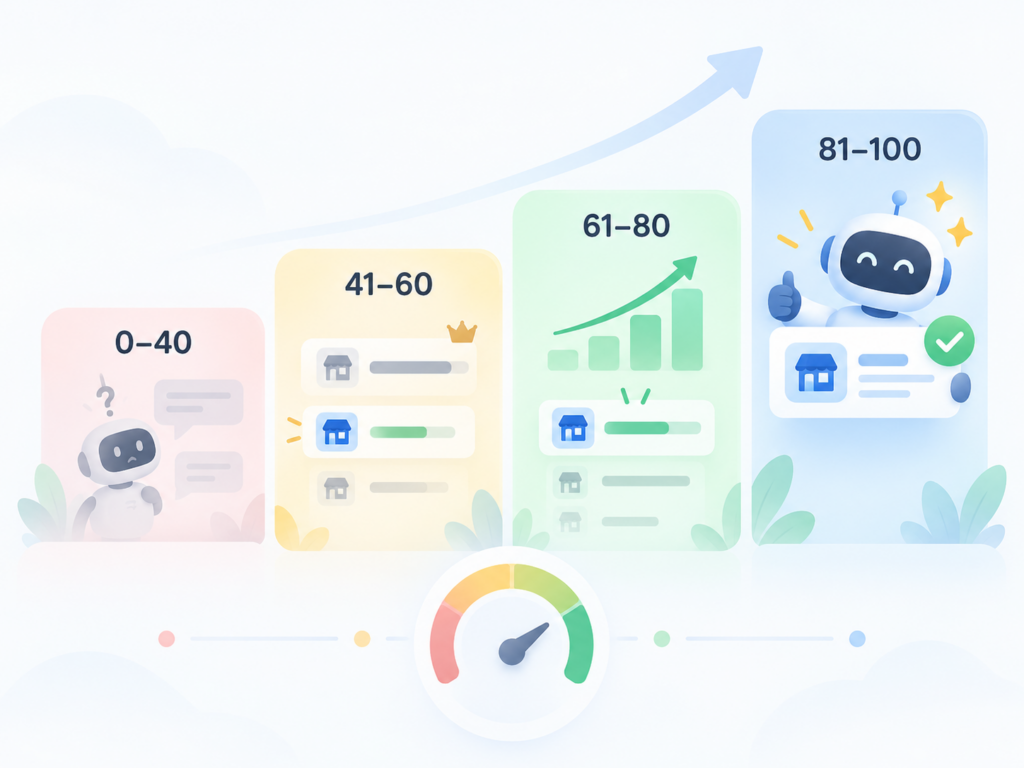
Score bands give you a quick read on severity: 0-40 means AI can barely identify or recommend you, 41-60 means you’re visible but competitors have a clear edge, 61-80 is solid with room to grow, and 81-100 means AI is likely to recommend you on its own.
Three Reasons Brands Score Below 40 Without Realizing It
Reason one: the crawler never got in. Blocking rates vary a lot depending on who you ask, but the direction is consistent. One Q3 2026 crawl of 1,744 sites found that 9.9% block GPTBot outright, and 84.2% have no AI crawler policy at all, meaning most sites haven’t made a deliberate choice either way. Among the top 1,000 sites specifically, block rates for GPTBot have been tracked as high as 25%, often set years ago by a developer who’s since left the team.
This is typically the easiest problem to fix and the hardest one to notice. A single disallow rule buried in robots.txt, added during a security review or inherited from a CDN’s default settings, is enough to keep every AI crawler out while your site continues to rank normally on Google. Nothing about the site looks broken from the outside.
Reason two: structured data isn’t the fix people think it is. For years, adding schema markup was treated as the go-to GEO tactic. A controlled Ahrefs study tracking 1,885 pages found that adding JSON-LD produced no statistically significant citation lift on ChatGPT, AI Overviews, or AI Mode. The correlation people cite, pages with schema do get cited more often, exists because AI systems already favor well-maintained, authoritative sites, not because the markup itself moves the needle. Content depth and independent verification still do the heavy lifting.
That distinction matters more than most audits admit.
Reason three: nobody else is vouching for you. AI models cross-check what your site says against what other sources say. A Trustpilot-commissioned study found that only 1% of AI responses cite a brand with no review profile at all, compared to 53.5% for brands with an active one, and 75.3% for brands that actively collect and respond to a high volume of reviews. If your only evidence of quality lives on your own domain, AI treats that as unverified.
Bottom line: none of these three issues shows up in a typical SEO audit, because none of them affects how Google ranks a page. That’s exactly the blind spot a GEO-specific audit is built to catch.
How to Run the Audit and Read Your Score
The process takes less time than reading this section:
- Open the GEO Score Checker and enter your domain.
- Wait about 60 seconds for the four-dimension scan to finish.
- Read each dimension separately rather than just the overall number. A 70 overall can still hide a Bot Access score in the 20s.
- Rank the dimensions from weakest to strongest and start with whichever one is dragging the average down.
No account, no credit card, no sales call. That’s the point of a free audit: confirm whether the problem exists before you commit to fixing it.
One Score Tells You Where You Stand. It Won’t Tell You If You’re Slipping.
A single audit is a snapshot. AI platforms change which sources they trust every few weeks as models get updated and retrieval systems get retuned. A score that’s fine today can drift by next quarter, and a one-time check won’t tell you when that happens.
| Capability | Free GEO Score Checker | Topify Platform |
|---|---|---|
| Check frequency | One-time snapshot | Continuous monitoring |
| Dimensions tracked | 4 GEO scores | Full GEO analytics plus sentiment and citation tracking |
| Historical trends | None | Full trend history with alerts |
| Competitor benchmarking | Not included | Real-time competitor tracking |
| Platform breakdown | Aggregated | Per-platform view across ChatGPT, Perplexity, Gemini, and AI Overviews |
That’s the role Comprehensive GEO Analytics plays. Instead of a static score, you get a live view of where your visibility is trending, which competitors are gaining ground, and which specific citations disappeared and why. Teams that want to see it running on their own domain can start a free trial, and pricing scales from single-brand teams up to agencies managing multiple accounts.
Conclusion
If your brand isn’t showing up in ChatGPT, the reason is almost always technical, not creative, and it’s usually invisible until you measure it. Running a free GEO audit takes about a minute and tells you exactly which of the four dimensions is holding you back. From there, deciding whether to fix it once or track it continuously is a much easier call.
Frequently Asked Questions
What is a GEO audit? A GEO audit checks whether AI search engines like ChatGPT and Perplexity can access, understand, and cite your website. It typically scores factors like crawler access, structured data, content authority, and actual visibility across AI platforms.
Is a free GEO audit accurate enough to trust? A free audit gives you a directional read across the same four dimensions that drive AI visibility. It’s accurate enough to tell you where the problem sits, though ongoing monitoring is needed to catch changes over time as AI platforms update their models.
How is GEO different from traditional SEO? Traditional SEO optimizes for backlinks and keyword rankings on Google. GEO optimizes for how AI models retrieve, verify, and cite content when generating answers, which depends more on crawl access and third-party trust signals than on-page keyword density.
How often should I re-run a GEO audit? Quarterly is a reasonable baseline for most brands, since AI models and retrieval systems update on that rough cadence. Brands in fast-moving categories or ones that recently made site changes should check more often.

