

Search “free AI rank checker” in 2026 and you’ll run into an odd situation. Microsoft now hands out official AI citation data inside Bing Webmaster Tools. HubSpot grades your brand’s AI perception at no cost. Both tools are free, both come from credible platforms, and neither answers the question you actually typed: where does my brand rank when a buyer asks ChatGPT for a recommendation?
One counts citations. The other scores perception. The word “rank” appears in neither product, and that’s not an accident. Understanding what each free tool measures, and what it deliberately avoids measuring, is the difference between a useful baseline and a misleading report to your boss.
The Free AI Rank Checker Boom Started with Platforms, Not Startups
For years, checking your AI search visibility meant scraping answers or paying a third-party tool to run prompt panels. In 2026, the platforms themselves entered the game.
Microsoft moved first. In February 2026, Bing Webmaster Tools launched its AI Performance dashboard in public preview, showing publishers how often their content is cited across Copilot, Bing’s AI summaries, and partner integrations. Then on June 16, 2026, Microsoft added four preview capabilities: Intents, Topics, Citation Share, and Compare. Industry coverage tracked the rollout closely, with ALM Corp noting that Citation Share is the first metric from a major platform to show your slice of citations for a query rather than a raw count.
HubSpot took a different route. After acquiring XFunnel, it launched the free AEO Grader in April 2026, a one-time diagnostic that scores how ChatGPT, Perplexity, and Gemini represent your brand.
Platform-native tools entering GEO is a signal worth taking seriously. It means AI visibility is now an official discipline with official metrics. But official doesn’t mean complete, and free doesn’t mean sufficient.
What Bing’s AI Performance Metrics Actually Measure
The AI Performance dashboard gives you four original metrics plus the June additions. Total Citations counts how many times your content appeared as a source in AI-generated answers during a selected period. Average Cited Pages shows the daily average of unique URLs referenced. Grounding Queries reveal the reformulated search phrases the AI generated internally to retrieve your content, which are not the prompts users actually typed.
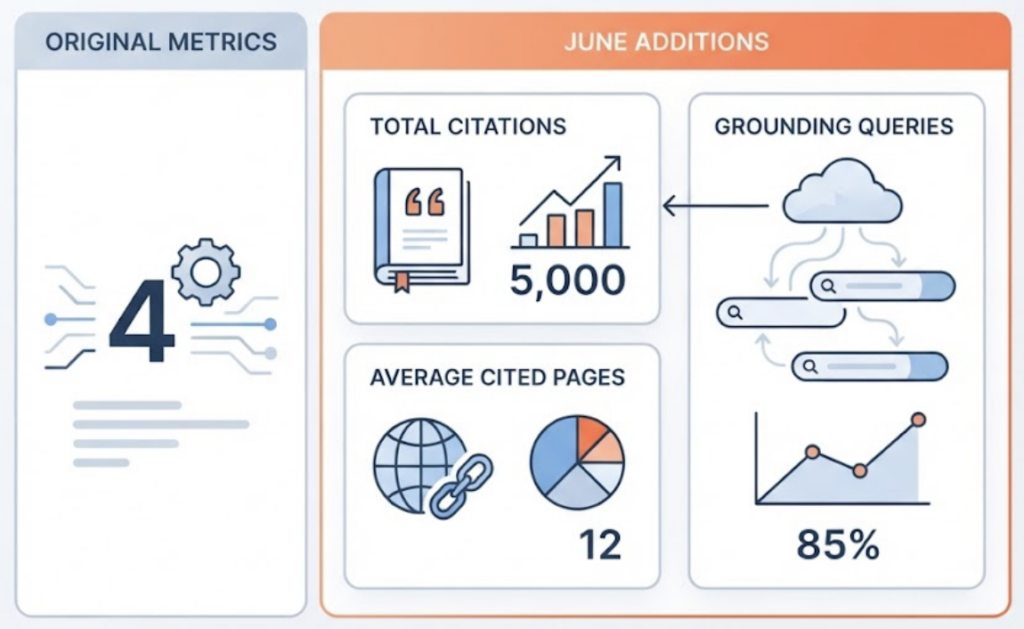
Grounding queries are the most valuable and most misunderstood metric in the set. When someone asks Copilot “how do I improve my marketing team’s productivity,” the system rewrites that into retrieval queries like “marketing team productivity strategies 2026.” You’re seeing the machine’s shopping list, not the customer’s question.
The June update layered on interpretation. Intents classify grounding queries into buckets like Informational, Commercial, and Research. Topics group related queries into themes. Compare overlays a previous time period onto your current chart. And Citation Share, the headline feature, shows the percentage of total citations your site owns for a specific grounding query. If an AI answer drew on 10 citations and 3 came from your site, your Citation Share for that query is 30%.
Why Citation Counts Aren’t Rankings
Here’s where the “rank checker” framing breaks down. Microsoft explicitly states that Citation Share is an observational metric, not a ranking system. It doesn’t expose competitor domains, doesn’t represent traffic share, and doesn’t indicate whether your link was the primary source or a footnote buried at the bottom of the response.
In practice, that means a page with a 40% Citation Share could be the lead source shaping the entire answer, or a supporting reference nobody notices. The dashboard can’t tell you which. Bing’s data confirms you’re in the running for a query. It stays silent on where you finish.
HubSpot’s AEO Grader: A Brand Snapshot, Not an AI Rank Checker
HubSpot’s free tool approaches the problem from the brand side. Enter your company name, location, industry, and product description, and the AEO Grader queries ChatGPT, Perplexity, and Gemini about how they characterize your brand, then returns a composite score out of 100.
The weighting tells you what HubSpot thinks matters. Sentiment Results carries 40 points, measuring how AI models characterize your brand. Presence Quality and Brand Recognition take 20 points each, covering mention depth and how specifically the models can discuss you. Share of Voice and Market Competition round out the last 20, capturing citation frequency relative to competitors and whether AI classifies you as a Leader, Challenger, or Niche Player.
That’s genuinely useful for spotting narrative gaps. If Gemini describes your premium product as “a budget alternative,” you have a positioning problem no traditional SEO tool would surface.
The limitation is structural: it’s a one-time snapshot based on training data and current inference. Run it today and you get today’s perception. There’s no longitudinal tracking, no prompt-level detail, no way to see whether last month’s content push moved anything. The $50/month paid tier adds tracking for 25 prompts, but reviewers point to missing pieces like competitor citation benchmarking and aggregate citation-trend analysis. ContentMonk’s comparison of HubSpot AEO against dedicated GEO platforms reaches a similar conclusion: it’s a perception audit with light monitoring attached, not a competitive rank tracking system.
Where Free AI Rank Checkers Go Blind
Put the two free tools side by side and a pattern emerges. Each one measures a real thing well, and both skip the same three things entirely.
| Capability | Bing AI Performance | HubSpot AEO Grader Free | Dedicated AI Rank Tracking |
|---|---|---|---|
| Primary goal | Operational citation visibility | Brand perception score | Competitive ranking and CVR |
| Platform coverage | Bing, Copilot, partner AI | ChatGPT, Gemini, Perplexity | Cross-platform, LLM agnostic |
| Rank or position data | No, Citation Share only | No, perception score only | Yes, relative position |
| Data nature | Aggregated, longitudinal | One-time snapshot | Continuous, prompt-level |
| Competitor data | Limited, aggregated | Basic, manually configured | Dynamic, auto-detected |
| Price | Free | Free | Paid |
Blind spot one is platform coverage. Bing’s report covers the Microsoft ecosystem and stops there, missing the 70%+ of AI search activity happening on ChatGPT, Gemini, and Perplexity. HubSpot covers those three engines but only as a point-in-time perception check.
Blind spot two is position. Neither tool tells you whether you’re the first brand named in a recommendation list or the seventh. For a buyer-intent prompt like “best CRM for small agencies,” that difference is most of the commercial value.
Blind spot three is competitors. Citation Share won’t show you which domains own the rest of the pie. The Grader’s competitive dimension classifies you into broad categories rather than tracking a named rival prompt by prompt.
Free tools tell you that you were cited. They don’t tell you where you rank.
Closing the Gap: From Free Snapshots to Prompt-Level AI Rank Tracking
Once the free tools have shown you the outline of the problem, the next question is operational: how do you track your relative position, against named competitors, on the prompts your buyers actually use, across every major AI engine?
That’s the layer where dedicated platforms earn their keep. Topify approaches AI rank checking the way marketers expect a rank tracker to work: you define the prompts that matter to your business, and the platform continuously samples AI answers across ChatGPT, Gemini, Perplexity, DeepSeek, and other engines to record whether your brand appears, in what position, and relative to which competitors. Position Tracking addresses the exact gap Bing and HubSpot leave open, showing your brand’s ordering within AI recommendations rather than a bare citation count or a perception grade. Because LLM answers are non-deterministic, repeated sampling matters; a single query proves little, while trends across hundreds of sampled answers reveal your true standing. The data rolls up into seven metrics covering visibility, sentiment, position, volume, mentions, intent, and CVR, so a drop in ChatGPT mentions can be traced to the specific source that stopped citing you.
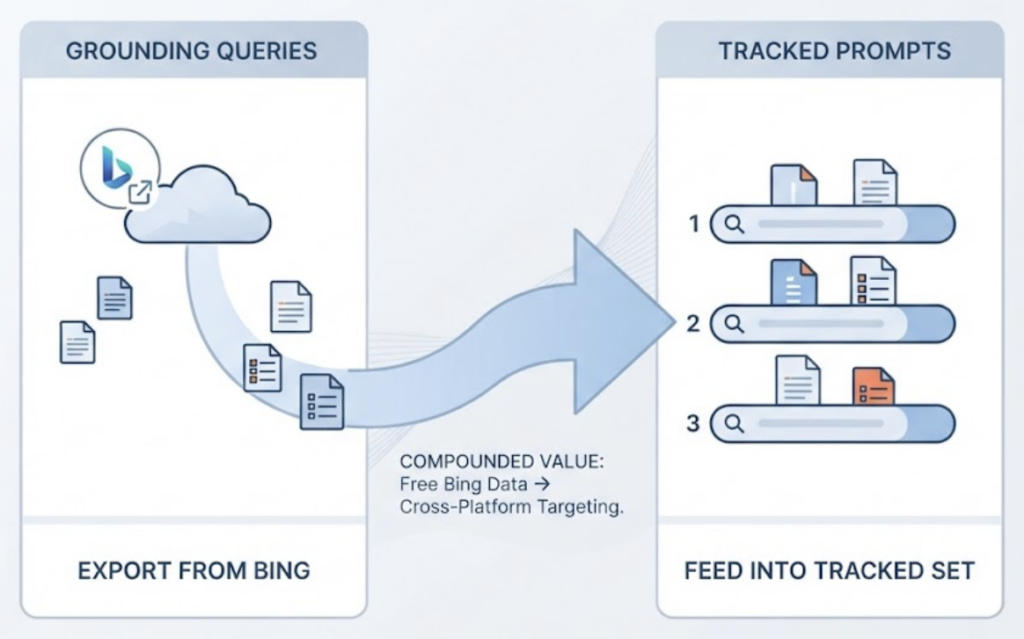
The two approaches also compound each other. Export your grounding queries from Bing Webmaster Tools and feed them into your tracked prompt set, and you’ve turned Microsoft’s free operational data into targeting input for cross-platform rank tracking.
Pricing follows a usage model rather than enterprise bundles. The Basic plan runs $99 per month with 100 tracked prompts and 9,000 AI answer analyses, and includes a 30-day trial you can start without a sales call.
A Free-First Workflow for Checking AI Rankings in 2026
You don’t need to choose between free and paid on day one. A sensible sequence uses each tool for what it’s built for.
Step one, verify your site in Bing Webmaster Tools and open the AI Performance report. Expect a 48 to 72 hour delay before data appears. Look at which pages earn citations and which grounding queries trigger them. Pages with strong grounding activity are your proven AI-ready assets.
Step two, run the HubSpot AEO Grader on your brand and one or two competitors. It takes about two minutes and requires no account. Flag any sentiment or positioning mismatch between how AI describes you and how you actually position yourself.
Step three, decide based on the gaps. If the free data shows you’re barely cited, fix content structure and entity clarity first. If you’re cited but can’t see position or competitors, that’s the signal to move to prompt-level tracking. A maintained reference list of free GEO tools is worth bookmarking for this audit stage, since the free tier of this market keeps expanding.
Bottom line: use free tools to find out whether you have a visibility problem, and dedicated tracking to find out whether you’re winning.
Conclusion
The 2026 free tool boom is real progress. Official citation data from Microsoft and a no-cost perception audit from HubSpot would have seemed unlikely two years ago. But neither is an AI rank checker in the sense marketers mean the phrase. One measures citation frequency inside a single ecosystem, the other grades brand perception at a single moment.
Run both this week. They cost nothing and take under an hour combined. Then look at what they can’t show you, your position against named competitors on high-intent prompts across every major engine, and decide whether that blind spot is one your brand can afford to keep.
FAQ
Q: Is there a truly free AI rank checker in 2026?
A: There are free AI visibility checkers, but no free tool currently reports rank position. Bing’s AI Performance report shows citation counts and Citation Share within the Microsoft ecosystem, and HubSpot’s AEO Grader scores brand perception across ChatGPT, Perplexity, and Gemini. Neither reveals where your brand sits relative to competitors within an answer.
Q: What’s the difference between Bing’s Citation Share and an actual AI ranking?
A: Citation Share is your percentage of the citations shown for a grounding query, calculated as your citations divided by total citations across all sites. Microsoft frames it as observational. An AI ranking, by contrast, records the order in which brands or sources appear within the generated answer itself, which Citation Share doesn’t capture.
Q: Does HubSpot’s AEO Grader track rankings over time?
A: No. The free Grader is a one-time snapshot of how AI models currently characterize your brand. The $50/month HubSpot AEO tier adds ongoing tracking for 25 prompts, but it centers on visibility and sentiment rather than competitive position benchmarking.
Q: How do I check my brand’s ranking in ChatGPT specifically?
A: You need prompt-level tracking: define the buyer questions that matter, sample ChatGPT’s answers repeatedly to account for answer variation, and record whether and where your brand appears versus competitors. Platforms like Topify automate this sampling across ChatGPT and other engines and report position trends over time.

