

Three weeks ago, ChatGPT recommended your brand second in its answer to your category’s biggest buying question. This Monday, a prospect ran the same prompt and you weren’t in the answer at all. Your Google rankings didn’t move. Search Console looks normal. Nothing in your stack flagged the change, because nothing in your stack was built to watch it.
That’s not an edge case. Research tracking 3.5 million citation events across 120,000+ domains found that AI citation activity drops by half in roughly 4.5 weeks. On ChatGPT, the churn is even faster: 3.4 weeks. A 35% loss inside five weeks isn’t a disaster scenario. It’s close to the statistical default for brands that publish once and stop watching.
AI Rankings Don’t Decay. They Collapse.
Google rankings erode. A page slips from position 3 to position 5 over a quarter, you notice it in your monthly report, and you have time to react. AI rankings don’t work that way. They move in step functions: your brand is in the answer, then it isn’t.
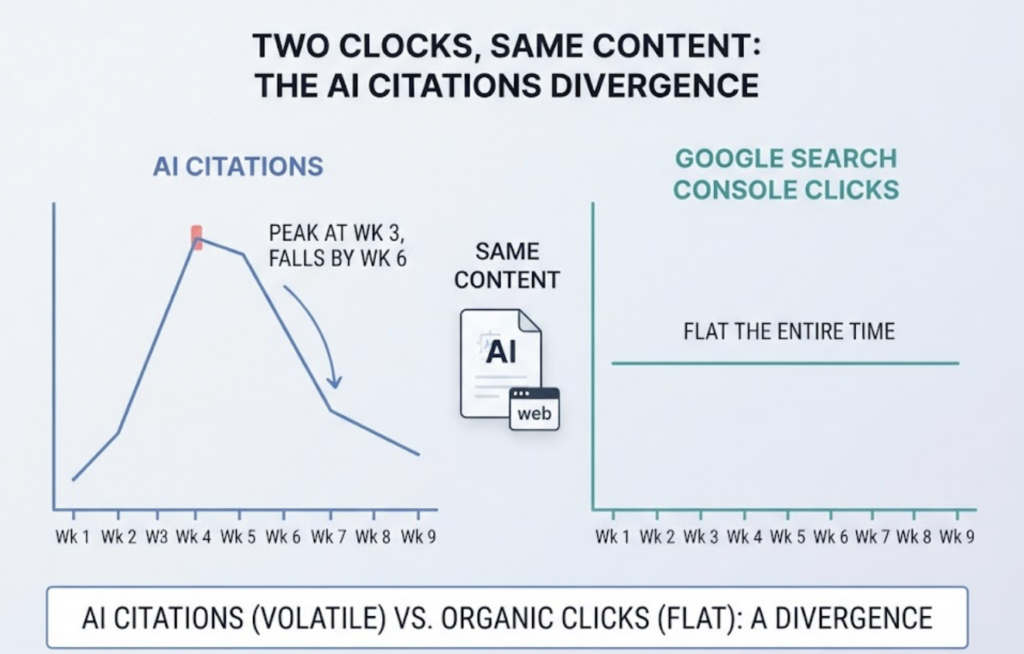
One practitioner who logged AI citations weekly for nine weeks watched them peak at week three, then fall by more than half by week six. His Google Search Console clicks for the same pages stayed flat the entire time. Two completely different clocks, running on the same content.
Three mechanics drive the collapse pattern:
Citation pool resets. When LLMs retrain or adjust retrieval thresholds, they refresh the set of URLs they pull from. AI-cited domains turn over 40 to 60 percent every month. Your brand can vanish overnight without a single change on your side.
Youth bias. AI engines are optimized for information currency. As the citation pool refreshes, older content gets swapped for fresher, more contextually dense sources, even when the older content has higher domain authority.
Non-determinism. AI answers are probabilistic. The same prompt can return different citations depending on model updates and context. A single manual check tells you almost nothing. Only longitudinal sampling produces a rank that means anything.
That last point is the one most teams miss. If your monitoring method is “someone asks ChatGPT about us once a month,” you’re not measuring a trend. You’re rolling a die.
Why an AI Rank Checker Isn’t a Rank Tracker With Extra Steps
The obvious move is to extend your existing rank tracker to AI platforms. The problem is that the two tools measure structurally different things.
| Dimension | Traditional Rank Tracker | AI Rank Checker |
|---|---|---|
| Primary metric | SERP position (1-100) | Mention rate and citation probability |
| Underlying logic | Deterministic (links, keywords) | Probabilistic (retrieval, semantic authority) |
| Decay pattern | Gradual, linear | Step-function collapse |
| Core dependency | Domain authority, backlinks | Entity clarity, topical authority |
| Useful check frequency | Monthly | Weekly |
There’s also a distinction traditional tools can’t see at all: the gap between being mentioned and being cited. An AI answer can name your brand in text without linking your domain as a source, or cite your domain without recommending you. A rank tracker collapses both into a single number. An AI rank checker has to treat mention rate as the leading indicator and citation as a separate authority event.
The measurement gap is industry-wide. Semrush’s 2026 AI Visibility Index, built on 126 million real US AI search prompts, found that 45% of marketing leaders can’t accurately measure their brand’s visibility in AI answers, and only 9% have tools that track all relevant metrics across platforms. In the same study, only 36 brands worldwide held top-100 visibility across all four major AI platforms in every month of the analysis. Everyone else fluctuated.
If global brands with dedicated teams can’t hold their AI rank steady, assuming yours is stable without checking is a bet, not a strategy.
The Three Early Signals of a Rank Drop
By the time your position falls, the drop already happened weeks earlier in metrics you probably weren’t watching. Position loss is a lagging indicator. These three signals lead it.
Signal 1: Mention Rate Slips Before Position Does
Before a brand gets dropped from an AI answer, it typically gets demoted inside the model’s internal entity list. In practice, a 10% decline in mention rate across a consistent prompt set is a statistically meaningful warning that citation loss is coming.
This is why mention rate, not position, should be the first number on your dashboard. Position tells you where you stand today. Mention rate tells you where you’ll stand next month.
Signal 2: A Citation Source Goes Quiet
AI engines lean on a small set of preferred sources per topic, and they switch between primary and secondary sources as confidence shifts. If your domain is being swapped out for a competitor’s in more than 20% of occurrences on a given prompt, the model is signaling reduced confidence in your content, even if you’re still appearing.
Watch the sources, not just the answers. A review site that stopped updating its listicle, or a comparison page that dropped you in its last refresh, often explains a rank drop weeks before it registers.
Signal 3: A Competitor Starts Splitting Your Prompts
Collapse rarely starts on head terms. It starts on long-tail, sub-intent prompts: the specific buyer questions you used to own outright. As a competitor improves their GEO, they capture those first. Your share of voice fragments quietly at the edges before the head-term drop makes it visible.
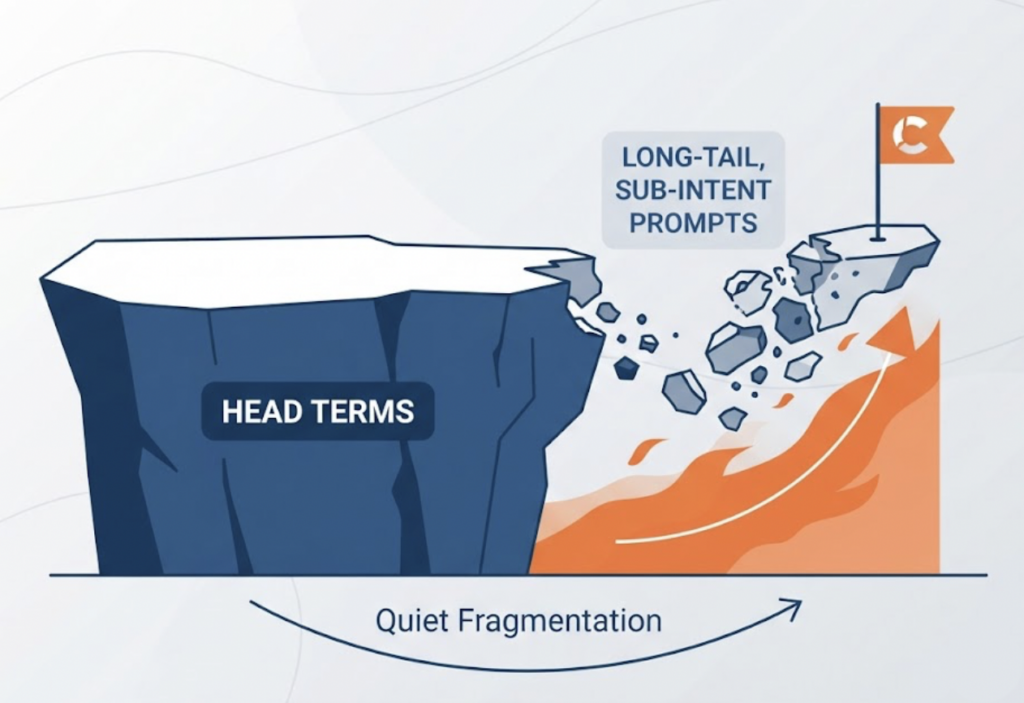
If a new name keeps showing up next to yours on prompts where you used to be the only recommendation, that’s not noise. That’s the opening move.
How to Set Up Weekly AI Rank Monitoring
Catching a 35% drop early is a process problem, not a talent problem. The setup takes an afternoon.
Step 1: Define your prompt taxonomy. Pick 20-50 core, high-intent buyer questions. Source them from sales call transcripts and support tickets, not just keyword volume tools. These are the prompts your revenue actually depends on.
Step 2: Fix your platform set. ChatGPT, Perplexity, and Google AI Overviews at minimum. Platforms cycle sources at different speeds: ChatGPT refreshes fastest at 3.4 weeks, Perplexity holds citations nearly 70% longer at 5.8 weeks. A drop on one platform doesn’t predict the others.
Step 3: Sample weekly, not monthly. Google rankings tolerate monthly checks. AI rankings don’t, because half-lives are measured in weeks and single samples are noise. Weekly runs across the same prompt set smooth out non-determinism and give you a real trend line.
Step 4: Set alert thresholds. Two rules cover most cases: flag any position loss greater than 2 places on key discovery prompts, and flag any drop in total mention frequency above 10% over a rolling 4-week window.
Running this manually across 30 prompts, three platforms, and weekly sampling means roughly 400 checks a month, before you even start attributing causes. This is the point where tooling stops being optional. Topify was built around exactly this loop: its Position Tracking monitors where your brand ranks relative to competitors inside AI answers, while Visibility, Sentiment, and Mention metrics run alongside it in the same view. When something slips, Source Analysis shows you which cited domains changed, so a drop comes with a probable cause instead of a mystery. The Basic plan covers 100 prompts and 9,000 AI answer analyses per month across ChatGPT, Perplexity, and AI Overviews at $99/month, which maps neatly onto the 20-50 prompt taxonomy above with room for expansion. You can start a free trialand have your baseline in the first week. If you want to test the waters before committing to a platform, this GEO free tools reference collects no-cost checkers worth bookmarking.
One week of data is a snapshot. Four weeks is a baseline. Eight weeks is the difference between guessing and knowing.
What to Do in the First Week After a Drop
A five-week collapse window means your response clock runs in days, not quarters. When an alert fires, work through four questions in order.
Is it platform-wide or brand-specific? Check whether competitors on the same prompts also moved. If everyone shuffled, it’s likely a model update. If only you dropped, it’s about your content or your sources.
Which source went quiet? Pull the citation data for the affected prompts. In most brand-specific drops, a third-party source stopped citing you: a stale listicle, an updated comparison, a review roundup that refreshed without you.
Did a competitor make a move? Look at what’s being cited in your former slot. A recently published, tightly structured piece from a rival usually means they’re running their own GEO play, and your long-tail prompts are next.
Refresh what the model dropped. Given ChatGPT’s 3.4-week source cycle, content targeting it generally needs updates on a biweekly-to-monthly cadence. Prioritize the pages tied to your highest-intent prompts, and pitch updates to the third-party sources that went quiet.
Teams that run this loop tend to recover within one or two citation cycles. Teams that discover the drop from a quarterly traffic report start the same process five weeks late, after the pipeline damage is already booked.
Conclusion
The uncomfortable math: with a median citation half-life of 4.5 weeks, your next AI rank drop isn’t a possibility, it’s a schedule. What’s optional is whether you find out in week one or week five, after prospects have spent a month hearing a competitor’s name in the answers you used to own.
Start this week. Pull 20 buyer questions from your last ten sales calls, run them across three AI platforms, and log what comes back. That’s your baseline. Everything after that is just keeping the loop running before the next reset hits.
FAQ
Q: How often do AI rankings actually change?
A: Faster than most teams expect. Median citation activity drops by half in about 4.5 weeks across platforms, with ChatGPT cycling sources in roughly 3.4 weeks. Google rankings can be checked monthly; AI rankings need weekly sampling to catch changes inside the response window.
Q: Can I use a free AI rank checker instead of a paid platform?
A: For a one-time baseline, yes. Free checkers can tell you whether you appear on a handful of prompts today. What they typically can’t do is run consistent weekly sampling across a full prompt set, alert on threshold breaches, or attribute a drop to specific citation sources, which is where early detection actually happens.
Q: Why did my brand disappear from ChatGPT answers overnight?
A: Most likely a citation pool reset. When models retrain or adjust retrieval thresholds, they refresh their source sets, and AI-cited domains turn over 40-60% monthly. Check whether the third-party pages that previously cited you were updated or replaced. That’s the cause in most brand-specific cases.
Q: Does a strong Google ranking protect my AI rank?
A: No. AI visibility runs on entity clarity and topical authority, not backlink profiles, and the two move independently. Documented cases show AI citations halving while Google Search Console traffic for the same pages stayed completely flat. You need to measure both separately.

