

It’s Monday morning and you’re building the visibility report. Your AI rank checker says your brand sits at #2 in ChatGPT answers for your core buying prompt. The same tool, same prompt, same day, shows you at #6 on Perplexity. Your client asks the obvious question: which number is real?
Neither number is wrong. That’s the uncomfortable part.
If you’re evaluating an ai rank checker right now, or doubting the one you already pay for, this divergence is the single most important thing to understand. It’s not a measurement bug. It’s the natural output of two AI systems that retrieve, weigh, and assemble evidence in fundamentally different ways. Once you see why, you’ll read AI rank data very differently, and you’ll stop chasing a “true rank” that doesn’t exist.
Your AI Rank Checker Isn’t Broken. The Platforms Just Don’t Agree.
Every AI answer is the end product of a retrieval-augmented generation pipeline: the model pulls sources, weighs them, and writes a response. Two platforms running two different pipelines will produce two different answers, and two different brand rankings, from the identical prompt.
How different? According to the Generative Visibility Benchmarks 2026 report, cross-platform citation overlap between ChatGPT and Perplexity for the same intent-based query is often below 25%. The two engines aren’t ranking the same list in a different order. Three-quarters of the time, they’re not even reading the same sources.
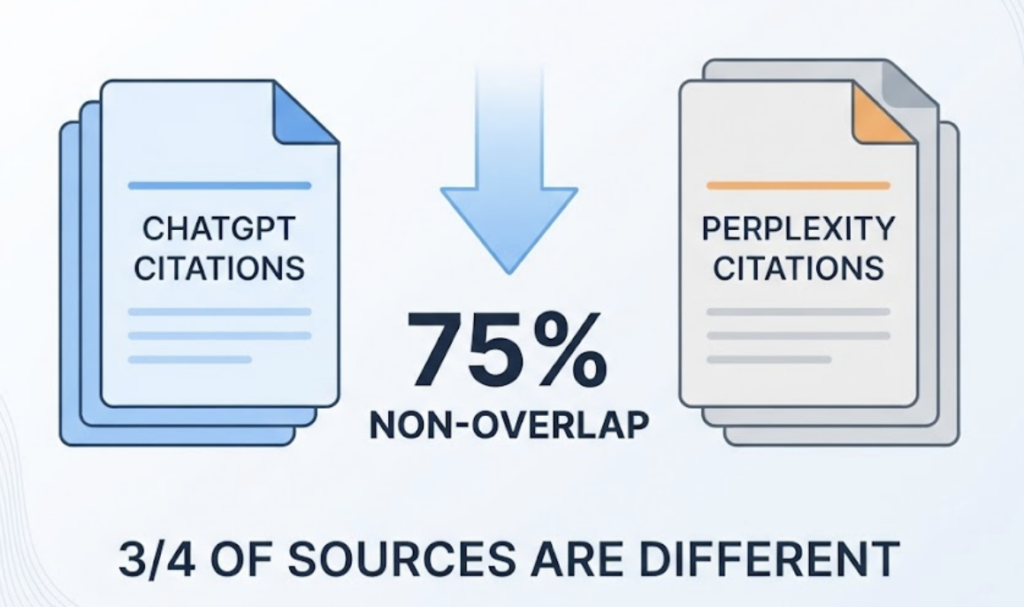
That single statistic reframes the entire problem. When your dashboard shows #2 on one platform and #6 on another, you’re not looking at one reality measured twice. You’re looking at two realities, each internally consistent, each built on a different evidence pool.
The rest of this article breaks down the three structural causes: divergent retrieval, the gap between ranking and mention, and plain statistical noise.
ChatGPT and Perplexity Retrieve From Different Worlds
ChatGPT leans heavily on parametric memory, the knowledge baked into its training data, and supplements it with real-time Bing search when needed. Its generation logic favors coherence and narrative flow. If your brand built a strong footprint in the content that shaped the model’s training, you can rank well in ChatGPT even with a modest current web presence.
Perplexity works the other way around. It’s a search-native engine that prioritizes real-time indexing, dense citations, and fresh sources. Its retrieval pipeline tends to reward news outlets and recently updated domains over legacy authority.
In practice, this means the same brand is being judged by two different juries reading two different case files. A five-year-old cornerstone guide might carry your ChatGPT visibility while doing almost nothing for Perplexity, where last month’s comparison article from an industry publication wins the citation instead.
Here’s the thing: this isn’t a flaw to be engineered away. It’s a permanent feature of a multi-model search world, and your measurement approach has to absorb it rather than average it out.
Ranking Isn’t the Same Thing as Being Mentioned
Traditional rank trackers taught us to think in positional lists: you’re #1, #3, or #9, but you’re always somewhere on the list. AI search breaks that assumption in two ways.
First, a brand can be mentioned in the narrative text of an answer without being cited as a linked source, or cited without a meaningful mention. Research published in the Journal of Generative Analytics treats citation counts and ranking positions as two distinct GEO pillars precisely because they move independently.
Second, and more consequentially, a brand can simply be absent. You might appear in the answer text on ChatGPT with a high mention rate while Perplexity omits you entirely. At that point, comparing “ranks” across the two platforms isn’t just misleading. It’s mathematically impossible, because one platform has no rank to report.
Most single-score AI rank checkers flatten this distinction into one number and hide the absences.
That’s the gap that costs brands real pipeline. Being #6 in answers where you appear is a position problem. Not appearing at all in 60% of relevant prompts is a visibility problem, and the two demand completely different fixes.
Sampling Noise: Why the Same Prompt Gives Different AI Ranks
Even inside a single platform, your rank isn’t a fixed value. LLMs are probabilistic systems. Temperature settings, plus the shifting order of retrieved search results, mean the same prompt can produce a different answer an hour later.
The AI Observability Consortium’s 2026 research on the probabilistic nature of LLM rankings found that variance can exceed 40% in high-competition topics. Their reliability threshold: at least 3 to 5 samples per prompt per day before a ranking figure becomes statistically meaningful.
Now consider what most free or single-snapshot checkers actually do. One query, one platform, one moment in time. That’s not a measurement. That’s a coin flip with a dashboard attached.
The practical implication is simple. Any AI rank number worth reporting has to come from repeated sampling over time, tracked as a trend line rather than quoted as a point. A single check can tell you a brand appeared once. Only a sampled series can tell you whether it reliably appears, where it typically lands, and whether that’s improving.
How to Read AI Rank Data Without Fooling Yourself
Once you accept that platforms diverge structurally, the reporting framework follows. Three rules cover most of it.
Isolate platforms. Never average rankings across ChatGPT, Perplexity, and Gemini into one score. Each platform serves different user intent: Perplexity skews toward research and fact-checking, ChatGPT toward conversational product advice. A drop on one may require no action on the other.
Read mention rate before position. If your brand shows up in only 20% of relevant prompts, celebrating a #2 position inside that 20% is vanity reporting. Presence comes first, position second.
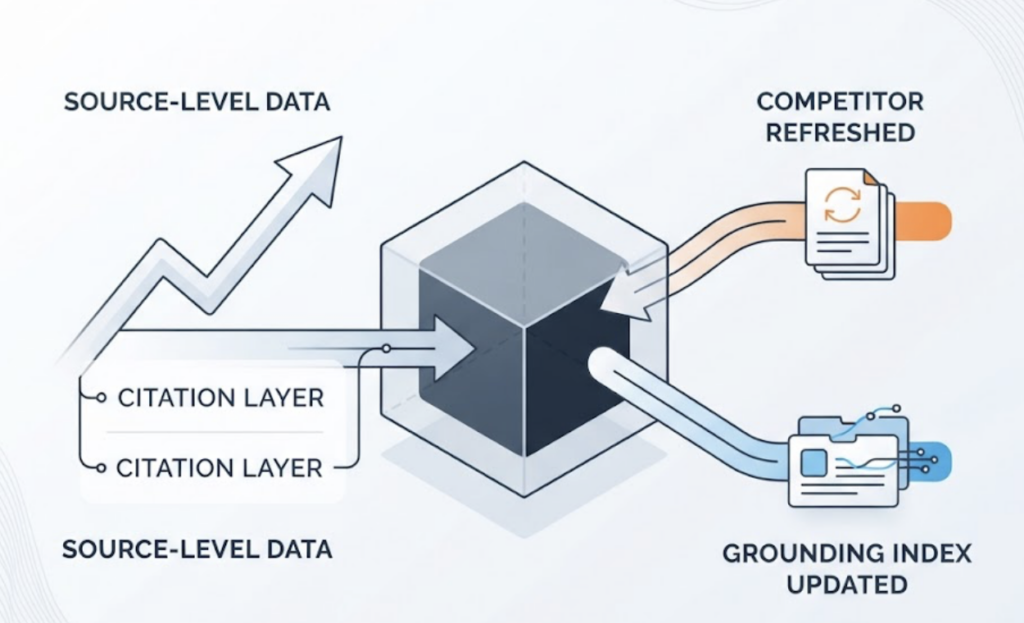
Attribute movements to sources. When a rank shifts, the cause usually lives at the citation layer: a competitor refreshed their content, or the platform’s grounding index updated. Without source-level data, every fluctuation is a black box.
The capability gap between tool categories maps directly onto these rules:
| Capability | Single-Snapshot Checker | Multi-Platform Monitoring |
|---|---|---|
| Data basis | Single query, single platform | Repeated, cross-platform sampling |
| Metric focus | Abstract rank score | Mention rate, position, sentiment |
| Attribution | None | Source-level analysis |
| Strategic utility | Vanity reporting | Actionable GEO strategy |
Bottom line: a snapshot tells you where you stood once. A monitoring system tells you why you moved, and what to do about it.
Tracking One Brand Across Many AI Realities
If the diagnosis is “two platforms, two realities, plus sampling noise,” the tooling requirement writes itself: per-platform tracking, repeated sampling, mention and position measured separately, and citation-level attribution.
This is where Topify fits the problem cleanly. Its Position Tracking monitors where your brand lands relative to competitors on each AI platform separately, ChatGPT, Perplexity, Gemini, Google AI Overviews, and others, so you’re never averaging incompatible numbers. Visibility Tracking measures mention rate independently of position, which surfaces the “absent on Perplexity, ranked on ChatGPT” pattern that single-score tools hide. And Source Analysis maps the exact domains each platform cites, letting you trace a Perplexity rank drop back to a specific source that stopped referencing your brand.
The platform’s seven-metric model, covering visibility, sentiment, position, volume, mentions, intent, and CVR, mirrors the KPI framework GEO practitioners are converging on: presence first, framing second, position third, and revenue correlation last.
Pricing scales with usage rather than enterprise bundles. The Basic plan runs $99/month with 100 tracked prompts and 9,000 AI answer analyses, which at daily sampling covers the 3-to-5-samples-per-prompt threshold the reliability research calls for. You can start a free trial and establish per-platform baselines before committing. For teams still comparing options, this curated GEO free tools reference is a useful starting point for testing what different checkers actually measure.
Conclusion
Back to Monday morning’s question: which number is real, the #2 or the #6? Both are. ChatGPT and Perplexity retrieve from evidence pools that overlap less than 25% of the time, treat mention and citation as separate events, and add 40%-level sampling variance on top. Expecting them to agree was the error, not the data.
The action item is a mindset shift. Stop searching for your one true AI rank. Start building platform-specific baselines: track mention rate and position separately on each engine, sample repeatedly instead of checking once, and attribute every movement to the citation layer. Teams that make that shift turn AI rank data from a confusing vanity number into a working growth channel.
FAQ
Q: Why does my AI rank differ between ChatGPT and Perplexity?
A: The two platforms run different retrieval pipelines. ChatGPT blends training-data memory with Bing search and favors narrative coherence, while Perplexity prioritizes real-time indexing and citation density. Their source overlap for the same query is often under 25%, so their rankings are built from different evidence.
Q: How often should an ai rank checker sample AI answers?
A: Research from the AI Observability Consortium suggests at least 3 to 5 samples per prompt per day, since answer variance can exceed 40% in competitive topics. Anything less is a point-in-time snapshot, not a reliable measurement.
Q: Is a free ai rank checker accurate enough for reporting?
A: It’s useful for spot checks and initial audits, but most free tools run single queries on single platforms. For client or executive reporting, you need repeated sampling, per-platform separation, and mention-rate data alongside position.
Q: Can I improve my rank on one AI platform without hurting another?
A: Generally, yes. Because the platforms draw from largely separate source pools, optimizing for Perplexity typically means earning fresh, citation-dense coverage, while ChatGPT visibility rewards durable authoritative content. The strategies are additive more often than they conflict.

