

A customer forwards you a ChatGPT screenshot claiming your company shut down last year, or got acquired, or dropped the feature they were about to buy. None of it is true. Your first instinct is to find someone to complain to, maybe even a lawyer. That instinct is understandable, and it’s also the slowest possible way to fix the problem.
AI hallucination brand incidents are not rare edge cases anymore. Long-tail factual questions, which is exactly what “tell me about [your company]” is to a model that has never seen your brand at scale, hallucinate at 15 to 40 percent even on frontier models. If your brand isn’t a household name, you’re squarely in that long tail.
Why AI Invents Facts About Your Brand in the First Place
Models don’t check a master database before answering. They predict the most statistically likely next words based on training data and whatever pages they retrieved live. When your brand barely shows up in that mix, the model fills the gap with something that sounds plausible.
That’s a technical explanation, not an excuse. OpenAI’s own SimpleQA benchmark, which tests short factual recall from memory, put o3’s hallucination rate at 51 percent and o4-mini’s at 79 percent on that exact kind of query. Frontier models have gotten dramatically better on easy, grounded tasks. Top models now fabricate facts less than 1 percent of the time on simple summarization, down from 15 to 20 percent two years ago. Open-ended brand questions aren’t the easy case.
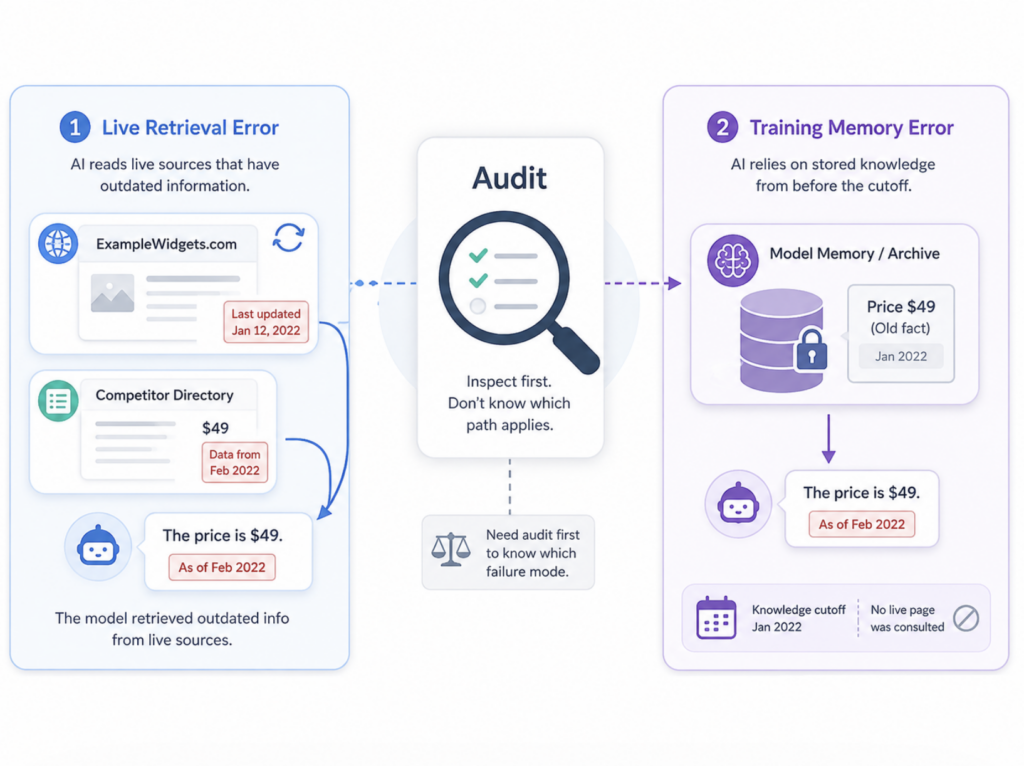
There are really two different failure modes here, and they need different fixes. A live retrieval error happens when the model reads a real page, yours or a competitor’s directory listing, and repeats something outdated from it. A training-memory error happens when the model absorbed something wrong before its knowledge cutoff and has no live page to correct it. You can’t tell which one you’re dealing with until you audit.
A Lawsuit Won’t Update What ChatGPT Says Tomorrow
Suing the AI company feels like the obvious move when the fabrication is bad enough to hurt your reputation. It’s worth understanding what that path actually looks like before you spend six figures on it.
The most developed case so far is Walters v. OpenAI. Radio host Mark Walters sued after ChatGPT told a journalist he’d embezzled funds from a gun rights nonprofit, a claim that was entirely invented. In May 2025, a Georgia judge dismissed the case, ruling that Walters hadn’t shown OpenAI acted with negligence or actual malice. The court leaned heavily on the fact that OpenAI’s terms of use repeatedly warn that ChatGPT may produce inaccurate information, and that a reasonable reader should know not to treat chatbot output as verified fact.
That’s the pattern so far across this first wave of cases. Courts are skeptical of holding AI companies liable for what their models happen to invent, largely because disclaimers do a lot of legal work. There’s also no formal channel for correcting a business fact the way you’d request a correction from a newspaper. As one legal analysis put it plainly, there’s no fact-correction submission route for business information at all.
None of this means legal counsel is never the right call. A fabricated criminal accusation or a claim that causes measurable, provable financial damage is a different situation than a wrong founding year. But for the vast majority of brand hallucinations, waiting on a legal outcome that could take two years just leaves the wrong answer live in the meantime. The faster path runs through your own content, not the courtroom.
Find Every Source Feeding the Wrong Answer
Before fixing anything, you need to know exactly what’s broken and where it’s coming from. Skipping this step is the single biggest reason corrections don’t stick.
Test the same set of prompts across ChatGPT, Claude, Perplexity, Gemini, and Copilot. Use the actual questions a prospect would type, not just your brand name in isolation. Screenshot every answer, and when the model cites sources, open every linked page and find the specific sentence driving the claim.
This is where most teams get the diagnosis wrong. A wrong price on your pricing page is a five-minute fix. A fabricated claim with no traceable source at all is a training-memory problem that no amount of editing your website will resolve overnight. Sort your list of errors by which category they fall into before you decide what to do next.
Inconsistent facts across the web make this worse. If your homepage, your LinkedIn page, and a three-year-old directory listing all say something slightly different, the model has to guess which version is authoritative, and it often guesses wrong. Entity salience, meaning how confidently a system recognizes your company as a distinct, well-documented entity, depends on repetition and consistency across trusted sources.
This is also exactly the kind of gap Topify’s Source Analysis feature is built to close. Instead of manually opening a dozen tabs across five AI platforms, it reverse-engineers which domains and URLs each model is actually citing when it talks about your brand, so you can see the pattern instead of guessing at it.
Fix the Evidence AI Is Actually Reading
Once you know the source, correct it there, not in a chat window. Arguing with the model inside a single conversation only fixes that one conversation. The next user who asks the same question gets the same wrong answer, because nothing about the model’s underlying knowledge changed.
Start with your own pages. Update the specific page that’s out of date, and make sure the correct fact appears in plain language near the top, not buried in a paragraph. A four-step correction process that’s held up well in practice: identify the exact false claim and its correct replacement, update every signal the model can read including your schema markup and any llms.txt feed, prompt crawlers to re-index the corrected pages, then keep checking until the fix actually shows up in answers.
Third-party sources matter just as much as your own site, sometimes more. Claim and correct your Bing Places listing, since it directly feeds what ChatGPT says about local and business details. Update your Google Business Profile too. Where a platform offers direct feedback, like ChatGPT’s thumbs-down or Perplexity’s citation flag, use it. It won’t fix things instantly, but it adds another signal on top of the source-level fix.
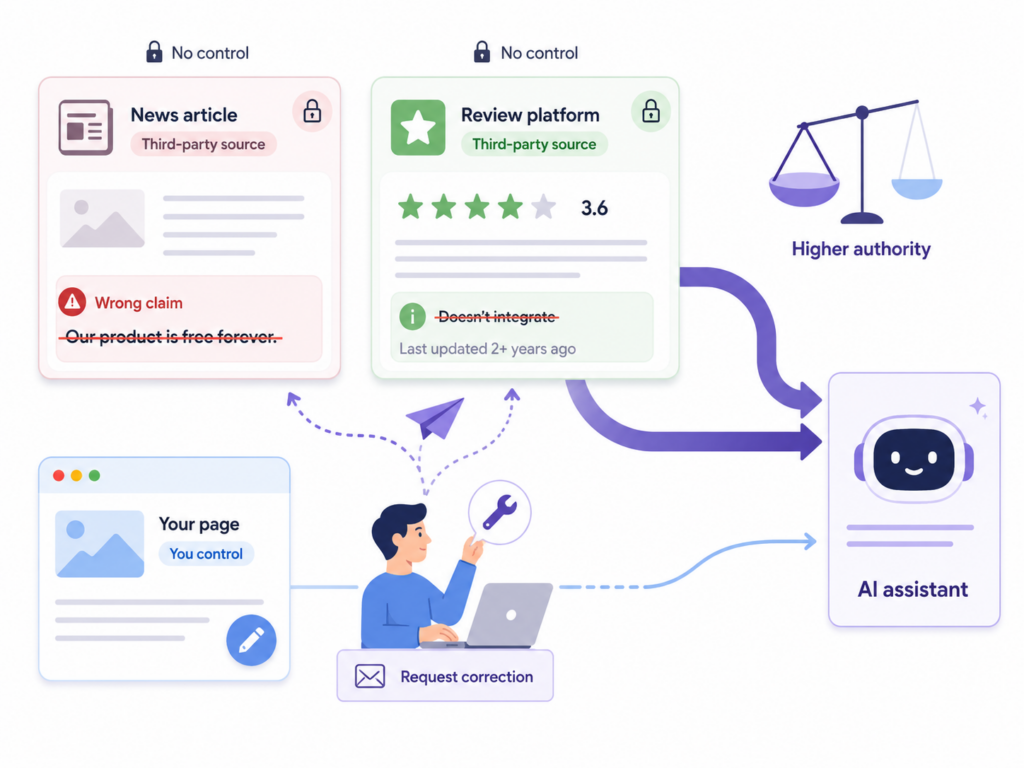
If the wrong claim is repeated on a high-authority third-party site you don’t control, like an old news article or a review platform, reach out and request a correction the same way you would for any factual error in the press. It’s slower than editing your own page, but those pages often carry more weight with the model than your own marketing copy does.
Re-Test the Exact Prompts That Triggered the Hallucination
Correcting the source and assuming the problem is solved is the most common mistake in this whole process. Models don’t refresh instantly, and a training-memory error can persist for months after the source is fixed, simply because no new training run has happened yet.
Go back to the exact prompts from your original audit and run them again, on a schedule, not just once. Live retrieval errors tend to clear up within days to a few weeks once the source page updates and gets re-crawled. Training-memory errors can outlast that by a wide margin, and there’s genuinely no way to force a model provider to retrain on your schedule.
This is the point where manual tracking starts to break down. Checking the same twenty prompts across five platforms by hand, every week, isn’t a task most marketing teams have the bandwidth for. Topify’s High-Value Prompt Discoverysurfaces the exact prompts your audience is actually asking, across ChatGPT, Perplexity, Gemini, and other major platforms, so re-testing becomes a standing process instead of a one-time scramble you have to remember to repeat.
Set Up Monitoring So the Correction Actually Holds
Here’s the part that surprises most brands: a hallucination you fixed six months ago can come back. Models get retrained, the web gets re-crawled, and an old, uncorrected copy of a page can resurface from an archive or a scraper site that never got the update.
Global losses tied to AI hallucinations reached $67.4 billion in 2024, and incorrect AI outputs now contribute to roughly 30 percent of AI-related reputational incidents tracked across organizations. That’s not a one-time cleanup problem. It’s an ongoing category of risk that needs the same kind of standing measurement you’d give to site traffic or brand sentiment.
This is where a comprehensive GEO analytics approach earns its keep. Topify tracks Visibility, Sentiment, and Position together across major AI platforms, so a hallucination doesn’t just get caught once during an audit, it gets flagged the moment it reappears. Basic plans start at $99 a month with tracking across ChatGPT, Perplexity, and AI Overviews, which is a fairly small line item next to the cost of a single lost enterprise deal because a prospect trusted a fabricated claim.
When It’s Serious Enough to Call a Lawyer
Objectively, most hallucinations don’t rise to this level. But a handful do. A fabricated criminal accusation, a false claim your product caused physical harm, or a pattern of repeated defamatory statements after you’ve documented good-faith attempts to correct the source are all situations where legal counsel belongs in the conversation.
Even then, treat it as running in parallel with the content-side fix, not instead of it. The Air Canada chatbot case, where a tribunal ordered the airline to honor incorrect bereavement-fare information its own chatbot gave a customer, shows that legal exposure for AI-generated claims is real. It also involved a company-owned chatbot, a meaningfully different situation from a third-party model hallucinating about you with no contract between you and the user at all.
Conclusion
Suing an AI company over what it says about your brand is slow, expensive, and unlikely to change tomorrow’s answer even if you win. Fixing the actual source data, correcting it everywhere it lives, and re-testing until the fix sticks is slower to feel satisfying but far more likely to work. Set up recurring checks now, because the same hallucination has a real chance of coming back once a model gets retrained.
FAQ
Q: Why does ChatGPT make up information about my company?
A: Models predict likely text rather than checking a verified database. When your brand has thin or inconsistent coverage across the web, the model fills gaps with plausible-sounding guesses instead of admitting it doesn’t know.
Q: Can I sue an AI company for false information about my business?
A: You can, but the first wave of cases, including Walters v. OpenAI, has favored AI providers so far, largely because of disclaimers stating the tools can be inaccurate. Legal action tends to make sense only for serious, provable harm, not routine factual errors.
Q: How long does it take for an AI correction to show up in answers?
A: Live retrieval errors, where the model reads a page directly, can clear up within days to a few weeks after you fix the source and it gets re-crawled. Training-memory errors baked into the model before its knowledge cutoff can take months, since they only clear on the provider’s next training cycle.
Q: Does reporting a wrong answer through ChatGPT’s feedback button actually fix it?
A: It can help, but it’s not a guaranteed fix on its own. Treat feedback buttons as one signal alongside correcting the underlying source content, not a replacement for it.

