

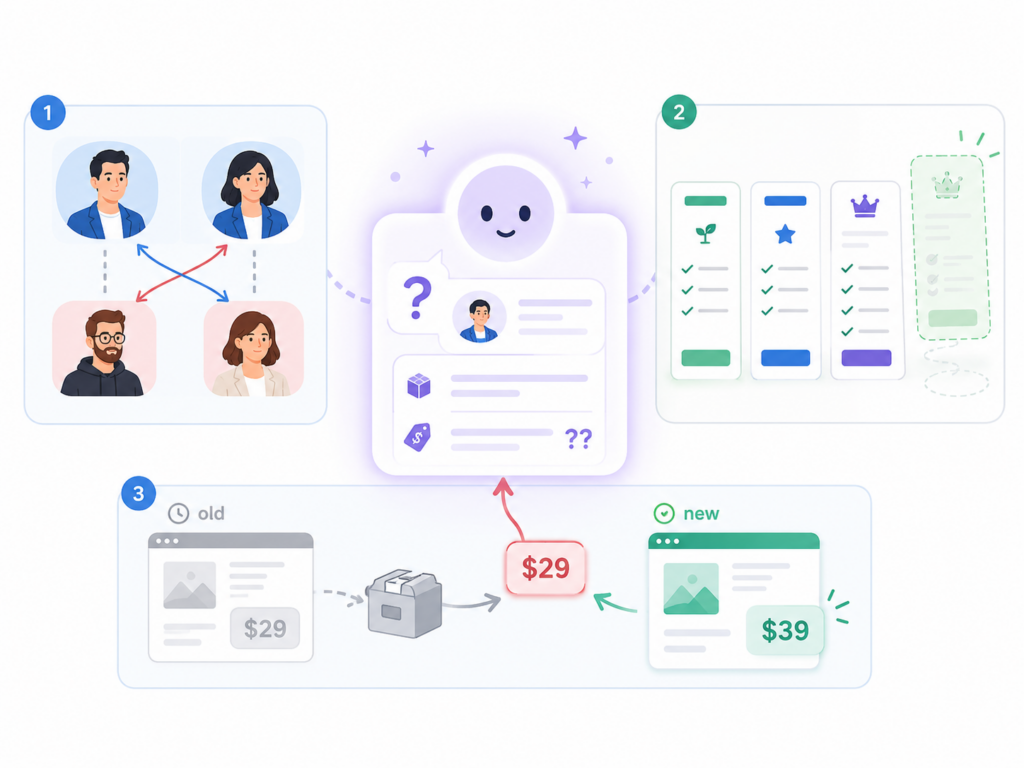
You’ve spent two years positioning your SaaS product as an enterprise-grade platform. Then a prospect shows up to a demo and says, “ChatGPT told me your Pro plan is $79 a month.” Your actual price is $99. Nobody at your company ever listed $79. No page on your site has ever said it. The model just made it up, stated it with full confidence, and handed it to a paying customer as fact.
That’s what an AI hallucination about your brand looks like in practice. And it’s happening to more companies than most marketing teams realize.
Why LLMs Invent Facts About Brands They’ve Never Actually Verified
An AI hallucination isn’t a bug in the traditional sense. It’s the model doing exactly what it’s built to do: predict the next plausible word, even when it doesn’t have a verified answer.
For brands, that shows up in a few recognizable patterns. Models mix up your founders with a competitor’s. They invent a product tier that doesn’t exist. They quote a price your company retired months ago because that’s the number still sitting on an old cached page somewhere on the web.
The failure rate depends heavily on the task. On grounded summarization, frontier models hallucinate on roughly 1 to 2.5 percent of outputs. Once retrieval is involved, that climbs to 4 to 9 percent, because the model now has to reconcile what it “knows” with whatever a search result hands it, and those two sources don’t always agree.
Here’s the part most brand teams miss: newer reasoning models don’t automatically fix this. Some open-ended factual benchmarks show reasoning models drifting to 33 to 51 percent error rates precisely because they “think through” an answer instead of sticking close to a source. More computation doesn’t mean more accuracy about your company specifically.
The Real Cost of an AI Hallucination About Your Brand
A wrong answer about your brand doesn’t stay contained to one chat window. It shapes a decision, and then it shapes how the buyer feels about you afterward.
Fifty-eight percent of shoppers say they blame the retailer or brand, not the AI tool, when a recommendation contains incorrect product information. Sixteen percent say they’d walk away from the purchase entirely. That’s demand lost to an error you likely never saw happen.
Trust doesn’t rebound cleanly once the AI’s story conflicts with yours, either. When AI-generated information contradicts a brand’s own messaging, only 29 percent of consumers trust the brand outright, and just 12 percent trust the AI. The other 54 percent go looking for a third source to settle the dispute, and nearly half have already taken some action, like avoiding a purchase or switching to a competitor, based on what the AI told them.
Consumers aren’t inclined to blame the model, either. In a YouGov survey spanning 17 markets, 54 percent said the company deploying the chatbot carries most of the responsibility for its errors. Only 26 percent pointed to the developer.
The dollar figure behind all this isn’t small. AI hallucinations were estimated to have cost businesses $67.4 billion in 2024 alone, and that was before AI-driven shopping and research became as routine as it is now.
The hallucination isn’t the AI’s mistake to fix. It’s yours.
You Can’t Fix What You Can’t See
Here’s the trap most brands fall into: they run sentiment monitoring on social media and review sites, and they assume that covers reputation risk. It doesn’t.
A negative review is visible. You can read it on G2 or Trustpilot, respond to it, and let future readers see both the complaint and your reply. A hallucinated answer inside a private ChatGPT session with a prospect leaves no public trace at all. You only find out when a sales call goes sideways or a support ticket references a feature you’ve never shipped.
This gets worse because of how confidently wrong these answers sound. MIT researchers found that AI models are 34 percent more likely to use confident language specifically when they’re generating incorrect information. There’s no hedge, no “I’m not certain.” Just a clean, wrong answer that reads exactly like a right one.
Without a way to see what ChatGPT, Perplexity, and Gemini are actually saying about your company across hundreds of prompts, you’re managing a reputation channel blind. By the time a pattern surfaces on its own, it’s usually already shaped a few months of buyer perception.
How Topify Catches Brand Hallucinations Before They Cost You a Customer
Fixing a hallucination starts with knowing it exists, and that’s the layer most marketing stacks skip entirely.
Topify runs Sentiment Analysis across major AI platforms, scoring how accurately and how favorably each engine describes your brand on a 0-100 scale. When an AI answer starts drifting from your actual positioning, whether it’s pricing, features, or who founded the company, that drift shows up as a measurable dip instead of a customer complaint you hear about weeks later.
Source Analysis takes it a step further. Instead of just flagging that something’s wrong, it traces the answer back to the domain the AI actually cited or leaned on. In practice, that means you’re not guessing where a bad number came from. You can see the outdated page, forum post, or third-party listing feeding the model the wrong information, and go fix the source directly rather than hoping the AI eventually catches up.
Both plug into the same Comprehensive GEO Analytics dashboard that tracks visibility, position, and volume, so a hallucination doesn’t sit in isolation. You see it next to how often you’re mentioned at all and where you rank against competitors, which is usually the context that tells you how urgent the fix actually is.
What to Do the Moment You Spot One
Catching a hallucination is only step one. What you do in the next 48 hours determines whether it’s a one-time glitch or a pattern that keeps recurring.
Start by identifying the source, not the symptom. If Source Analysis points to a stale pricing page, an old press release, or a directory listing you don’t control, that’s the actual thing to fix, not the AI’s output itself.
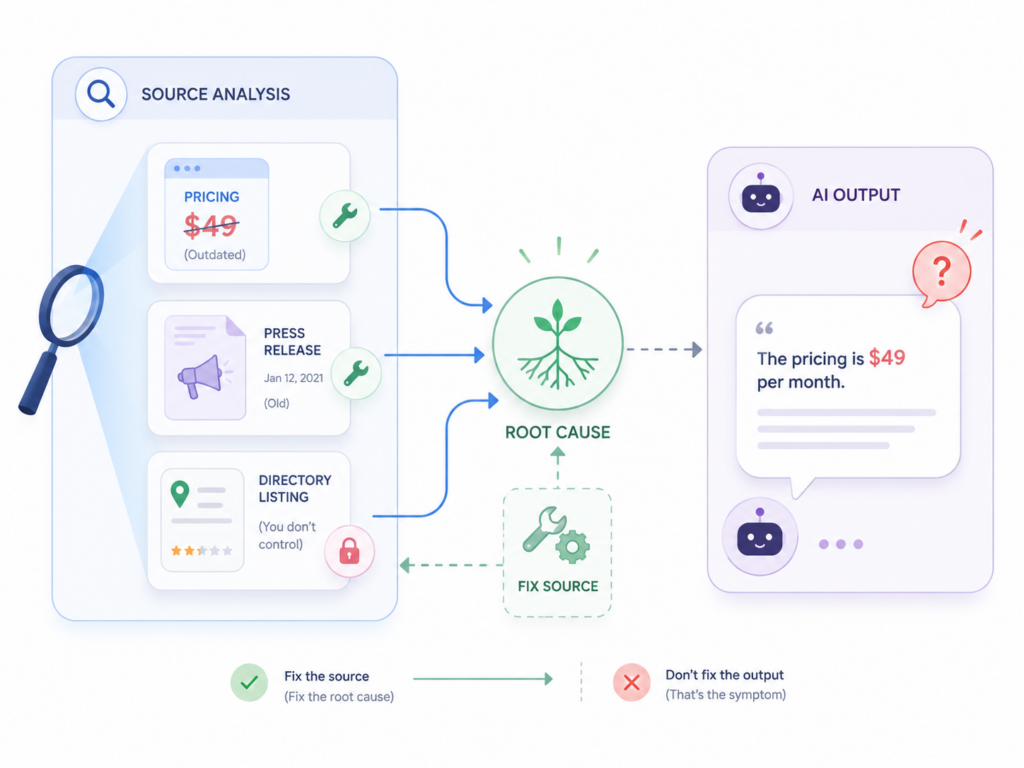
Publish a clear, authoritative correction where the model is likely to find it: an updated pricing page, a current “About” or leadership page, a product spec sheet with today’s numbers. LLMs favor clarity, recency, and consistency across sources, not persuasive copy.
Then re-test. Ask the same prompts across ChatGPT, Perplexity, and Gemini a few weeks later. Corrections at the source layer typically take weeks, not hours, to fully propagate, so treat this as a monitoring loop rather than a one-time fix.
Conclusion
An AI hallucination about your brand isn’t a rare glitch you can afford to ignore. It’s a recurring risk that scales with how much AI-assisted research and shopping keeps growing, and the companies getting blamed for it are the brands, not the models making the errors. The fix isn’t complicated: know what AI is saying about you, trace it to the source, and correct it before it costs you a customer you never got the chance to talk to.
FAQ
Q: What exactly counts as an AI hallucination about a brand?
A: It’s any confidently stated but false claim an AI makes about your company, including wrong pricing, invented product features, incorrect founders or leadership, or outdated policies. The defining trait is that the model states it as fact, without hedging.
Q: How common are brand hallucinations in 2026?
A: Rates vary widely by task. Grounded, document-based answers hallucinate at roughly 1 to 2.5 percent, but RAG-based lookups and open-ended factual questions about specific companies run considerably higher, especially for smaller or less-documented brands with limited coverage across the web.
Q: Can you make ChatGPT stop hallucinating about your company?
A: You can’t edit the model directly, but you can influence what it says by strengthening the sources it already trusts, like your own site, press coverage, and structured data, and by removing or updating outdated pages that feed it wrong information.
Q: How long does it take to fix a hallucination once you catch it?
A: Source-level corrections typically take a few weeks to propagate into AI answers, depending on how often the model refreshes its retrieval index and how authoritative the corrected source is. Ongoing monitoring after a fix matters just as much as the fix itself.