

A customer forwards you a ChatGPT screenshot. The pricing is wrong. The plan names don’t match what’s on your site. Somewhere in the answer, the AI has confidently described a feature you don’t actually offer.
Your first instinct is to call it a glitch. It isn’t. AI hallucination about your brand follows a pattern, and that pattern almost always traces back to how your content is structured, not to some random malfunction in the model.
When ChatGPT Gets Your Pricing Wrong, It Isn’t Making It Up
AI hallucination about your brand happens when a model states something false with the same confidence as something true. There’s no flag, no hedge, nothing to tell the reader it’s guessing.
Here’s the part that surprises most marketing teams: the model usually isn’t inventing information from nothing. According to research on fixing incorrect AI answers about brands, the root problem is typically that the surrounding web ecosystem is fragmented, outdated, or inconsistent, not that the AI is hallucinating in a vacuum. The model pulled from an old pricing page, confused you with a similarly named competitor, or grabbed a claim from a reseller instead of your own site.
That distinction matters. If the AI is guessing, you can’t fix guessing directly. But if the AI is filling gaps left by messy content, you can close those gaps.
Why AI Models Guess Instead of Cite
Modern AI search doesn’t just draw on training data. Most consumer AI assistants use retrieval-augmented generation, or RAG: the system fetches candidate pages in real time, then writes an answer grounded in whatever it retrieved. Ahrefs’ breakdown of RAG explains that different platforms weight freshness, authority, and structure differently, which is why the same brand can look accurate on one engine and wrong on another.
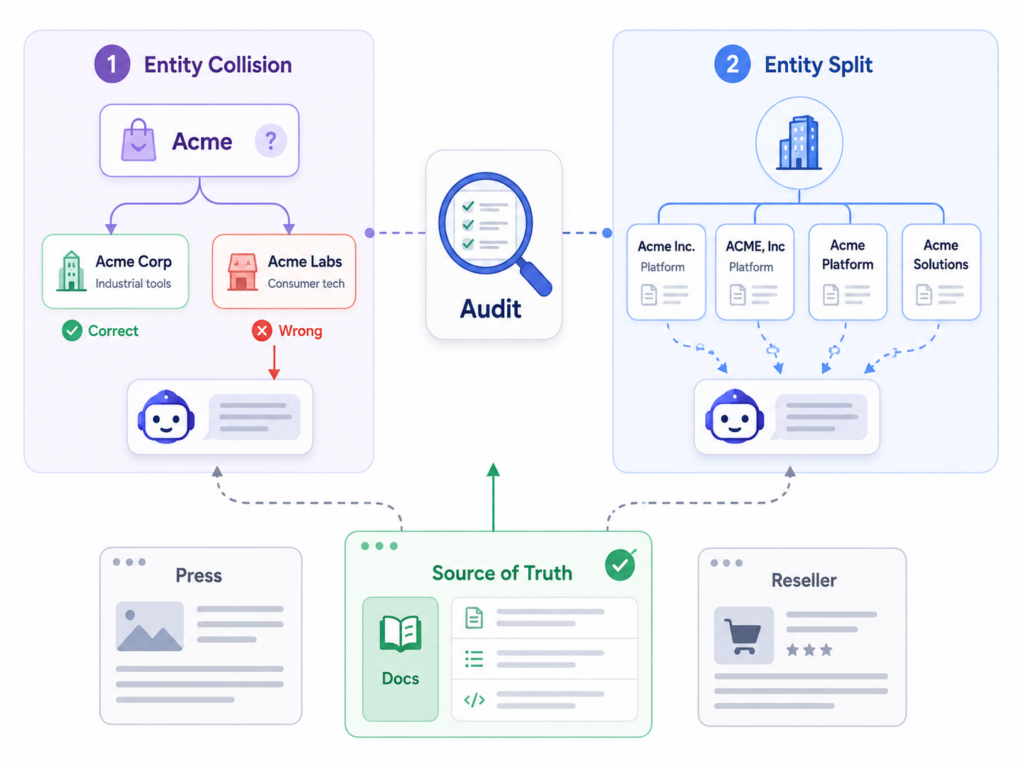
The failure mode here has a name. Omnia’s guide to RAG describes “entity collision,” where an ambiguous brand name causes the model to retrieve the wrong company, and “entity split,” where your own signals get scattered across inconsistent variants of your name or product line. Without a clear source of truth page, the assistant may retrieve a press mention or a reseller’s page instead of your own documentation.
This is why hallucination rates aren’t uniform. Frontier models now hold long-tail factual queries at a 15 to 40 percent error rate even after major 2026 accuracy gains, according to Presenc AI’s benchmark roundup. RAG-faithfulness errors specifically sit at 4 to 9 percent, meaningfully higher than clean summarization tasks. Brand queries fall squarely into that harder, messier category. The model isn’t malfunctioning. It’s doing its best with incomplete evidence.
The Content Patterns That Confuse AI the Most
Three content habits show up again and again in brands that get misrepresented by AI.
Vague, non-committal language. A pricing page that says “contact us for a custom quote” gives the model nothing concrete to retrieve. It’ll pull a number from somewhere else, often an old review or a competitor comparison.
Information scattered across pages. Your product’s core capability lives on one page, your differentiator on another, your use case on a third. Jeevan AI’s guide to RAG and brand visibility recommends building one consistent brand entity paragraph and placing it on your homepage, product pages, and comparison pages, rather than assuming retrieval will stitch the fragments together on its own. It usually won’t.
Missing structured markup. Plain paragraphs ask the model to interpret meaning. Structured data states it directly. That’s the gap most brands still haven’t closed.
What Structured Content Actually Means for AI Retrieval
“Structured” doesn’t mean better formatting or nicer headers. It means content written so a machine can extract a single, unambiguous fact without inference.
Compare two ways of stating a price. “Our plans start affordably and scale with your team” requires the model to guess. “The Basic plan is $99 per month, billed monthly” requires nothing but extraction. The second version is retrievable. The first is a prompt for hallucination.
The SSRN study on schema markup and AI citation found that pages ranking first in search results got cited in 43 percent of the queries where they appeared, a rate that dropped to just 5 percent by the seventh position. Structure and ranking work together: a clear, well-marked page still has to be found before it can be cited accurately.
How Schema and FAQ Formatting Cut Ambiguity
Schema markup, written in JSON-LD, tells AI systems explicitly what a piece of content is: an Organization, a Product, a price, a review score. Search Engine Journal’s coverage of a BrightEdge study found that schema markup improved brand presence and citation rates specifically inside Google’s AI Overviews.
FAQPage schema deserves particular attention. It packages a question and its answer as a single retrievable unit, which is close to the exact shape an AI assistant needs to generate a response. Content with properly implemented schema has roughly a 2.5x higher chance of appearing in AI-generated answers, and sites with complete core schema coverage see up to 40 percent more AI Overview appearances, per Stackmatix’s 2026 structured data guide.
None of this guarantees a citation. Content quality, authority, and freshness still matter. What structure does is remove the ambiguity that forces a model to guess in the first place.
Why Fixing One Engine Isn’t Enough
Here’s a detail that trips up a lot of GEO strategies: AI engines don’t cite brands at anywhere close to the same rate. An analysis of AI citation accuracy found that ChatGPT cites brands in just 0.59 percent of responses, Perplexity in 13.05 percent, and Grok in 27 percent. That’s not a small gap, and it means the engines haven’t converged on a shared standard for what counts as citable.
In practice, that means a brand can look well-represented on Perplexity while being nearly invisible, or worse, misdescribed, on ChatGPT. Structuring content for one platform’s preferences and assuming the rest will follow is a common and costly mistake.
| Engine | Brand citation rate in responses |
|---|---|
| ChatGPT | 0.59% |
| Perplexity | 13.05% |
| Grok | 27% |
Source: AuthorityTech’s 2026 citation accuracy analysis
How to Find Out If AI Already Has You Wrong
Fixing content structure is only half the job. You also need to know whether it’s working, and that requires actually checking what AI systems are saying about you across platforms, not assuming a schema update solved everything.
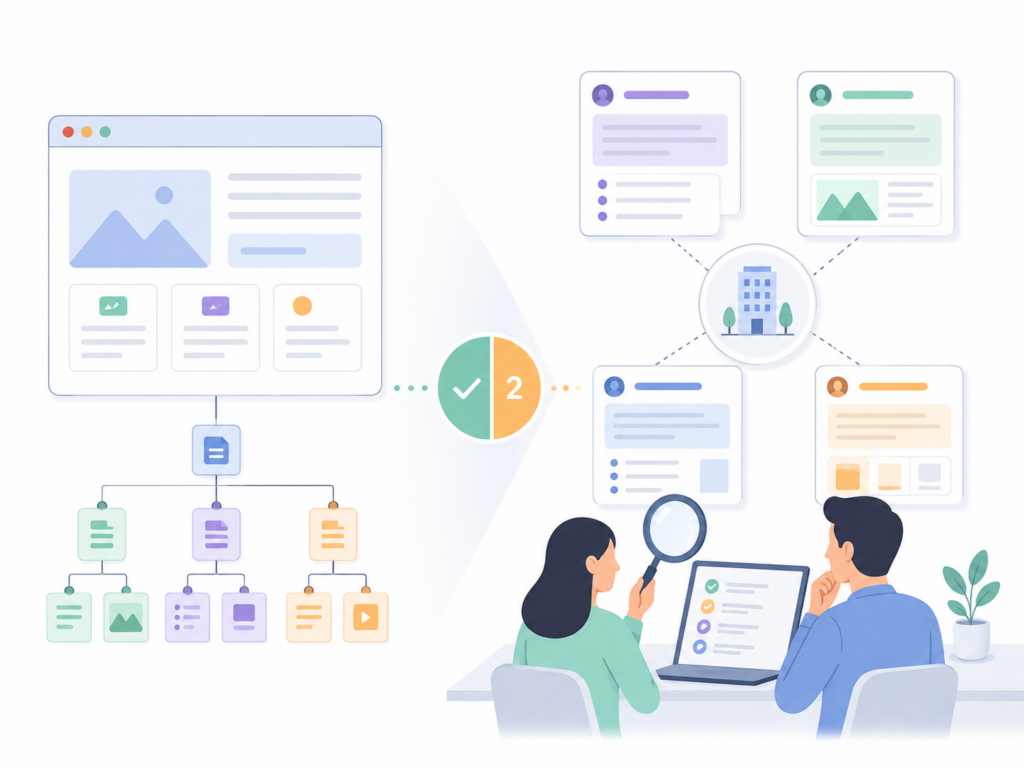
This is the part most teams skip, and it’s where Topify‘s Source Analysis becomes useful in practice. It tracks the exact domains and URLs that AI platforms cite when they mention your brand, which surfaces the content gaps and outdated sources feeding inaccurate answers before they spread further. If AI models are pulling from a five-year-old press release instead of your current documentation, Source Analysis is what shows you that.
From there, Topify’s broader GEO Analytics layer tracks sentiment and position alongside visibility, so you can see not just whether you’re mentioned, but whether the mention is favorable and how it stacks up against competitors across ChatGPT, Perplexity, Gemini, and other major AI platforms. That combination turns hallucination correction from a one-time content cleanup into something you can actually measure over time.
Conclusion
AI hallucination about your brand isn’t random and it isn’t unfixable. It’s usually the predictable result of fragmented, vague, or unstructured content forcing a model to guess. Clear, structured statements of fact, backed by schema markup and consolidated into a single source of truth, give AI systems something solid to retrieve instead of something to infer. Pair that with ongoing monitoring of what AI platforms are actually citing, and you move from reacting to bad answers to preventing them.
FAQ
Why does AI make up facts about my brand?
In most cases it isn’t inventing facts from nothing. It’s filling gaps left by outdated, inconsistent, or vague content with the best guess it can construct from whatever it retrieved.
Does schema markup actually help with AI search visibility?
Yes, though it isn’t a guarantee. Structured data reduces ambiguity and gives AI systems a clear fact to extract, which research links to meaningfully higher citation rates. Content quality and authority still matter alongside it.
How do I know if AI is already describing my brand incorrectly?
Test the exact questions your customers are likely to ask across multiple AI platforms, not just your brand name alone. Tools that track AI citations and source domains, like Topify’s Source Analysis, can show you where inaccurate information is coming from.
Is fixing this a one-time project or ongoing work?
Ongoing. AI platforms re-crawl and re-retrieve content continuously, and each engine weighs sources differently. Structured content reduces the odds of hallucination, but monitoring is what confirms it’s actually working.

