

Your team manages forty regional landing pages, three product lines, and a content calendar that’s already booked two quarters out. Then leadership asks one question no existing report can answer: when a buyer asks ChatGPT for the best solution in your category, does your brand come up, or does a competitor? Most of the tools on your shortlist were built to answer that for a single brand in a single market. Enterprise reality is messier, and the distance between what these tools track and what a global organization actually needs to govern is exactly where AI search visibility leaks without anyone noticing.
Most AI Search Visibility Tools Weren’t Built for Enterprise Scale
Most early AI visibility tools assumed one brand, one market, and one person refreshing a dashboard. Enterprise organizations don’t work that way. They run multi-brand architectures across regions, with dozens of seats, approval chains, and the need to audit thousands of regionalized prompts at once.
That mismatch is where most enterprise evaluations go wrong.
The first cost of the gap is silent. Enterprises tend to lose share in AI-generated answers well before traditional traffic dips, so the loss shows up in pipeline before it ever shows up in a rank tracker. By the time a brand notices, a competitor has already been named the “best solution” to a high-intent buyer question for weeks.
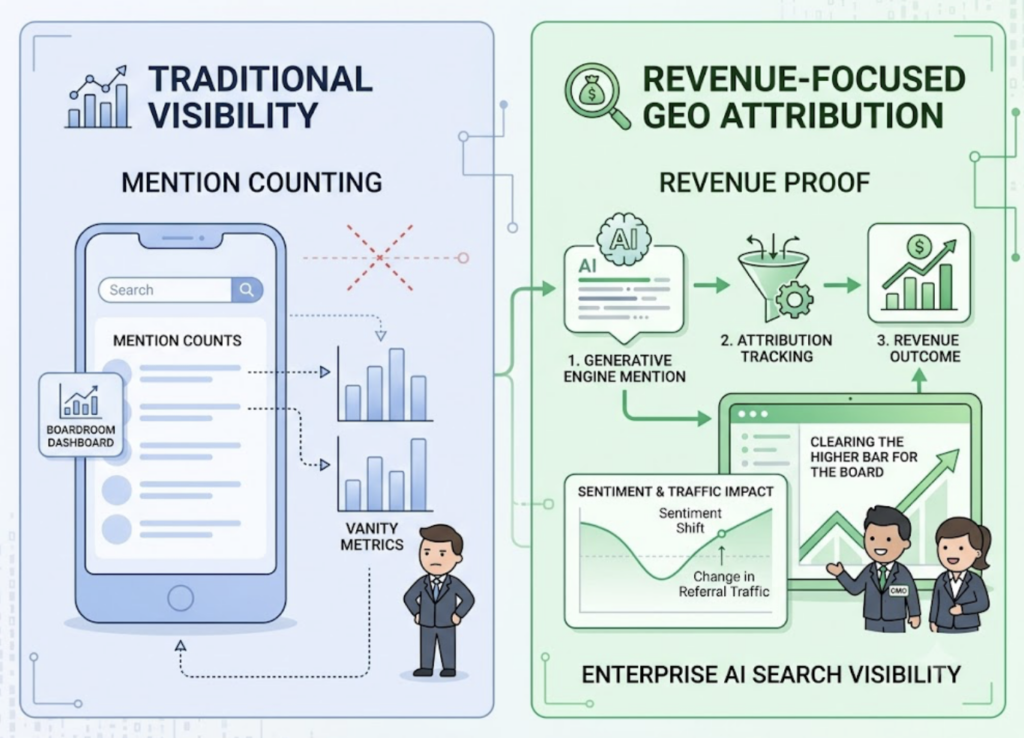
The second cost is attribution. CMOs are now asking for revenue proof on Generative Engine Optimization, and a monitor that can’t connect a mention to a sentiment shift or a change in referral traffic stays a vanity metric at the board level. Enterprise AI search visibility tools have to clear a higher bar than mention counting.
What Enterprise AI Search Visibility Tools Actually Need to Track
Before comparing products, set the bar. An enterprise ai search visibility monitor faces requirements a single-brand tool never has to meet.
| Capability | Enterprise requirement |
|---|---|
| Multi-engine coverage | Monitoring across ChatGPT, Claude, Gemini, Perplexity, DeepSeek, and Google AI Overviews at once |
| Prompt granularity | Thousands of buyer-journey prompts, sorted by region, product line, and intent |
| Competitive benchmarking | Side-by-side share of voice against rivals across a proprietary prompt library |
| Citation attribution | Reverse-engineering which URLs and domains drive AI trust |
| Workflow integration | API-driven publishing and a fit with the existing SEO and analytics stack |
| Governance and audit | Role-based access, audit trails, and hallucination or misinformation alerts |
Read the table as a filter, not a wish list. A tool that nails analytics but can’t support multiple seats or projects will stall the moment a second product line or a third regional team needs in.
The Enterprise AI Search Visibility Tools, Compared
Here’s how the main enterprise AI search visibility tools stack up at a glance, before the deeper look at each.
| Tool | Engine coverage | Key strength | Best fit |
|---|---|---|---|
| Topify | 7+ (ChatGPT, Gemini, Perplexity, and more) | End-to-end GEO intelligence plus execution | Global enterprises that need to act, not just watch |
| Profound | Specialized LLM benchmarks | High-fidelity citation mapping | Strategy-focused teams |
| Peec AI | ChatGPT, Perplexity, Claude, Gemini | Sentiment and position depth | SaaS and tech-first brands |
| Lumentir | 8+ (including Copilot) | Hallucination and risk detection | Highly regulated industries |
1. Topify
Topify lands at the top of most enterprise shortlists for one reason: it doesn’t stop at measurement. Topify runs Comprehensive GEO Analytics across seven metrics, visibility, sentiment, position, volume, mentions, intent, and CVR, and tracks them across ChatGPT, Gemini, Perplexity, DeepSeek, and other major engines in one view.
Here’s what that looks like day to day. You spot a drop in ChatGPT mentions for a product line, open Dynamic Competitor Benchmarking to see which rival picked up the share, then use the citation analysis to trace the shift back to a specific source domain that stopped referencing you. The whole diagnosis happens in one place, not across four browser tabs and a spreadsheet.
The part enterprise teams tend to underweight is execution. Most tools hand you a dashboard and leave the content work to you. Topify’s One-Click Execution layer connects visibility insight to action: you state a goal in plain English, review the proposed strategy, and deploy, which strips out the manual workflow that usually stalls large SEO teams.
Topify also reverse-engineers AI citations down to the exact domains and URLs each platform trusts. For an enterprise, that turns a vague “we’re losing visibility” into a specific content or schema gap a brand manager can own.
For organizations auditing thousands of regionalized prompts, the multi-project and multi-seat structure matters as much as the analytics. Large teams can split work by product line or market, keep separate prompt libraries, and report up without exporting everything by hand. That’s the bridge between AI visibility insight and site-wide optimization most tools never build.
On price, Topify’s Enterprise plan starts from $499 per month with a dedicated account manager. You can view pricing options or get started with a trial before committing budget.
2. Profound
Profound concentrates on the source attribution layer, which makes it a strong pick for teams that want to understand why a model prefers one source over another. In Profound AI search visibility work, the focus tends to be on the entity authority signals that drive AI trust rather than on downstream execution. It fits strategy-led teams who’ll hand the content changes to another group.
3. Peec AI
Peec AI does sentiment and position tracking well across conversational platforms, and it’s a reasonable fit for tech-heavy brands that care most about how an AI describes them. Coverage is solid on the major chat engines, though execution and large-team governance are lighter.
4. Lumentir
Lumentir stands out for enterprises in sensitive or regulated sectors, mostly on the strength of its hallucination detection and misinformation alerting. If your main risk is an AI confidently stating something false about your brand, that risk layer earns its place. For pure growth-side visibility, it’s more specialized than broad.
Matching an AI Search Visibility Suite to Enterprise Value
Picking from a feature grid is the easy part. The harder question is which capabilities map to value your enterprise can actually defend in a budget review.
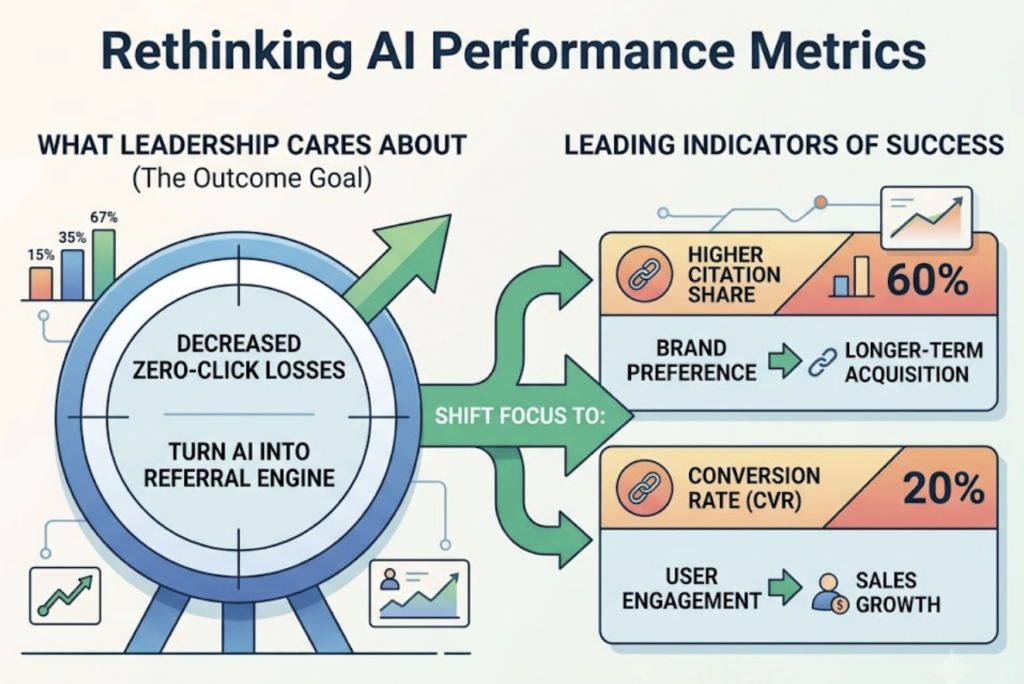
Start from the outcome leadership cares about. If the goal is reducing zero-click losses and turning AI into a referral engine, then citation share and CVR matter more than raw mention counts, because high citation share tends to be a leading indicator of brand preference and longer-term acquisition. That framing is how the ROI of AI visibility gets argued at the board level rather than the dashboard level.
The value of an AI search visibility suite also scales with how mature your program is. Early on, coverage and monitoring carry the weight. As programs grow, the differentiator shifts to execution and governance, which is the same arc Adobe describes in how GEO programs mature at scale.
Match the tool to where you are. A multi-brand agency wants seats, projects, and clean client reporting. An in-house enterprise software team wants the execution layer that closes the loop between insight and published content.
AI Search Visibility Strategies for Enterprise Software
A tool only pays off with a strategy behind it. For enterprise software teams, four moves turn monitoring into measurable outcomes, the same shift toward AI search optimization for enterprise brands that’s reshaping how large organizations think about discovery.
First, define your AI golden set. Curate 200 to 500 high-value buyer prompts written as natural questions your customers actually ask AI engines, not bare keywords. Something like “Which platform is best for enterprise GEO compared to a single-platform tracker?” beats a one-word term every time.
Second, build entity authority. Models lean on sources they can verify, so audit your presence across Wikipedia, G2, Capterra, and industry knowledge bases to give the AI a consistent truth to cite.
Third, restructure high-intent pages answer-first. Lead with a direct, declarative answer and add FAQ and Organization schema, so a model can extract a clean response without wading through long introductions.
Fourth, operationalize the feedback loop. Run a monthly GEO review: find where citations are slipping, assign updates to the right brand manager, and verify the impact in next month’s report. That cadence is what separates a tool that watches from a program that moves the number.
Conclusion
Enterprise teams get more out of AI visibility when they stop treating it as a ranking problem and start treating it as trust engineering. The tool you choose sets the ceiling on what you can see and act on, but the value comes from wiring it into your content supply chain. Filter your shortlist on the capabilities that survive enterprise scale, multi-engine coverage, competitor benchmarking, citation attribution, and execution, then commit to a monthly review cycle. Track it, optimize it, report it. That’s the difference between knowing you’re losing AI search visibility and doing something about it.
FAQ
What’s the core difference between an SEO rank tracker and AI search visibility tools enterprise teams use?
A rank tracker measures click-throughs to a URL on a list of blue links. AI search visibility tools measure how often, how favorably, and from which sources your brand gets mentioned and cited inside an AI-generated answer. They’re answering different questions.
Do I still need an AI search watcher if I already have a rank tracker?
Yes. A traditional rank tracker can’t see conversations happening inside LLMs, so using one as an ai search watcher is like reading a subway map to follow air traffic. The two tools cover different surfaces.
How do enterprise AI search visibility tools prove ROI?
By cutting zero-click losses and turning AI answers into a referral channel. High citation share in AI tends to lead brand preference, which is why teams increasingly treat it as an early signal of acquisition rather than a vanity metric.
What’s the biggest mistake enterprise teams make?
Relying on a single-platform tool, often a Google-only tracker, while ignoring the growing volume of buyer questions handled by Perplexity, ChatGPT, and other engines. Coverage gaps hide the losses that matter most.

