

Your rank tracker says you’re holding Position 3 for your main keyword. Good news, on paper. Then a buyer opens Perplexity, types your category, and reads back five recommendations. Yours isn’t one of them. The dashboard you check every morning has no field for that moment, because it was built to watch links, not what an AI chooses to say about you. That’s the gap most brand monitoring still can’t see.
What an AI Brand Monitoring Platform Actually Does
An AI brand monitoring platform tracks how your brand shows up inside the answers that LLMs and answer engines generate. Not your link position. Your mention, your description, and your ranking relative to competitors when an AI responds to a real question.
The difference matters more than it sounds. A traditional rank tracker scrapes search results for keyword positions. An AI search engine tracking system instead simulates thousands of user-intent queries across multiple models, then reads the narrative the AI produces about your brand.
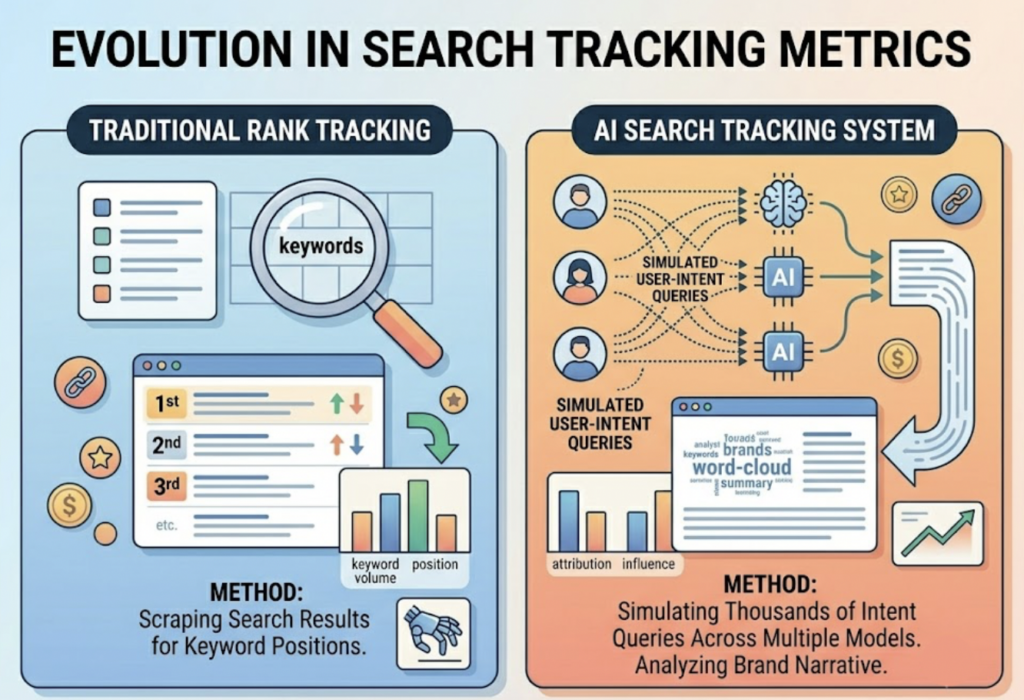
That shift in object, from link to entity, changes everything downstream. You’re no longer asking “where does my page rank.” You’re asking “does the AI recommend me, and how does it describe me when it does.”
There’s a second reason this category exists. Most AI search users never click through when the answer is complete. So the value isn’t a visit, it’s the implied authority of being the brand the AI names. A monitoring platform’s job is to make that invisible authority measurable.
Why Search Engine Visibility Platforms Look Different in AI
Traditional SEO leans on Domain Authority and keyword rankings to predict performance. In AI search, those signals are largely decoupled from whether an AI cites you.
LLMs don’t rank pages against a static score. They synthesize an answer based on the trust an entity has built across the open web. So a site with a strong DA can still be absent from the answer, while a smaller competitor with consistent third-party validation gets named first.
Keyword density makes it worse, not better. Stuffing tends to read as spam to a model, while clear entity signals, schema, steady PR, and credible citations, tend to get prioritized.
Here’s the part teams miss most often.
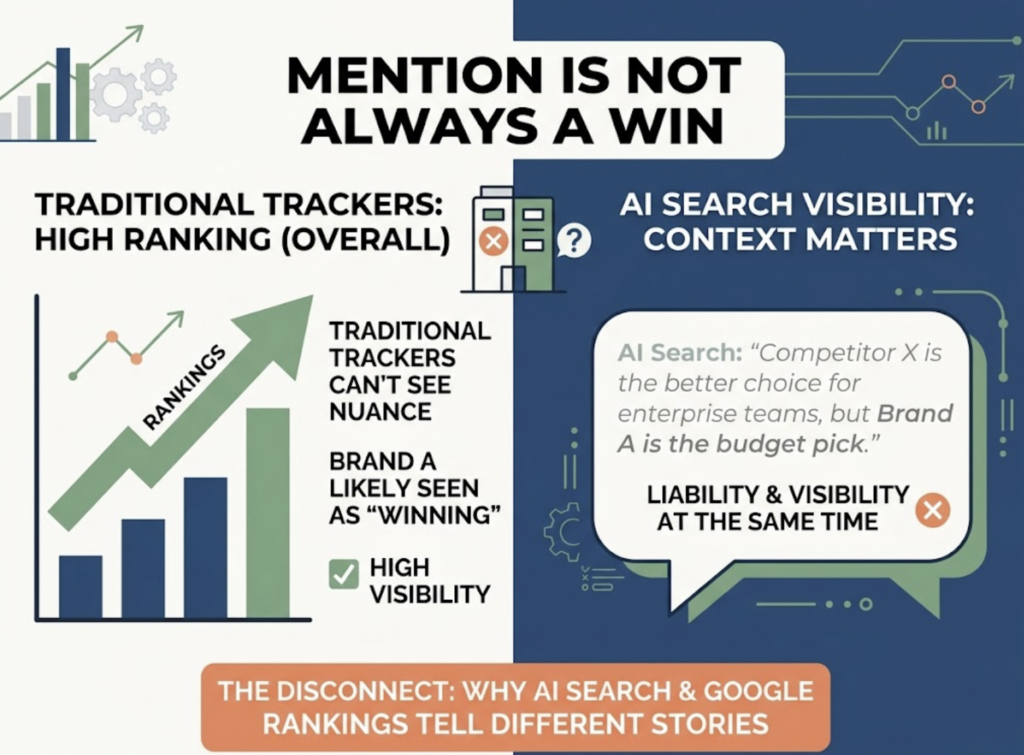
A mention is not automatically a win. If the AI says “Competitor X is the better choice for enterprise teams” and lists you as the budget pick, you have visibility and a liability at the same time. Traditional trackers can’t see that nuance, which is the whole reason a dedicated search engine visibility platform exists. The same disconnect is why AI search visibility and Google rankings often tell two completely different stories about the same brand.
The Core Metrics: AI Search Engine Visibility, Position, and Sentiment
A useful platform doesn’t hand you one number. It separates ai search engine visibility into the dimensions that map to actual business questions.
| Metric | The question it answers |
|---|---|
| Visibility Rate | In what share of category-relevant queries does my brand appear at all? |
| Citation Frequency | How often does the AI link to my domain as a trusted source? |
| Sentiment Score | Does the AI frame me as a leader, a budget option, or an afterthought? |
| Share of Voice | How prominent am I versus top competitors inside AI answers? |
| Source Attribution | Which third-party sites, G2, Reddit, forums, is the AI using to validate me? |
Read together, these turn “we feel invisible” into a diagnosis. Low visibility points to an entity problem. Strong visibility with weak sentiment points to a positioning problem. Strong everything except citation frequency points to a content-anchor problem.
That last column, source attribution, tends to be the one that changes what teams actually do next.
Perplexity Search Engine Tracking: A Closer Look
Perplexity deserves its own lens. Its source-first architecture sets it apart from a model like ChatGPT that leans on internal weights. Perplexity actively searches the live web and links the citations it used, right under the answer.
That transparency is a gift for monitoring. Because the sources are visible, perplexity search engine tracking can reverse-engineer exactly why your brand was picked or skipped for a given query.
It’s also volatile. Perplexity’s ranking is sensitive to the recency and authority of the sources it pulls, so its citations churn. Effective perplexity search engine rank monitoring watches that churn, because a shift in which sources get linked often precedes a shift in whether your brand gets mentioned at all. For a deeper walkthrough, this guide on tracking Perplexity rankings and brand visibility breaks down the workflow step by step.
From Tracking to AI Search Engine Ranking Optimization
Monitoring tells you where you stand. It doesn’t move you. The platforms worth paying for close the loop from data to action.
This is where Topify fits the discussion. It runs the full lifecycle rather than stopping at a scoreboard.
It starts with discovery. Topify’s Comprehensive GEO Analytics builds a baseline across ChatGPT, Gemini, Perplexity, DeepSeek, and others using seven core metrics: visibility, sentiment, position, volume, mentions, intent, and CVR. You get a read on every major engine your audience actually uses, not just one.
Then comes attribution. Topify reverse-engineers AI citations to show the exact domains and URLs each engine pulls from, so you can see whether a product page, a whitepaper, or a third-party review is acting as the anchor for your mentions. In practice, this is what makes ai search engine ranking optimization possible at all, because you can’t fix a citation gap you can’t locate.
The third step is execution. State a goal in plain English, review the proposed strategy, and deploy it in one click instead of routing the fix through three teams and a two-week backlog.
For a brand manager, that sequence is the point. You can spot a drop in Perplexity mentions, trace it to a source that stopped citing you, and act on it inside the same view.
Choosing AI Search Engine Visibility Tracking Tools
Most teams evaluating ai search engine visibility tracking tools fixate on the dashboard’s looks and miss the four things that decide whether the tool changes anything.
Multi-engine coverage comes first. A tool that only watches Google AI Overviews ignores the traffic and discovery moving to Perplexity and ChatGPT. Single-engine visibility is a half-answer.
Prompt-level granularity comes second. The platform should let you build custom prompt libraries that mirror your real customer journey, not just track high-volume keywords that no buyer actually types into an answer engine.
Source attribution is third, and it’s the one teams underrate. Knowing where the AI pulls its information is what separates a fix from a guess. Without it, you’re optimizing blind.
Workflow integration is fourth. The honest test: does the tool suggest a content or schema fix, or does it just show you a falling line and wish you luck.
On price, Topify starts at $99/month and covers ChatGPT, Perplexity, and AI Overviews tracking with a 100-prompt library on the entry plan, which keeps the multi-engine and prompt-level requirements from becoming an enterprise-only luxury. Other tools in the category each have their place, and the right pick depends on how many of those four criteria you actually need on day one.
Conclusion
The blue-link dashboard isn’t wrong. It’s just answering a question buyers stopped asking. When discovery happens inside an AI answer, the brand that gets named, described accurately, and ranked ahead of rivals wins the moment, click or no click.
Start by measuring one baseline. Pick the 20 prompts a real buyer would type into ChatGPT and Perplexity, then check whether you appear, where you rank, and how you’re described. That single read usually settles the “do we need this” debate faster than any pitch. You can get started with Topify and pull that baseline across engines in a few minutes.
FAQ
Q: What does an AI brand monitoring platform track?
A: It tracks how AI search engines mention, describe, and rank your brand inside generated answers. That includes visibility rate, citation frequency, sentiment, share of voice versus competitors, and which third-party sources the AI uses to validate you, none of which a traditional rank tracker reports.
Q: How is this different from a standard SEO rank tracker?
A: A rank tracker watches where your link sits in search results. An AI brand monitoring platform watches what an LLM says about you and whether it recommends you. The first measures link position, the second measures entity visibility, and the two often disagree.
Q: How do you monitor brand visibility specifically in Perplexity?
A: Perplexity links the sources behind each answer, so perplexity search engine tracking works by mapping which domains it cites for your category queries and watching how those citations change over time. Because its rankings shift with source recency and authority, ongoing rank monitoring matters more here than a one-time snapshot.
Q: Are AI search engine visibility tracking tools worth it for a mid-sized brand?
A: If buyers in your category are already asking ChatGPT or Perplexity for recommendations, then yes, because being absent from those answers costs share you can’t see in Google Analytics. The value scales with how much of your discovery is moving to conversational search.

