

Your rank tracker says you’re #2 for your main keyword. Solid. Then a buyer opens ChatGPT, types the same question in plain English, and gets a three-brand recommendation that doesn’t include you. Your Google position didn’t move. Your position inside that AI answer, the one quietly shaping the buyer’s shortlist, was never something you could see.
That’s the blind spot. Traditional rank tracking was built for a static list of blue links, and AI answers aren’t lists. They’re synthesized on the fly, and where your brand lands inside them shifts prompt by prompt, platform by platform.
What an AI Visibility Analytics Service Actually Does
An AI visibility analytics service monitors how often, how prominently, and how favorably your brand shows up inside AI-generated answers. Not your Google ranking. Your standing inside the response ChatGPT, Perplexity, Claude, or Google AI Overviews hands a user who never clicks through.
Traditional analytics count clicks, sessions, and keyword positions. An AI visibility analytics service measures something the old stack can’t see: entity authority and source attribution. In plain terms, whether the model knows your brand exists, treats it as trustworthy, and names it before your competitors.
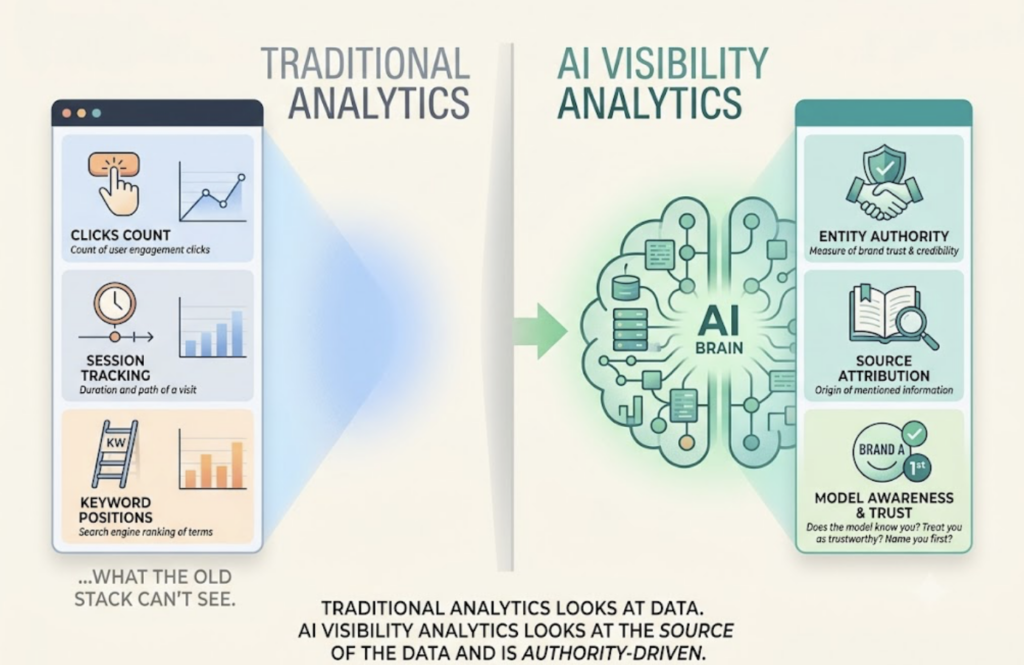
The distinction that trips up most teams is mention versus rank.
You can be mentioned in passing and still lose. Being one of five brands listed is not the same as being the first one cited, or the source the AI links to as authoritative. A real service tracks both: presence, and where you sit relative to everyone else in the same answer.
How AI Visibility Analytics Works Across ChatGPT, Perplexity, and AI Overviews
Most services run a three-stage loop, and understanding it tells you a lot about what to expect from the data.
First, prompt sampling. The service maintains a set of prompts that mirror real buyer intent, like “best enterprise CRM for small teams” or “compare Product A vs Product B.” This prompt library is the backbone. If it doesn’t reflect how your actual buyers ask questions, every metric downstream is noise.
Second, cross-platform retrieval. The system runs those prompts across the major answer engines and records what each one says. This is where chatgpt website rank tracking, perplexity website rank tracking, and ai overview website rank tracking stop being separate tools and become one feed. Each platform synthesizes answers differently, so your brand can lead on Perplexity and disappear on Gemini for the same question.
Third, parsing and scoring. NLP reads each response and extracts whether your brand appears, whether the AI cites your domain as a source, the tone of the description, and where you rank against named competitors.
The output isn’t a single number. It’s a map of where you stand, broken out by prompt and by platform.
LLM Website Rank Tracking vs. Traditional SERP Rank
Here’s the part that breaks old mental models. On a Google SERP, position #7 is position #7 until the algorithm updates. It’s deterministic and stable for days or weeks.
LLM website rank tracking works on shifting ground. There is no fixed slot. An AI synthesizes a fresh answer for each query, and your placement inside it can change between two near-identical prompts run an hour apart. So ai overviews website rank tracking isn’t measuring a position you hold. It’s sampling a distribution, then reporting how reliably you show up and how high.
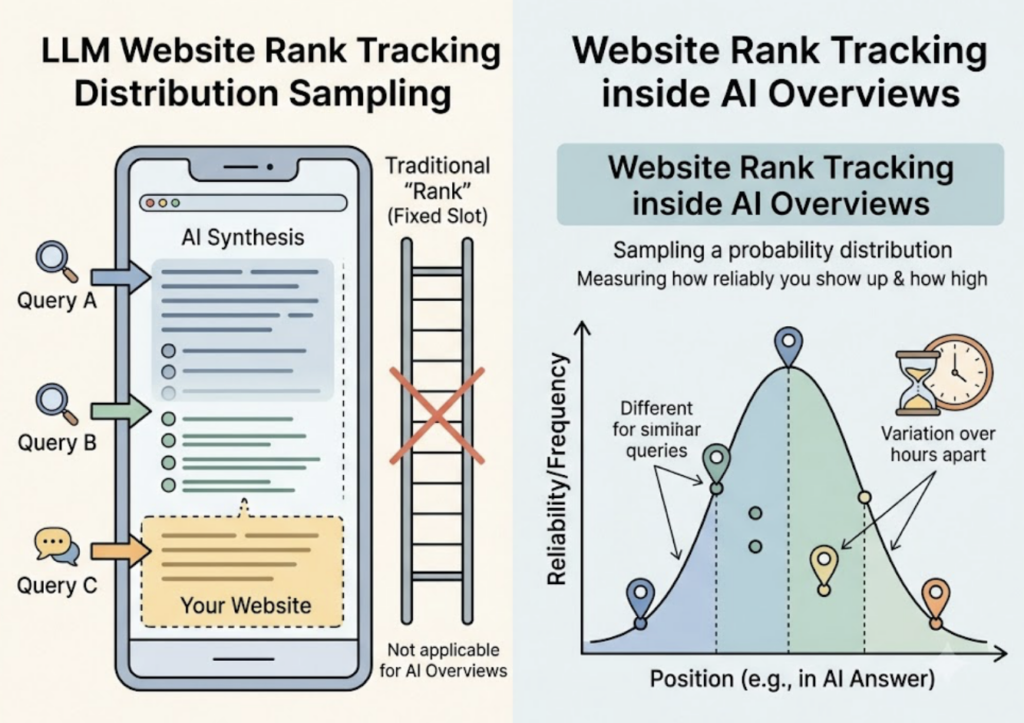
That’s why a credible service tracks rank as a rate across many runs, not a single snapshot. One query proves nothing. Two hundred queries over thirty days, across four platforms, start to tell the truth.
The Metrics That Tell You Where You Stand
Once you’ve got cross-platform data flowing, the question becomes which numbers actually matter. Four tend to carry the weight.
Brand presence is the north-star metric: the share of category-relevant prompts where your brand gets mentioned at all. If you’re invisible here, nothing else counts.
Citation share measures something stricter. Among answers where the AI provides sources, how often is your domain one of them? High-performing brands optimize for citation, not just mention, because citations signal the model treats you as an authority rather than an afterthought.
Sentiment captures tone. An AI calling your product “a budget option” when you sell premium is a positioning problem that no traffic report would ever surface.
Share of voice ties it together: your presence against direct competitors across the same prompt set. This is the metric that turns “we’re doing fine” into “we’re behind on 60% of our buying-intent prompts.”
Measure these consistently and you stop guessing. You know exactly where the gaps are.
What to Look for in an AI Visibility Analytics Service
Not every tool that promises AI visibility actually delivers the parts that change decisions. When you’re evaluating an AI visibility analytics service, four capabilities separate the useful from the decorative.
| Capability | Why it matters | What weak tools do |
|---|---|---|
| Platform coverage | AI search is fragmented across engines | Track Google AI Overviews only |
| Prompt granularity | Buyer-intent prompts beat generic ones | Use canned prompt sets you can’t edit |
| Attribution mapping | Tells you why a competitor won | Show scores with no explanation |
| Actionability | Turns data into a next step | Stop at a dashboard of numbers |
That last row is where most platforms quietly fail. A visibility score with no recommendation attached is a thermometer, not a strategy.
This is the gap Topify is built to close. Its Comprehensive GEO Analytics tracks seven dimensions in one view: visibility, sentiment, position, volume, mentions, intent, and conversion visibility rate. Coverage spans ChatGPT, Gemini, Perplexity, DeepSeek, and other major engines, so a drop on one platform doesn’t hide inside a blended average.
In practice, that means you can watch your Position Tracking slip on a key buying-intent prompt, trace it to a competitor that recently earned a citation you didn’t, and see the suggested fix in the same dashboard. For teams that want to track AI search visibility and rankings in ChatGPT alongside every other engine, that single-view consolidation is the difference between a report and a workflow. When you’re ready to test it against your own prompts, you can get started with Topifydirectly.
Where Most Teams Get AI Visibility Wrong
The failure modes are predictable, and avoiding them costs nothing but attention.
Single-platform bias is the big one. Teams monitor Google AI Overviews because it feels closest to SEO and call it done. By one 2026 estimate, that ignores more than half of AI search traffic flowing through Perplexity and ChatGPT. You’re optimizing for the platform you understand instead of the ones your buyers use.
Confusing mentions with citations is the subtle one. A passing mention feels like a win until you realize the AI cited a competitor as its source and mentioned you only as context. One is authority. The other is a footnote.
Then there’s the technical foundation. The smartest content strategy fails if your site isn’t AI-readable. Missing schema markup, copy buried behind JavaScript, thin entity signals: any of these can keep a model from trusting or even parsing your pages, no matter how good the writing is.
Turning Visibility Data into a Strategy
Tracking is the start. Improving is the point.
The strongest results tend to come from answer-first content. Put a direct, declarative answer to a common industry question in the first 150 words of a page, before the preamble. Models extract clean, self-contained answers far more readily than they parse a buildup.
Entity alignment matters more than people expect. Keep your product names, services, and leadership consistent across every web property, because LLMs use those connections to decide whether your brand is a coherent, trustworthy entity. Modular formatting helps too: structure content in labeled, self-contained sections an AI can lift cleanly.
Then earn outside validation. AI models lean on trusted third-party sources, so placements on G2, credible industry sites, and active forums feed the citations that move your share of voice.
None of this is guesswork once you’re measuring it. You change a page, you watch the rank tracking respond across platforms, you keep what works. That feedback loop, more than any single tactic, is what separates brands that show up in AI answers from brands that only hope they do. For a fuller picture of how AI search visibility differs from Google rankings, the gap is worth understanding before you set targets.
Conclusion
The buyer who asked ChatGPT instead of Google didn’t see your #2 ranking, and that’s the whole problem. AI answers are where more category decisions get made every quarter, and your position inside them isn’t visible through any traditional tool. An AI visibility analytics service exists to close that gap: measure where you stand across every engine, find out why competitors get cited when you don’t, and act on it before the next buyer asks. Start by quantifying your current presence. You can’t improve a position you can’t see.
FAQ
Q: What is an AI visibility analytics service?
A: It’s a tool that tracks how your brand performs inside AI-generated answers across platforms like ChatGPT, Perplexity, Claude, and Google AI Overviews. Instead of measuring clicks and Google rankings, it measures whether AI mentions your brand, cites your domain as a source, describes you favorably, and ranks you ahead of or behind competitors.
Q: What does AI visibility analytics service pricing look like?
A: Pricing usually scales with the number of prompts tracked, platforms covered, and seats. Entry plans tend to start around $99 per month for core platform tracking and a capped prompt set, with higher tiers adding more prompts, projects, competitor benchmarking, and dedicated support. Match the tier to how many buyer-intent prompts you actually need to monitor rather than the largest bundle.
Q: What are some examples of AI visibility analytics service use cases?
A: A SaaS team checking whether ChatGPT recommends them for “best CRM for small teams.” A brand manager catching that Perplexity describes their premium product as “budget-friendly.” An agency reporting AI search performance to a client who asked “are we showing up in AI answers.” Each starts with the same step: sampling real prompts across engines.
Q: How is AI rank tracking different from Google rank tracking?
A: Google rank tracking measures a fixed position on a static results page. AI rank tracking measures a shifting distribution, since AI answers are synthesized fresh for each query and your placement can change between near-identical prompts. That’s why credible tools report rank as a rate across many runs and platforms, not a single position.

