

You’ve spent two years positioning your product as enterprise-grade. Then a customer mentions that ChatGPT described you as “great for solo founders on a budget.” Gemini says something different again. Neither matches your messaging, and neither is technically a lie. It’s a guess, delivered with total confidence, and nobody on your team was watching for it.
Why AI Gets Your Brand Facts Wrong in the First Place
Large language models don’t look things up every time they answer a question. When they’re asked something from memory rather than pulled from a live source, they generate the most statistically likely answer, not the verified one.
That distinction matters more than most people realize. On grounded tasks, where the model has a document in front of it, frontier models hallucinate on roughly 1 to 2.5 percent of summaries in 2026, down sharply from a few years ago. Ask the same model a closed-book factual question from memory, and the error rate climbs fast.
| Task type | Typical hallucination rate in 2026 |
|---|---|
| Grounded summarization | 1.0% to 2.5% |
| RAG-based retrieval | 4% to 9% |
| Long-tail factual recall | 15% to 40% |
| Multi-turn conversation | Up to 19% |
Brand facts fall closer to the risky end of that range. Your pricing, your founding story, your feature list: these are exactly the closed-book questions where the model is reconstructing an answer from scattered, sometimes outdated, mentions across the web rather than checking a source in real time.
This isn’t a bug that gets patched. It’s how the underlying mechanism works, and it means every brand is exposed by default.
The Manual Check: Prompting AI Platforms Yourself
The first thing most people do after hearing about AI hallucination is ask ChatGPT one question about their brand, get a reasonable-sounding answer, and assume it’s fine. That’s the wrong way to read the result.
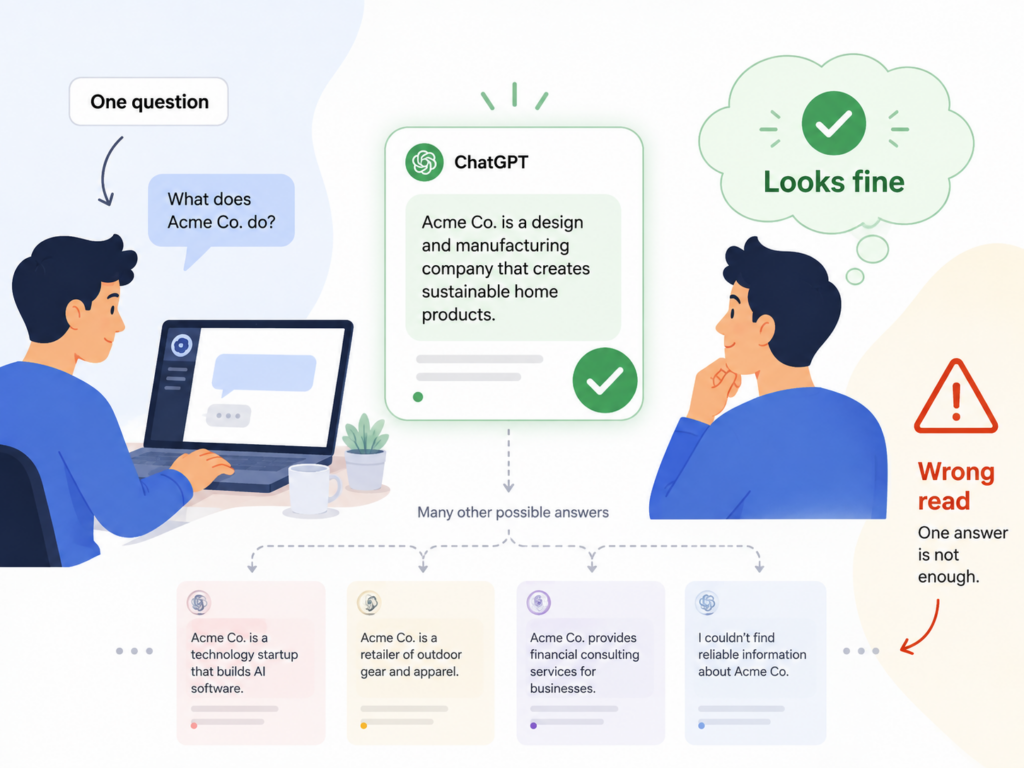
A single clean answer tells you nothing about the other 40 prompts a prospect might type. A proper manual audit means running a structured set of questions across every platform your audience actually uses:
- Factual prompts: pricing, founding date, headquarters, core features
- Comparison prompts: how you’re positioned against named competitors
- Recommendation prompts: whether the model suggests you for relevant use cases
- Sentiment prompts: how the model characterizes your brand overall
Run each set on ChatGPT, Gemini, Perplexity, Google AI Overviews, and Claude, and record the exact response, not a paraphrase. Different platforms pull from different training data and different live sources, so the same question routinely produces different answers depending on where you ask it.
The manual version of this works. It’s also slow, easy to under-sample, and gives you a single snapshot that starts going stale the moment a new article gets indexed.
What Counts as a Hallucination vs a Simple Outdated Fact
Not every wrong answer is an AI hallucination in the strict sense, and the distinction changes what you do about it.
An outdated fact means the AI found a real source, it’s just old: last year’s pricing page, a team bio for someone who left two years ago, a press release from a pivot you’ve since moved past. A true hallucination is different. It’s the model inventing a detail with no source behind it at all, a feature that doesn’t exist, a partnership that never happened, a founder story that’s simply made up.
The fix differs accordingly. Outdated facts get corrected by updating and re-indexing the source. Fabricated ones require finding out why the model felt confident enough to invent something in the first place, which usually points to a gap: there’s no clear, authoritative answer available anywhere for the model to have found.
Why Sentiment Shifts Are Often the First Warning Sign
Most brand hallucinations don’t announce themselves as an obviously wrong sentence. They show up first as a change in tone.
Before a factual error gets caught, it often nudges how an AI platform talks about you. A model that starts describing your product as “budget-friendly” when you’re positioned as premium isn’t lying outright. It’s drawing on a source that misrepresents you, and the sentiment drift is the visible symptom.
That’s the gap most brands can’t see with a one-off prompt test. Catching a sentiment shift early means you can investigate the source before it hardens into a repeated, confidently stated wrong answer.
This is where continuous monitoring earns its keep over manual spot checks. Topify’s Sentiment Analysis feature tracks how AI platforms characterize your brand over time and flags meaningful swings, so a drift in tone becomes a signal to dig deeper rather than something you notice by accident three months later.
Tracking Down Where the Wrong Information Came From
Once you’ve confirmed a hallucination, the next question is where it came from. AI systems mostly don’t invent claims from nothing. They synthesize from whatever’s out there, and if the answer is wrong, some source in that mix is the reason why.
The starting point is often closer to home than expected. A surprising share of brand misinformation traces back to the brand’s own website: an old pricing table buried in a forgotten blog post, a service description that never got updated after a pivot, a press page still showing a 2023 announcement front and center.
Beyond your own site, the model may be pulling from a stale review, a competitor’s comparison page, or an old news article that got republished with outdated numbers still intact. Web mentions correlate with AI citations at roughly three times the strength of backlinks, which means the sources shaping what AI says about you are broader than your typical SEO backlink profile.
This is the specific job Topify’s Source Analysis handles: it surfaces the exact domains and URLs an AI platform is citing when it talks about your brand, so instead of guessing, you get a direct path from the wrong answer back to the page responsible for it.
Building a Recurring Check Instead of a One-Time Audit
Here’s the part that catches people off guard: a fix that worked last quarter can quietly come undone. One monitoring specialist described correcting a client’s misinformation, only to watch ChatGPT start repeating the same wrong claim four months later after the model ingested a newly republished article with the old, incorrect details.

That’s not an edge case. It’s the normal lifecycle of AI-indexed information. Models get updated, new articles get crawled, and old errors resurface without warning. A single audit tells you where things stood on the day you ran it, nothing about the day after.
Treating this as an ongoing operational check rather than a project with an end date is the only version of this that actually holds. That’s what Visibility Tracking, Sentiment Analysis, and Source Analysis are built to do together inside Topify: a fixed set of brand prompts running on a schedule, sentiment and factual drift flagged automatically, and a direct line back to the source whenever something changes. You find out an error resurfaced the week it happens, not the week a prospect mentions it on a sales call.
Conclusion
AI hallucination about your brand isn’t a rare glitch. It’s a structural side effect of how these models answer closed-book questions, and it’s already shaping what prospects hear before they ever talk to your team. A manual prompt audit is the right place to start. Ongoing, cross-platform monitoring is what keeps a fixed error from quietly coming back.
FAQ
Q: How often does AI actually get brand facts wrong?
A: It depends heavily on the type of question. Grounded, document-based tasks see hallucination rates near 1 to 2.5 percent, but closed-book factual recall, the category most brand questions fall into, can run anywhere from 15 to 40 percent depending on the model and platform.
Q: Can I ask OpenAI or Google to correct a specific false fact about my brand?
A: Not directly. None of the major AI providers offer a correction portal for a specific claim. Feedback buttons like thumbs-down can flag an issue, but the more reliable fix is correcting and re-indexing the source the model is pulling from.
Q: How long does it take for a correction to show up in AI answers?
A: Meaningful corrections typically take two to six months, since it involves updating multiple sources, waiting for AI systems to recrawl or retrain on the new data, and confirming the fix actually held rather than assuming it did.
Q: What’s the difference between AI hallucination and normal brand misinformation?
A: Misinformation usually traces back to a real, findable source that’s simply wrong or outdated. A true hallucination is the model generating a detail, like a feature or partnership, that has no source behind it at all.

