

You’d expect the sites with the most content, the biggest engineering teams, and the most at stake in AI search to move first on llms.txt. A 300,000-domain study found the opposite. Sites pulling in 100,001 or more monthly visits adopt the file at a lower rate than sites getting a few thousand visits a month. That’s not a rounding error. It’s a pattern that says something about who actually believes llms.txt does anything.
The Adoption Number Everyone Quotes Is Only Part of the Story
Most coverage of llms.txt leads with one headline figure. SE Ranking’s analysis of roughly 300,000 domains found a 10.13% overall adoption rate. That’s the number that gets quoted in every “should you implement llms.txt” post.
Break that number down by traffic tier and the story changes. Low-traffic sites, the ones getting 0 to 100 visits a month, sit at 9.88% adoption. Mid-traffic sites in the 1,001 to 5,000 visit range come in highest at 10.54%. High-traffic sites, the 100,001-plus tier, land at just 8.27%.
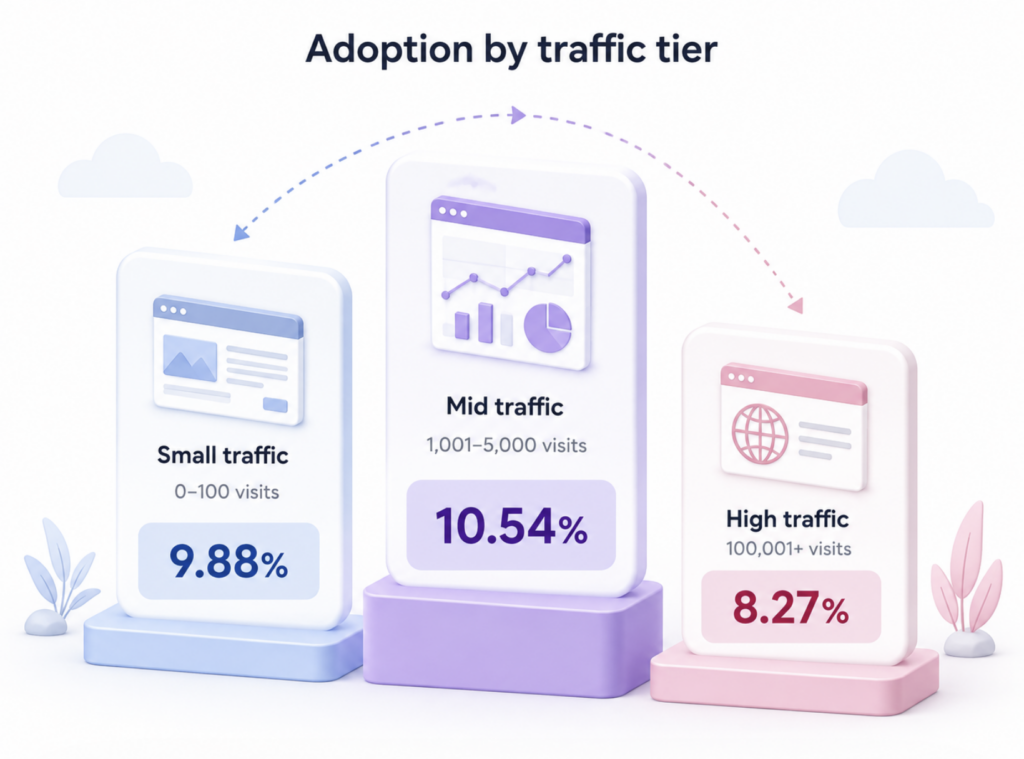
The largest, most authoritative domains in the dataset are the least likely to have shipped the file. A separate look at the same data found adoption among the top 1,000 domains by traffic sits near zero percent. If llms.txt were becoming an SEO best practice the way XML sitemaps did, you’d expect the opposite curve. You’re not seeing that curve.
Why Would the Biggest Sites Adopt llms.txt Less
Look at who actually shipped llms.txt early and the pattern starts to make sense. The named adopters cited across multiple studies read like a developer tools roster: Anthropic, Stripe, Cloudflare, Vercel, Supabase, Pinecone, and LangChain. These are companies with small, technical teams who can ship a Markdown file in an afternoon without a sign-off chain.
Enterprise sites don’t work that way. A Fortune 500 marketing team can’t add a new file to a production domain without legal review, security sign-off, and a business case. llms.txt has no governance body and no conformance test behind it, which makes that business case hard to write. Nobody wants to be the person who spent three sprint cycles shipping a file with no measurable return.
Mid-size sites split the difference. They have enough technical staff to implement llms.txt without a committee, and enough curiosity about AI search to try a low-cost, low-risk tactic. That combination is exactly what shows up in the 10.54% figure. It’s not that mid-size sites believe more in llms.txt. It’s that they face less friction trying it.
| Site Type | Adoption Rate | Why |
|---|---|---|
| Low-traffic (0-100 visits) | 9.88% | Small teams, easy to ship, nothing to lose |
| Mid-traffic (1,001-5,000 visits) | 10.54% | Technical enough to implement, curious enough to test |
| High-traffic (100,001+ visits) | 8.27% | Slower approval chains, higher bar for unproven tactics |
| Top 1,000 domains | Near 0% | Highest scrutiny, least tolerance for unproven SEO bets |
Does Having llms.txt Actually Change Anything
Adoption rate is one question. Whether the file does anything once it’s live is a separate one, and the evidence there is thin.
SE Ranking tested this directly. They built an XGBoost model to predict AI citation frequency using dozens of site-level features, including llms.txt presence. Removing the llms.txt variable from the model actually improved its accuracy. The file wasn’t a weak signal. It was noise.
Google’s position matches that finding. Gary Illyes has confirmed Google doesn’t support llms.txt and has no plans to. John Mueller compared it directly to the long-discredited keywords meta tag. In June 2026, Google updated its AI optimization documentation to state plainly that llms.txt has no effect, positive or negative, on Search rankings or AI Overviews.
Crawler behavior tells the same story from a different angle. Adoption has genuinely grown, up roughly 8.8x in twelve months to more than 36,000 sites according to Originality.ai. But 97% of those files never get requested by an AI crawler at all. A separate monitoring run across 500 million AI bot events found only a few hundred requests targeting llms.txt directly, out of that entire dataset. GPTBot, ClaudeBot, PerplexityBot, and Google-Extended are still overwhelmingly crawling regular HTML.
What the Adoption Curve Actually Tells You About AI Visibility
Here’s the trap in the adoption numbers. Total llms.txt adoption in the top-10k domains climbed from 1.04% to 5.61% in a single year, a 5.4x jump that looks like real momentum on a chart. Most of that growth is platform-driven rather than organic. Shopify alone accounts for over 78% of adopting sites in some samples, because the file gets auto-generated at the platform level, not chosen deliberately by each merchant.
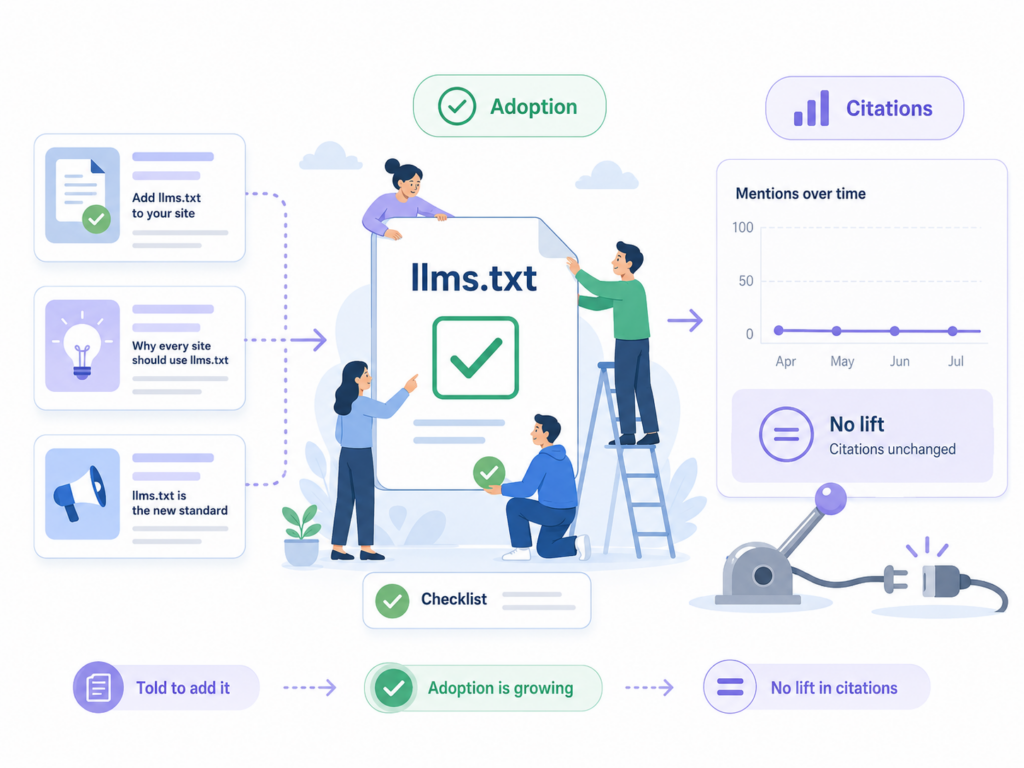
Growing adoption plus flat-to-zero impact on citations is a specific combination worth sitting with. It means the file is spreading as a checkbox, not as a lever. Teams are adding it because a blog post told them to, not because they’ve measured a before-and-after difference in how often AI systems mention them.
That gap between “we shipped something” and “we know if it worked” is exactly where most GEO efforts stall. Guessing whether a crawler read a file is a weak substitute for watching what AI systems actually cite. Topify’s Source Analysis tracks the specific domains and URLs that ChatGPT, Perplexity, and Google AI Overviews pull from when they answer prompts in your category, so you’re looking at confirmed citation behavior instead of an unverifiable file request log.
Visibility Tracking closes the other half of the loop. Instead of asking “did the crawler read my llms.txt,” it asks “did my brand show up in the answer,” across the platforms your buyers actually use. That’s the metric that maps to pipeline, not the one that maps to a file sitting quietly at your domain root.
If Not llms.txt, Where Should the Effort Go
The same SE Ranking dataset that found llms.txt added noise also identified what actually moves citation frequency. According to a related analysis of over 150,000 citations, FAQPage schema lifted citation rate by 34% on Perplexity and 28% on ChatGPT. ClaimReview markup on stat-dense pages added a 41% lift on AI Mode specifically. Organization SameAs linkages, the structured data that ties your brand identity across LinkedIn, Crunchbase, and Wikipedia, added a 22% lift by helping models disambiguate who you are.
| Tactic | Measured Lift | Where |
|---|---|---|
| llms.txt presence | No measurable effect | All platforms |
| FAQPage schema | +34% / +28% | Perplexity / ChatGPT |
| ClaimReview on stats | +41% | Google AI Mode |
| Organization SameAs | +22% | Entity disambiguation |
| Speakable cssSelector | +18% | Google AI Mode |
None of these tactics involve a root-level text file. They involve structured markup, entity consistency, and content that answers a question in a self-contained sentence an AI model can lift directly. If your team is deciding where to spend the next sprint, that table is a more defensible starting point than llms.txt.
Conclusion
The counterintuitive part of the llms.txt story isn’t that adoption is low. It’s that the sites with the most resources to test new tactics are the ones adopting it the least, while the tactics that actually move citation frequency have nothing to do with the file at all. If you’re deciding where to invest, treat llms.txt as a half-day, low-risk addition at best, and put the real effort into schema, entity consistency, and content structure you can actually measure against AI citation data.
FAQ
Q: Does llms.txt help with AI search rankings?
A: No measurable effect has been found. Google has confirmed it doesn’t factor into Search rankings or AI Overviews, and a 300,000-domain study found the same for citation frequency.
Q: Why don’t large websites use llms.txt as often as expected?
A: Larger sites typically face longer approval chains and a higher bar for adopting unproven tactics. Early adopters skew toward small, technical teams like developer tools companies that can ship a file without a formal business case.
Q: Is it still worth implementing llms.txt in 2026?
A: It’s low-cost and low-risk to add, but it shouldn’t replace higher-impact work like FAQPage schema, ClaimReview markup, or entity consistency, which have measurable citation lifts.
Q: How do I know if AI models are actually reading my site?
A: File request logs for llms.txt tell you almost nothing, since most files get zero AI crawler requests. Tracking actual citations in AI answers, which tools like Source Analysis are built for, is a more reliable signal.

