

You’ve published over 100 blog posts. Organic traffic looks solid. But qualified leads are close to zero, and your sales team keeps asking why marketing can’t source more pipeline.
Here’s what’s actually happening: you have a content production problem disguised as a content quality problem. And in 2026, with AI assistants handling more of the buyer research process, the gap between “publishing content” and “having a strategy” has never been more expensive to ignore.
54% of marketing leaders describe their content strategy as “advanced.” Only 19.1% can actually track how that content contributes to sales pipeline. That’s not a measurement problem. That’s a structural one.
Most Content Teams Are Running Without a Map
There’s a meaningful difference between a content production operation and a content marketing strategy. Most B2B teams have the first. Very few have the second.
A production-centric model runs on an editorial calendar. Topics are picked by keyword volume, published on schedule, and measured by page views. It feels like progress because output is visible. The problem is that output without intent doesn’t build pipeline.
A strategy-led model starts from the opposite end: What commercial decision do we need to influence? Which buyer persona needs to move? What does that person need to read at each stage of their journey to get closer to a “yes”? Every piece of content is engineered to move a specific person closer to a specific action.
The performance gap is stark. Organizations with a documented and consistently executed strategy achieve conversion rates nearly 6x higher than teams running on volume alone.
That said, only about 29% of B2B marketers view their documented strategy as “extremely effective.” Which means the majority are somewhere in between: they have a strategy on paper, but not one that’s connected to revenue.
The Buyer Journey Is Your Editorial Strategy Backbone
80% of the B2B buying journey now happens before a prospect ever speaks to a sales rep. 67-70% of buyers actively prefer a “rep-free” research experience, relying on content, peer reviews, and AI assistants to make decisions independently.
This changes everything about how inbound marketing content should be structured.
Most content teams invest heavily in TOFU — broad educational posts that attract traffic but don’t drive decisions. Roughly 90% of blog content in B2B sits at the awareness layer. But buyers engage with 3 to 7 pieces of content before reaching out to sales. If 6 of those 7 touchpoints are “awareness” content from your brand, you’ve missed every conversion window.
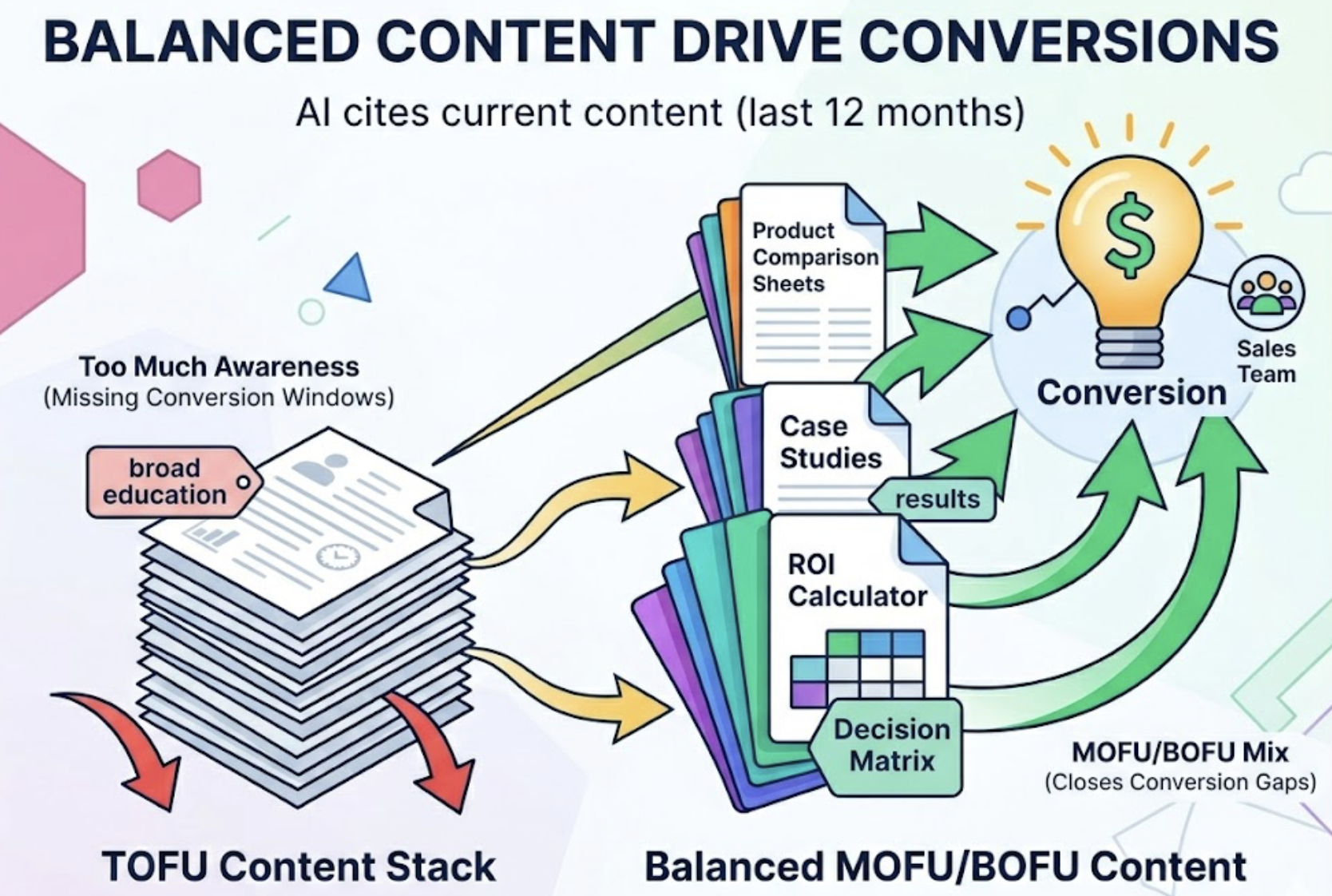
The funnel math is unambiguous:
| Funnel Stage | Intent Level | Content Types | Benchmark CVR |
|---|---|---|---|
| TOFU | Informational | Explainer blogs, infographics | 0.3% – 0.6% |
| MOFU | Investigatory | Solution briefs, webinars, e-books | 1% – 3% |
| BOFU | Decisional | Comparisons, ROI calculators, case studies | 5% – 10%+ |
Effective blog content strategy doesn’t start by filling the top of the funnel. It starts by asking: do we even have the BOFU assets that let traffic convert? If those don’t exist, more TOFU traffic just means more bounce rate.
High-performing editorial strategies are built bottom-up, with BOFU assets anchoring the architecture before TOFU content is scaled.
Topical Authority Beats Volume. Every Time.
Ranking for isolated keywords is no longer a durable growth strategy. Both Google and generative AI engines now evaluate “topical authority” — the depth and coherence of a brand’s coverage across an interconnected knowledge network.
The pillar-cluster model is the most effective structure for building this authority. A pillar page covers a broad core topic comprehensively. Cluster pages go deep on specific sub-topics, linked back to the pillar through a deliberate internal linking architecture. The result isn’t just better rankings — it’s a content ecosystem that signals genuine expertise.
The numbers back this up. Content organized into clusters drives approximately 30% more organic traffic and maintains rankings 2.5x longer than standalone posts. That longevity matters for ROI: evergreen clusters compound value over time rather than fading two weeks after publication.
For content-led growth, the strategic implication is clear. When a brand covers a subject with 10 to 15 interconnected articles, it becomes the default recommendation — for Google and for AI assistants alike. ChatGPT and Perplexity prioritize sources with “entity authority,” meaning platforms that are recognized as definitive references for specific subject matter.
This is where content funnel strategy meets AI search optimization. Topical authority isn’t just an SEO play anymore. It’s a prerequisite for being cited at all.
Content Marketing for B2B: The Thought Leadership Layer
B2B purchases involve long decision cycles (typically 6 to 18 months), 6 to 10 stakeholders, and high trust costs. Standard inbound marketing content handles awareness and education. But it doesn’t build the kind of credibility that moves a skeptical VP or technical evaluator.
That’s the job of thought leadership content.
97% of B2B marketers agree thought leadership is critical to full-funnel success. More specifically, 95% of decision-makers report that strong thought leadership makes them more receptive to sales outreach — even before they’ve had any direct contact with the vendor.
The mechanism is simple: thought leadership doesn’t sell a product. It frames the buyer’s problem in a way that makes the vendor’s perspective feel indispensable. When a prospect arrives at a sales conversation already aligned with your worldview, the sales cycle can be shortened by up to 30%.
Original research is 93% more effective at driving leads and building trust than generic commentary. Proprietary data — surveys, benchmarks, original analysis — creates content that can’t be replicated or commoditized. It also happens to be the single most reliable trigger for AI citations.
One underused application: 47% of marketers stop using thought leadership after the sale. Yet it’s a primary driver of customer retention and expansion. Post-sale content that reinforces the wisdom of the initial purchase reduces churn and accelerates upsell cycles.
Publishing Consistency Is a Lead Generation Engine
45% of B2B content marketers cite the inability to scale production as their primary operational challenge. The solution isn’t more headcount. It’s building a content engineering workflow: repeatable processes that integrate AI tools, repurposing frameworks, and clear ownership at every stage.
The data on publishing frequency is hard to ignore. B2B companies that publish 16 or more blog posts per month generate 4.5x more leads than those publishing 0 to 4 times per month.
That number isn’t an argument for publishing filler. It’s an argument for building systems that make consistent, high-quality publishing operationally achievable.
Repurposing is the highest-leverage move for teams with limited budgets. A single well-researched pillar post can generate a LinkedIn article series, an email nurture sequence, a webinar script, and three short-form video scripts — all without starting from zero. Emails informed by published blog content improve open rates by approximately 14%.
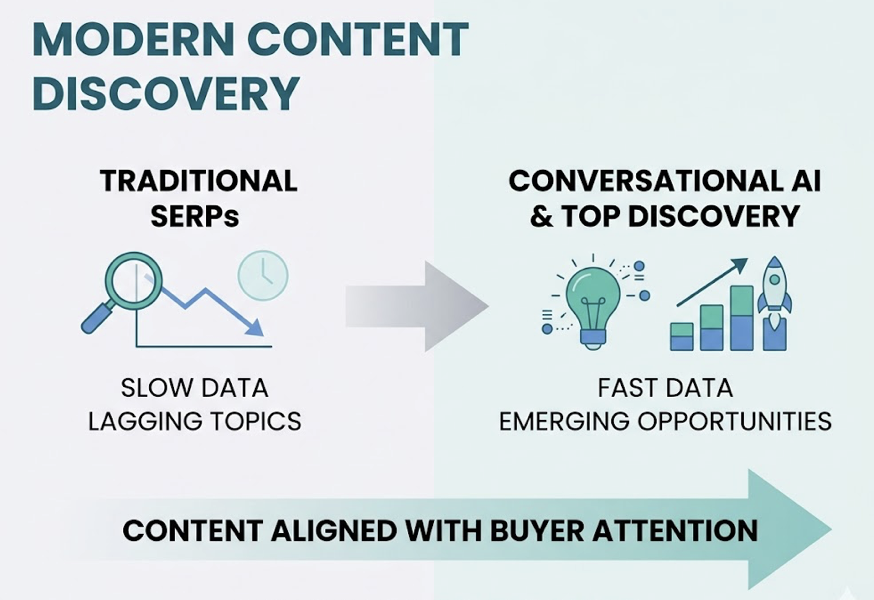
On the topic discovery side, 93.7% of B2B marketers now use AI in some part of their content operations. The most sophisticated teams have moved past AI drafting to AI-assisted discovery. Topify’s AI Volume Analytics surfaces “dark queries” — high-volume topics being asked in conversational AI platforms like ChatGPT and Perplexity that haven’t yet developed significant competition in traditional SERPs. Getting to these topics early means your content calendar is aligned with where buyer attention is actually moving, not where it was 18 months ago.
Measuring Content Marketing ROI Without Vanity Metrics
Page views don’t pay salaries. Yet many content teams still report to leadership using metrics that have no reliable connection to revenue.
The shift to a strategy-led measurement model starts with “content-influenced pipeline” — joining content consumption data to CRM opportunity data to see which specific assets were touched by accounts that eventually closed. It’s not a trivial build, but it’s the only way to credibly demonstrate that content drives business outcomes.
The core formula: (Closed-Won Revenue Influenced by Content – Total Content Production Cost) / Total Production Cost × 100
For 2026, three additional metrics have become essential for brands operating in AI search environments:
Answer Inclusion Rate (AAIR): What percentage of relevant queries result in an AI-generated answer that cites your brand?
AI Citation Rate: How often does the AI engine link back to your content as an authoritative source — not just mention your brand?
Conversion Visibility Rate (CVR): What’s the likelihood that an AI citation leads to a high-intent brand interaction (demo request, signup, direct visit)?
Topify’s Source Analysis and Visibility Tracking layers are built specifically to surface these metrics across ChatGPT, Perplexity, Gemini, and other major AI platforms. The CVR metric in particular closes the loop between GEO performance and commercial outcomes — making it possible to tie AI-search visibility directly to pipeline, not just impressions.
B2B companies that invest in advanced tracking achieve an average content ROI of 5:1, with top-performing SEO and thought leadership campaigns reaching returns of 700% or higher.
One Content Plan for SEO Rankings and AI Search Citations
The emergence of generative search doesn’t replace traditional SEO. It adds a new layer — and that layer has different rules.
SEO optimizes for a click. GEO optimizes for a citation. These are meaningfully different goals, and they require different content structures.
| Feature | SEO Optimization | GEO Optimization |
|---|---|---|
| Goal | Clicks to website | Citations within AI answer |
| Primary Signal | Backlinks / Keywords | Authoritative citations / Original data |
| Content Structure | Long-form, SEO-friendly | Concise, fact-level, citable sections |
| Technical Need | Crawlability / Speed | Structured data (Schema.org) / RAG-friendly |
Research from Princeton and Georgia Tech demonstrates that traditional tactics like keyword density perform poorly in generative environments. AI systems prioritize “extractability” — they need content that is factually dense, clearly structured, and citable at the sentence level.
Practical adjustments that work for both channels: answer the primary query within the first 200 words (satisfies AI’s opening-content bias), structure headers as exact questions, and include verifiable statistics and expert quotes. These changes have been shown to boost AI visibility by up to 40%. Original data points, specifically, increase AI citation likelihood by approximately 30%.
Topify’s Visibility Tracking monitors brand performance across both Google SERPs and AI platforms simultaneously, allowing content teams to see their share of voice in real time. When a content calendar is built to satisfy both SEO and GEO requirements from the start, the effort compounds across channels rather than being siloed.
The brands that will dominate the next search cycle aren’t the ones publishing the most. They’re the ones publishing content that’s authoritative enough to earn both a Google ranking and a ChatGPT citation.
Conclusion
The traffic-no-pipeline problem is structural, not tactical. Adding more content to a broken system doesn’t fix the system. What changes outcomes is a genuine content marketing strategy: one that maps to buyer stages, builds topical authority, measures pipeline influence, and now extends into AI search visibility.
If your content is ranking but not converting, start with a full-funnel audit. Identify where MOFU and BOFU assets are missing. Build the pillar-cluster architecture that earns topical authority over time. And make sure your measurement stack can actually tell you which content is closing deals — not just attracting clicks.
The tools and frameworks exist. The brands pulling ahead are the ones deploying them systematically.
FAQ
Q: How do you build a content marketing strategy from scratch?
A: Start by defining where your brand has a genuine “right to win” — the niche topics where you have real expertise. Then: (1) Map buyer personas to their specific pain points at each funnel stage; (2) Audit existing assets to identify MOFU and BOFU gaps; (3) Build a pillar-cluster map for 3 to 5 core topics; (4) Set up a content engineering workflow for consistent production; (5) Integrate CRM data to track pipeline influence from the first publish.
Q: What’s the difference between a content marketing strategy and an editorial strategy?
A: A content marketing strategy is the high-level system — it aligns content effort with business goals, revenue targets, and the buyer journey. It answers “why” and “how much.” An editorial strategy is a subset: it governs topic prioritization, voice, publishing cadence, and format decisions. Think of the content strategy as the architecture, and the editorial strategy as the floor plan.
Q: How do you measure content marketing ROI without relying on vanity metrics?
A: Connect content consumption data to CRM opportunity data. Track content-influenced pipeline (deals that touched specific assets), SQL conversion rate by content type, and Customer Acquisition Cost (CAC) by channel. In AI search environments, also track Answer Inclusion Rate, AI Citation Rate, and Conversion Visibility Rate to capture the full picture of how content drives commercial outcomes.
Q: How does a blog content strategy support AI search visibility (GEO)?
A: AI engines prioritize extractable, authoritative, and factually dense content. A blog strategy that uses question-based headers, includes original data points, and structures content for “citable sections” is significantly more likely to be referenced in ChatGPT, Perplexity, and Google AI Overviews. Topical authority also matters: brands that cover a subject comprehensively are recognized as “entity authorities” and become default citations for related queries.

