


Most blog posts never get found. Not because they’re poorly written, but because they weren’t built to be discovered.
Ahrefs data consistently shows that roughly 91% of web content receives zero organic traffic. And with AI Overviews now intercepting top-of-funnel queries, organic click-through rates for informational content have dropped by as much as 58%. Writing a good article is no longer enough. You need to engineer content that both Google and AI engines can retrieve, parse, and cite.
That’s what this guide covers.
SEO Blog Writing vs. Regular Blog Writing: The Gap That Costs You Rankings
Good writing and ranking content are not the same thing.
Regular blog posts prioritize narrative flow and brand voice. They might build community, earn shares, or express perspective. What they typically don’t do is tell search algorithms and AI models exactly what they’re about.
SEO blog writing is different in intent. Every structural decision, from heading hierarchy to paragraph length, serves a retrieval function. The goal isn’t just for a human to read the piece. It’s for an automated system to extract the right passage at the right moment.
The gap shows up most clearly in how each approach handles user intent. Informational queries make up roughly 70% of global search volume. A conversational blog post might address the topic. An SEO-optimized post answers the specific question, in the first paragraph, in plain language, before doing anything else.
That’s not a stylistic choice. It’s an architectural one.
In 2026, AI models use what researchers call “retrieval-augmented generation” (RAG) to pull content fragments into their responses. If your post doesn’t front-load its core answer with clean structure, it won’t be extracted. It’ll be skipped, even if the underlying argument is stronger than anything that does get cited.
Blog Post Structure for SEO: The Framework Behind Ranking Content
Structure is the first signal. Before Google or an AI model reads a single sentence, the heading hierarchy tells them whether this content is worth parsing.
Research across 10,000+ queries suggests the optimal heading depth for blog posts sits between three and five levels. Too shallow, and retrieval algorithms can’t find enough organizational cues. Too deep, and crawler attention gets diluted across too many structural tokens.
Here’s what that looks like in practice:
H1 (Title): Under 60 characters, contains the core keyword, solves a specific problem. Not “A Guide to SEO Writing” but “The SEO Blog Writing Playbook That Works for Google and AI Search.”
Introduction: Provide a direct answer to the central query within the first 40 to 60 words. This satisfies Google’s NavBoost signals and the prompt-completion requirements of AI models simultaneously.
H2 subheadings: Phrase these as questions or intent-anchored statements, not topic labels. “How to Structure a Blog Post for SEO” outperforms “Blog Structure” every time.
Paragraph rhythm: Two to three sentences per paragraph is the baseline. This isn’t just for readability. It’s because AI agents index content at the passage level, and a bloated paragraph often returns a diluted extraction.
The “modular block” principle applies here: each paragraph should be contextually complete on its own. If an AI engine pulls a single paragraph from a 2,500-word article, that paragraph should still make sense and deliver value. If it can’t stand alone, it probably won’t get cited.
On-Page SEO for Blogs: What Actually Moves the Needle in 2026
The old hierarchy of on-page SEO factors has been reshuffled significantly since Google’s August 2025 Core Update.
Keyword density is now a liability, not an asset. Google’s SpamBrain systems can flag over-optimized content for demotion. What replaced it is entity coverage: does your content mention, define, and connect the concepts that belong in this topic’s semantic neighborhood?
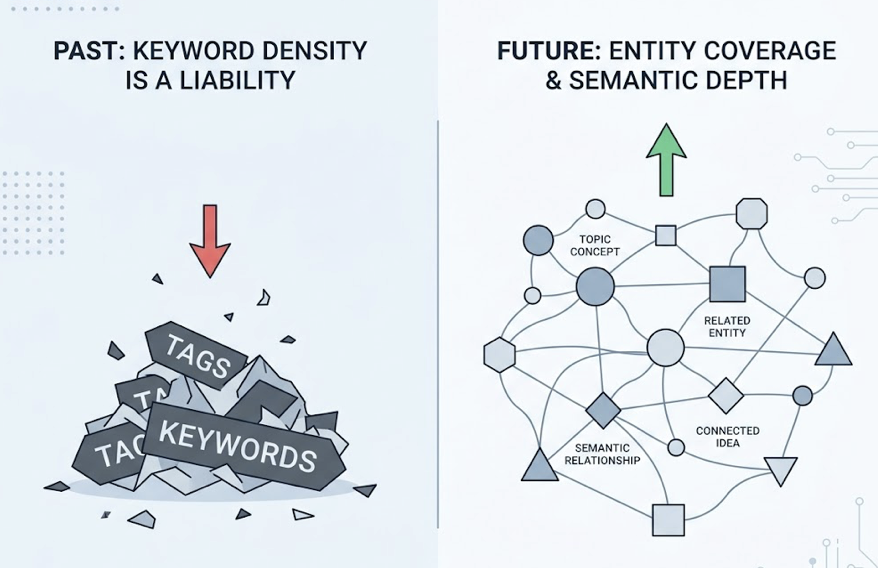
The highest-weight on-page factors in 2026 look like this:
| Factor | 2026 Ranking Weight | Impact on AI Citations |
|---|---|---|
| Schema Markup (JSON-LD) | High | Essential for extraction accuracy in AIO and Perplexity |
| Mobile Core Web Vitals | High | Prerequisite for Google Discover inclusion |
| Internal Linking (Clusters) | High | Establishes topical authority and entity relationships |
| Image Alt Text | Medium | Critical for multimodal retrieval |
| Keyword Density | Low / Negative | Can trigger spam demotions if overused |
Schema markup deserves specific attention. Connecting your Article, Person (author), and Organization schema nodes with stable @id identifiers creates a machine-readable knowledge graph. AI systems use this to verify E-E-A-T before deciding whether to cite your content. Without it, you’re asking the model to trust a source it can’t verify.
Featured snippets remain valuable, but the dynamic has changed. When an AI Overview is present on a search results page, the top organic result’s CTR drops by roughly half. The upside: content cited inside the AI Overview earns 35% more clicks than non-cited competitors on the same page. Winning the citation is the new winning the top spot.
To earn those citations, use direct answer formatting: state the question explicitly as a subheading, then answer it in one to two clean sentences immediately below. That’s the exact format AI agents are trained to extract.
How to Use Keywords Naturally in SEO Blog Writing
Keyword stuffing is dead. But keyword avoidance isn’t the answer either.
The shift is from frequency to semantic coverage. Research on long-tail keyword distribution shows that nearly 74% of keywords receive fewer than 10 searches per month. The bulk of valuable traffic lives in conversational, intent-specific queries, not high-volume head terms.
That changes the writing strategy.
Instead of repeating a target keyword five times per 500 words, the goal is to cover the topic’s full semantic neighborhood. A post about “sustainable investment” that never mentions ESG criteria, carbon disclosure, or green bonds signals topical thinness to both Google and AI models. They expect related concepts to appear naturally in expert-level content.
Three techniques for natural keyword integration:
1. Term definition at first use. Define complex or technical terms when they first appear. This aids AI comprehension and signals genuine expertise.
2. Entity linking. Link to authoritative external sources (academic institutions, government sites, established publications) at relevant points. Research cited by Princeton University found that this type of authoritative citation increases generative search visibility by over 30%.
3. Cross-query coverage. AI engines often break down complex user queries into multiple sub-queries before synthesizing a response. If your article answers the main question and several adjacent ones, it’s more likely to be selected for synthesis. One post, multiple related questions, clean structural separation between them.
What you’re not doing: mentioning the primary keyword in every other paragraph, forcing LSI terms into sentences that don’t need them, or writing for a keyword density percentage instead of a reader.
Writing Blog Posts That Rank on Google and AI Search Simultaneously
This is where most content strategies still have a blind spot.
Traditional SEO optimizes for PageRank logic: backlinks, domain authority, crawlability. AI search visibility runs on different logic: answer inclusion rate, citation frequency, and content freshness. The mistake is assuming these are the same problem with the same solution.
They’re not. But they’re not incompatible either.
Analysis of 6.8 million AI citations shows that different platforms have distinct sourcing preferences. Google’s AI Overviews favor brand-owned content, LinkedIn, and structured web pages. ChatGPT gravitates toward Wikipedia, Reddit, and major news outlets. Perplexity prioritizes niche expertise: G2, Gartner, industry blogs.
That has direct implications for content strategy:
| AI Platform | Most Cited Source Types |
|---|---|
| Google Gemini (AIO) | Brand websites, LinkedIn, Quora, Reddit, YouTube |
| ChatGPT (OpenAI) | Wikipedia, Reddit, Forbes, Business Insider |
| Perplexity | G2, Gartner, PCMag, Industry Blogs |
A blog post optimized purely for Google domain authority won’t automatically earn Perplexity citations. And vice versa. The hedge is content that satisfies cross-platform trust signals: original data, expert attribution, authoritative external links, and structured formatting.
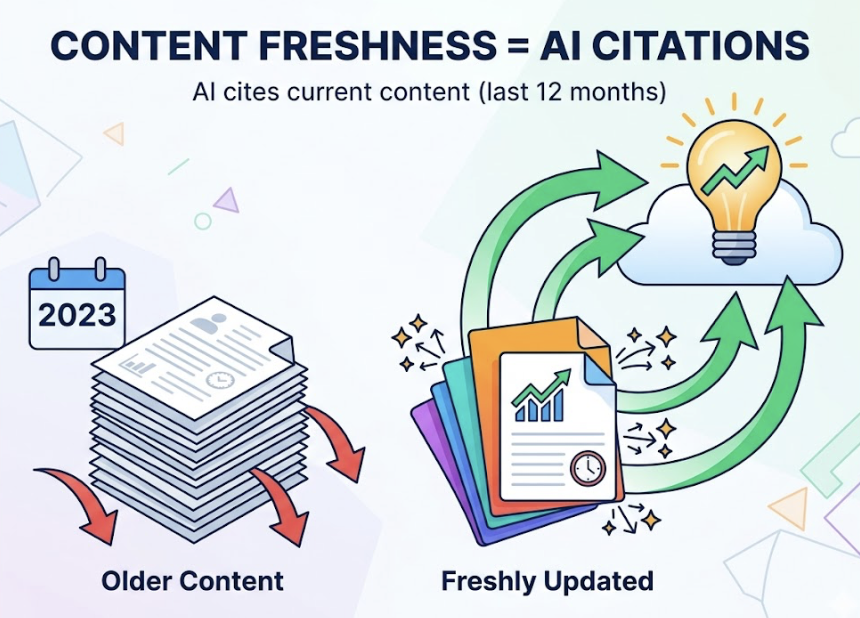
Content freshness is a compounding factor. Research shows 65% of AI citations occur on content updated within the last 12 months. A post written in 2023 and never touched is losing citation ground every month, even if it still ranks in Google’s top ten. Build a refresh cycle into your editorial calendar.
One more thing worth knowing: most AI crawlers, including OAI-SearchBot and PerplexityBot, can’t execute JavaScript. If your blog runs on client-side rendering, these crawlers may never see your content at all. Server-side rendering isn’t optional for AI visibility.
The SEO Blog Writing Checklist: From Draft to Published (and Beyond)
The process doesn’t end at publish. That’s the outdated model.
Before you write:
- Map search intent: what specific answer does the searcher want, and how do they want it structured?
- Audit your brand’s current share of model: is your site already being cited for related topics by ChatGPT or Gemini?
- Identify which sources AI engines currently cite for your target keyword. Competitors? Wikipedia? Niche blogs? That tells you what you’re actually competing against.
While you write:
- Front-load the direct answer in the H1 and the first H2
- Include at least 5 to 10 specific data points per major article
- Add 2 expert quotes with clear attribution
- Implement JSON-LD schema connecting Article, Author, and Organization nodes
- Keep paragraphs to 2 to 3 sentences; no paragraph should require more than one reading to parse
After you publish:
- Link the new post from 3 to 5 high-authority internal pages immediately
- Check server logs for OAI-SearchBot and PerplexityBot to confirm crawler access
- Move beyond rank tracking: measure citation frequency across LLMs, not just Google position
- Schedule a 6-month content refresh to maintain citation eligibility
The last point matters more than most teams realize. Organic rankings can hold steady while AI citation rates erode quietly. You need different metrics to catch that.
How Topify Turns SEO Blog Writing into a Measurable Growth Channel
Writing the content is one side of the equation. Knowing whether it’s actually being found by AI is the other.
That’s the gap most brands still operate in the dark on.
Topify is built to close it. The platform tracks brand visibility across ChatGPT, Gemini, Perplexity, and other major AI engines using seven core metrics: visibility, sentiment, position, volume, mentions, intent, and CVR (Conversion Visibility Rate). Instead of guessing whether a blog post is earning AI citations, you can see it directly.
Two features are especially relevant for content teams:
Source Analysis shows which third-party domains AI platforms are currently citing in responses related to your target topics. That’s the competitive intelligence most content strategies are missing. You can see whether AI is citing a competitor’s white paper, a Reddit thread, or a niche industry blog, and then adjust your content to become the stronger source. It’s not guesswork. It’s reverse-engineering the citation graph.
Visibility Tracking quantifies how a published post performs across AI platforms over time. If a piece earns strong Google rankings but low AI citation rates, that’s a specific signal: the content may need structural adjustments, fresher data, or additional schema implementation.
For teams that want to outsource the production side, Topify’s content writing service delivers GEO-native articles built to rank on both Google and AI search from day one. The Basic plan at $3,999/month includes 60 high-quality articles. The Business plan at $4,999/month adds Source Analysis, dark query discovery, and multi-engine visibility tracking alongside 60 articles per month.
The team behind the platform includes a Google White-Hat SEO champion with 10-plus years of experience scaling sites to 1M+ organic visitors, an LLM researcher from Stanford with publications at NeurIPS, AAAI, and ICLR, and a growth operator who has scaled over 100 companies from zero to $20M in revenue. The methodology isn’t theoretical.
Conclusion
SEO blog writing in 2026 is a two-front discipline. You’re writing for Google’s entity graphs and for AI engines’ synthesis logic at the same time. The structural requirements overlap significantly, but the measurement frameworks don’t.
The fundamentals haven’t changed: answer the question clearly, support claims with data, build topical authority through internal linking, and keep technical hygiene tight. What has changed is the visibility layer. Ranking in Google’s top ten no longer means your content is actually reaching users in the AI search era.
Track citation frequency, not just position. Refresh content on a defined cycle. And audit which sources AI platforms currently cite for your target topics before you write, not after.
That’s the gap between content that exists and content that gets found.
FAQ
How to write a blog post that ranks on Google in 2026?
Prioritize information gain and E-E-A-T. Google’s current systems reward original research, first-hand expertise, and fast-loading mobile pages. Use semantic clusters and clear heading hierarchies rather than keyword repetition. The key signal is whether your content adds something that doesn’t already exist at the top of the results page.
What’s the difference between SEO blog writing and regular blog writing?
Regular blog writing focuses on narrative and voice without technical structure. SEO blog writing is engineered for retrieval: structured data via Schema markup, intent-mapped headers, semantic LSI coverage, and direct-answer formatting in the introduction. The intent is for the content to be parsed and cited by automated systems, not just read by humans.
How to write blog posts that rank in AI search results?
Lead with a direct answer in the first 40 to 60 words. Include 5 to 10 specific data points and at least 2 expert quotes with attribution. Use tables and lists that AI agents can extract easily. Implement connected JSON-LD schema and link to authoritative external sources. Content freshness is also a major factor: 65% of AI citations go to content updated within the last 12 months.
How to measure the SEO performance of your blog posts?
Traditional traffic metrics are increasingly insufficient. Add Answer Inclusion Rate (AAIR), AI Share of Voice, and citation frequency to your measurement stack. Platforms like Topify’s Visibility Tracking can show how often and in what context your content is cited across ChatGPT, Perplexity, and Google AI Overviews.
How to write blog introductions that improve SEO?
Use the inverted pyramid: provide a direct answer to the query within the first two sentences. Don’t warm up with context or statistics. The first sentence should tell the reader (and the AI crawler) exactly what this post is about and why it matters. Save the supporting detail for the body.

