

You’ve read the launch coverage. The new flagship tops the benchmarks, runs for days without supervision, and reasons like a senior researcher. Then you see the price: exactly double what you pay now. That’s where most upgrade decisions stall.
The honest answer isn’t “yes” or “no.” It depends on what your work actually looks like, and on one factor most comparison posts skip entirely. Let’s work through both.
What Upgrading to Claude Fable 5 Actually Buys You
Claude Fable 5 isn’t a bigger version of Opus. It’s a different tier. Anthropic released it on June 9, 2026 as the first generally available model in its “Mythos-class,” a rung above the Opus line.
That distinction matters more than a version number would suggest. The gap between the two models isn’t fixed. It’s small on quick, self-contained prompts and grows wider the longer and more complex the task gets. On a one-shot summary, you might not notice the difference. On a multi-day agentic run, you will.
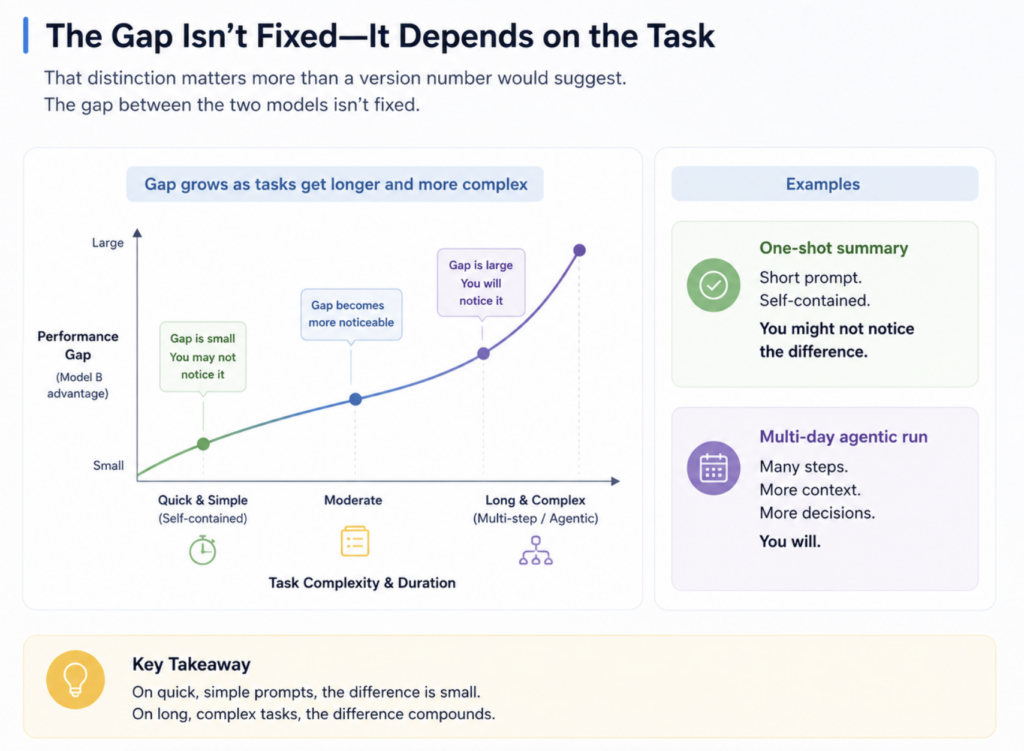
So the upgrade question isn’t “which model scores higher.” Nearly any frontier model scores well now. The real question is whether your workload lives in the zone where Fable 5’s lead shows up.
Four things decide that: capability ceiling, cost, operational predictability, and how each model handles safety routing. We’ll take them in order.
Claude Fable 5 vs Opus 4.8: The Head-to-Head
Here’s how the two models line up on the specs that drive the decision.
| Feature | Claude Fable 5 | Claude Opus 4.8 |
|---|---|---|
| Tier | Mythos-class | Opus-class |
| Release date | June 9, 2026 | May 28, 2026 |
| Pricing (input / output) | $10 / $50 per MTok | $5 / $25 per MTok |
| SWE-Bench Pro | ~80.3% | 69.2% |
| Max context window | 1M tokens | 1M tokens |
| Safety behavior | Auto-routes high-risk queries to Opus 4.8 | Direct execution |
| Best fit | Long-horizon agents, senior-scientist research | Cost-sensitive production, everyday reasoning |
Two numbers frame the whole choice. Fable 5 leads on the hardest coding benchmark by roughly ten points. It also costs twice as much per token. Everything below is about whether that capability gap earns back the price gap for your specific tasks.
Where Claude Fable 5 Pulls Clearly Ahead
The upgrade earns its cost in one environment above all others: long, autonomous, multi-step work.
Fable 5 is built to operate over days, not turns. It can take a broad goal, break it into sub-tasks on its own, run through them, and correct its own mistakes along the way without a human re-prompting at each step. That’s a different mode of work than most teams are used to.
It also holds up on dense synthesis. When a task involves reading across many documents, interpreting nested charts and tables, or reasoning over a large codebase, Fable 5 pulls ahead of Opus 4.8 by a meaningful margin.
The efficiency data backs this up. On complex spreadsheet suites and multi-step reasoning tasks, Fable 5 shows a 25 to 30 percent gain in execution efficiency over Opus 4.8, and it tends to finish in fewer turns.
That last point is easy to miss. Fewer turns at a higher success rate can offset part of the higher per-token price on exactly the tasks where Fable 5 belongs.
Where Opus 4.8 Is Still the Smarter Default
For a large share of real production work, staying on Opus 4.8 is the rational call.
Start with cost. At half the price of Fable 5, Opus 4.8 is far more economical for high-volume, routine, or latency-sensitive work. If your pipeline is running frequent, fairly standard calls, doubling the token bill for a capability edge you rarely trigger is hard to justify.
Then there’s predictability, which is where the tiers genuinely diverge. Fable 5 ships with an aggressive safety classifier that reroutes flagged queries, specifically in cybersecurity, biology, and chemistry, to Opus 4.8 instead. Anthropic says this triggers in under 5 percent of sessions, and you aren’t charged Fable prices for a rerouted request. Still, inside an automated pipeline, a mid-run switch in the underlying model can introduce latency or a shift in behavior you didn’t plan for.
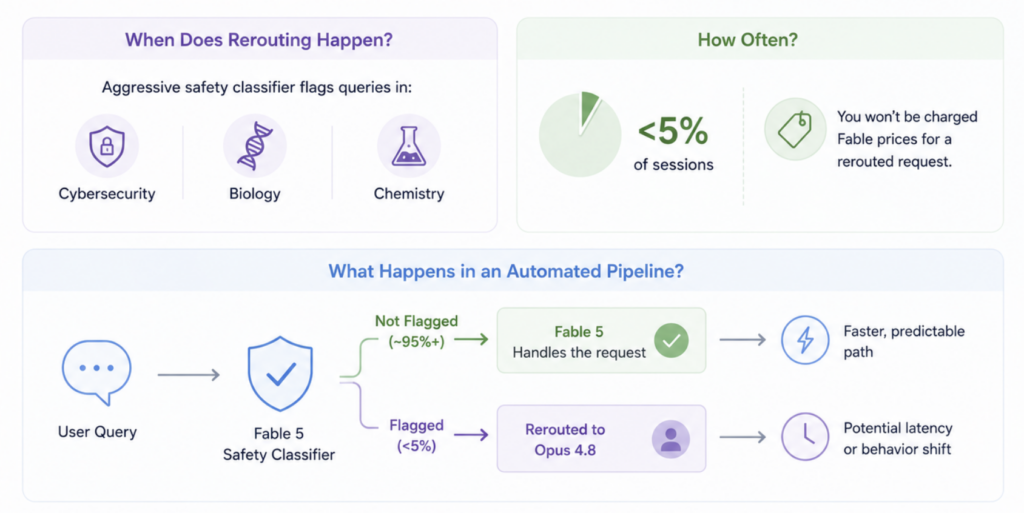
Opus 4.8 executes directly. No reroute, no fallback layer.
That matters most where reproducibility is non-negotiable: audit-grade tooling, CI/CD pipelines, and any workflow where the same input needs to produce a stable output every time. Teams running those report that Opus 4.8’s determinism is worth more to them than Fable 5’s ceiling.
Sometimes the reliable model is the better model. This is one of those times.
The Upgrade Question Most Brands Are Asking Wrong
Here’s the factor the spec sheets leave out.
If you’re a marketing or brand team, the internal question of which Claude model you run is far less important than an external one: how the AI systems your customers use decide whether to mention your brand at all. And that answer changes every time a frontier model ships.
Different models use different logic to evaluate and cite sources. When a platform swaps in a new frontier model, the weights that determine which sources get cited get reset. Content that ranked well in AI answers under one model can quietly drop under the next. The launch of Fable 5 is exactly that kind of reset.
This is the decoupling most teams haven’t priced in. Visibility inside AI-generated answers is drifting away from traditional search ranking. You can hold your Google position and still lose “mention share” inside a synthesized ChatGPT or Perplexity answer, because the newer model’s reasoning favors different structural or authority signals. Adobe’s research on AI search behavior across customer journeys points at the same shift, and Search Engine Land has mapped how SEO priorities are moving as AI-driven discovery grows.
The practical problem: you can’t manage what you can’t see. Getting your brand recommended by AI now depends on knowing, in near real time, how each model treats you.
That’s a monitoring job, and it’s what Topify is built for. Its Comprehensive GEO Analytics tracks brand mentions, citation frequency, sentiment, and competitor position across ChatGPT, Gemini, Perplexity, and other major platforms. When a model transition reshuffles who gets cited, you see the movement instead of guessing at it. The internal model you run is your choice. How AI answers represent your brand is the part you need eyes on regardless.
Should You Upgrade? A Scenario-Based Call
Skip the blanket recommendation. Match the model to the workload.
Upgrade to Claude Fable 5 if your core objective is running long-horizon autonomous agents: automated R&D, multi-stage code development, or deep-dive intelligence gathering. In those cases the performance gain typically offsets the 2x cost.
Stay on Opus 4.8 if you need deterministic outputs, operate under tight cost constraints, or run high-frequency API calls that are sensitive to the reroute latency Fable 5’s classifiers can introduce. For standard content generation and predictable pipelines, Opus 4.8 remains the more viable pick.
Most enterprises are landing somewhere in between. The pattern taking hold is a routing strategy: send routine tasks through Opus 4.8 or Sonnet, and reserve Fable 5 for the complex, mission-critical reasoning blocks that actually need it. You get the ceiling where it counts and the cheaper rate everywhere else.
Conclusion
The Fable 5 versus Opus 4.8 decision comes down to task shape, not leaderboard position. Fable 5 wins on long, autonomous, high-complexity work and charges double for it. Opus 4.8 wins on cost, stability, and predictable execution, which is most day-to-day production. A tiered routing setup lets you stop choosing and use each where it’s strongest.
Whichever you run internally, remember the part that lives outside your infrastructure. Every model release rewrites how AI answers cite and recommend brands. If you want to get started tracking that movement before it costs you visibility, that’s the layer to watch.
FAQ
Is Claude Fable 5 worth the price over Opus 4.8?
For autonomous, complex agentic tasks, the performance gains often offset the 2x cost increase. For standard content generation or predictable production pipelines, the added cost and the reroute latency make Opus 4.8 the more practical choice.
Why do some Claude Fable 5 requests get answered by Opus 4.8?
Fable 5 runs a safety classifier that monitors for high-risk domains, mainly cybersecurity, biology, and chemistry. When a prompt crosses those thresholds, the system reroutes it to Opus 4.8 for stricter evaluation. You aren’t billed Fable prices for a rerouted request.
Does upgrading my model change how AI search engines mention my brand?
Yes. Different models evaluate sources differently, so a platform’s move to a new frontier model often reshuffles the hierarchy of trusted sources. Your brand’s citation frequency in AI answers can rise or fall on that transition alone.
Can I use both models together?
Yes, and most teams should. A tiered setup routes routine queries to lower-cost, faster models and sends only the most complex reasoning tasks to Fable 5.

