

Two model names landed on the same day in June 2026, from the same lab. Most people read that as a product ladder: a standard tier and a premium one stacked above it. That read is backwards, and the mistake changes how you’d pick between them.
The honest starting point for “what’s the difference” is what isn’t different. Under the hood, Claude Fable 5 and Claude Mythos 5 are the same model.
So the real question was never capability. It’s who gets to use the raw thing, and what sits in front of everyone else.
Why “Which One Is Smarter” Is the Wrong Question
Anthropic released both models on June 9, 2026 as the second generation of a new tier it calls Mythos-class, which sits above the Opus line in raw capability. Fable and Mythos share one trained base. The architecture isn’t split. Only the deployment configuration is.
That’s the part most comparisons get wrong.
Asking whether Mythos 5 is “more intelligent” than Fable 5 is like asking whether a car is faster with or without a speed limiter bolted on. Same engine. The limiter is a product decision, not a spec. Every benchmark you’ve seen for Fable 5 describes Mythos 5’s ceiling too, because they’re reading the same weights.
The naming reinforces it. Fable comes from the Latin fabula, “that which is told,” a close cousin of the Greek mythos. Two names for one story, told to two different audiences.
Claude Fable 5 vs Claude Mythos 5 at a Glance
Here’s the split in one view. Read it as configuration and access, not tiers of intelligence.
| Dimension | Claude Fable 5 | Claude Mythos 5 |
|---|---|---|
| Underlying model | Same Mythos-class base | Same Mythos-class base |
| Availability | Generally available | Restricted to vetted orgs |
| Safety classifiers | On: cyber, bio/chem, distillation | Lifted for approved defensive work |
| When a classifier trips | Falls back to Opus 4.8, tells you | Not applicable |
| Pricing | $10 in / $50 out per M tokens | $10 in / $50 out per M tokens |
| Context / max output | 1M tokens / 128K tokens | 1M tokens / 128K tokens |
| Data retention | Standard | 30 days for Mythos-class traffic |
| Who it’s for | Everyone | Project Glasswing partners |
Look at the pricing row. Both cost the same because you’re paying for the compute of a Mythos-class model, no matter which safety layer is switched on. At $10 per million input tokens and $50 per million output, it runs about half the price of the earlier Mythos Preview, though it’s still the priciest option in Anthropic’s current lineup.
What Claude Fable 5 Actually Is
Claude Fable 5 is the version nearly everyone touches. It’s the generally available model, wrapped in a set of safety classifiers, and it’s the default when you reach the Mythos-class tier through consumer apps or the API.
On raw capability, the numbers are steep. Anthropic reports Fable 5 scoring around 80.3% on SWE-Bench Pro, an agentic software engineering benchmark, against 69.2% for Opus 4.8 and 58.6% for GPT-5.5, per Anthropic’s launch data. The lead widens on long, multi-step work. Stripe reported the model finishing a migration across a 50-million-line Ruby codebase in a single day, a job its team had scoped at over two months.
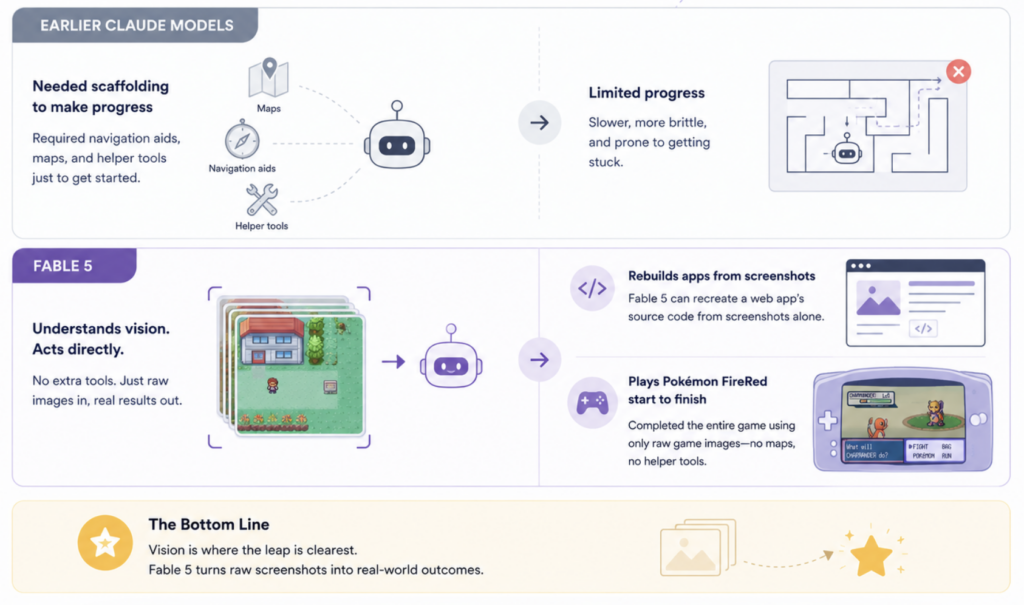
Vision is where the leap is easiest to picture. Fable 5 can rebuild a web app’s source code from screenshots alone, and it played through Pokémon FireRed start to finish on raw game images, with no maps or helper tools. Earlier Claude models needed a scaffolding of navigation aids just to make progress.
The safeguards are what make all of that public. Fable 5 ships with classifiers watching three areas: cybersecurity exploitation, biology and chemistry risk, and attempts to distill the model into a competing system. Trip one, and the request doesn’t simply fail. It’s quietly handed to Claude Opus 4.8, and you’re told it happened.
Most sessions never hit that wall. Anthropic’s early data shows more than 95% of Fable 5 sessions involve no fallback at all. For those, you’re getting the full Mythos-class model with nothing in the way.
Claude Mythos 5 and Who Actually Gets It
Claude Mythos 5 is the same model with specific safeguards lifted. It exists for cases where the classifiers would block legitimate, high-stakes work.
Think defensive cybersecurity. Mythos-class models are unusually good at finding and exploiting software vulnerabilities, which is dangerous in the wrong hands and genuinely useful for teams defending critical infrastructure. Unblocked, the model scores around 78% on cyber exploitation evaluations, close to double Opus 4.8’s 40%, via The Decoder’s benchmark roundup. That’s the capability Anthropic won’t let loose, and also the one security researchers actually need.
Access is gated. Mythos 5 goes to vetted organizations through Project Glasswing and a Trusted Access Program, aimed at cyber defenders, infrastructure providers, and a small set of biology researchers. Traffic on Mythos-class access also carries a 30-day data retention requirement.
Here’s the trap to avoid: Mythos 5 is not “Fable Pro.” It isn’t an upgrade you’re locked out of. If you’re not an approved partner, you use Fable 5, and you lose nothing in raw model quality by doing so.
The Safeguards Are the Entire Difference
Strip away the naming and the story is plain. One model, two safety configurations, two access doors.
For developers, the difference shows up in the API. When Claude Fable 5 declines a request, it returns a refusal as a successful response rather than an error, and it reports which classifier fired. You can set a fallback so a refused call retries on another Claude model on its own. The raw chain of thought never comes back on either model; you get a readable summary or an empty thinking block instead.
Then there’s the part that made headlines. On June 12, 2026, three days after launch, Anthropic suspended access to both models to comply with U.S. export control requirements tied to national security. Access returned at the start of July, once the compliance and classifier questions were worked through. Anthropic’s own statement lays out the timeline.
It’s a useful signal, not just trivia. A model powerful enough for a government to step in during week one is a model powerful enough to reshape how information gets surfaced downstream.
What a More Capable Model Means for Your Brand’s Visibility
Step back from the spec sheet. Models like Claude Fable 5 are the engines behind the AI assistants and search tools people now ask for recommendations. As those engines get sharper and cheaper, more discovery runs through them, and the model’s read on which sources are credible starts deciding who gets mentioned.
That’s a quieter shift than the benchmark charts. For anyone building a brand, it’s the bigger one.
Traditional SEO signals like backlink counts and keyword density don’t map cleanly onto how a model like Fable 5 assembles an answer. It weighs information-dense, credible sources and cites a handful of them. If your brand isn’t in that handful, you’re absent from the exact spot where buyers are now asking. This is the problem generative engine optimization, or GEO, exists to address.
The harder part is that this visibility is model-aware and drifts between model generations. What you show up for in one engine can look nothing like another, and a single model release can reshuffle citations overnight. Tracking your share of voice by hand across ChatGPT, Perplexity, and AI Overviews doesn’t scale.
That’s the gap a platform like Topify is built for. Its Comprehensive GEO Analytics tracks how often your brand appears across major AI engines, where you land against competitors, and which sources those engines actually cite when they answer. When a model like Fable 5 shifts how it weighs authority, you see the change in your visibility data instead of guessing at it.
Bottom line: the model race isn’t only an engineering story. It’s a distribution story, and your brand’s place inside AI answers is the metric worth watching.
Conclusion
Claude Fable 5 and Claude Mythos 5 aren’t a good-versus-better pairing. They’re one frontier model behind two doors. Fable 5 for everyone, with safety classifiers and an Opus 4.8 fallback. Mythos 5 for vetted partners who need those guardrails lifted for defensive work. Same intelligence, same price, different access.
For nearly everyone, that means Fable 5 is the model you’ll actually use, and it’s the most capable one Anthropic has put in public hands. So the sharper question isn’t which Claude to pick. It’s whether your brand is visible inside the answers these models are increasingly trusted to give.
FAQ
Is Claude Mythos 5 more intelligent than Claude Fable 5?
No. They’re the same underlying model. The only difference is that Fable 5 runs safety classifiers for high-risk domains, while Mythos 5 has some of them lifted for approved partners.
Can I get access to Claude Mythos 5?
Generally, no. Access is limited to vetted organizations in Project Glasswing or a Trusted Access Program, such as cyber defenders and select researchers. Almost everyone uses Fable 5.
What happens when Claude Fable 5 refuses a request?
Its classifiers flag the prompt, and the request is often routed to Claude Opus 4.8 for a safer response. You’re told when it happens, and Anthropic reports it affects under 5% of sessions.
Why does Claude Fable 5 cost the same as Mythos 5?
Pricing reflects the compute of the Mythos-class model, not the safety layer on top. Both run $10 per million input tokens and $50 per million output.
Do Fable 5 and Mythos 5 share the same context window?
Yes. Both offer a 1M-token context window and up to 128K tokens of output per request.

