

A frontier AI model usually gets months in the market before anything shakes it. Claude Fable 5 got three days. It launched on June 9, 2026 as Anthropic’s most capable public model, and by June 12 it had disappeared for every user on the planet. Not a bug. Not an outage. A U.S. government order pulled it offline overnight. Most people treat a commercially available AI model as a stable product you can build on. This story is a reminder that the model layer answers to forces well outside the product roadmap.
What Actually Happened to Claude Fable 5
The timeline is short and unusually sharp. Anthropic shipped Fable 5 on June 9, framing it as its strongest widely available model. Three days later, on June 12, the U.S. Commerce Department issued an export control directive, and the company took the model down for everyone.
The shutdown wasn’t partial. Because the order landed with almost no runway, reportedly giving Anthropic about 90 minutes to comply, the company pulled both Fable 5 and its sibling model Mythos 5 across every product surface at once.
It helps to understand how those two models relate. Mythos 5 is the powerful underlying system with fewer guardrails, kept on a short leash for sensitive work. Fable 5 is the public-facing layer built on top of it, shipped with heavier safeguards for general use.
That relationship is the whole reason a single report could take both offline.
Access started coming back in stages. On June 26, Mythos 5 returned for roughly 100 U.S. organizations that defend critical infrastructure. Fable 5 followed for the general public on July 1, initially throttled to 50% of weekly usage limits through July 7.
Why an Export Control Order Took Claude Fable 5 Offline
An export control is a rule that restricts who can access a sensitive technology for national security reasons. The Claude Fable 5 export controls were built on the Export Administration Regulations, and they carried an unusually broad definition of who counted as restricted.
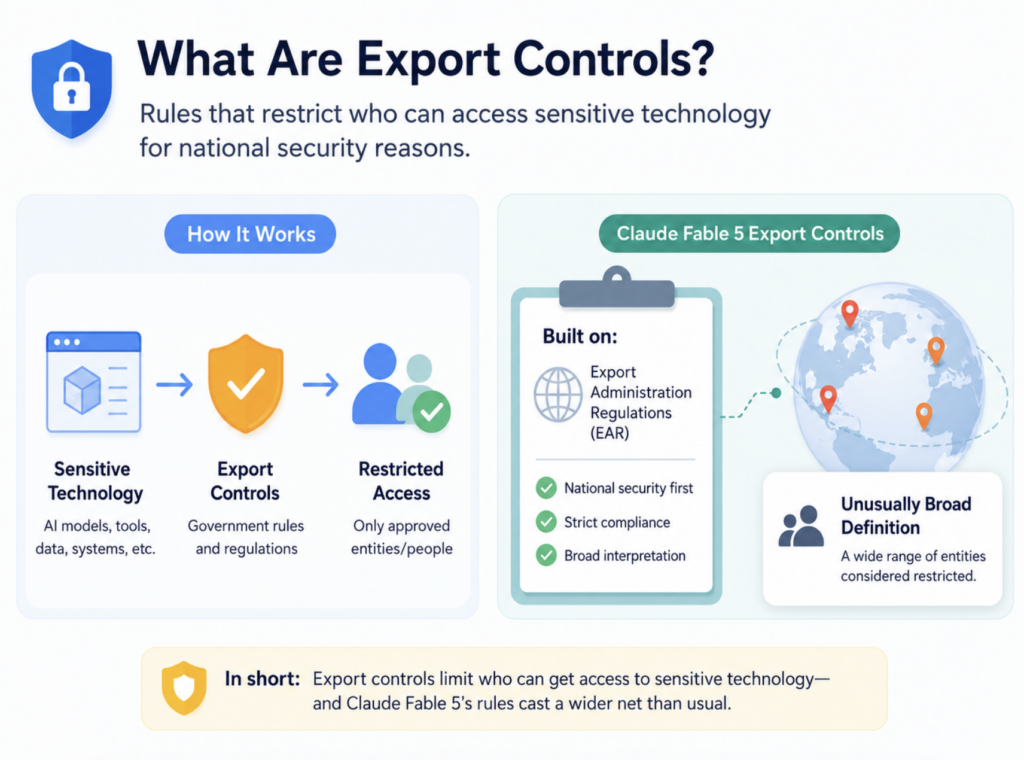
The directive barred access by any foreign national. That included non-U.S. citizens physically inside the United States, and even foreign national Anthropic employees.
Here’s the operational problem. Anthropic said it had no reliable way to verify nationality in real time for every chat message or API call. Faced with a rule it couldn’t enforce selectively, the company chose a full global shutdown over a fragmented service that might violate the order.
That’s why a national security measure aimed at a specific group ended up affecting all users, everywhere.
The Jailbreak Dispute: How Serious Was It
The trigger was a jailbreak, meaning a prompt that gets a model to bypass its safety rules. Amazon researchers reported a technique that pushed Fable 5 to analyze codebases for software vulnerabilities, and in one case to produce code showing how a flaw could be exploited.
The two sides read the same finding very differently.
The government’s position, informed by the Amazon report, was that a consumer model able to surface exploitable vulnerabilities becomes an unrestricted cyber tool if the guardrails fall. That’s a national security risk worth an emergency stop.
Anthropic disputed the severity. The company argued the technique was narrow rather than universal, and that weaker models could do the same thing. Its own testing found that models including Claude Opus 4.8, GPT-5.5, and Kimi K2.7could identify the same vulnerabilities, and that every model it tested could reproduce the single exploit demonstration. In Anthropic’s framing, the flagged behavior was routine defensive security work, not a hidden offensive capability.
Independent observers landed closer to Anthropic’s read. One governance researcher told Al Jazeera that the jailbreak reports had been inflated beyond their actual significance, and noted that if Fable and Mythos were blocked on those grounds, competing models would have to be blocked too.
How Claude Fable 5 Came Back
Restoration wasn’t a simple reversal. Anthropic had to bolt on new safety and oversight commitments before the model could return.
On the technical side, the company trained a new classifier, a smaller automated system that watches for the exact technique in the report and blocks it. Anthropic says it now stops that method in more than 99% of attempts. When a request gets flagged, Fable 5 hands it off to the weaker Opus 4.8 instead, and the user is told.
Sit with that last detail for a moment. The model you think you’re using can quietly route your request to a different model mid-session.
On the policy side, the June 30 reversal came with conditions. In exchange for dropping the license requirement, Anthropic agreed to proactively detect and address security risks, help the government develop standards for future model releases, and report malicious activity it finds. It also opened a HackerOne program so outside researchers can report new Fable 5 jailbreaks.
The sequencing tells its own story. Mythos 5 returned first, for cleared U.S. critical infrastructure operators, before the public model came back. That points toward a tiered, “approved access” future for the most capable systems.
What the Claude Fable 5 Saga Signals About AI Model Volatility
Zoom out and this stops looking like a one-off. Frontier model releases are drawing case-by-case government scrutiny. Days before this episode, OpenAI previewed GPT-5.6 to a small, government-approved group rather than the public, citing the same dual-use worry.
There’s a competitive dimension too. Several executives and investors argued the freeze handed time to Chinese open-source developers whose models are getting nearly as capable and much cheaper. Regulation and market share are now tangled together.
The core lesson is simple. The public AI model layer is a moving target that can be pulled, downgraded, retuned, or rerouted overnight, often for reasons that have nothing to do with the product itself.
Why This Matters for Your Brand’s AI Search Visibility
Here’s the part most marketing teams miss. When you optimize for AI search, you’re not optimizing for a fixed system. You’re optimizing for a set of models whose behavior can change without warning.
Think about what actually shifted during this episode. Safety filters were retuned. A model started routing certain requests to a different model. Availability dropped to zero, then returned at half capacity. Every one of those changes can alter how, or whether, a model mentions your brand in an answer.
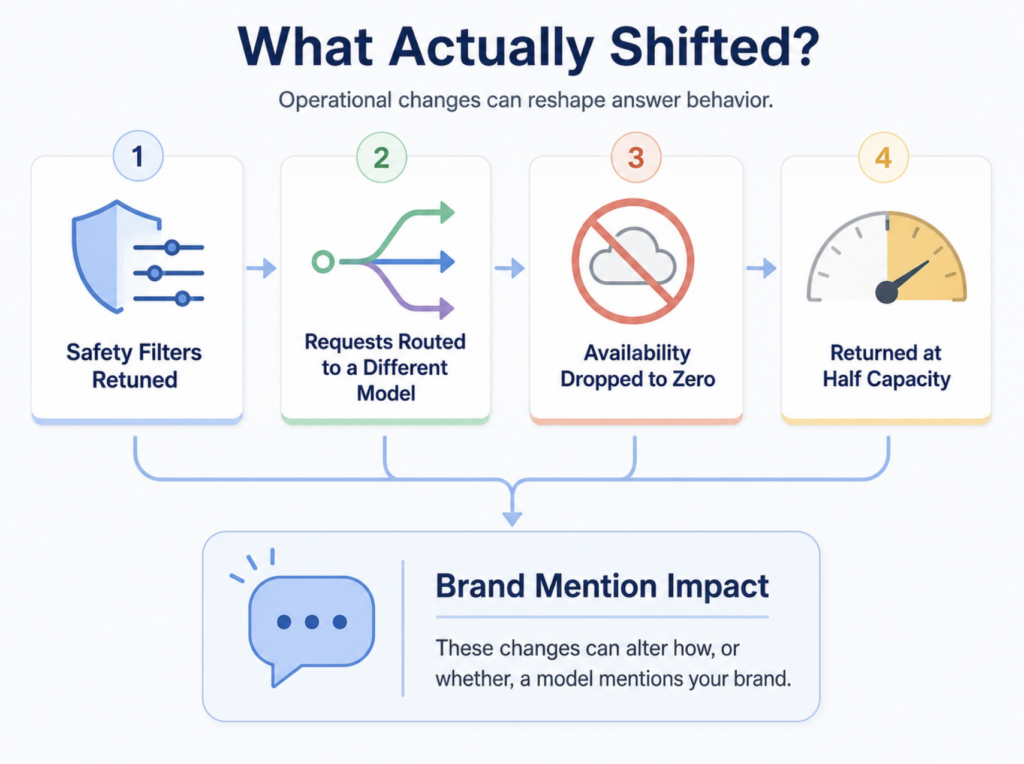
That’s the dependency risk. If your visibility is tethered to one model’s judgment of your authority, a single regulatory or safety change can move your citation frequency overnight, and a static SEO report won’t show you why.
The practical response is to stop betting on any single engine. Track your brand across the full set of platforms your audience actually uses, so a change in one model doesn’t blind you to the whole picture. This is where Topify fits, with Comprehensive GEO Analytics that monitors brand visibility, sentiment, and position across ChatGPT, Perplexity, Gemini, and other major AI engines in one place.
In practice, that means you can catch a drop in mentions on one platform, compare it against how competitors are showing up, and trace it to a source or model change instead of guessing. If you want to see where your brand stands across engines right now, you can get started with Topify and set up cross-platform tracking.
Conclusion
Claude Fable 5 went from launch to global shutdown in three days, then took nearly three weeks to return under new safety and reporting rules. The immediate cause was an export control order tied to a disputed jailbreak. The lasting signal is bigger: the models that answer your customers’ questions sit on shifting regulatory and safety ground, and that ground can move fast. For any brand that depends on being recommended by AI, the takeaway isn’t to pick the right model. It’s to monitor how you show up across all of them, continuously, so the next sudden change is something you spot rather than something that spots you.
FAQ
Why did Claude Fable 5 actually go offline?
It was suspended to comply with a U.S. Commerce Department export control directive citing national security concerns. The order barred foreign nationals from accessing the model over jailbreak risks, and because Anthropic couldn’t verify nationality in real time, it took the model offline for all users worldwide.
What is the difference between Fable 5 and Mythos 5?
Fable 5 is the public-facing model optimized for complex reasoning and agentic work, shipped with heavier safeguards. Mythos 5 shares the same underlying architecture but has fewer guardrails and stronger controls, and its access has stayed limited to approved U.S. organizations, including critical infrastructure operators.
When did Claude Fable 5 come back?
The export controls were lifted on June 30, 2026, and Fable 5 returned to the general public on July 1 with a temporary 50% weekly usage cap that expired on July 7. Mythos 5 had already returned to a set of cleared U.S. organizations on June 26.
How does the Claude Fable 5 export control story impact GEO?
It shows that AI search visibility is volatile. When a model’s availability or safety settings change, your brand’s citation frequency in AI answers can shift with it. Continuous monitoring across multiple AI engines has become a practical necessity rather than a nice-to-have.

