

Your marketing team spent the last two quarters building out an AI visibility program. You’ve got dashboards tracking mentions across ChatGPT, Perplexity, and Gemini, and the numbers look healthy. Then someone on the team asks Claude Fable 5 for a recommendation in your category, and your brand doesn’t come up once. The sources it pulls from aren’t the ones you’ve been optimizing for. What worked everywhere else somehow doesn’t move the needle here, and nobody can tell you why.
That gap isn’t a fluke. It’s how Claude Fable 5 works.
Claude Fable 5 Isn’t Citing What You Think It Is
Anthropic released Claude Fable 5 on June 9, 2026, positioned it as a Mythos-class model for long-horizon reasoning, and after a brief export-control suspension, restored global access on July 1. Most of the launch coverage focused on coding and agentic autonomy. The part that matters for brand visibility got almost no attention: Claude sources information differently from every other major model.
Here’s the thing most AI visibility programs miss. They treat “AI search” as one channel with one optimization playbook. The data says that assumption is wrong.
Yext Research analyzed 17.2 million AI citations across four major models in Q4 2025 and found that each engine draws from a distinct source pool. Claude was the clear outlier. Across every sector studied, it cited user-generated content at 2 to 4 times the rate of other models, yet it also leaned harder on analytical, independently verified publications for anything that wasn’t a local or subjective query. That combination doesn’t exist anywhere else in the lineup.
If your visibility strategy is built for the average across all AI platforms, you’re optimizing for a target that no single model actually represents.
How Claude Fable 5 Picks Its Sources
Claude’s citation behavior traces back to its Constitutional AI framework, which weights helpfulness, harmlessness, and honesty. In practice, that translates into visible skepticism toward commercially biased content, including a brand’s own marketing pages.
Ask Claude Fable 5 how an enterprise tool actually performs, and it tends to route around the vendor’s homepage. It pulls from third-party reviews, independent analysis, and editorial coverage instead.
The publications it favors tell a clear story. The 5W AI Platform Citation Source Index 2026 found Claude leaning toward The New York Times, The Atlantic, The New Yorker, and The Economist. Depth-oriented, analytical sources. Not the fast-churn news cycle that other models chase.
Timing works differently too. Muck Rack’s analysis of how Claude cites media found a citation sweet spot roughly in the past 10 weeks, and Claude is about three times more likely than ChatGPT to cite content from two to four weeks ago. ChatGPT rewards immediate visibility and drops off sharply after about a week. Claude rewards sustained relevance.
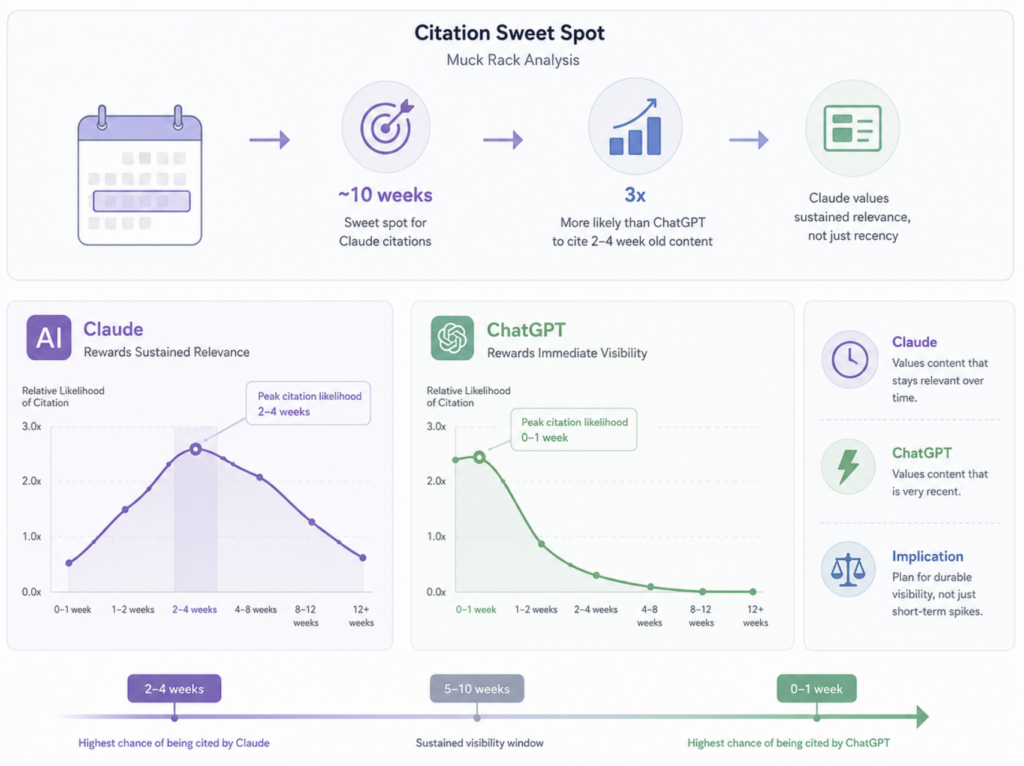
That’s the difference between a news spike and a slow drumbeat. Claude listens to the drumbeat.
Claude Fable 5 vs. ChatGPT vs. Perplexity: Citation Behavior Compared
The source preferences split cleanly once you line them up. What earns a citation in one engine can be invisible in another.
| Platform | Primary source lean | Citation trait |
|---|---|---|
| Claude Fable 5 | Analytical media, third-party validation, reviews | Skeptical of commercial pages, rewards evergreen depth |
| ChatGPT | Wikipedia (47.9% of top citations) | Broad assistant, recency-heavy, sharp drop-off |
| Perplexity | Reddit (46.7% relative share) | Real-time, social-proof driven |
| Gemini | First-party and brand-controlled content | Behaves closest to traditional search authority |
The fragmentation runs deeper than preference. Yext found that only about 11% of cited domains appear across multiple engines. The other 89% are platform-specific.
Read that number again. Nearly nine out of ten sources feeding AI answers are unique to a single model. A page that earns you citations in ChatGPT has roughly a one-in-nine chance of doing the same in Claude.
There’s no universal AI visibility playbook. There are four separate ones, and they barely overlap.
Why Most Brands Are Invisible in Claude Fable 5 Answers
When a brand doesn’t show up in Claude, it usually comes down to three structural problems, not brand size.
The first is technical. Claude reads content through three crawlers, ClaudeBot, Claude-User, and Claude-SearchBot, and a single misconfigured line in robots.txt can silently block all of them. If those bots aren’t getting 200 responses in your server logs, your content is invisible to Claude’s retrieval layer no matter how good it is.
The second is corroboration. Claude’s logic leans on multiple independent third-party signals before it trusts a source. A brand that only publishes on its own commercial domain gives Claude nothing to cross-check, so the model treats that content as potential marketing rather than objective evidence.
The third is a strategy mismatch. Omnia’s tracking found Claude cited Reddit zero times across nearly 500,000 citations, while ChatGPT cited it more than 100,000 times in the same window.
Forum seeding and community UGC are real levers for ChatGPT. For Claude, they produce almost no citation signal. If your AI visibility plan is built around Reddit threads, you’ve built it for the wrong model.
How to Track Claude Fable 5 Citations at Scale
You can’t fix what you can’t see, and Claude makes manual checking especially unreliable. Its answers vary even for identical prompts, so a single lookup tells you almost nothing about your real citation presence.
Tracking Claude properly means measuring four things over time: how often your brand appears across a fixed prompt set, whether Claude cites your own domain or talks about you secondhand, the sentiment of what it says, and how your mention share compares to competitors in the same answer.
This is where Topify fits into a Claude-specific workflow. Its Source Analysis feature reverse-engineers the exact domains and URLs a model cites, so you can see whether your brand or a competitor dominates the references that shape answers in your category.
Consider a common scenario. One morning your dashboard flags a divergence: visibility in ChatGPT is holding steady, but your recommendation position in Claude Fable 5 slipped out of the top three overnight. Source Analysis traces it to a single independent review thread that Claude weights heavily, where a recent complaint spread across the discussion. Now you know exactly where the drop came from and why it moved one model but not the other.
Topify’s Visibility Tracking runs the same prompt set across ChatGPT, Gemini, Perplexity, and Claude, which is the only way to catch the single-platform blind spots the Yext data exposed. Its Competitor Monitoring surfaces the prompts where a rival gets cited in Claude and you don’t, turning an invisible gap into a specific list of fixes.
Track it across models. Diagnose the source. Close the gap.
What Content Actually Gets Cited by Claude Fable 5
Optimizing for Claude means writing for an editor that checks its sources. The tactics that work reflect what Claude rewards, not what ranks on Google.
Structure comes first. Content that leads with a clear definition, backs it with numerical facts, adds comparison, and lays out procedural steps gives Claude clean, extractable passages to lift. Vague, promotional prose gives it nothing to work with.
Durability matters more here than anywhere else. Given Claude’s roughly 10-week citation window, a single content moment fades fast. Sustained, detailed coverage of a narrow topic builds a signal that keeps earning citations long after a news-cycle spike would have died.
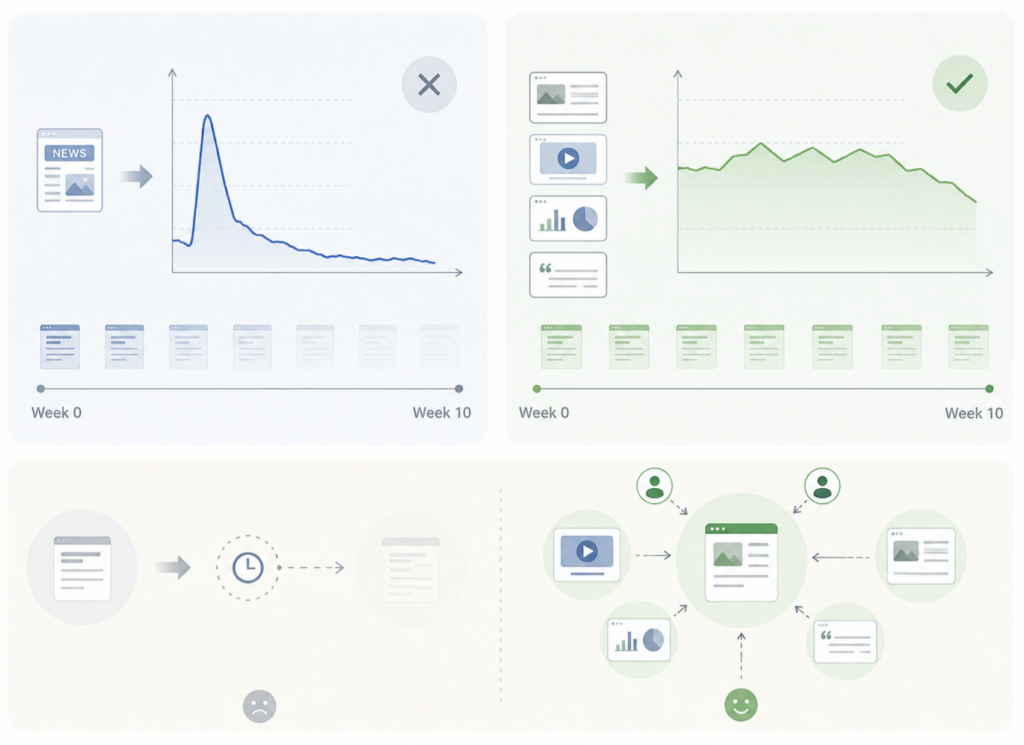
Then there’s third-party validation. Because Claude cross-checks, the highest-leverage moves happen off your own domain: independent reviews, industry reports, and analytical coverage from outlets Claude already trusts.
One practical redirect on social. Omnia’s data showed LinkedIn accounts for 43.1% of social citations in Claude’s ecosystem, while Reddit sits near zero. If you’re spending effort on community channels for Claude, a content-rich LinkedIn presence returns far more than forum activity.
Conclusion
Claude Fable 5 doesn’t play by the rules the rest of the AI search field follows. It rewards analytical depth, independent corroboration, and evergreen relevance, and it quietly ignores much of what earns citations in ChatGPT or Perplexity. The brands that stay visible are the ones that stopped treating AI as one channel and started measuring each model on its own terms.
Start with visibility. Run a fixed prompt set across every engine, find out which sources Claude actually cites in your category, and build from the gaps. Get started with Topify to see where your brand stands in Claude Fable 5 answers before your competitors close the door.
FAQ
Q: Does Claude Fable 5 cite Reddit?
A: Almost never. Omnia’s tracking recorded zero Reddit citations across nearly 500,000 Claude citations, compared to more than 100,000 for ChatGPT in the same window. Community and forum content is a strong lever for other models but produces virtually no citation signal in Claude.
Q: What’s the difference between Claude Fable 5 and ChatGPT citation behavior?
A: ChatGPT leans heavily on Wikipedia and recent news, with citations dropping off sharply after about a week. Claude Fable 5 favors analytical publications and third-party validation, and it keeps citing quality content for roughly 10 weeks. Only about 11% of cited domains overlap across the major engines.
Q: How often should I track Claude Fable 5 citations?
A: Monthly is the minimum useful cadence. Claude’s answers vary even for identical prompts, and citation presence shifts as content ages, competitors earn coverage, or retrieval weights change. Consistent tracking across a fixed prompt set is the only way to separate real movement from normal variance.
Q: Can I improve my brand’s visibility in Claude Fable 5 answers?
A: Yes, but the moves differ from standard SEO. Confirm ClaudeBot, Claude-User, and Claude-SearchBot aren’t blocked in robots.txt, build independent third-party coverage Claude can cross-check, structure content with clear definitions and data, and prioritize LinkedIn over Reddit for social signal.

