

You ranked on page one. Your domain authority is 70-something. Your content team shipped 40 blog posts last quarter. Then someone asked Claude for a recommendation in your category, and it listed three competitors.
Not you.
Claude Fable 5, Anthropic’s most capable model to date, doesn’t pull recommendations from the same playbook as Google. It runs a different citation logic entirely, and the brands it favors often aren’t the ones winning traditional search.
Why Claude Fable 5 Changes Who Gets Recommended
Anthropic launched Claude Fable 5 on June 9, 2026 as its first publicly available Mythos-class model. Mythos sits above Opus, the previous flagship. Fable 5 is built for complex, multi-stage knowledge work: deep research, vendor comparisons, analyst-grade analysis. The kind of tasks that B2B buyers increasingly hand to AI assistants instead of Google.
That matters because Claude isn’t a niche product anymore.
As of July 2026, Claude holds roughly 17% of the US mobile chatbot market, up from under 2% at the start of the year. Its share of global generative AI web traffic hit 8.9% by late May 2026, a six-fold increase in six months. For B2B specifically, Anthropic leads the enterprise LLM API market with 40% share, meaning Claude punches well above its consumer numbers in professional research and purchasing workflows.
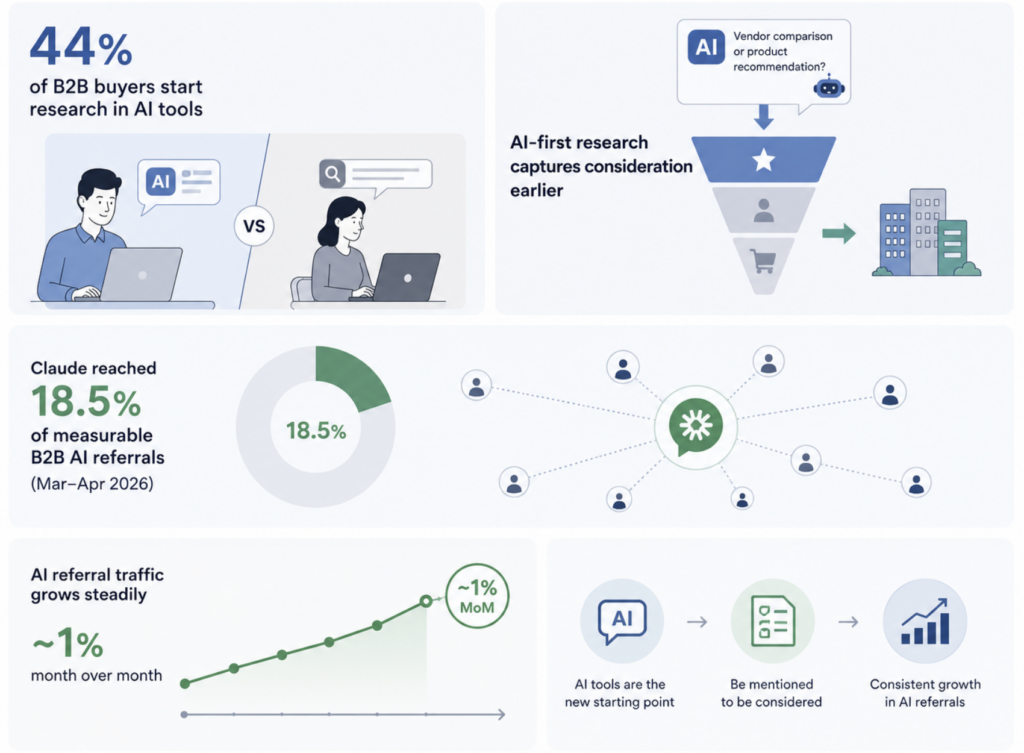
Here’s the thing: 44% of B2B buyers now start their research in AI tools rather than traditional search. When those buyers ask Claude for a vendor comparison or product recommendation, the brands mentioned capture consideration before a Google result even loads. Claude reached 18.5% of measurable B2B AI referrals in March and April 2026, and AI referral traffic overall grows roughly 1% month over month.
If your brand doesn’t appear in those answers, you’re losing deals you’ll never know about.
The “Unrecognized Entity Rule” That Decides Your Claude Fable 5 Visibility
When Claude Fable 5’s system prompt leaked in June 2026, one section stood out for anyone working on GEO. It’s called the Unrecognized Entity Rule, and it governs how Claude decides what to recommend.
The rule is direct: Claude must search the web before answering about any product, brand, or entity it doesn’t already recognize from training data. Partial recognition doesn’t count. If the model isn’t confident it knows your brand, it goes looking. And what it finds on the open web determines whether you get mentioned or skipped entirely.
That creates a two-tier system. Established brands with years of accumulated content across high-authority sources benefit from training data recognition. Newer or less-covered brands depend entirely on what Claude retrieves in real time.
The retrieval behavior itself is highly selective. Research on Claude’s citation patterns shows a “10-week window” for content citation, compared to ChatGPT’s aggressive 1-week breaking-news bias. Claude consistently avoids social forums and commercial marketing pages, favoring analytical, depth-oriented publications. Where ChatGPT leans on Wikipedia for 47.9% of its top-10 citations and Perplexity draws heavily from Reddit, Claude prefers sources like independent industry reports, research publications, and long-form analysis.
That’s a completely different citation paradigm.
The content strategy that works for ChatGPT or Perplexity often fails for Claude. And with cross-platform citation overlap as low as 11%, according to meta-analysis from ZipTie.dev, brands relying on a single-channel AI visibility strategy are likely invisible in Claude’s ecosystem.
Why Your Competitor Shows Up and You Don’t
Claude is the most selective major AI engine in production. An arXiv study of health-related citations found that 97.8% came from established institutions with a median Domain Authority of 92. Claude also has the lowest social citation rate among major AI platforms at just 3.99%, per data from the same research.
Brands typically fail to appear in Claude’s answers for three structural reasons.
Robots.txt misconfiguration. If your server blocks ClaudeBot, Claude-User, or Claude-SearchBot, the model literally can’t see your content. An audit of server logs for Anthropic-specific user agents is one of the simplest technical fixes, yet it’s the one most teams skip.
Lack of independent validation. Claude’s retrieval logic treats first-party commercial content with skepticism. If the only pages mentioning your brand live on your own .com domain, Claude interprets this as potentially biased material rather than an objective source. It needs multiple, independent, third-party signals: industry reports, analyst reviews, expert commentary, earned media coverage.
Community strategy mismatch. Analysis of 500K+ citations via Omnia data shows Claude has near-zero citation rates for Reddit. If your AI visibility strategy relies on social forum seeding, that investment doesn’t translate. Meanwhile, LinkedIn articles outperformed Reddit for social citations in recent datasets, which makes sense given Claude’s preference for professional-grade analysis over crowd-sourced opinion.
And the scale of the fragmentation is worse than most teams expect. Only 11% of cited domains overlap across major AI platforms. A brand fully optimized for ChatGPT visibility can be completely invisible to Claude. Gartner projected a 25% drop in traditional search volume by 2026, which means the traffic you’re losing to AI answers isn’t coming back through Google.
How to Track Whether Claude Fable 5 Mentions Your Brand
The manual approach is straightforward: open Claude, ask 20 buyer-intent prompts in your category, and record whether your brand appears. You’ll get a snapshot. But it’s not scalable. AI citation patterns shift every few weeks, and a one-time check won’t catch when a competitor moves into a position you used to hold.
For marketing teams tracking visibility across multiple AI platforms, Topify stands out by combining Visibility, Sentiment, and Position data into a single view. In practice, that means you can set up 100+ buyer-intent prompts, monitor brand mentions across ChatGPT, Claude, Perplexity, and Gemini, and see exactly where you rank relative to competitors in each platform’s answers.
The Competitor Monitoring feature is where the strategic picture comes together. It auto-detects which brands Claude is recommending in your category and surfaces why they’re getting cited. That often traces back to specific source domains: a competitor published an industry report that Claude picks up, or a third-party analyst wrote a comparison where they’re featured and you’re not.
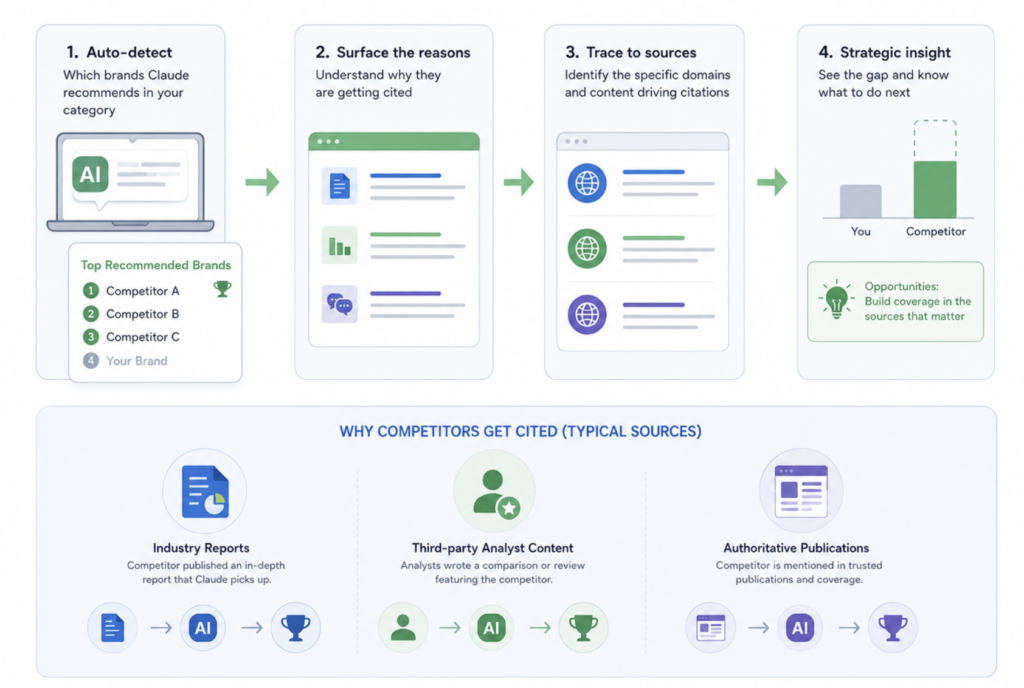
Topify’s Source Analysis takes this further by tracking the exact domains and URLs that AI platforms cite. You can identify which third-party sources are driving your competitor’s visibility and where your brand has a content gap.
The gap between “feeling like your SEO is fine” and “knowing exactly who Claude recommends” is where most brands lose ground without realizing it.
What Gets Claude Fable 5 to Cite Your Brand
The brands that will dominate Claude’s answers won’t be the ones with the biggest content libraries. They’ll be the ones with the most authoritative presence off their own domain. Think of it as PR-Ops rather than SEO: the leaked system prompt confirms that what credible third parties have published about you recently matters more than the copy on your homepage.
Build structural signal. Claude favors content with clear entity definitions, concrete numerical data, comparison tables, and step-by-step procedural depth. If your content reads like a marketing brochure, Claude skips it. If it reads like an independent technical analysis with specific claims and evidence, it gets cited.
Earn third-party validation. Focus on the source types Claude actually pulls from: industry reports, independent review sites like G2, analyst publications, and LinkedIn thought-leadership articles. A single well-placed analyst review carries more weight in Claude’s citation logic than 50 blog posts on your own site.
Audit your technical access. Check your server logs for Claude-SearchBot requests. If the bot is getting blocked or receiving non-200 responses, your content is invisible to Claude’s retrieval layer regardless of its quality. This is a five-minute fix that many teams overlook for months.
Monitor continuously. Claude’s citation patterns aren’t static. A competitor can displace you within weeks by publishing new third-party coverage. Topify lets you track Domain Citation Rate by provider and set alerts when your visibility drops on any platform. The difference between catching a competitor displacement in 48 hours versus discovering it three months later is the difference between a quick fix and a lost pipeline.
Conclusion
Claude Fable 5 isn’t just another model update. It’s a new citation architecture that favors independent authority over marketing spend, analytical depth over viral reach, and consistent third-party presence over first-party volume. With Claude now holding 17% of the US mobile chatbot market and 40% of enterprise API usage, the brands that show up in its answers are capturing buyer consideration that Google rankings alone can’t deliver.
The fix starts with visibility: knowing where you stand, where your competitors stand, and which sources are driving the difference. Get started with Topify to track your brand across Claude and every other major AI platform before the gap widens further.
FAQ
Q: What is Claude Fable 5 and why does it matter for brands?
A: Claude Fable 5 is Anthropic’s most capable publicly released AI model, launched June 9, 2026. It matters because Claude now holds 17% of the US mobile chatbot market and 40% of the enterprise LLM API market. When professionals ask Claude for product recommendations, the brands it mentions capture consideration before traditional search results even load.
Q: How does Claude Fable 5 decide which brands to recommend?
A: Claude uses a two-tier system. For well-known entities in its training data, it draws on existing knowledge. For anything it doesn’t confidently recognize, its Unrecognized Entity Rule forces a live web search. What it finds on high-authority, independent third-party sources determines the recommendation. It avoids social forums and commercial marketing pages.
Q: Can I optimize my brand for Claude’s AI answers?
A: Yes, but the strategy differs from traditional SEO. Claude favors independent third-party validation like analyst reports, industry reviews, and earned media. It also prioritizes structured content with concrete data and technically accessible pages not blocked by robots.txt. Reddit seeding and first-party blog volume carry little weight in Claude’s citation logic.
Q: How do I track my brand’s visibility in Claude Fable 5?
A: Manually, you can ask Claude buyer-intent prompts in your category and record results. For systematic tracking, platforms like Topify monitor brand mentions, sentiment, and position across Claude, ChatGPT, Perplexity, and Gemini, while also tracking which source domains drive citations so you can identify and close visibility gaps.

