

You run a brand query through an AI assistant one week and your company shows up in the answer. You run the same query a month later, after the model behind that assistant gets swapped for a newer one, and you’re gone. Your site didn’t change. The model did.
That’s the part most brands still miss. AI search visibility isn’t a fixed property of your content. It’s a function of whichever model is reading your content on a given day, and those models are changing faster than most marketing teams can track.
Claude Fable 5 is the clearest example yet.
What Claude Fable 5 Actually Is, and Why a Model Jump Matters
Claude Fable 5 is Anthropic’s first Mythos-class model made available to the public. It launched on June 9, 2026, priced at $10 per million input tokens and $50 per million output tokens, roughly double the rate of Opus 4.8.
The specs aren’t the interesting part for marketers. What matters is what “Mythos-class” does to how answers get built. Fable 5 is tuned for long-horizon, multi-step reasoning instead of quick lookups, and the capability gap over the previous flagship is wide.
| Benchmark | Claude Fable 5 | Claude Opus 4.8 |
|---|---|---|
| SWE-Bench Pro | 80.3% | 69.2% |
| FrontierCode | 29.3% | 13.4% |
Those numbers, compiled in benchmark testing published by Truefoundry in 2026, represent an 11.1-point jump on SWE-Bench Pro and a 15.9-point jump on FrontierCode. A model that reasons this differently selects sources differently.
And source selection is where your visibility lives or dies.
How Deeper Reasoning Rewrites What AI Search Surfaces
Older models leaned closer to retrieval: pull the top results, summarize them, move on. Fable 5 moves past straight next-token prediction toward reflection and self-correction. It reads more, compares more, and validates before it commits to an answer.
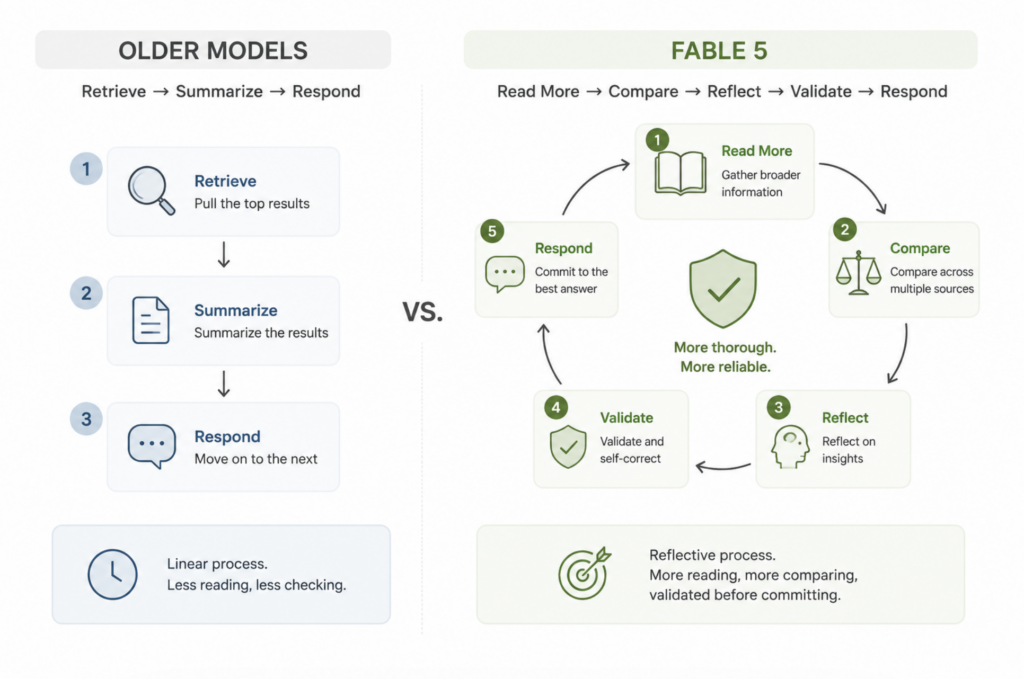
That changes the math on AI search visibility. When a model synthesizes rather than retrieves, ranking number one on a traditional results page no longer guarantees you show up in the AI’s answer.
This gap has a name: ranking–mention separation. Traditional SEO signals like keyword density and backlink volume predict where you land on a search engine results page. They don’t reliably predict whether a reasoning model will cite you.
Here’s the thing. The stronger the model’s reasoning, the wider that gap tends to get. Fable 5 evaluates information density, clarity, and structural authority, not the classic ranking factors that decades of SEO work were built around.
The Source-Selection Shift: Who Gets Cited When Models Get Smarter
Smarter models are pickier about sources. Fable 5’s preference for structurally sound, internally consistent content means it effectively runs its own fact-check before choosing what to reference.
A few patterns separate how reasoning-heavy models pick citations from how retrieval-first models did it:
| What the model rewards | Retrieval-first models | Reasoning models like Fable 5 |
|---|---|---|
| Content density | Keyword coverage | One-shot clarity, high information density |
| Source type | Whatever ranks | Stable, credible references: primary docs, encyclopedic, authoritative |
| Structure | Loosely weighted | Heavy weight on internal consistency |
There’s a concentration effect on top of this. AI citation research indicates that a small set of top domains accounts for a disproportionate share of all citations across many AI surfaces, which makes visibility more winner-takes-most than a search results page ever was.
If your content is fragmented, or takes several clicks to parse, a model optimized for one-shot understanding tends to skip it. Clean structure isn’t a nice-to-have anymore. It’s the entry ticket.
Why One-Time Optimization Fails When Models Change This Fast
Fable 5’s own timeline makes the case better than any argument could. It launched June 9, got suspended three days later over a safeguard issue, and came back on July 1. Nineteen days, one full cycle of appear, vanish, reappear.
Now picture your brand’s visibility riding on top of that. A model update or a safety-policy tweak can reshuffle which sources get cited, with no warning to you.
That’s the obsolescence trap. Optimization tuned to one model version risks going stale the moment that version changes.
Static audits can’t catch this. By the time you rerun a quarterly SEO check, the model behind the answer may already be two iterations ahead. Visibility management has to move from a one-time effort to a continuous, telemetry-based process.
Tracking AI Search Visibility Across Models, Not Just One
The fix isn’t optimizing harder for Fable 5. It’s building a way to see visibility shift in real time, across every model your audience actually uses.
That’s the problem Topify is built for. Topify tracks how AI systems mention and cite brands across ChatGPT, Gemini, Perplexity, Claude, and other major engines, so a change in any single model shows up as a measurable movement rather than a mystery you notice too late.
Its Comprehensive GEO Analytics covers seven metrics: visibility, sentiment, position, volume, mentions, intent, and CVR. Two of them earn their keep the moment a model like Fable 5 lands. Source Analysis reverse-engineers the exact domains an AI cites for your brand keywords, so you can tell whether Fable 5’s stricter source selection dropped you or a competitor. Competitor Benchmarking shows how a model shift changes share of voice, catching the moment a rival starts winning citations you used to own. Together they turn a model swap from an invisible event into a line on a chart.
The point isn’t a one-time report. It’s telemetry.
Where to Start Before the Next Model Lands
You don’t need to predict the next release. You need a baseline you can measure against when it arrives.
Start with three moves. Establish your current visibility across the major AI engines. Lock in the core prompts where your brand should appear. Track which domains those answers cite today. A free GEO score check gives you a starting read without a signup.
When the next Mythos-class model ships, you’ll see the shift in your own numbers instead of hearing about it from a client.
Conclusion
Claude Fable 5 isn’t the endpoint. It’s a signal. Each jump in reasoning capability quietly rewrites which brands AI search chooses to mention and cite, and the jumps are coming faster.
The brands that stay visible won’t be the ones that optimized perfectly for one model. They’ll be the ones watching every model, all the time.
FAQ
Does Claude Fable 5 have its own search engine?
No. Fable 5 is a foundation model, not a search product. Your visibility changes because models like it get integrated into AI assistants and agents that synthesize answers, and those systems decide which sources to cite.
How is Claude Fable 5 different from Opus 4.8 for AI search visibility?
Fable 5 weights deep reasoning and validation more heavily than lighter, faster models. It tends to prefer stable, high-density sources, so it can cite a different set of domains than Opus 4.8 for the same query.
Do I need to re-optimize my content for every new model?
Not for every change. What you need is a baseline visibility measurement that flags when a model update meaningfully moves your citation frequency, so you only act when it actually matters.
How can I track brand mentions in AI answers across models?
Use a cross-model GEO analytics platform that monitors mentions, citations, and share of voice across ChatGPT, Gemini, Perplexity, and Claude, rather than checking each tool by hand.

