
You’ve spent years building citations for local clients. Submitting NAP to Yelp, syncing Google Business Profiles, cleaning up inconsistent listings across dozens of directories. Then a client asks: “Are we showing up when someone asks ChatGPT for recommendations in our category?” And you realize the word “citation” no longer means what it used to.
A Search Atlas study analyzing over 18,000 queries found that only 12% of URLs cited by LLMs appear in Google’s top 10 results. The other 88% come from somewhere else entirely. Citation SEO now operates on two separate tracks, and most teams are only running one.
The Old Citation SEO Playbook: NAP, Directories, and Local Trust
For more than a decade, “citation” in SEO meant one thing: your business Name, Address, and Phone number appearing consistently across the web. Every Yelp listing, every Yellow Pages entry, every industry directory submission was a citation. The logic was straightforward. The more places search engines found your NAP data, the more confident they became that your business was real, active, and located where you claimed.
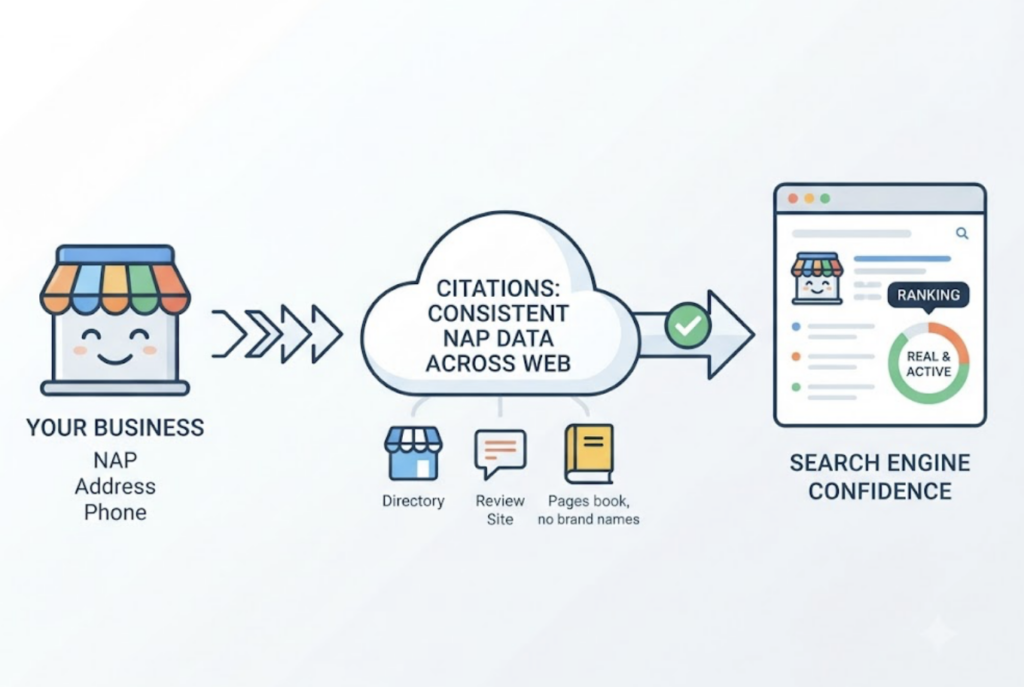
This system still works. According to Moz’s Local Search Ranking Factors report, citation signals account for roughly 7% of local pack ranking weight. That’s down from 13% in 2020, but citations remain a foundational signal for local visibility. Whitespark’s research shows that NAP consistency across platforms improves local rankings by an average of 23%.
None of that has stopped being true. But it’s no longer the full picture.
What “Citation” Means When AI Generates the Answer
When ChatGPT, Perplexity, or Gemini answers a user’s question, it doesn’t return a list of links. It synthesizes an answer and attributes specific claims to specific sources. That attribution is a citation in the AI context, and it works nothing like a directory listing.
There are three levels of brand appearance in AI answers, and they’re not interchangeable. A mention means the AI names your brand without linking to any source. A citation means the AI explicitly references and links to a URL as supporting evidence. A recommendation means the AI suggests your product or service as a solution. Only citations create a verifiable connection between your content and the AI’s answer.
The gap between Google rankings and AI citations is wider than most SEO teams expect. The same Search Atlas study found that ChatGPT has only 8% URL overlap with Google’s top 10. Gemini sits at 6%. Perplexity, because it performs live web retrieval, is higher at 28%. Google’s own AI Overviews pull 76% of citations from its existing top results, but that’s the exception, not the rule.
A top Google ranking and an AI citation are two different achievements.
Why Ranking Well on Google Doesn’t Guarantee AI Citations
Google ranks pages based on backlinks, keyword relevance, and domain authority. AI engines select sources based on a different set of signals: claim specificity, entity authority, content freshness, and how easy it is for the model to extract a usable answer from the page.
Brand search volume is now the strongest predictor of LLM citations, showing a 0.334 correlation in a ConvertMate analysis of 80 million citations. Backlinks, the backbone of traditional SEO, show a weak or neutral relationship with AI citation frequency. Ahrefs’ study of 75,000 brands found that branded web mentions correlate 3x more strongly with AI visibility than backlinks do.
Content freshness has become a citation gatekeeper. AirOps research shows that pages updated within three months are 3x more likely to be cited by AI engines. Pages that sit untouched for six months or longer quietly drop out of the AI citation pool, regardless of how well they rank on Google.
Where your key information sits on the page matters too. According to Growth Memo’s analysis, 44.2% of all LLM citations pull from the first 30% of an article’s text. Another 31.1% come from the middle. Only 24.7% reference the conclusion. Front-loading your most citable claims isn’t a style preference. It’s a structural requirement for AI visibility.
From NAP Consistency to Claim Specificity: What AI Engines Actually Cite
Traditional citation SEO optimized for one thing: making your business information identical everywhere. AI citation SEO optimizes for something different: making your content easy for a model to extract, attribute, and trust.
The unit of value has shifted from the NAP listing to the citation-ready claim. A citation-ready claim has three properties. It’s specific, containing a number, a named entity, or a date. It’s verifiable, meaning a model can cross-reference it against other sources. And it’s attributed, clearly tied to a named author, study, or organization.
Compare these two statements. “AI search is changing how brands get discovered” is a general observation that no model needs to cite because it can generate that sentence on its own. “Only 12% of URLs cited by LLMs rank in Google’s top 10, based on a Search Atlas analysis of 18,377 queries” is a claim a model can lift, attribute, and trust. The second statement earns citations. The first one doesn’t.
Earned media amplifies this effect significantly. Stacker’s 2026 GEO study, which analyzed 87 stories across 30 brands and 8 AI platforms, found that distributing content through third-party publishers produces a median 239% lift in AI search visibility. A separate Muck Rack analysis found that 94% of AI citations come from non-paid, non-brand-owned sources. AI engines trust third-party editorial coverage far more than anything a brand publishes about itself.
How to Track Whether AI Engines Are Citing Your Brand
Old-school citations are auditable with tools like BrightLocal or Moz Local. You enter your business name, and the tool scans directories for NAP inconsistencies. Simple.
AI citations require a fundamentally different tracking approach. You need to monitor specific prompts across multiple AI platforms and see which domains get cited, how often, and in what position. This is prompt-level citation tracking, and it’s where traditional SEO tools have a blind spot.
Topify approaches this through its Source Analysis feature, which tracks exactly which domains AI platforms cite when users ask questions relevant to your brand. You input the prompts your buyers are likely asking, and the platform shows citation distribution across ChatGPT, Perplexity, Gemini, and AI Overviews. If a competitor’s blog post is getting cited 40% of the time and your domain isn’t appearing at all, that’s a specific gap you can act on.
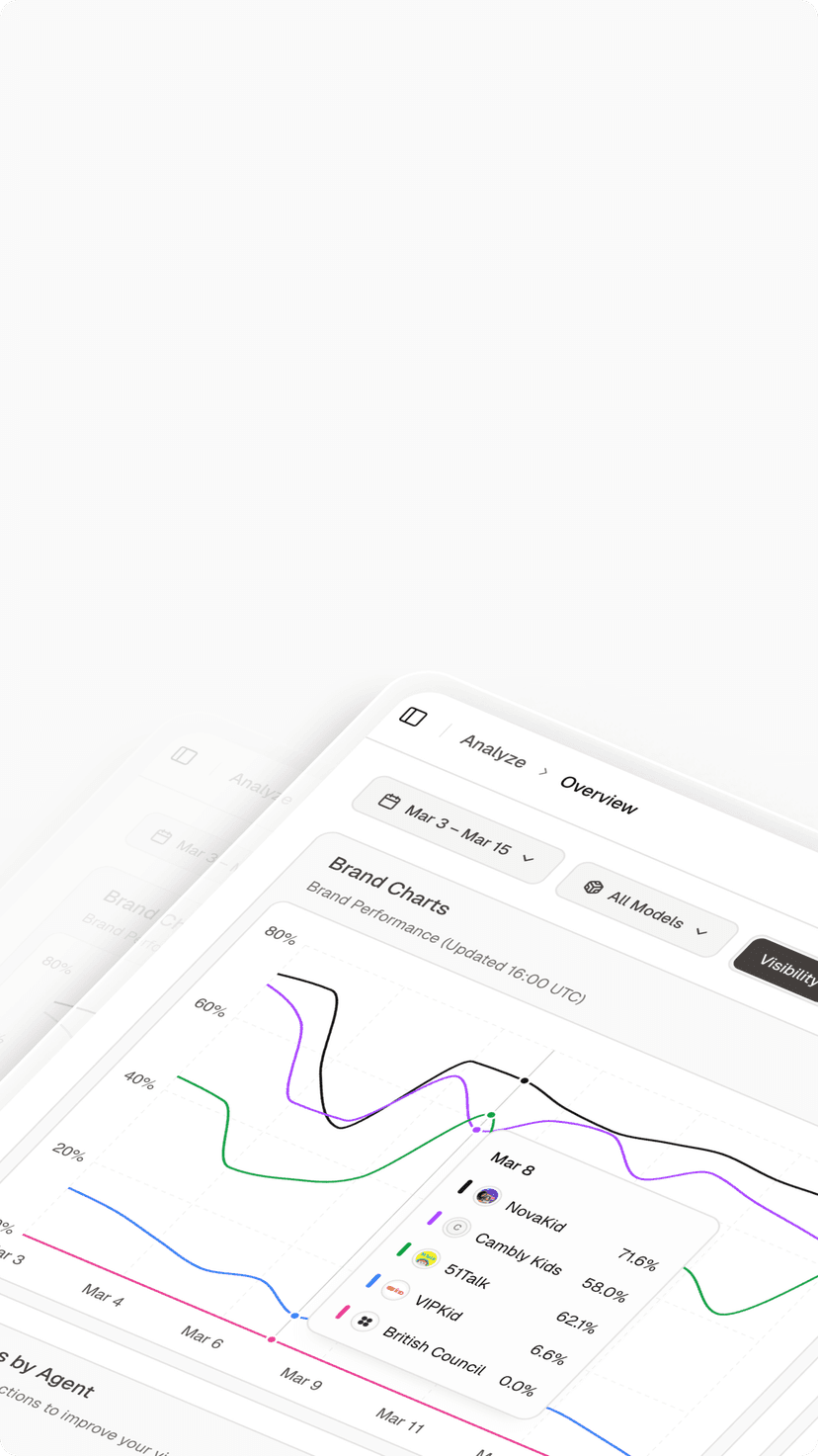
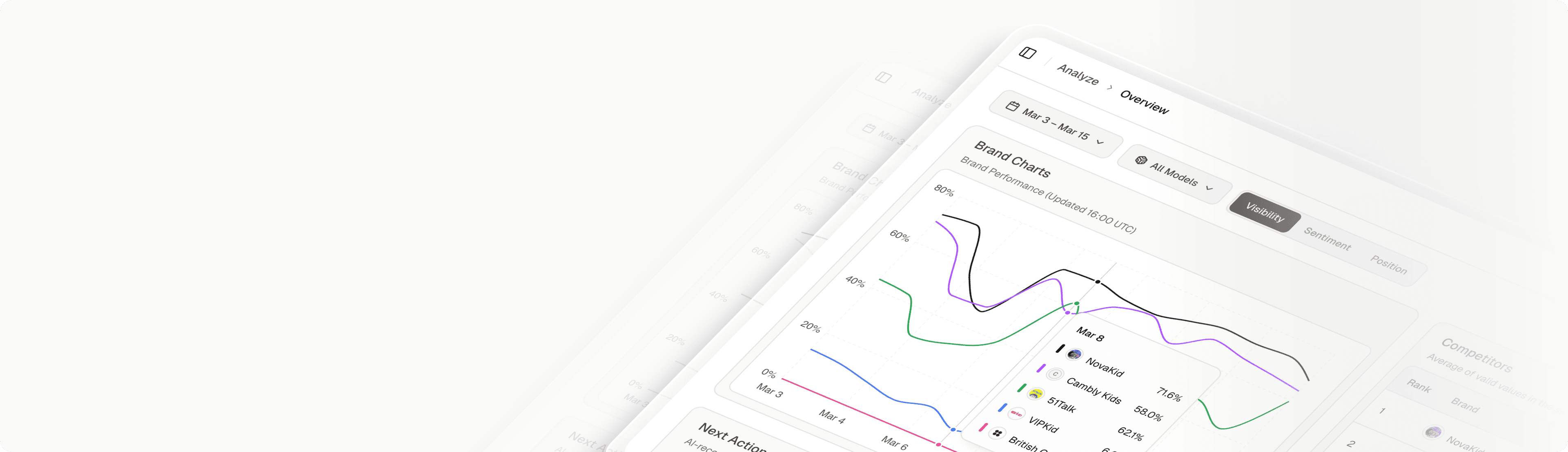
The tracking layer extends beyond source URLs. Topify’s Visibility Tracking monitors how often your brand appears in AI responses across platforms, while Position Tracking shows where you rank relative to competitors within each answer. Together, these metrics give you something that no traditional citation audit can: a real-time map of how AI engines perceive your brand’s authority.
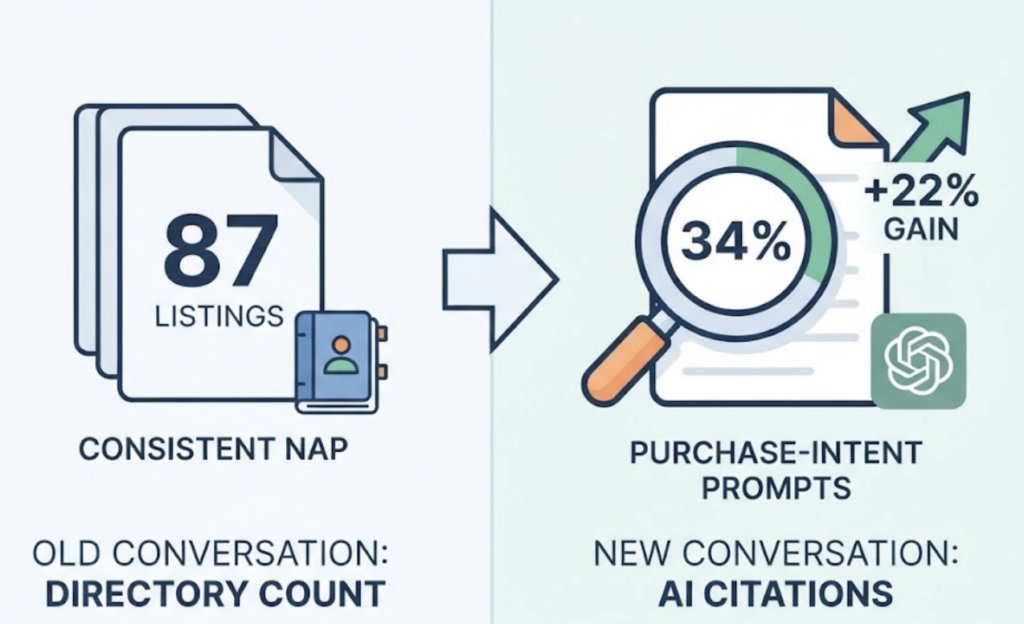
That visibility data changes the conversation with clients and stakeholders. Instead of reporting “we’re listed on 87 directories with consistent NAP,” you can report “ChatGPT cited our domain in 34% of purchase-intent prompts in our category this month, up from 12% last quarter.”
Both Citation Playbooks Still Matter in 2026
This isn’t a story about old citations dying. It’s about a second citation layer emerging on top of the first.
Local citation SEO, the NAP-and-directory work, remains essential infrastructure for any business with a physical location. Google’s local pack still relies on it. AI engines like Gemini, which pull heavily from Google Maps data, also benefit from consistent directory listings. If your NAP data is a mess, you’ll have problems in both traditional and AI search.
But if you’re only doing directory citations, you’re missing the bigger shift. AI-powered search has captured between 12% and 15% of global search market share as of early 2026, and that number is growing. For non-local brands (SaaS, DTC, B2B), AI citations are often the primary discovery channel where potential customers encounter the brand for the first time.
The practical action plan looks like this: audit both citation layers. Use directory management tools for local NAP hygiene. Use prompt-level citation tracking for AI visibility. Refresh key content pages at least quarterly to maintain citation eligibility. And invest in earned media distribution, because AI engines cite third-party sources at dramatically higher rates than brand-owned content.
Citation SEO hasn’t been replaced. It’s been expanded. The teams that recognize both definitions will hold the advantage.
Conclusion
For years, citation SEO meant one thing: getting your business name, address, and phone number listed correctly across directories. That work still matters for local search. But the word “citation” now carries a second, arguably larger meaning: getting your content cited by AI engines when they synthesize answers for your buyers.
The data is clear. Google rankings don’t predict AI citations. Content freshness, claim specificity, brand recognition, and earned media presence do. Teams that track both citation layers, directory listings and AI source attribution, will see the full picture of their brand’s discoverability. Those that don’t will keep optimizing for a fraction of where their customers are actually looking.
FAQ
What is citation SEO?
Citation SEO traditionally refers to optimizing your business’s Name, Address, and Phone number (NAP) across online directories to improve local search visibility. In 2026, the term has expanded to include getting your content cited as a source by AI search engines like ChatGPT, Perplexity, and Gemini when they generate answers to user queries.
Are local SEO citations still important in 2026?
Yes. Local citation signals still account for about 7% of local pack ranking weight according to Moz, and NAP consistency remains a foundational trust signal for Google. They’re less dominant than in 2020, but still necessary for any business with a physical location.
How do I check if ChatGPT is citing my brand?
You can manually ask ChatGPT purchase-intent questions in your category and look for your brand in the response. For systematic tracking, platforms like Topify monitor citation rates across multiple AI engines at the prompt level, showing you exactly which domains get cited and how often.
What’s the difference between a citation and a mention in AI search?
A mention means the AI names your brand in its answer without attributing the information to any source URL. A citation means the AI explicitly links to a specific page as evidence for a claim. Citations carry more authority and are more actionable for optimization because you can trace which content earned the reference.