

Your domain authority is solid. Your keyword rankings look healthy. But when someone asks ChatGPT for a recommendation in your category, the response cites three competitors and skips your page entirely. You check the content. It’s thorough, well-written, and ranks on page one of Google. None of that mattered.
The gap isn’t authority. It’s structure. Research on AI citation patterns shows that 44.2% of all LLM references come from the first 30% of a document. If your opening 300 words are context-setting fluff instead of extractable answers, AI systems discard your page before they reach the good stuff.
AI Doesn’t Read Your Page. It Extracts Passages.
The biggest misconception in citation SEO is that AI engines process your content the way a human reader does: top to bottom, absorbing the full narrative. They don’t.
ChatGPT, Perplexity, Gemini, and Google AI Overviews all run a Retrieval-Augmented Generation (RAG) pipeline. When a user asks a question, the model breaks it into sub-queries, retrieves matching content from multiple sources, chunks each page into 300 to 500 word blocks, and then ranks those chunks by relevance, specificity, and authority. The highest-scoring chunks get cited. Everything else gets discarded.
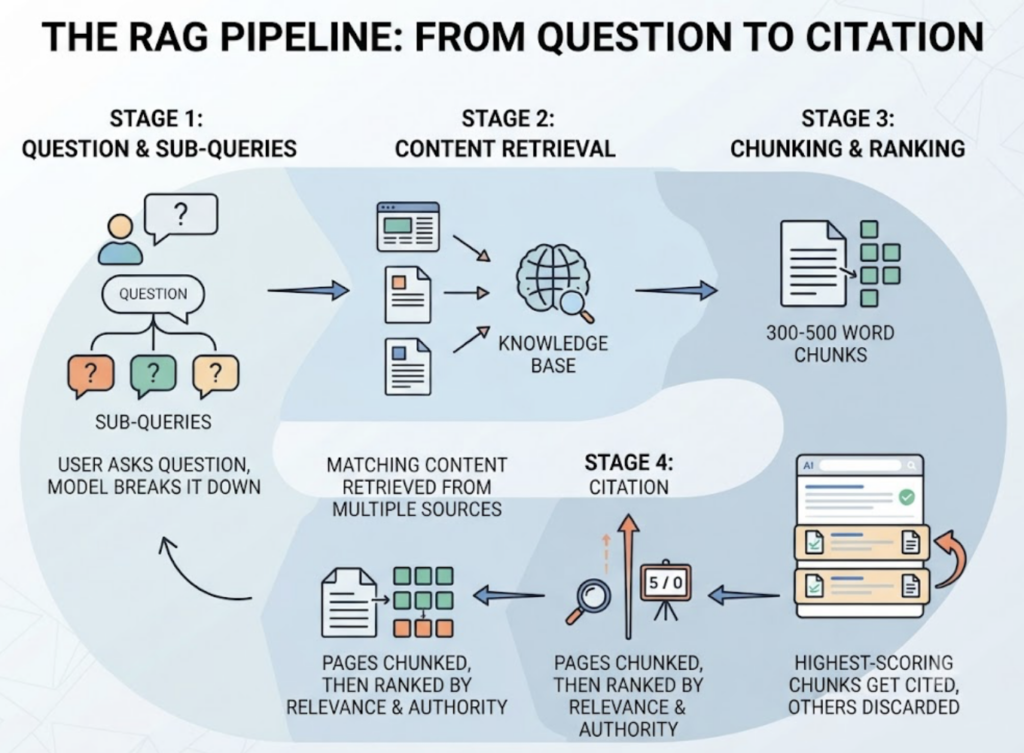
The unit of competition isn’t your page. It’s your paragraph.
AirOps analyzed 548,534 pages retrieved by ChatGPT across 15,000 prompts and found that only 15% of discovered pages ever appeared in a final answer. The other 85% were pulled into the pipeline, evaluated, and silently dropped. Your content can rank on Google, get retrieved by ChatGPT, and still never surface to a single user. Retrieval and citation are two distinct events, and the gap between them is where most brands quietly disappear.
That distinction changes the optimization target. Traditional SEO gets you into the retrieval pool. Citation SEO gets you out of it and into the answer.
The Ski Ramp Effect: 38% of AI Citations Come From Your First 100 Words
Not all chunks are created equal. AI systems exhibit a strong position bias toward the top of a page, a pattern researchers call the “ski ramp” effect.
A June 2026 study analyzing over 100,000 citation placements across 10,000 AI Overviews responses found that 38% of all citations are pulled from the first 100 words of a page. The distribution drops steeply after that. By the time you’re past the first 500 words, citation frequency has already fallen to a fraction of what it was at the top. The tail is long and flat.
This aligns with earlier research showing 44.2% of LLM references originate from the first 30% of a document. The structural choices you make at the top of a page, a clear summary, entity-rich context, and direct answers, directly determine whether an AI system reaches for your content when generating a response.
Here’s why traditional blog structure fails this test. Most SEO content opens with 200 to 300 words of scene-setting before stating an actual answer. In a RAG pipeline, those opening words form their own chunk. That chunk contains no extractable claim, no statistic, and no definition. It gets scored low and discarded. You’ve lost your highest-value real estate before the AI ever sees your expertise.
The fix is architectural, not cosmetic. Answers first, context second, elaboration last.
What Citation SEO Actually Optimizes For
Traditional SEO optimizes for ranking signals: backlinks, keyword relevance, page speed, domain authority. Citation SEO optimizes for extractability, the ease with which an AI system can pull a self-contained, accurate, quotable passage from your content.
Cyrus Shepard’s meta-analysis of 54 experiments and case studies, published in May 2026, scored 23 AI citation factors by evidence strength. The top five: URL accessibility (9.5), search rank (9.4), fan-out rank (9.3), preview controls (9.2), and query-answer match (9.2). Traditional SEO still matters. But a new layer sits on top of it.
The Princeton GEO study (Aggarwal et al., KDD 2024) tested nine content optimization strategies across 10,000 queries and quantified the impact on AI citation rates. The results drew a clear line between what works and what doesn’t.
| Optimization Method | Citation Visibility Change |
|---|---|
| Statistics Addition | +41% |
| Quotation Addition | +28% |
| Cite Sources | +22% (up to +115% for lower-ranked pages) |
| Fluency Optimization | +17% |
| Authoritative Voice | +15% |
| Keyword Stuffing | Negative impact |
| Content Padding | No measurable improvement |
The pattern is clear. AI systems favor content that’s fact-dense, source-attributed, and structured for extraction. They penalize content that’s padded, keyword-stuffed, or built around persuasive narrative rather than verifiable claims.
One data point often gets overlooked: only 14% of marketers currently track AI citation visibility, despite 43% naming AI optimization a core 2026 strategy. The gap between intention and measurement is wide.
5 Content Structure Patterns That Win AI Citations
Knowing that AI extracts passages is useful. Knowing how to structure those passages is what moves the numbers. These five patterns have the strongest correlation with citation rates across ChatGPT, Perplexity, and AI Overviews.
1. Answer-First Formatting
Lead every H2 section with a self-contained answer in the first 40 to 75 words. The answer should resolve the question implied by the heading without requiring surrounding context. Think of it as writing the passage an AI would quote, then building the section around it.
One case study documented a Featured Snippet rate increase from 8% to 24% after adopting answer-first formatting, a 3x improvement. ChatGPT citations for the same content increased by 140%.
2. Atomic Paragraphs
Each paragraph should contain exactly one idea, expressed in two to four sentences. When a RAG system chunks your content and a single block contains four partially developed ideas instead of one complete claim, that block scores low for every query it’s tested against. Pages with unstructured “blob” content become vaguely relevant to many queries but definitively cited for none.
The ideal extractable passage runs 134 to 167 words. That’s roughly one focused paragraph.
3. Entity-Explicit Language
Pronouns kill citations. When a chunk is extracted in isolation, “it works with 10,000 users” means nothing. Replace vague references with full entity names. Write “Topify’s Source Analysis tracks the exact domains AI platforms cite” instead of “the tool tracks cited domains.” LLMs evaluate each chunk independently. If a passage can’t stand alone, it won’t get cited.
4. Comparison Tables and Structured Lists
Content with tables and structured data gets cited 2.5x more often than unstructured prose. Listicles account for roughly 50% of top-cited content formats across AI search engines. Tables create explicit data relationships. Numbered lists create clear extraction boundaries. Both reduce the AI’s interpretation work and increase its confidence in citing the source.
5. Citation Hooks
A citation hook is a standalone statement, typically 40 to 60 words, designed to be lifted directly into an AI response. Place four to six of these throughout a post. They function like pull quotes that happen to be optimized for machine extraction rather than human scanning. Each hook should include a specific claim, a number or named entity, and enough context to make sense without the surrounding paragraph.
How to Audit Your Content for Citation SEO Readiness
Knowing the principles is one step. Auditing your existing content against them is what produces results. Run this checklist before publishing or updating any page you want AI to cite.
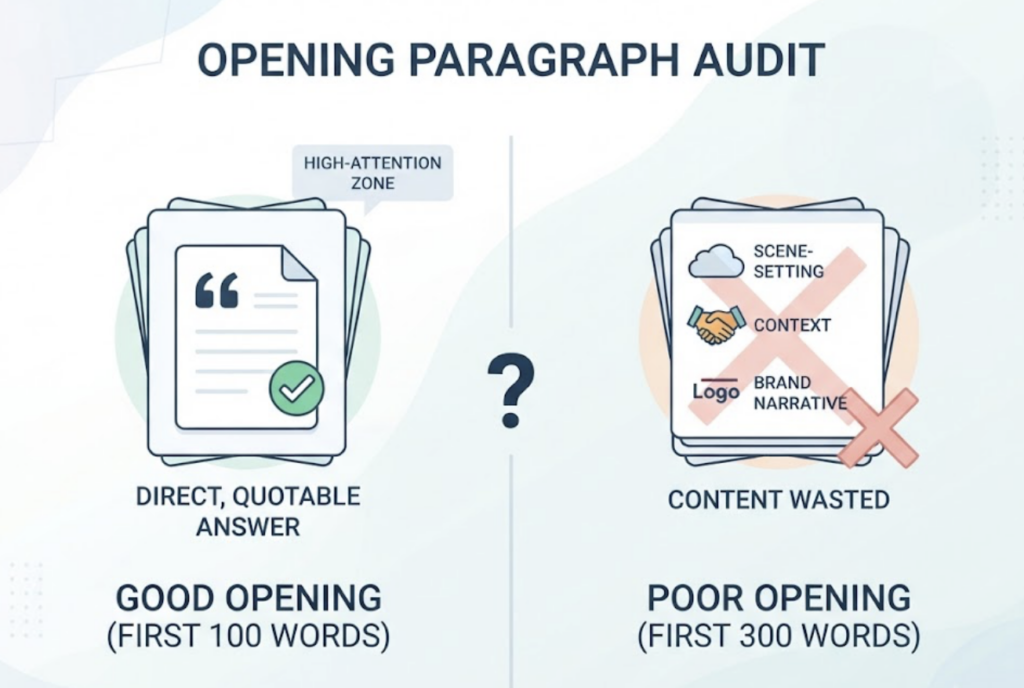
First 100 words: Does your opening paragraph contain a direct, quotable answer to the page’s primary question? If the first 300 words are scene-setting, context, or brand narrative, the highest-attention real estate on your page is wasted.
Section independence: Can each H2 section stand on its own and be cited independently, without needing the rest of the article for context? If a section relies on pronouns that reference earlier sections, rewrite it.
Fact density: Count the verifiable facts (numbers, named entities, specific dates, attributed data points) per 100 words. If you’re below one fact per 100 words on informational content, you have a citation gap.
Entity clarity: Search for “it,” “this,” “they,” and “the platform” in your text. Every instance is a potential citation failure where an AI system can’t identify what you’re referring to.
The harder question is tracking whether these changes actually move your citation rates. Tools like Topify address this directly. Topify’s Source Analysis reverse-engineers the exact domains and URLs that AI platforms cite for prompts in your category, showing whether your content or your competitors’ content dominates those references. Visibility Tracking monitors your brand’s presence across ChatGPT, Perplexity, Gemini, and AI Overviews over time, so you can tie structural content changes to measurable citation outcomes.
That tracking matters because AI citations fluctuate 40 to 60% month over month. A single audit won’t tell you if your changes are working. Ongoing monitoring will.
Conclusion
Citation SEO isn’t a separate discipline from traditional SEO. It’s a structural layer on top of it. The fundamentals still apply: rank well, build authority, publish quality content. But the content that earns AI citations in 2026 is built differently than the content that earns Google clicks.
The data points converge on the same conclusion. Your first 300 words are your highest-value real estate. AI systems extract passages, not pages. And the gap between being retrieved and being cited is where 85% of content silently disappears. Structure your content for extraction, audit your pages against citation readiness criteria, and track the results with a platform built for AI visibility. You can get started with Topify to see exactly where your brand stands across every major AI search engine.
FAQ
Q: What is citation SEO?
A: Citation SEO is the practice of optimizing content so that AI search engines (ChatGPT, Perplexity, Google AI Overviews, Gemini) cite your pages when generating answers. It focuses on content structure, extractability, and fact density rather than traditional ranking signals like backlinks and keyword density.
Q: How does AI decide which sources to cite?
A: AI engines use a Retrieval-Augmented Generation (RAG) pipeline that chunks your content into 300 to 500 word blocks, scores each block for relevance, specificity, and authority, then cites the highest-scoring passages. Pages with answer-first formatting, atomic paragraphs, and entity-explicit language score higher than unstructured content.
Q: Do Google rankings help with AI citations?
A: Yes, but they’re not sufficient. Cyrus Shepard’s 2026 meta-analysis ranked search rank as the second most important AI citation factor (9.4 out of 10). But only 15% of pages ChatGPT retrieves from search results are actually cited. Ranking gets you into the retrieval pool. Content structure determines whether you survive the cut.
Q: How can I track if AI is citing my content?
A: Traditional analytics tools don’t track AI citations. You need dedicated AI visibility platforms like Topify that monitor which domains AI engines cite, how your brand appears in AI-generated answers, and how citation patterns change over time across ChatGPT, Perplexity, Gemini, and AI Overviews.

