

Your NAP profiles are spotless. Yelp, Google Business Profile, Apple Maps, all consistent down to the suite number. Whitespark gives you a clean bill of health. Then someone asks ChatGPT for a recommendation in your category, and the answer pulls from Reddit threads, Wikipedia entries, and a competitor’s blog post you’ve never seen. Your directory listings don’t appear anywhere in the response.
That disconnect is the new reality of citation SEO. The term hasn’t changed, but what it takes to earn a citation has.
What Citation SEO Meant for 15 Years
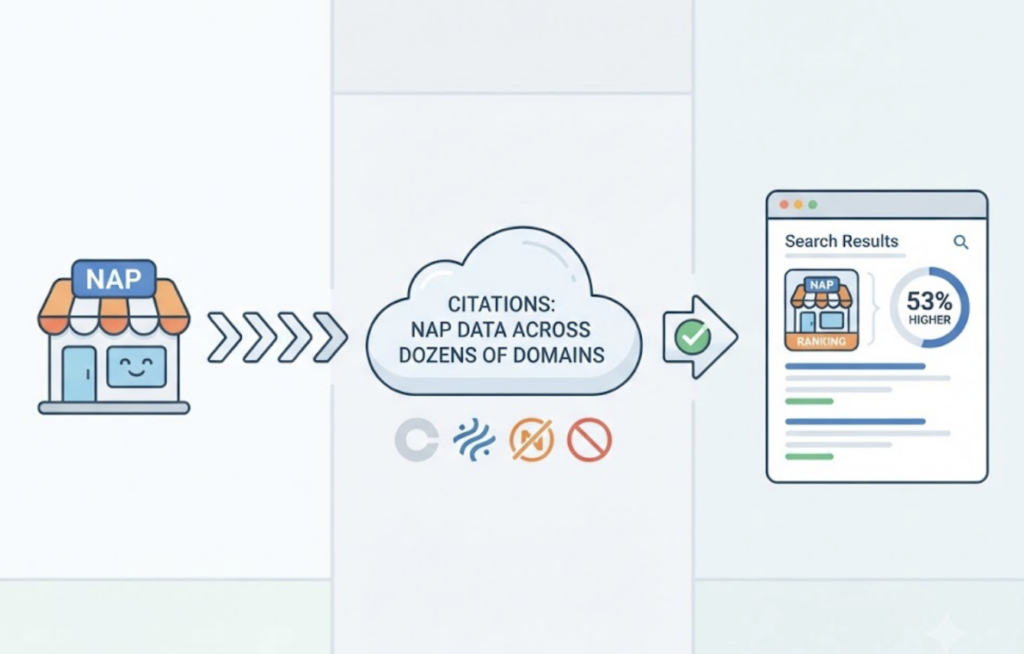
For most of its history, “citation SEO” referred to one thing: getting your business name, address, and phone number (NAP) listed consistently across online directories. Yelp, YellowPages, Bing Places, industry-specific portals. The logic was straightforward. More consistent directory listings meant stronger local authority, which meant higher placement in Google’s Local Pack.
Tools like Moz Local, BrightLocal, and Yext built entire businesses around this model. Data from Uniek Digital shows businesses with 40 or more accurate citations rank 53% higher in local search results. Google cross-references NAP data across dozens of domains to verify legitimacy. In a world where Google was the only search engine that mattered, citation building worked.
That world no longer exists.
How AI Search Rewrote the Rules of Citation SEO
ChatGPT now has over 900 million weekly active users. Perplexity processes roughly 780 million search queries per month. Google’s own AI Overviews appear on an estimated 15 to 25% of all searches. Nearly a third of Americans are projected to use generative AI search in 2026, according to eMarketer data cited by Control Alt Digital.
None of these systems use directory listings to decide who gets recommended.
When ChatGPT assembles an answer, it pulls from a narrow set of sources it considers authoritative. According to Ahrefs’ July 2026 analysis, the top cited domains in ChatGPT are Reddit, Wikipedia, Amazon, Forbes, and Business Insider. Research from Contently found that roughly 30 domains account for about 67% of ChatGPT citations within any given topic. And ChatGPT only cites 15% of the pages it retrieves during a search, meaning 85% of retrieved sources never make it into the answer.
That’s a fundamentally different citation model. Your Yelp listing doesn’t factor into whether Perplexity mentions your brand when someone asks “what’s the best project management tool for remote teams.”
What Citation SEO Looks Like in 2026
The new definition of citation SEO is simple: making your brand and content the source that AI systems quote, link, and recommend.
There are two forms of AI citation. The first is a direct mention, where the AI names your brand in its response. The second is a source citation, where the AI links to your content as a reference supporting its answer. Both matter. Both require different strategies than traditional directory citation building.
Here’s what the data says drives AI citations versus traditional citations:
| Dimension | Traditional Citation SEO | AI Citation SEO |
|---|---|---|
| Definition | NAP mentions across directories | Brand/content cited in AI-generated answers |
| Target platforms | Google Local Pack, Apple Maps, Bing | ChatGPT, Perplexity, Gemini, AI Overviews |
| Primary signal | Directory consistency, listing volume | Brand mentions, earned media, content authority |
| Measurement | NAP accuracy score, citation count | Citation share, mention rate, source frequency |
| Key tools | Moz Local, BrightLocal, Yext | Topify, AI visibility trackers |
The strongest predictor of AI citation is not what you’d expect. An Ahrefs study of 75,000 brands found that branded web mentions correlate with AI Overview visibility at 0.664, while traditional backlinks sit at just 0.218. That’s a 3x gap. YouTube mentions showed an even stronger signal at 0.737.
In other words, AI engines care more about how often your brand is talked about across the web than how many links point to your site.
Why Your Old Citation Metrics Can’t Measure This
Traditional citation tools were built to count directory listings and flag NAP inconsistencies. They don’t track whether ChatGPT mentioned your brand in response to a product comparison query, or which source domains Perplexity cited when recommending your competitor.
A Goodfirms 2026 survey found that only 14% of marketers currently use AI citation tracking, even though 43% name AI search optimization as a core strategy for the year. That’s the largest measurement gap in the current SEO stack.
The problem compounds fast. AI answers vary by session, by platform, and by phrasing. You can’t manually check 200 prompts across four AI platforms every week and call it a monitoring strategy. You need structured tracking.
Topify’s Source Analysis feature tracks exactly which domains and URLs AI platforms cite when answering prompts in your category. It shows whether your content is among the cited sources, or if competitors are dominating the citation layer. The Visibility Tracking module monitors how often your brand appears across ChatGPT, Perplexity, Gemini, and AI Overviews, giving you a citation share metric that traditional tools simply don’t offer.
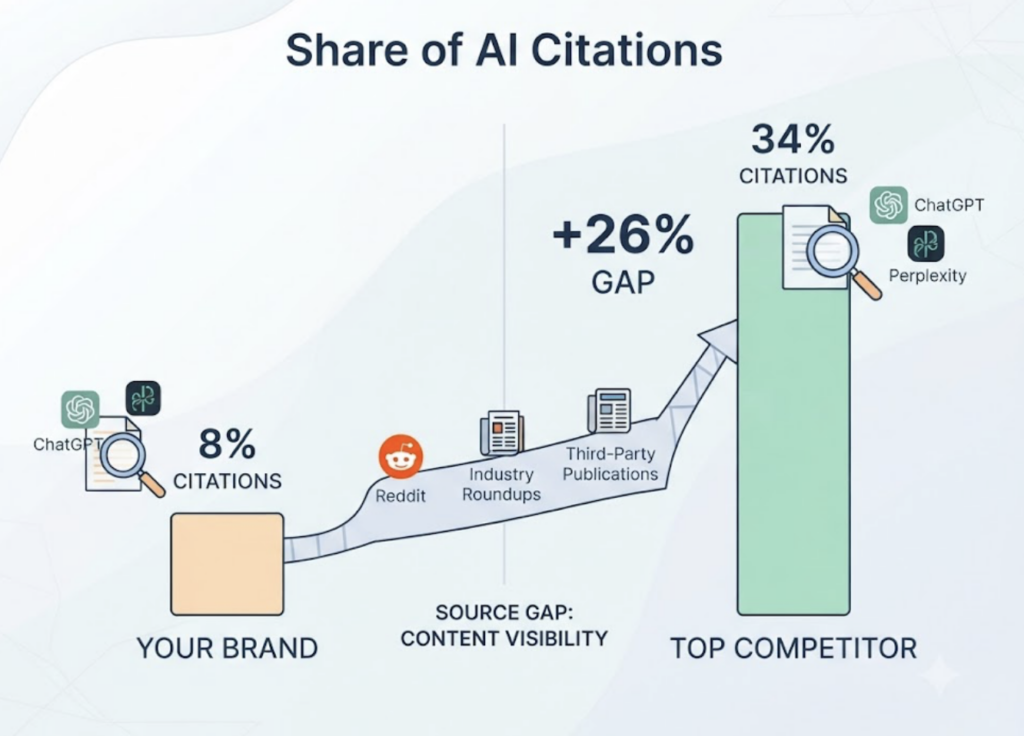
Here’s an example of what that looks like in practice. You run a SaaS brand and track 100 prompts related to your category. Topify shows your competitor gets cited as a source in 34% of those prompts across ChatGPT and Perplexity. Your brand: 8%. The gap isn’t because your domain authority is lower. It’s because their content appears on Reddit, gets referenced in industry roundups, and shows up in the third-party publications that AI engines actually pull from.
5 Ways to Build Citation SEO for AI Search
The tactics that earn AI citations look different from the directory submission playbook. Here’s what the research supports.
1. Publish Content That AI Wants to Quote
AI systems favor content with clear structure, original data points, and direct answers. The Princeton/Georgia Tech GEO paper tested 10,000 queries and found that adding statistics improves AI visibility by 30 to 40%. Content with FAQ schema, comparison tables, and front-loaded answers in the first 60 words of each section performs best.
Listicles, articles, and product pages are the three most-cited content formats across AI Mode, ChatGPT, and Perplexity, accounting for over 50% of citations combined.
2. Earn Third-Party Mentions, Not Just Links
Unlinked brand mentions now outperform backlinks as a predictor of AI visibility by roughly 3x. A Stacker and Scrunch study found that distributing content across third-party news publications increased AI citation rates by up to 325% compared to publishing only on the brand’s own site. Brand-only content achieved 7.6% citation rates. Earned distribution achieved 34%.
The implication is clear: digital PR, media placements, and guest contributions on trusted publications do more for AI citation SEO than another batch of directory submissions.
3. Build Presence Where AI Actually Pulls From
Reddit is the single most-cited domain across generative AI engines in 2026, according to Everything-PR Research. An SE Ranking study found that domains with strong Reddit presence averaged 3.9x more ChatGPT citations than those without. Wikipedia, YouTube, LinkedIn, and Forbes round out the top five.
This doesn’t mean spamming subreddits with promotional posts. It means contributing genuine, experience-based answers in the communities where your audience already asks questions.
4. Monitor Your AI Citation Share
You can’t optimize what you don’t measure. Set up tracking across your target prompts and platforms. Topify’s Competitor Monitoring feature automatically detects which brands AI engines recommend alongside yours, so you can see citation shifts as they happen rather than discovering them months later.
Track three metrics: citation frequency (how often your brand is mentioned), source frequency (how often your pages are linked as sources), and sentiment (whether AI describes your brand accurately).
5. Keep Content Fresh
Pages that go more than three months without an update are over 3x more likely to lose AI visibility. Over 70% of AI-cited pages were updated within the past 12 months. AI engines weight recency when selecting sources, so add new data, updated examples, and clear “last updated” timestamps to your core pages.
Traditional Citation Building Isn’t Dead. It’s Just Not Enough.
Directory citations still matter for local SEO. Whitespark’s 2026 Local Search Ranking Factors report found that citations actually rank third in importance for AI visibility among local businesses, accounting for 13% of the signal. Consistent NAP data still helps Google verify your business, and review platforms like G2, Capterra, and Yelp create the kind of structured third-party presence that AI engines notice.
But stopping at directory listings means you’re optimizing for one citation model while ignoring the one that’s growing fastest. The brands that win in 2026 treat traditional citation building as the foundation and AI citation strategy as the growth layer on top.
Conclusion
Citation SEO used to be a checklist: submit to 50 directories, match your NAP, and move on. In 2026, it’s a visibility strategy that spans every platform where AI systems look for sources to quote.
The shift from directory citations to AI citations isn’t coming. It’s already here. Over 900 million people use ChatGPT weekly. AI Overviews appear on a quarter of Google searches. And the data is unambiguous: brand mentions, earned media, and content authority predict AI visibility 3x better than traditional backlinks.
The first step is knowing where you stand. Check which prompts in your category trigger AI answers, see whether your brand appears in those answers, and identify the sources AI is quoting instead of you. Get started with Topify to track your AI citation share across ChatGPT, Perplexity, Gemini, and AI Overviews in one dashboard.
FAQ
Q: What is citation SEO?
A: Citation SEO is the practice of optimizing your brand’s presence so it gets cited across search platforms. Traditionally, this meant directory listings with consistent NAP data for local search. In 2026, it increasingly means earning citations and mentions from AI search engines like ChatGPT, Perplexity, and Google AI Overviews.
Q: Is traditional citation building still important?
A: Yes, but for a narrower purpose. Directory citations still support local pack rankings and help search engines verify business legitimacy. They’re a baseline, not a complete strategy. For AI search visibility, earned media mentions and content authority carry significantly more weight than directory listing volume.
Q: How do I check if AI is citing my brand?
A: Manual spot-checking (searching your target queries on ChatGPT, Perplexity, and Google) gives you a snapshot, but AI responses change between sessions. For systematic tracking, tools like Topify monitor citation frequency, source links, and brand sentiment across multiple AI platforms and prompt sets over time.
Q: What’s the difference between AI citations and backlinks?
A: A backlink is a hyperlink from one website to another, and it primarily signals authority to Google’s algorithm. An AI citation is when an AI system references your brand or links to your content in a generated answer. The two overlap (strong backlink profiles can help), but AI citations are more strongly correlated with brand mentions and earned media presence than with link counts alone.

