

Your domain authority is 70. Your keyword rankings haven’t budged in the wrong direction for six months. Then your CMO asks, “Why did ChatGPT just recommend three competitors and not us?” and nobody on the team has an answer. The metrics you’ve been tracking for years don’t measure what AI engines actually do when they assemble a response: choose a handful of sources to cite, ignore everything else, and move on. That selection process is citation SEO, and the data from Q1 2026 suggests the rules are being rewritten faster than most brands realize.
LinkedIn Went from #11 to #5 on ChatGPT in 90 Days. Most Brands Missed It.
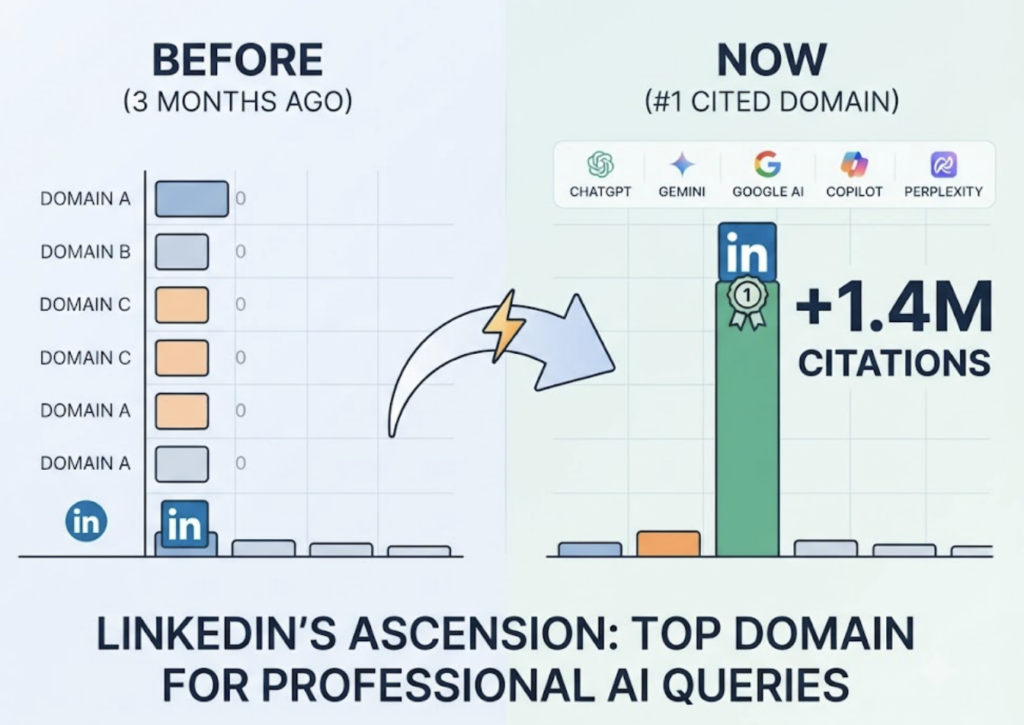
Between November 2025 and February 2026, LinkedIn’s domain rank on ChatGPT climbed from approximately #11 to #5, more than doubling its citation frequency. It was the largest domain authority shift tracked all year.
That wasn’t an isolated signal. A separate Semrush study analyzing 325,000 unique prompts across ChatGPT Search, Google AI Mode, and Perplexity identified 89,000 LinkedIn URLs being cited in AI-generated responses. On average, 11% of AI responses referenced a LinkedIn URL. On ChatGPT specifically, that number was 14.3%. On Google AI Mode, 13.5%.
That puts LinkedIn ahead of Wikipedia, YouTube, and every major news outlet.
For professional queries specifically, the picture is even sharper. An analysis of 1.4 million citations across six AI platforms found LinkedIn is the #1 most-cited domain for professional topics across ChatGPT, Gemini, Google AI Overviews, Google AI Mode, Microsoft Copilot, and Perplexity. Three months earlier, it wasn’t even in the top 10 on most of those platforms.
The shift happened fast, and the brands that noticed had a head start. The ones that didn’t are still reporting on keyword rankings that can’t explain why their competitors keep showing up in AI answers.
What Citation SEO Actually Measures (and Why Google Rankings Don’t Cover It)
Traditional SEO tracks how pages rank in a list of ten blue links. Citation SEO tracks something structurally different: whether an AI engine names your brand, links to your content, or references your data as a source inside its generated response.
The distinction matters because the math is different. A typical AI-generated answer cites only 2 to 7 sources. Compare that to the ten organic results on a traditional SERP. Fewer slots, higher stakes, and a selection process that doesn’t map neatly onto domain authority or backlink profiles.
Here’s the part that trips up most SEO teams: the engines don’t even agree on which sources to cite. A cross-engine study of 127,198 citations across five AI platforms found that 69.6% of cited domains appeared in only one engine’s answers. Just 2.7% were cited across all five. Optimizing for “AI search” as a single target is optimizing for an average that no engine actually is.
Citation SEO sits at the intersection of GEO (generative engine optimization) and AEO (answer engine optimization). It’s the measurable layer: who gets cited, how often, where, and by which engine. Without that data, you’re guessing whether your content strategy is actually reaching the places where your audience now looks for answers.
Why AI Engines Keep Citing LinkedIn (and What the Data Reveals About Citation Patterns)
LinkedIn’s rise isn’t random. The data points to specific content patterns that AI engines reward, and those patterns apply far beyond LinkedIn itself.
The first pattern is a shift toward authored, fresh content. Between November 2025 and February 2026, feed posts and long-form articles together rose from 26.9% to 34.9% of all LinkedIn citation types, while static profile page citations fell sharply. AI systems are leaning less on identity pages and more on published content that looks like ongoing expertise.
The second pattern is individual authorship. On ChatGPT Search and Google AI Mode, roughly 59% of cited LinkedIn content comes from individual creators. Personal posts, personal articles, content tied to individual profiles. Company Pages account for 41%. Perplexity flips this: 59% Company Pages, 41% individual creators. The platform mix matters.
A deeper URL-level analysis tells an even stronger story. Named individuals accounted for 87.8% of cited LinkedIn content URLs and 91.7% of total citations, earning 8.5 citations per URL compared to 5.5 for company pages.
The third pattern is consistency over virality. The median cited LinkedIn post has only 15 to 25 reactions. Likes, comments, and hashtags correlate near zero with citation frequency. What does correlate: 75% of cited authors posted five or more times in a four-week period. Frequency and depth beat virality every time.
And the fourth: original content accounts for 95% of all LinkedIn citations. Reshares account for 5%. AI engines want the source, not the amplification.
The Citation SEO Playbook: 5 Patterns That Earn AI References
LinkedIn’s data is a case study, but the principles generalize. Here’s what the citation research points to across platforms.
1. Publish on domains AI already trusts. AI engines have a short list of high-citation domains, and that list varies by engine. LinkedIn ranks near the top for professional queries. Reddit leads for general queries. Industry-specific publications, review sites, and established news outlets fill the rest. Getting featured on these platforms carries more citation weight than publishing the same content on your own blog.
2. Structure content for extraction. AI engines don’t read pages the way humans do. They pull specific answers from structured content. That means clear heading hierarchies, direct answers to questions within the first two sentences of each section, FAQ schema, and HowTo markup. The goal is to make your content extractable, not just readable.
3. Build entity authority across multiple surfaces. Only 2.7% of cited domains appear across all five major AI engines. The brands that do show up everywhere tend to have consistent entity signals: an accurate Wikipedia presence, a complete Google Knowledge Panel, structured data on their own site, and third-party mentions that reinforce the same information. AI engines cross-reference. If your brand story is fragmented, citations drop.
4. Prioritize third-party coverage. Research consistently shows that 85% or more of AI citations trace back to third-party sources. A brand that’s invested entirely in owned content has optimized for the 5 to 15% channel while ignoring the 85 to 95% channel. Earned media, listicle placements, review site coverage, and expert roundups are where citations actually come from.
5. Publish consistently, not virally. The LinkedIn data is unambiguous: engagement metrics don’t predict citations. Posting frequency does. The same principle applies to your blog, your YouTube channel, and your guest posting strategy. AI engines index active publishers differently than dormant ones, not just because of recency, but because frequent original publishing creates more brand-attributed content to draw from.
Most Brands Can’t See Their Own Citation Gaps. That’s the Real Problem.
The biggest obstacle in citation SEO isn’t strategy. It’s measurement.
Traditional SEO dashboards track keyword rankings, organic traffic, and backlink profiles. None of those tell you whether Perplexity is citing your competitor’s LinkedIn article instead of your product page. None of them show you which domains AI engines reference when someone asks a question in your category.
That visibility gap is where tools like Topify become relevant. Topify’s Source Analysis feature tracks the exact domains and URLs that AI platforms cite across ChatGPT, Gemini, Perplexity, and Google AI Overviews. Instead of guessing which sources AI trusts in your category, you can see the data: which domains dominate your target prompts, which URLs are cited most frequently, and where your content is absent from the citation layer entirely.
In practice, this means you can run a set of prompts relevant to your category and see immediately whether AI is citing your brand, your competitors, or third-party sources you’ve never considered. Topify’s Competitor Monitoring makes this actionable by showing how your citation profile stacks up against specific rivals across the same set of prompts.
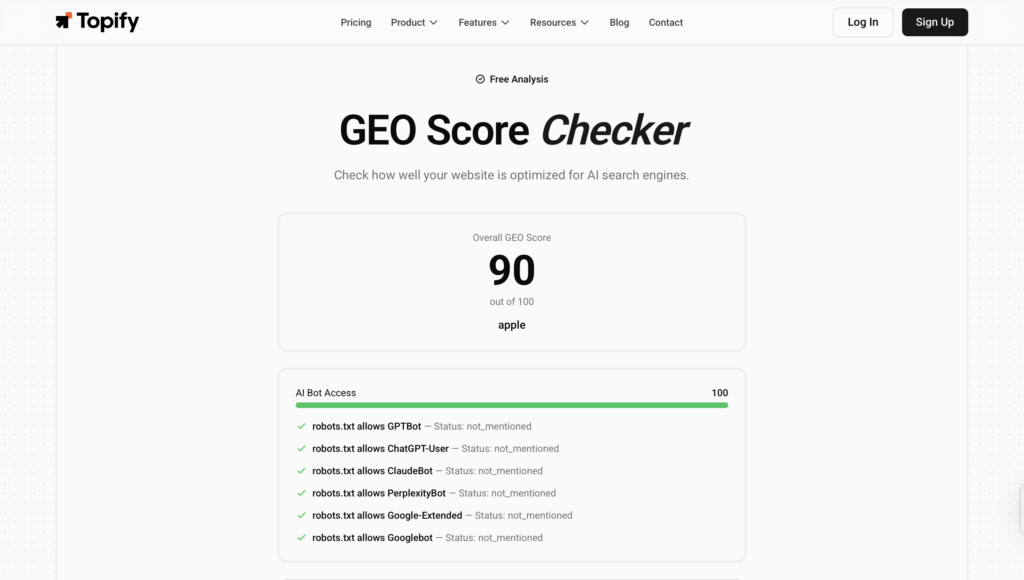
The GEO Score Checker is a free starting point. It audits whether AI crawlers can access and parse your site, which is the technical prerequisite before citations become possible. But the citation layer goes deeper than crawlability. It’s about whether AI engines consider your brand authoritative enough to reference when they synthesize an answer.
GEO Score Checker
Only about 30% of brands maintain consistent AI visibility from one query regeneration to the next. Citations aren’t permanent. They shift with model updates, new training data, and changes in the competitive landscape. Continuous tracking is the only way to know whether your citation position is holding, improving, or eroding.
Citation SEO Is Not a Separate Discipline. It’s Where SEO Is Heading.
There’s a temptation to treat citation SEO as an add-on, a side project that sits next to your “real” SEO program. That framing underestimates the speed of the shift.
ChatGPT now has over 900 million weekly active users. Google AI Overviews appear on more than 40% of search queries. Roughly 37% of consumers start their searches with AI tools rather than a traditional search engine. The audience has moved. The question is whether your visibility strategy has moved with it.
Traditional SEO remains the foundation. Technical optimization, content quality, E-E-A-T signals, and backlinks still matter. They’re necessary. They’re just no longer sufficient. The LinkedIn example makes this point clearly: a domain that wasn’t in the top 10 on ChatGPT three months ago is now #1 for professional queries across six AI platforms. Citation authority reshuffles fast, and the brands that track it in real time will see the shifts before their competitors do.
The path forward isn’t complicated. Audit your current citation footprint. Identify the prompts that matter in your category. See which domains AI is citing today. Find the gaps. Fill them with structured, original, third-party-distributed content. Then measure again.
If you haven’t started, your competitors probably haven’t either. But the window won’t stay open.
Get started with Topify to see exactly where your brand stands in AI search today.
Conclusion
Citation SEO isn’t a buzzword or a passing trend. It’s the measurable layer of AI search visibility, and Q1 2026 proved how fast the landscape can shift. LinkedIn went from outside the top 10 to the #1 cited domain for professional queries in under 90 days. That kind of movement doesn’t happen in traditional SEO.
The brands that win in citation SEO will be the ones that track where AI gets its answers, publish on the domains AI trusts, and treat citation data as a core performance metric rather than an afterthought. The tools exist. The data is available. The only variable left is whether you start now or wait until the competition has already locked in their advantage.
FAQ
Q: What is citation SEO?
A: Citation SEO is the practice of optimizing your brand’s visibility in AI-generated search responses. Unlike traditional SEO, which focuses on ranking in a list of links, citation SEO focuses on getting your brand named, linked, or referenced as a source inside the AI’s actual answer. It overlaps with GEO (generative engine optimization) and AEO (answer engine optimization).
Q: How is citation SEO different from traditional SEO?
A: Traditional SEO optimizes for ten organic results on a search engine results page. Citation SEO optimizes for the 2 to 7 sources an AI engine cites inside its generated response. The selection criteria differ, too. AI engines weigh content freshness, entity authority, third-party consensus, and structured data more heavily than backlink volume alone.
Q: Which platforms should I optimize for AI citations?
A: The major AI citation surfaces in 2026 are ChatGPT Search, Google AI Overviews, Google AI Mode, Perplexity, Gemini, Microsoft Copilot, and Claude. Each engine has different citation behavior. Research shows only 2.7% of cited domains appear across all five major engines, so a multi-platform strategy is essential.
Q: How can I track whether my brand is being cited in AI search?
A: Free tools like Topify’s GEO Score Checkerprovide a baseline audit of your AI crawlability. For ongoing citation tracking, Topify’s full platform monitors your brand’s visibility, sentiment, position, and source citations across ChatGPT, Gemini, Perplexity, and Google AI Overviews, with real-time competitor benchmarking.

