

Your marketing team spent months building domain authority, publishing content, and earning backlinks. Then someone asked ChatGPT for a recommendation in your category. The response cited three competitors by name, linked to two industry publications, and didn’t mention your brand once. Your Google rankings are fine. Your organic traffic looks healthy. But none of that tells you whether AI is using your content as a source, or whether it’s treating your competitor’s blog as the authority in your space.
That gap between SEO performance and AI citation performance is where brands are losing ground without realizing it. And the problem is growing: 37% of consumers now start their searches with AI tools rather than a traditional search engine.
What AI Brand Citations Are and Why They’re Not the Same as Mentions
There’s a distinction that most marketing teams overlook: the difference between an AI brand citation and an AI brand mention.
A mention means your brand name appeared somewhere in an AI-generated response. A citation means the AI platform linked to your content as a source backing its answer. One gives you visibility. The other gives you authority, referral traffic, and a compounding advantage in how AI models evaluate your brand over time.
Here’s why the difference matters in practice. Your brand might show up in a ChatGPT answer, but the citation backing the claim could link to a competitor’s blog or a third-party review site. You got the name-drop. Someone else got the authority signal and the click. The reverse is equally important: if your content is frequently cited as a source even when your brand name isn’t explicitly mentioned, you’re still building domain credibility with the AI model.
The business impact is measurable. According to the Opollo 2026 AI Search Benchmark Report, AI-referred visitors convert at 14.2% compared to 2.8% from Google organic traffic across 312 B2B technology companies. That’s a 5x conversion premium, and it flows through citations, not mentions.
The Scale Problem: 900 Million Weekly Users and Your Brand Might Not Be in the Answer
The audience that never sees your brand in AI search is massive and growing fast. ChatGPT alone reached 900 million weekly active users as of February 2026, more than doubling its base from a year earlier. Google’s AI Overviews now reach roughly 2 billion monthly users. Perplexity has grown to approximately 45 million monthly active users, processing 780 million queries per month.
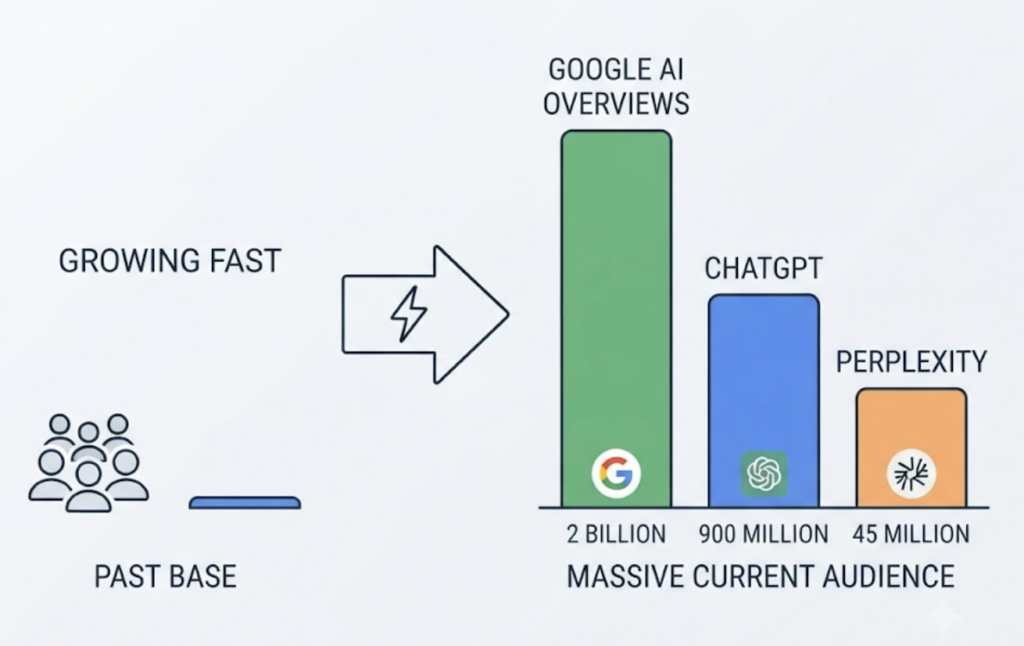
That’s billions of AI-mediated interactions every month where your brand is either being cited, mentioned without a link, or ignored entirely. And here’s the part that catches most teams off guard: traditional SEO tools can’t tell you which one is happening.
Google Analytics tracks organic clicks. Search Console tracks rankings. Neither tracks whether ChatGPT cited your pricing page, whether Perplexity linked to your competitor’s case study instead of yours, or whether Google AI Overviews pulled a definition from your blog and attributed it to someone else. The instrumentation most marketing teams rely on was built for a search model that’s quickly losing its monopoly on discovery. Gartner predicted that traditional search engine volume would drop 25% by 2026 due to AI chatbots and virtual agents, and the data from 2025 suggests that trajectory is on course.
Only 14% of marketers currently track AI search as a separate channel. The other 86% are flying blind on the fastest-growing discovery surface in marketing.
Why Tracking One AI Platform Gives You 11% of the Picture
One of the most counterintuitive findings in AI citation research is how little overlap exists between platforms. An analysis of 680 million AI citations found that only 11% of domains are cited by both ChatGPT and Perplexity for the same query. 71% of all cited sources appear on just one platform.
That means if you’re only checking your brand’s presence in ChatGPT, 89% of the citation picture is invisible to you.
The reason is architectural. Each AI platform builds answers from a fundamentally different source pool. ChatGPT leans on parametric knowledge from training data plus selective Bing integration. Perplexity runs a real-time web search for every prompt. Google AI Overviews draw from their own search index but apply different selection criteria than organic rankings. By early 2026, only about 38% of AI Overview citations came from pages ranking in the organic top 10, down from 76% the year before.
The citation rate structures differ too. According to Conductor’s AEO/GEO benchmarks, ChatGPT’s citation rate is just 0.7% of answers that include a clickable source URL. Perplexity’s is 13.8%. Google AI Mode’s is 9.5%. The same “AI search exposure” means completely different things depending on which platform you’re measuring.
A brand that dominates Perplexity’s citation pool can be nearly absent from ChatGPT, and vice versa. Cross-platform monitoring isn’t a nice-to-have. It’s the minimum viable measurement for any serious AI brand citation strategy.
Five AI Brand Citation Metrics That Actually Drive Decisions
Not all citation data is equally useful. Here are the five metrics that separate actionable monitoring from vanity dashboards.
Citation frequency measures how often your domain appears as a cited source across AI responses for your target prompts. This is your baseline. Without it, you can’t detect trends, measure the impact of content changes, or benchmark against competitors.
Source match tells you which specific pages AI platforms are citing. If ChatGPT keeps citing your 2023 pricing page instead of your updated 2026 product overview, you’ve identified a content gap you can fix. If it’s citing a G2 review instead of your own case study, that’s a different kind of problem with a different solution.
Citation position tracks where your citation appears in the response. Being cited as the first source in a Perplexity answer carries more weight than being the fifth footnote. Position data helps you understand not just whether you’re cited, but how much the AI platform trusts your content relative to alternatives.
Cross-platform coverage maps your citation presence across ChatGPT, Perplexity, Google AI Overviews, Gemini, and other platforms your audience uses. Given the 11% overlap problem, this is where most brands discover their biggest blind spots.
Competitor citation share compares your citation frequency against competitors for the same set of prompts. If a competitor is cited 4x more often than you for “best CRM for mid-market companies,” that tells you where to focus your content investment.
How to Build an AI Brand Citation Monitoring Workflow
Setting up citation monitoring doesn’t require rebuilding your analytics stack. It requires adding a new layer to it.
Start with prompt mapping. Identify the 30 to 50 AI queries most relevant to your brand. These aren’t keywords in the traditional SEO sense. They’re the questions your buyers actually type into ChatGPT or Perplexity: “What’s the best project management tool for remote teams?” or “How does [your category] pricing typically work?” Think intent, not keywords. Think questions, not phrases.
Establish your baseline. Run those prompts across ChatGPT, Perplexity, and Google AI Overviews. Record which brands appear, which sources get cited, and where your brand shows up (or doesn’t). This initial audit often produces surprises. Teams regularly discover that a competitor they don’t consider a threat has strong AI citation presence, or that a blog post they deprioritized is their single most-cited page.
Set monitoring cadence. AI citation patterns shift faster than organic rankings. 50% of content cited in AI responses is less than 13 weeks old, according to research from Lily Ray and Amsive. And 76.4% of ChatGPT’s most-cited pageswere updated within 30 days. That means monthly monitoring is the floor, not the ceiling. Weekly is better for competitive categories.
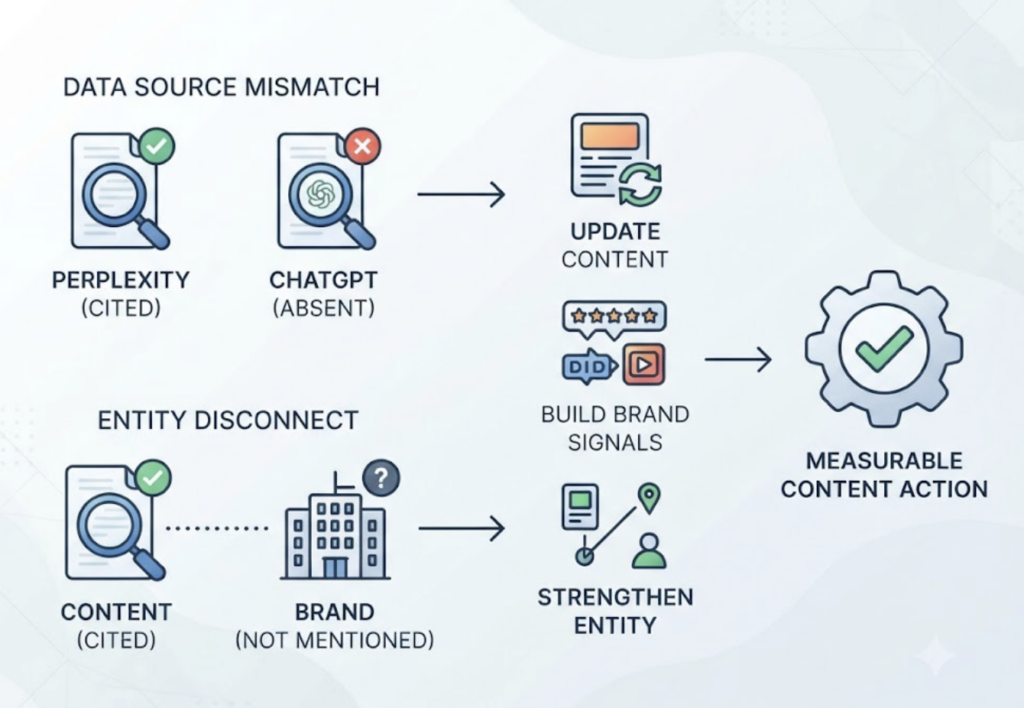
Connect citation data to content action. The point of monitoring isn’t a prettier dashboard. It’s knowing which content to create, update, or restructure. If you’re cited on Perplexity but absent from ChatGPT, the fix likely involves building third-party brand signals (reviews, earned media, community mentions) rather than just publishing more blog posts. If your content is cited but your brand isn’t mentioned in the answer text, you might need to strengthen entity signals so the AI connects your content to your brand name.
For teams that want this workflow in a single platform, Topify combines cross-platform citation tracking with source analysis, competitive benchmarking, and sentiment monitoring. Its Source Analysis feature identifies exactly which domains and URLs AI platforms cite, letting you trace a drop in ChatGPT mentions back to a specific content gap or a competitor’s new publication. And its Competitor Monitoring automatically detects rivals and compares your citation share, position, and sentiment side by side, across ChatGPT, Perplexity, Gemini, and other major AI engines.
Three Mistakes That Quietly Tank Your AI Brand Citation Rate
Treating mentions and citations as the same metric. Mentions tell you AI knows your brand name exists. Citations tell you AI trusts your content enough to use it as evidence. A brand with high mentions but low citations is being talked about but not relied upon. That’s a content authority problem, not a visibility problem, and the fixes are different. Focus your content strategy on producing citable assets: original data, structured comparisons, and expert analysis that AI can extract and attribute.
Monitoring one platform and assuming it represents the whole picture. Given that 89% of citations differ between platforms, a ChatGPT-only monitoring strategy misses most of what’s actually happening. Each platform has distinct source preferences. ChatGPT favors Wikipedia and consensus sources. Perplexity weights Reddit and real-time content heavily. Google AI Overviews lean toward structured, semantically complete pages. A comprehensive monitoring setup covers at least three platforms, ideally more.
Collecting data without closing the loop to content strategy. Citation monitoring that doesn’t feed back into what you publish, update, and distribute is just reporting. The brands gaining citation share in 2026 are the ones running a tight cycle: monitor which prompts matter, check which sources get cited, identify gaps, produce or update content to fill them, then measure again. Topify’s Comprehensive GEO Analytics supports this cycle with seven visibility metrics in a single view: visibility, sentiment, position, volume, mentions, intent, and CVR, so the path from “we lost citation share on this prompt” to “here’s the content we need to fix” is short.
The monitoring itself isn’t the competitive advantage. The speed at which you turn monitoring data into content action is.
Conclusion
AI brand citation monitoring isn’t a future priority. It’s a current blind spot. With 900 million weekly ChatGPT users, 2 billion AI Overview impressions per month, and only 11% citation overlap between platforms, the brands that don’t monitor cross-platform citations are making decisions based on incomplete data.
The starting point is straightforward: map your target prompts, audit your citation baseline across at least three AI platforms, and set up a weekly or bi-weekly monitoring cadence. From there, connect citation gaps to content action. Every week you wait is a week your competitors have to build citation authority you’ll need to catch up to.
Get started with Topify to track your brand’s AI citation presence across ChatGPT, Perplexity, Gemini, and more, all in one dashboard.
FAQ
Q: What’s the difference between AI brand citation and AI brand mention?
A: A citation means the AI platform linked to your content as a source in its response. A mention means your brand name appeared in the answer text but the link might point elsewhere, or nowhere. Citations carry more weight for building long-term AI authority and driving referral traffic that converts at 4 to 5x the rate of organic search.
Q: How often should marketing teams check AI brand citations?
A: At minimum, monthly. For competitive categories, weekly. AI citation patterns shift faster than traditional rankings. Research shows that 50% of AI-cited content is less than 13 weeks old, meaning your citation status can change significantly within a single quarter.
Q: Can you track AI brand citations for free?
A: You can do manual spot-checks by running prompts in ChatGPT, Perplexity, and Google and recording the results. That works for an initial baseline but doesn’t scale. Automated tools like Topify track citations across multiple platforms continuously, flag changes, and benchmark against competitors, which is where the real operational value sits.
Q: Which AI platforms should I monitor for brand citations?
A: Start with the three highest-traffic surfaces: ChatGPT, Google AI Overviews, and Perplexity. From there, add Gemini and Claude based on where your audience skews. Given the 11% cross-platform citation overlap, covering at least three platforms is the minimum to avoid major blind spots.

