

Your domain authority is solid. Your keyword rankings haven’t moved. But when someone asks ChatGPT for a recommendation in your category, your brand doesn’t show up in the answer, and your competitor does.
The disconnect isn’t a fluke. It’s a citation SEO problem, and it runs deeper than most marketers realize.
A controlled study by Stacker and Scrunch across five AI platforms found that the same article, when distributed through third-party news outlets, raised citation rates from 8% to 34%. Brand-only content sat at 7.6%. That’s a 325% lift from earned distribution alone, with zero changes to the content itself. The variable that moved wasn’t the writing. It was where the writing appeared.
Why Traditional SEO Metrics Can’t Predict AI Citations
Citation SEO starts with a counterintuitive fact: the signals that drive Google rankings and the signals that drive AI citations overlap less than most marketers assume.
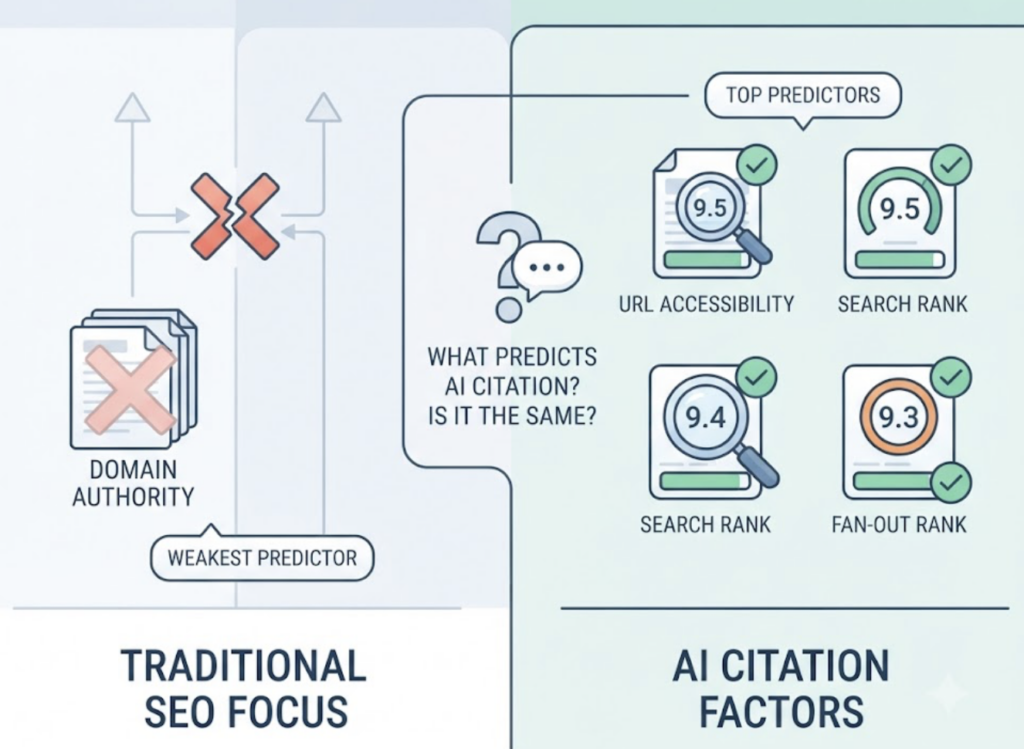
Profound’s research found only 6.82% overlap between ChatGPT’s most-cited sources and Google’s top 10 organic results. Cyrus Shepard’s meta-analysis of 54 experiments scored 23 citation ranking factors and confirmed the split: URL accessibility (9.5), search rank (9.4), and fan-out rank (9.3) topped the list, while domain authority barely moved the needle. The factor most SEO teams optimize for first is one of the weakest predictors of whether AI will cite you.
Here’s the thing. ChatGPT retrieves far more pages than it actually uses. AirOps’ analysis of 548,534 pages across 15,000 prompts found the model cites only 15% of what it pulls in. The other 85% gets evaluated and discarded before the user sees anything.
Being indexed isn’t the win. Being cited is. And the two require different strategies.
Earned Media Is the Strongest Citation SEO Signal
If citation SEO has a single dominant lever, the data points to earned media.
Muck Rack’s May 2026 analysis of 25 million cited links across ChatGPT, Claude, and Gemini found that earned media accounts for 84% of all AI citations. The University of Toronto ran large-scale controlled experiments confirming the pattern is structural: AI search exhibits a “systematic and overwhelming bias” toward third-party authoritative sources over brand-owned and social content.
The multiplier is measurable. Seer Interactive’s 2026 study of 800,000+ AI responses found brands with active third-party trust signals are cited in 75% of AI answers versus 1% for brands without. That’s a 75x gap. No amount of on-page optimization produces a difference of that magnitude.
ZipTie.dev’s research adds the brand-level view: brands in the top 25% for web mentions earn over 10x more AI citations than the next quartile. Brands in the bottom 50% are essentially absent from AI answers. Ahrefs’ study of 75,000 brandsconfirmed the hierarchy: brand web mentions correlate at 0.664 with AI visibility, while backlinks correlate at just 0.218. Three times stronger.
Content optimization without a corresponding earned media program is structurally limited.
Where the 325% Citation Lift Actually Comes From
The 325% figure isn’t about writing better content. It’s about earned distribution.
Stacker and Scrunch’s controlled study analyzed 944 prompt-platform combinations across five AI engines. When the same article lived only on the brand’s own site, citation rates averaged 7.6%. When that identical article was distributed through third-party news publishers, citation rates jumped to 34%. The median lift across all tested articles was 239%, with top performers reaching 325%.
Three mechanisms explain why this works:
| Mechanism | What Happens | Why AI Cites It |
|---|---|---|
| Entity association | Your brand appears alongside category terms on trusted domains | AI models build stronger brand-category connections |
| Authority transfer | High-DR publishers pass credibility to the content they host | AI engines treat publisher trust as a proxy for content trust |
| Corroboration signal | Multiple independent sources make the same claim about your brand | AI models weight corroborated claims higher than single-source claims |
Brands appearing on four or more third-party platforms are 2.8x more likely to be cited in ChatGPT responses than single-platform brands.
The distribution itself is the optimization.
What Citation-Ready Content Actually Looks Like
Earned media placement gets your content in front of AI engines. But the content still has to survive the extraction filter.
The Princeton/Georgia Tech GEO study (KDD 2024) tested six optimization strategies across 10,000 queries and found three techniques that consistently lifted AI citation rates. Adding statistics produced the strongest single gain: 41% visibility improvement. Citing authoritative sources drove a 115% improvement for lower-ranked pages. Quotation addition lifted visibility by 28%. Keyword stuffing performed 10% worse than doing nothing at all.
Structure matters as much as substance. Authoritas’ research found 44.2% of ChatGPT citations come from the first 30% of a page. Pages with FAQ schema are weighted roughly 40% higher in source selection. Tables get extracted at an 81% rate versus 23% for the same information written as paragraphs.
The GEO-16 framework from UC Berkeley quantified the threshold: pages scoring 0.70 or above on their 16-pillar audit with at least 12 pillar hits achieved a 78% cross-engine citation rate. The three pillars most strongly associated with citation were metadata and freshness, semantic HTML, and structured data.
Put those pieces together and the citation-ready formula becomes concrete: lead with a direct answer in the first 30% of the content, embed verifiable statistics with named sources, use tables and structured markup, and refresh on a regular cadence.
The 5-Step Citation SEO Playbook
Citation SEO isn’t a single tactic. It’s a system that connects content structure, earned distribution, and measurement.
Step 1: Audit Your Current AI Citation Baseline
Before optimizing anything, you need to know where you stand. Check whether your brand appears in AI answers for your core category queries across ChatGPT, Perplexity, Gemini, and Google AI Overviews. Only 14% of SEO teamscurrently track AI citation visibility, even though 43% name AI optimization a core 2026 strategy. That gap between intent and measurement is where most brands lose.
Topify provides this at scale. Its Source Analysis feature reverse-engineers which domains and URLs AI platforms cite for your category queries, showing you exactly where your brand appears, where it doesn’t, and which competitors own the citations you’re missing.
Step 2: Identify High-Citation Publications in Your Category
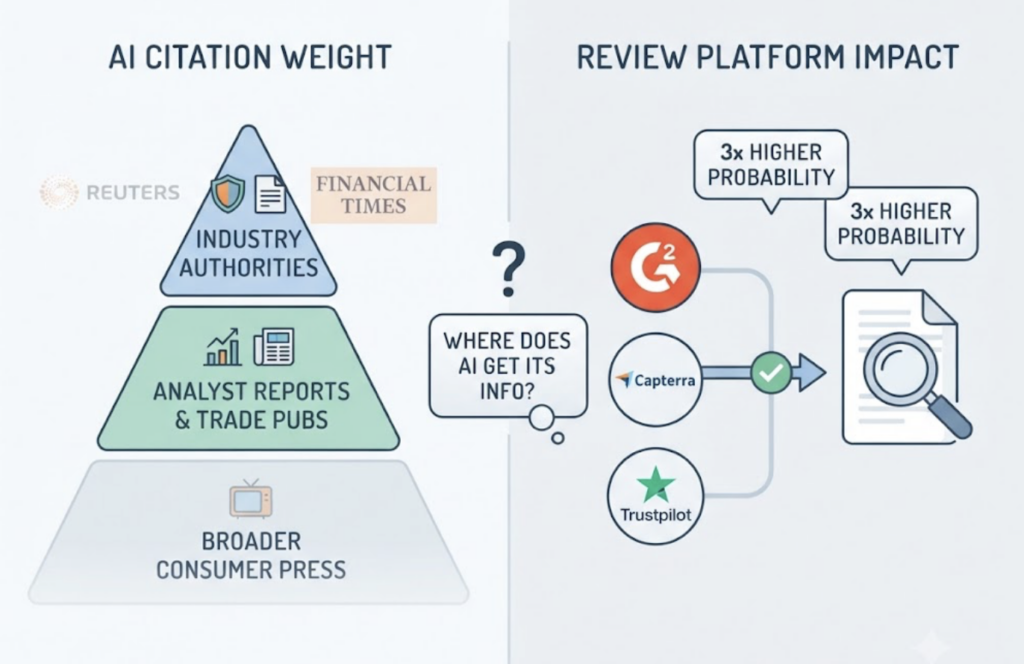
Not all earned media placements carry equal citation weight. AI engines cite trade publications, analyst reports, and category-specific outlets more frequently than broad consumer press. Reuters and Financial Times dominate ChatGPT citations. Review platforms like G2, Capterra, and Trustpilot carry outsized influence: sites with active review profiles show 3x higher citation probability.
Use Topify’s Competitor Monitoring to see which publications AI engines cite when recommending your competitors. That’s your target list.
Step 3: Build Citation-Ready Content Assets
Create content designed for extraction, not just engagement. Original research with proprietary data is the strongest citation magnet. Include specific statistics (the 41% lift applies here), direct expert quotes, and clear methodology. Structure with answer-first formatting, heading hierarchy, and FAQ schema.
One strong data asset, distributed well, outperforms ten generic blog posts. The Princeton study found that pages combining fluency optimization with statistics outperformed every single method by more than 5.5%.
Step 4: Distribute Through Earned Channels
Pitch your content asset to the publications you identified in Step 2. Focus on outlets AI engines already cite in your category. One placement in a publication that AI engines trust will generate more citation value than ten placements AI engines ignore. AirOps found that 32.9% of ChatGPT citations come from hidden fan-out queries, meaning your content needs to answer adjacent questions, not just the primary one.
Prioritize specificity. Verifiable claims. Named data sources. These are the elements AI extracts.
Step 5: Track the Correlation Window
Earned media placements typically appear in AI responses within two to four weeks as AI crawlers index new content. Set a measurement baseline before publishing, then track citation changes at the 2-week and 4-week marks.
Topify’s Visibility Tracking lets you monitor brand appearance across ChatGPT, Perplexity, Gemini, and AI Overviews from a single dashboard. When you publish an earned media placement, you can trace the exact citation lift it produces across platforms, connecting your PR investment to measurable AI visibility outcomes.
What Most Brands Get Wrong About Citation SEO
The biggest misconception is that citation SEO is just traditional SEO with a new label. It isn’t.
Optimizing your own website is necessary but insufficient. AI engines weight third-party validation significantly higher than self-published content. The Seer Interactive data makes this point starkly: the trust signal gap between brands with and without third-party mentions is 75x. A perfectly optimized page on a domain with no earned media presence will underperform a mediocre page on a domain with strong third-party coverage.
The second mistake is treating AI search as a single channel. Only 2% of cited URLs appear across AI Overviews, ChatGPT, and Perplexity simultaneously. Citation patterns are fragmented. What works on one platform may not register on another, which is why cross-platform tracking isn’t optional.
The third mistake is chasing volume over placement quality. Press releases account for a fraction of a percent of AI citations. Syndicated wire content earns just 0.04%. One well-placed article in a publication AI engines trust outweighs a dozen placements they don’t.
Conclusion
Citation SEO is where content strategy meets distribution strategy. The data is consistent across every major study from the past year: AI engines cite earned media at dramatically higher rates than brand-owned content, and the brands with the strongest third-party presence earn citations at 10x to 75x the rate of brands without it.
The 325% citation lift isn’t theoretical. It’s a measured outcome from distributing the same content through earned channels rather than keeping it on your own site. That’s the earned media play: build citation-ready content once, place it where AI engines look, and track the results across every platform that matters.
The brands measuring this now will own the citations that become harder to displace with every passing quarter.
FAQ
What is citation SEO?
Citation SEO is the practice of optimizing content so that AI search engines, including ChatGPT, Perplexity, Gemini, and Google AI Overviews, cite your brand in their generated answers. It combines content structure optimization with earned media distribution to increase the likelihood that AI models select and reference your content.
How does earned media improve AI citation rates?
AI engines show a structural preference for third-party, authoritative sources over brand-owned content. Research from the University of Toronto confirmed this bias is systematic across all major AI platforms. Distributing content through trusted publications provides the corroboration signal AI models need to confidently cite a brand.
How long does it take for earned media to appear in AI citations?
Earned media placements typically surface in AI responses within two to four weeks of publication as AI crawlers index the new content. However, building enough entity authority to cross the citation eligibility threshold generally takes six to twelve months of consistent earned media activity. Single placements help. Sustained programs compound.
What tools can track AI citation performance?
Tracking AI citations requires purpose-built platforms that monitor how AI engines reference your brand across multiple platforms. Topify provides cross-platform AI visibility tracking, source analysis to reverse-engineer what AI cites, and competitor monitoring to benchmark your citation performance against rivals. Traditional SEO tools like Ahrefs and SEMrush don’t currently measure AI citation behavior.

