

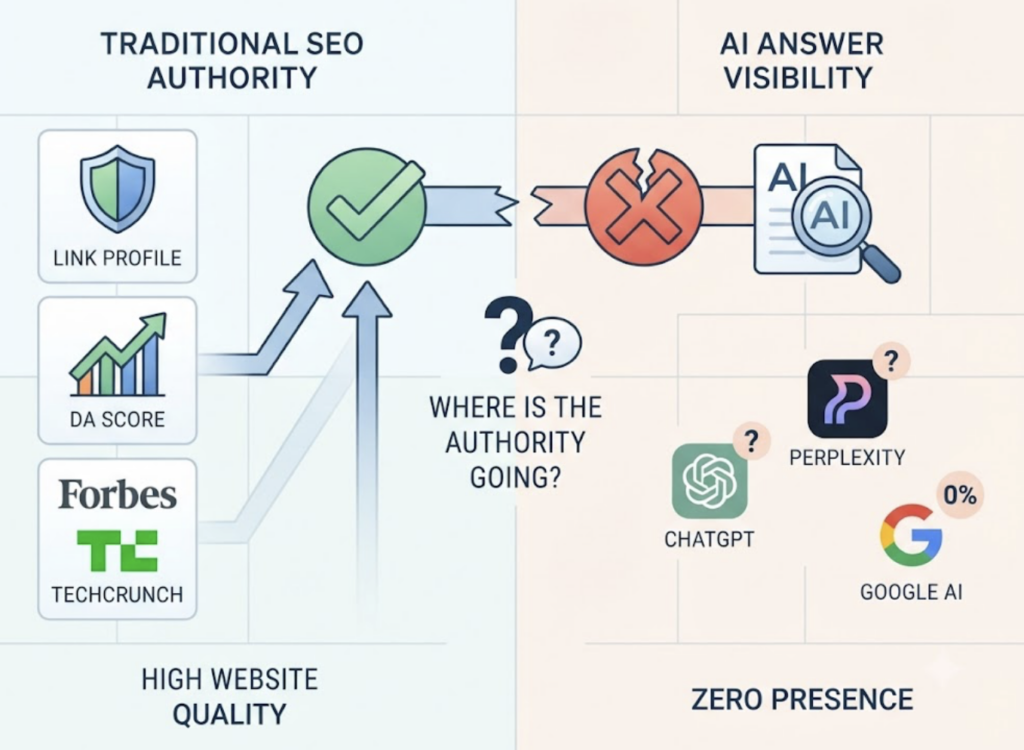
Your domain authority is 72. Your backlink profile took three years to build. Your keyword rankings are solid across every core category term. And when someone asks ChatGPT for a recommendation in your space, your brand doesn’t show up once.
That’s not an edge case. 90% of brands have zero mentions in AI search responses, according to a Search Engine Journal analysis of 177 brands across healthcare, SaaS, and financial services. The disconnect between traditional SEO authority and AI citation isn’t a bug in your strategy. It’s a structural shift that’s redefining what citation SEO actually means in 2026.
The Data Behind the DA-to-Citation Gap
The intuition is simple: high domain authority should equal high visibility everywhere. The data says otherwise.
Wellows’ 2026 analysis of citation signals across major AI platforms found Domain Authority correlates with AI citation probability at just r=0.18. Squared, that’s r²=0.032. In plain terms, DA explains roughly 3% of whether an AI engine cites your brand. The other 97% comes from signals DA doesn’t measure.
The gap gets sharper when you look at source overlap. Research across 22,410 domains found only 7.2% overlap between Google AI Overview sources and LLM citation lists. Two systems, reading from almost entirely different source libraries.
That’s the pattern showing up in marketing teams right now: a company with a solid backlink profile, a DA score they’re proud of, coverage in Forbes and TechCrunch, and zero presence in ChatGPT answers for their category. The explanation has nothing to do with their website quality and everything to do with where they’ve been building authority.
How AI Engines Pick Sources (It’s Not PageRank)
Google’s traditional ranking algorithm weights links as trust votes. More links from authoritative domains produce higher DA scores and generally higher rankings. AI citation selection works on a completely different mechanism.
AI search engines like ChatGPT, Perplexity, and Gemini use retrieval-augmented generation (RAG). They search an index first, retrieve candidate passages, then synthesize an answer using those passages. The selection favors content that’s extractable, verifiable, and directly responsive to the query, not content that accumulated the most link equity over time.
Cyrus Shepard’s 2026 meta-analysis of 54 experiments, patents, and case studies scored 23 AI citation factors by evidence strength. The top five: URL accessibility (9.5/10), search rank (9.4), fan-out rank (9.3), preview control (9.2), and query-answer match (9.2). Notice what’s missing from the top of that list: backlink count and domain authority.
Only 2% of cited URLs appear across AI Overviews, ChatGPT, and Perplexity simultaneously. 91% of citations appear in only one AI engine. Each platform is making independent source decisions, not importing Google’s authority hierarchy.
Five Citation SEO Signals That Outperform Domain Authority
If DA explains 3% of AI citation variance, what explains the rest? The research points to five signals, each with stronger data support than backlink metrics.
Brand Mention Frequency Beats Backlink Count
Ahrefs studied 75,000 brands and found branded web mentions correlate with AI Overview visibility at 0.664. Backlinks: 0.218. That’s a 3-to-1 gap in predictive power.
The implication is counterintuitive for anyone trained on traditional SEO. A Reddit thread that names your brand without linking is worth more for AI citations than a backlink from a low-authority blog. Brands present on four or more third-party platforms are 2.8x more likely to appear in ChatGPT responses.
YouTube mentions showed an even stronger signal at 0.737 correlation. AI engines are reading transcripts, descriptions, and comments. Publishing volume on your own domain showed almost no relationship with AI visibility. Earned presence matters. Self-published volume doesn’t.
Named Author Credentials and E-E-A-T Depth
The GoodFirms 2026 survey of 100+ SEO professionals across 20+ countries produced one unanimous finding: 100% of respondents agree E-E-A-T will matter more in 2026. It’s the only item in the entire survey that reached full consensus.
Wellows’ data backs this with numbers. E-E-A-T signals correlate with AI citation probability at r=0.81, compared to DA’s r=0.18. That’s a 4.5x difference in predictive strength.
A DR-30 site with named industry experts, verifiable credentials, and transparent sourcing can and does out-cite a DR-85 site that publishes unsigned content.
AI systems are selecting passages, not ranking domains. When a passage includes a named author with identifiable expertise, the AI engine treats it as higher-confidence evidence.
Original Data and Statistical Depth
The Princeton GEO study (KDD 2024) tested nine content modification strategies across 10,000 queries. Adding statistics was the single most effective tactic, improving AI visibility by up to 40%. Adding citations from credible sources produced comparable gains.
Content with specific data points, benchmark numbers, and verifiable claims gets preferential treatment in RAG pipelines. AI engines are essentially doing what a research assistant does: scanning five sources and picking the one with the most concrete, quotable evidence. A page with “our product improves efficiency” loses to a page with “a 12-week pilot across 340 accounts showed a 23% reduction in response time.”
Promotional content tone actually hurts. One analysis found a negative 26.19% correlation between marketing-style language and AI citation probability. The more your content sounds like a sales page, the less likely it gets cited.
Content Structure and Readability
Not all content formats earn citations equally. According to Wix’s 2026 research, articles and listicles are among the top content types cited by AI engines. The structure matters because AI systems extract passages, not pages. Content organized into clear, self-contained answer blocks with logical heading hierarchies is easier for RAG systems to parse and cite.
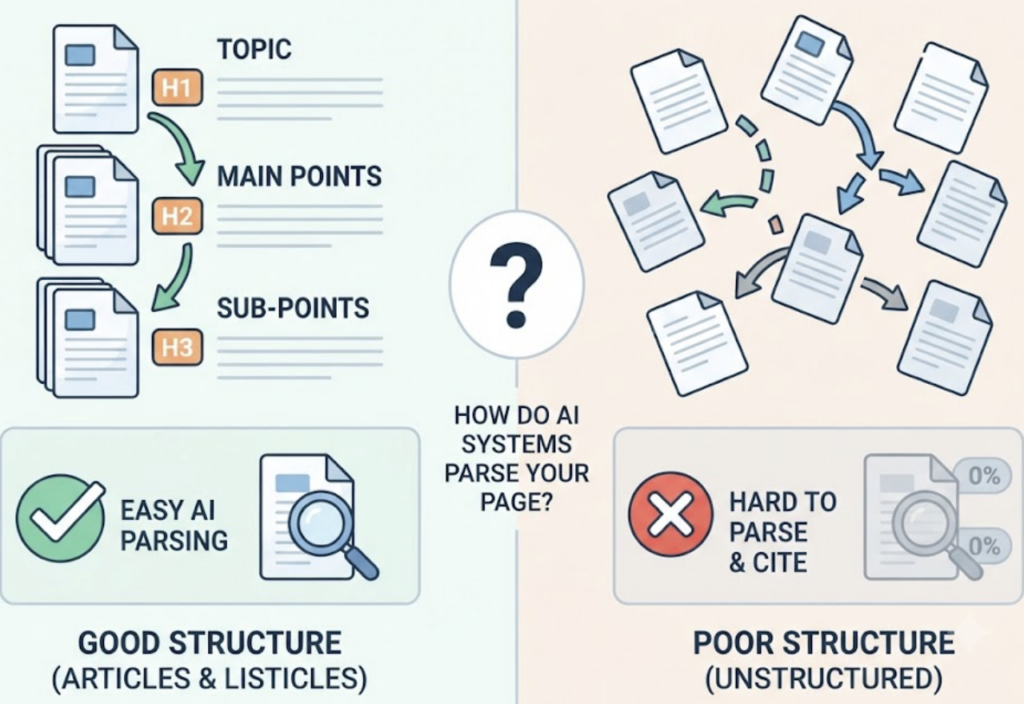
AirOps’ analysis of 50,553 ChatGPT responses found that ChatGPT only cites 15% of the pages it retrieves. The 85% that get retrieved but not cited typically lack the structural clarity needed for extraction. Getting into the retrieval pool isn’t enough. Your content has to be citable once it’s there.
That same GoodFirms survey found only 70% of marketers use plain, simple language, despite AI systems favoring it for citation. Readability isn’t a nice-to-have. It’s a citation signal.
Freshness and Refresh Cadence
Content updated within the last 30 days earns roughly 3.2x more AI citations than older pages. AirOps’ data narrows this further: pages aged 30 to 89 days hit the highest citation rate at 32.8%, while content older than two years drops to 27.5%.
The freshness effect is accelerating. ChatGPT’s shift to GPT-5.3 as its default model reduced the average number of cited domains from 19.1 to 15.2, a 20% decrease. The model is becoming pickier, and recency is one of the filters it’s applying more aggressively.
A five-year-old page with DA 85 that hasn’t been touched will get out-cited by a six-month-old page with DA 30 that has current statistics, a named author, and a visible “Last updated” timestamp.
Freshness doesn’t replace depth. But depth without freshness is increasingly invisible.
How to Track Whether AI Is Citing You
Here’s the operational blind spot: only 14% of marketing teams track AI/LLM citation visibility, even though 43% name AI optimization a core 2026 strategy. The gap between intention and instrumentation is enormous.
Traditional SEO tools like Ahrefs and Semrush can’t tell you whether ChatGPT cited your brand yesterday. They track rankings in Google’s index, not source selections in AI-generated answers.
That’s the problem Topify is built to solve. Its Source Analysis feature tracks the exact domains and URLs that AI platforms cite when answering queries in your category, across ChatGPT, Gemini, Perplexity, and other major engines. You can see which competitors are getting cited, which sources AI prefers, and where your content gaps are. The Visibility Tracking dashboard shows your brand’s mention frequency over time, broken down by platform and prompt. If ChatGPT stops citing you for a specific query cluster, you’ll know within the tracking cycle, not six months later when traffic declines become visible.
For teams not ready to commit to a paid plan, Topify’s free GEO Score Checker scans any URL across ChatGPT, Gemini, Perplexity, Claude, and Google AI Overviews. It returns a 0-to-100 score covering AI bot access, structured data, content signals, and current citation visibility. No signup required. Most teams find they can boost their score 20 to 30 points just by unblocking AI crawlers in robots.txt and deploying foundational schema markup.
DA Still Has a Job. It’s Just Not the One You Think.
None of this means you should stop building backlinks.
AI platforms still draw primarily from pages that rank well in traditional search. Ranking on page one for a query gives you roughly a 33% chance of citation. Once you rank across the fan-out query cluster too, your odds climb to 80-90%. Search rank scored 9.4 in Shepard’s framework, the second-highest factor.
The nuance is that DA is an upstream input, not the final signal. Backlinks help a page rank high enough to enter the AI retrieval pool. But once you’re in the pool, what determines whether you actually get cited is content quality, brand mention frequency, author credentials, statistical depth, and freshness. Think of DA as the entry ticket. The citation is the show.
The practical reallocation looks like this: if your DA is already above 40-50 and you’re ranking in the top 10 for core queries, the marginal return on more link-building is small for AI citation purposes. That next dollar of effort buys more visibility when spent on earning brand mentions, publishing original data, refreshing existing content monthly, and building named author presence across third-party platforms.
Conclusion
Domain Authority measures who deserves a Google ranking. AI citation authority measures who deserves to be quoted. Two different questions, two different answers.
The brands winning citation SEO in 2026 aren’t the ones with the highest DA scores. They’re the ones with the strongest combination of brand mentions, author credentials, original data, structured content, and aggressive refresh cadence. The correlation data is unambiguous: DA explains 3% of citation variance, while E-E-A-T explains over 65%.
Start by auditing where you actually stand. Run a free GEO score check to see what AI engines see when they look at your site. Then redirect effort from the signals that got you ranked to the signals that get you cited.
FAQ
Q: Does domain authority still matter for citation SEO?
A: Yes, but as an upstream input rather than a direct citation signal. DA helps your pages rank high enough to enter the AI retrieval pool. Once there, citation selection depends on content signals like E-E-A-T, brand mentions, and freshness. Wellows data shows DA correlates at r=0.18 with AI citation probability, while E-E-A-T correlates at r=0.81.
Q: How do I check if AI is citing my brand?
A: Traditional SEO tools can’t track this. You need an AI visibility platform that monitors citation patterns across ChatGPT, Gemini, Perplexity, and AI Overviews. Topify’s free GEO Score Checker provides a baseline diagnostic. For ongoing tracking, its Source Analysis feature shows which domains AI engines cite in your category at the prompt level.
Q: What content format gets cited most by AI engines?
A: Articles and listicles with clear heading hierarchies, self-contained answer blocks, and statistical evidence earn the highest citation rates. The Princeton GEO study found that adding statistics and source citations improved AI visibility by up to 40%. AirOps data shows 68.7% of ChatGPT-cited pages follow logical heading structures.
Q: How long does it take to improve AI citation rates?
A: Page-level edits like adding statistics, named authors, and refreshing content produce measurable citation changes within two to four weeks. Building brand-level AI citation authority through third-party mentions and cross-platform presence takes three to six months, as AI models retrain in cycles rather than continuously.

