

You’ve spent years shaping how people describe your brand. Then someone asks ChatGPT about your category, and the model calls your premium product a “budget option,” lists a competitor first, or states a refund policy you retired two years ago. Nobody wrote that. No journalist, no reviewer, no customer. The model generated it, and the person reading it has no reason to doubt it. Most brands still measure reputation through reviews and social mentions, channels where a human said something you can find and respond to. The harder problem is the sentence an AI produces on demand, phrased differently every time, that you never see. That blind spot is exactly what AI reputation monitoring tracking is built to close.
What AI Reputation Monitoring Tracking Actually Means
AI reputation monitoring tracking is the practice of systematically checking what AI models say about your brand, not just whether they mention it. It covers three things at once: the tone of the answer, the accuracy of the claims, and the sources the model leaned on to make them.
That’s different from social listening. Social listening captures things humans posted, which you can find, quote, and respond to. AI answers get generated on demand, phrased differently every time, and usually stay invisible to the brand they describe.
The shift matters because buyers are already there. In one December 2025 survey, 38% of consumers used AI specifically for product research and 30% used it to compare competing options side by side. Those are the exact moments a reputation gets shaped.
Here’s the part most teams miss. You aren’t tracking a page anymore. You’re tracking a machine’s opinion of you.
How AI Reputation Monitoring Tracking Works Under the Hood
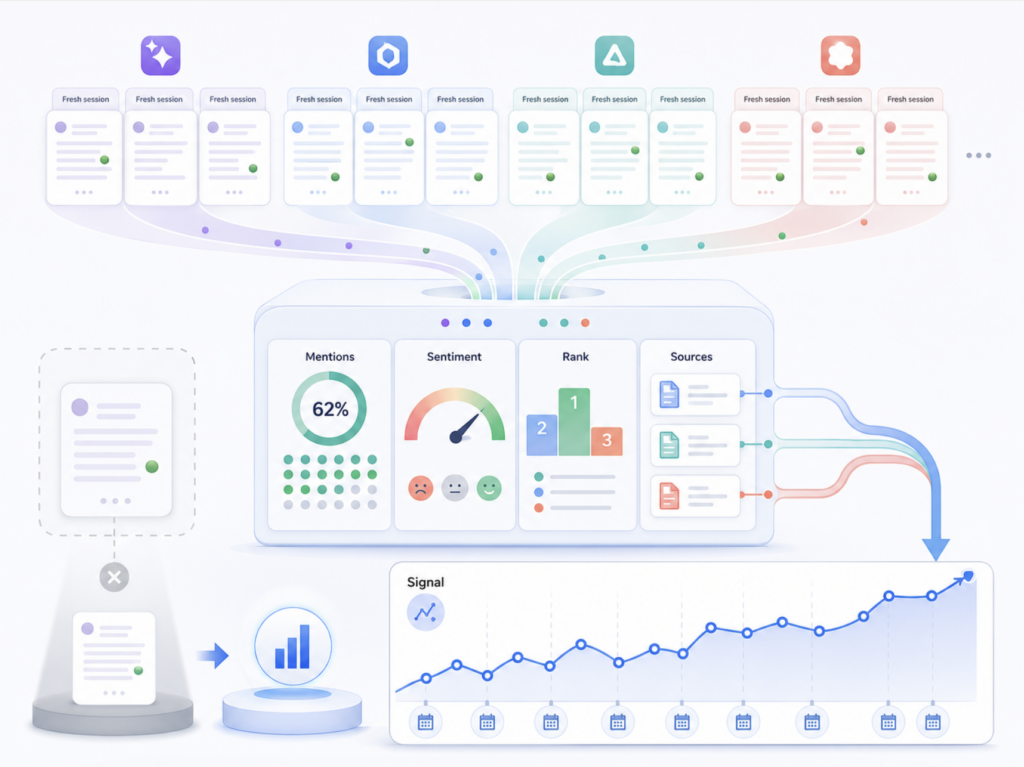
The mechanics are less mysterious than they sound. You start with a set of prompts real buyers ask in your category, run them across the models that matter, and record what comes back.
The catch is that AI answers aren’t stable. Benchmark tests show that running the same prompt 1,000 times can still produce 80 distinct responses, even with randomness dialed to its lowest setting. Ask ChatGPT about your brand on Monday and again on Wednesday, and you may get two different verdicts.
That’s why a single screenshot proves nothing. Real monitoring runs each prompt repeatedly across many fresh sessions, measures the percentage of runs that name your brand and how positively, then tracks that rate over time. From there, the system extracts every brand mention, scores the sentiment, notes your position relative to competitors, and captures which sources the model cited to build the answer. Do that on a schedule across ChatGPT, Gemini, Perplexity, and the rest, and you have a signal instead of an anecdote.
Why a Bad AI Answer Costs More Than a Bad Review
An AI recommendation carries more weight than most brands realize. Similarweb found that consumers recommended a brand by ChatGPT were 2.5 times more likely to visit it than a competitor, even with no link and no prior visit.
On the B2B side, the pull is stronger. G2 reported that 69% of software buyers picked a different vendor than they’d planned based on AI chatbot guidance, and one-third bought from a company they’d never heard of before.
Now flip it. When the answer is wrong, the damage lands on you, not the model. A court held Air Canada liable for a refund policy its chatbot invented, setting a precedent that a company owns what its AI says. Customers also rarely separate “the AI made a mistake” from “the company gave me false information”. One analysis pegged AI-driven misinformation at $2.6 billion in annual revenue loss for e-commerce brands alone.
A bad review sits on one page. A bad AI answer regenerates every time someone asks.
The Metrics That Tell You If Your AI Reputation Is Healthy
You can’t manage what you don’t measure, and “are we mentioned” is too blunt to act on. A useful AI reputation monitoring system tracks a handful of metrics together.
| Metric | What it measures | Why it matters |
|---|---|---|
| Mention rate | How often AI names your brand across repeated runs | Tells you whether you’re in the conversation at all |
| Sentiment | Whether the tone is positive, neutral, or negative | A negative mention can hurt more than no mention |
| Position | Where you land versus competitors in the answer | First-named brands capture most of the attention |
| Source mix | Which domains the model cites to describe you | Shows you what to fix and where |
| Competitor share | How often and how favorably rivals appear | Frames your reputation against the category |
One caveat on sentiment. AI answers tend to skew heavily positive across most engines, so a high raw score means less than it looks. The signal is in the movement: a dip in sentiment, a rise in neutral mentions, or a single negative claim that keeps resurfacing.
And no single platform tells the whole story. Across 50 buyer-intent prompts, three major engines named the same brand only 21% of the time. Track one, and you’re blind to the other two.
Turning Metrics Into an AI Reputation Dashboard
Scattered across five platforms, these numbers are noise. Pulled into one dashboard, they become a story you can act on.
That’s the job of a monitoring platform. Topify, for example, tracks seven metrics including visibility, sentiment, and position across ChatGPT, Gemini, Perplexity, DeepSeek, and other engines, so a drop in one place shows up next to the data that explains it.
Where Most AI Reputation Tracking Goes Wrong
Three mistakes show up again and again.
The first is tracking a single platform. It feels efficient, and it’s the fastest way to miss a problem, given how little the engines agree. The fix is to measure across every model your audience actually uses.
The second is watching visibility but ignoring sentiment. Being named in a negative or inaccurate answer is worse than not being named at all, and a mention count won’t catch that. Tone tracking will.
The third is the expensive one: ignoring sources. You can’t argue a model into changing its mind, because the answer reflects the sources it retrieved. 79% of consumers say they’d verify an AI recommendation against other sources before trusting it, and nearly 30% check a brand’s social profiles right after getting an AI answer. If those sources carry wrong or stale information, the AI repeats it, and so do your buyers.
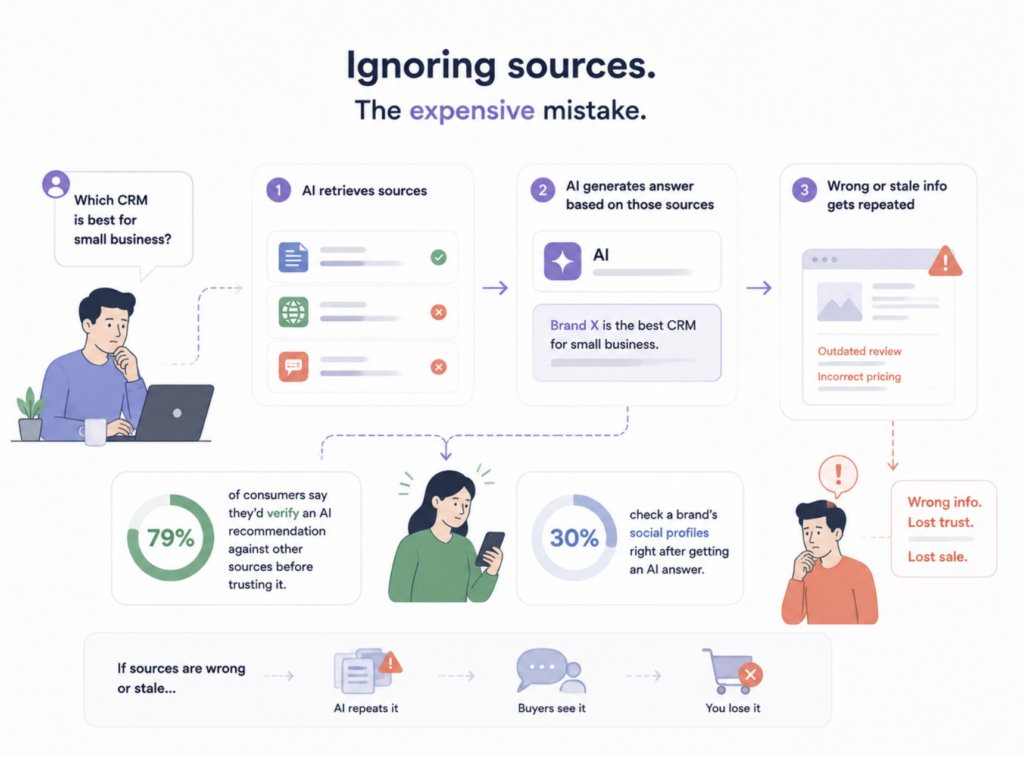
The fix is a loop, not a one-time cleanup. Build a register of inaccurate answers, repair the strongest sources feeding them, and retest on a schedule. That’s reputation work, done at the source layer.
What to Look for in an AI Reputation Monitoring Tool, Platform, or Software
Once you’re ready to buy, the criteria matter more than the label on the box, whether it’s sold as a tool, a software suite, or a full platform. A capable solution should cover multi-platform tracking, sentiment scoring rather than raw mention counts, source-level analysis so you can trace and fix the answer, competitor benchmarking, and repeated sampling to smooth out that non-determinism problem.
Most tools stop at “you were mentioned.” The useful ones tell you why.
This is where Topify fits for teams managing brand reputation. Its Sentiment Analysis scores how AI engines describe your brand on a 0 to 100 scale, so you can catch the moment a model starts calling your premium product a budget option. Source Analysis reverse-engineers the exact domains and URLs the engines cite, which turns a vague “the AI got it wrong” into a specific list of pages to fix. And Competitor Monitoring shows how rivals get described in the same answers, so you know whether a sentiment gap is your problem or the whole category’s.
Pricing starts at $99 per month on the Basic plan, which covers ChatGPT, Perplexity, and Google AI Overviews tracking with 100 prompts. For teams that want to move from watching to fixing, you can get started and have a baseline within a session.
Conclusion
The sentence an AI produces about your brand is now part of your reputation, and for most teams it’s the part nobody’s reading. Reviews and social mentions still matter, but they no longer cover the channel where a growing share of buyers form their first impression. Start small: define the prompts your buyers actually ask, run them across the models that matter, and watch tone and sources over time rather than checking once and hoping. The brands that treat AI answers as a measurable, fixable surface will stay accurately described. The rest will find out what the model thinks only after a customer does.
FAQ
Q: What’s a good checklist for AI reputation monitoring tracking?
A: Start with five items: a prompt set built from real buyer questions, coverage across every AI platform your audience uses, sentiment scoring alongside mention counts, source tracking so you can trace claims back to their origin, and a fixed cadence for re-running everything. Repeated sampling belongs on the list too, since one-off checks miss the variance built into AI answers.
Q: What does a strong AI reputation strategy look like?
A: It’s less about chasing a perfect score and more about a repeatable loop. Measure how AI describes you across models, identify the inaccurate or negative answers that affect buying decisions, repair the sources those answers pull from, then retest. A good strategy also benchmarks competitors, because reputation in AI search is relative to who else the model names.
Q: What are some examples of AI reputation problems?
A: Common ones include a model describing a premium product as budget, citing a discontinued product or an old pricing page, stating a policy you no longer offer, or ranking a competitor first in answers to your core category prompts. A widely cited case involved an airline held liable for a refund policy its chatbot fabricated.
Q: How much does AI reputation monitoring tracking cost?
A: It varies by coverage and prompt volume. Entry-level platforms tend to start around $99 per month for tracking across the major engines, with higher tiers adding more prompts, projects, and seats. The real comparison is against the cost of a single misinformed answer reaching buyers unchecked.

