


Your team spent six months building domain authority, earning backlinks, and climbing Google rankings. Then a prospect asked ChatGPT, “What’s the best project management tool for remote engineering teams?” and got a ranked list of four vendors with inline citations. Your brand wasn’t on it.
The strange part: your Google rankings didn’t drop. Your domain authority is stable. GA4 shows nothing unusual. But demo requests are quietly shrinking, and your pipeline can’t explain why. That disconnect points to a shift your dashboard wasn’t built to detect.
SaaS Buyers Don’t Start on Google Anymore
According to a March 2026 survey of 1,076 B2B software decision-makers, 51% now initiate vendor research inside an AI chatbot, up from 29% just eleven months prior. That’s not a gradual drift. That’s a structural break in the SaaS buyer journey.
The broader search data confirms it. Research from Bain & Company shows roughly 60% of all search sessions now end without a single click to an external website. In the US, that number sits at 58.5% according to SparkToro, and it climbs to 75% on mobile.
Google AI Overviews now appear on over 25% of tracked searches. In Google’s AI Mode, the zero-click rate hits 93%. The traditional click-through funnel that SaaS content marketing was built around is compressing faster than most teams realize.
That’s the gap most SaaS marketers still can’t see.
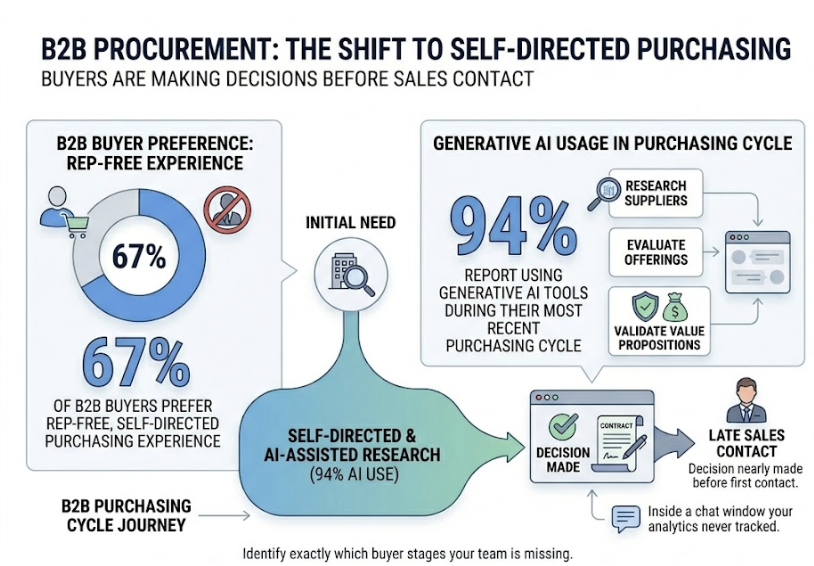
B2B procurement data backs this up: 67% of B2B buyers now prefer a rep-free, self-directed purchasing experience. And 94% report using generative AI tools during their most recent purchasing cycle to research suppliers, evaluate offerings, and validate value propositions. By the time a buyer contacts your sales team, the decision is nearly made, inside a chat window your analytics never tracked.
What AI Search Visibility Actually Means for B2B SaaS
Traditional SEO optimizes for a list of blue links. You rank pages, earn clicks, and nurture visitors through a funnel. AI search visibility is a fundamentally different metric: it measures how frequently, where, and in what context a brand is mentioned, recommended, or cited in AI-generated answers across platforms like ChatGPT, Gemini, and Perplexity.
The difference isn’t cosmetic. It’s structural.
| Dimension | Traditional SEO | Generative Engine Optimization (GEO) |
|---|---|---|
| Primary Goal | Rank pages to maximize CTR | Get cited and recommended in AI syntheses |
| Key Signals | Backlinks, keyword volume, domain authority | Entity clarity, structured data, factual density |
| Crawl Target | Googlebot indexing your domain | GPTBot, ClaudeBot scraping owned and third-party footprints |
| Conversion Path | High-volume TOFU traffic requiring on-site nurture | Compressed, pre-qualified traffic with high intent |
When a SaaS buyer types a multi-variable query like “best project management software for remote engineering teams using JIRA” into ChatGPT, the engine doesn’t return a list of blog posts. It evaluates dozens of sources, reads user sentiment on forums, scans documentation, and compiles a ranked shortlist of three to four vendors with inline citations.
For SaaS marketers, this compresses the middle of the funnel. Traditional content marketing relies on capturing broad informational queries to build email lists and run multi-month nurture sequences. In a zero-click, AI-mediated ecosystem, that middle layer gets bypassed entirely. Buyers who eventually click on a citation within an AI response are already pre-qualified: they’ve compared feature sets, verified pricing, and evaluated competitors inside the chat interface.
The Numbers That Explain the Shift
The scale of this migration isn’t speculative. AI chatbot environments have moved from novelty utilities to critical research tools, with total traffic growing 81% year-over-year to 55.2 billion annual visits.
Platform-specific adoption tells the story:
| Platform | Metric | Timeframe |
|---|---|---|
| ChatGPT | 2.5 billion daily queries | July 2025 |
| ChatGPT | 900 million weekly active users | February 2026 |
| ChatGPT | 79% share of generative AI traffic | September 2025 |
| Google Gemini | 1.1 billion monthly visits (157% growth) | April to September 2025 |
| Perplexity | 45 million monthly active users | H2 2025 |
Gartner projected a 25% decline in traditional search engine volume by 2026, expanding to 50% by 2028. That contraction isn’t evenly distributed. Informational queries, the foundation of SaaS content marketing, are the hardest hit.
| Query Type | Zero-Click Share | Impact on SaaS Content |
|---|---|---|
| Definitional / What-is | 85% | Extreme: AI resolves basic terms instantly |
| How-to / Step-by-step | 72% | High: steps extracted directly on the search page |
| Comparison / Versus | 61% | Moderate to High: multi-brand comparisons synthesized into tables |
| Best-of / Listicle | 57% | Moderate: vendor lists presented without blog clicks |
| Product Research | 38% | Low to Moderate: buyers seek verified pricing and reviews |
| Transactional / Buy | 22% | Low: users must click through to purchase |
Here’s the data point that reframes the entire conversation: visitors arriving at a website via AI search referrals convert at approximately 23 times the rate of traditional search visitors. They spend 68% more time on-site, with session durations four times longer. Less traffic, but dramatically higher quality.
Why Your Analytics Dashboard Can’t See This
GA4 and Google Search Console were built for a click-based web. They’re structurally incapable of measuring brand exposure within generative conversational environments.
Three blind spots compound the problem.
First, AI engines process crawled data within closed-loop systems. Brand mentions don’t trigger JavaScript pageviews or cookie-based tracking. When your brand gets recommended inside ChatGPT, GA4 registers nothing.
Second, when citation links are clicked, referral data is often stripped. That high-intent visitor who found you through an AI recommendation? GA4 classifies them as “Direct” traffic, misallocating conversion credit and understating AI’s true impact on your pipeline.
Third, zero-click behavior means users consume synthesized recommendations directly on the chat interface without ever visiting an external link. Your brand could be evaluated, compared, and shortlisted by thousands of potential buyers, and your analytics would show zero impressions.
Hallucination rates across major models range from 15% to 52%, materializing as fabricated product features, omitted differentiators, outdated pricing, and competitor confusion. Without dedicated monitoring, these errors compound as models recirculate inaccurate data.
SaaS marketing teams frequently make decisions using incomplete data as a result. They may cut high-performing content programs because GA4 shows declining organic traffic, unaware those same pages serve as primary training sources driving high-value recommendations in ChatGPT and Perplexity.
How to Track the Shift Before Your Competitors Do
Manual auditing is mathematically impractical. Assessing just 10 conversational prompts across three major engines requires processing 30 unique syntheses and cataloging hundreds of brand mentions. Scale that to the 50 to 100 prompts that matter for a typical SaaS category, and it’s a full-time job with no historical trend data.
Topify resolves this efficiency barrier by automating brand presence evaluation across multiple AI engines in seconds. The platform tracks AI search visibility across seven core metrics:
| Metric | What It Measures |
|---|---|
| Visibility Rate | Percentage of relevant prompts where your brand is explicitly mentioned |
| Sentiment Score | How favorably AI models describe your brand (0 to 100 scale) |
| Recommendation Position | Whether you’re the primary recommendation or listed as an afterthought |
| AI Query Volume | Estimated monthly searches across AI platforms for category prompts |
| Mentions | Absolute frequency of brand mentions per 1,000 queries |
| Intent | Classifies prompts into Awareness, Consideration, Decision, or Retention |
| CVR (Conversion Visibility Rate) | Percentage of queries that translate into purchase intent |
Most analytics tools give you two or three of these signals. Topify connects all seven and links them to downstream revenue indicators.
Where Topify Tracks Across AI Platforms
Each generative engine uses distinct retrieval-augmented generation (RAG) architectures, web crawls, and citation behaviors. ChatGPT, Gemini, Perplexity, DeepSeek, Doubao, and Qwen don’t “read the same internet.” A brand consistently recommended in ChatGPT responses may be completely absent on Perplexity, which pulls nearly 46.5% of its top citations from Reddit.
Topify isolates visibility metrics across each platform independently. When the system detects a competitor securing a new citation in a “best of” prompt, it flags the gap and identifies the content change needed to close it. That’s the difference between reacting to lost visibility and staying ahead of it.
What to Do Once You See the Data
Tracking is the first step. Acting on the data is where AI search visibility turns into pipeline growth.
Topify’s Source Analysis reverse-engineers AI citation patterns, identifying the specific domains and URLs that generative models trust when answering category questions. If your competitor is being cited and you’re not, Source Analysis shows exactly which authoritative sources you’re missing.
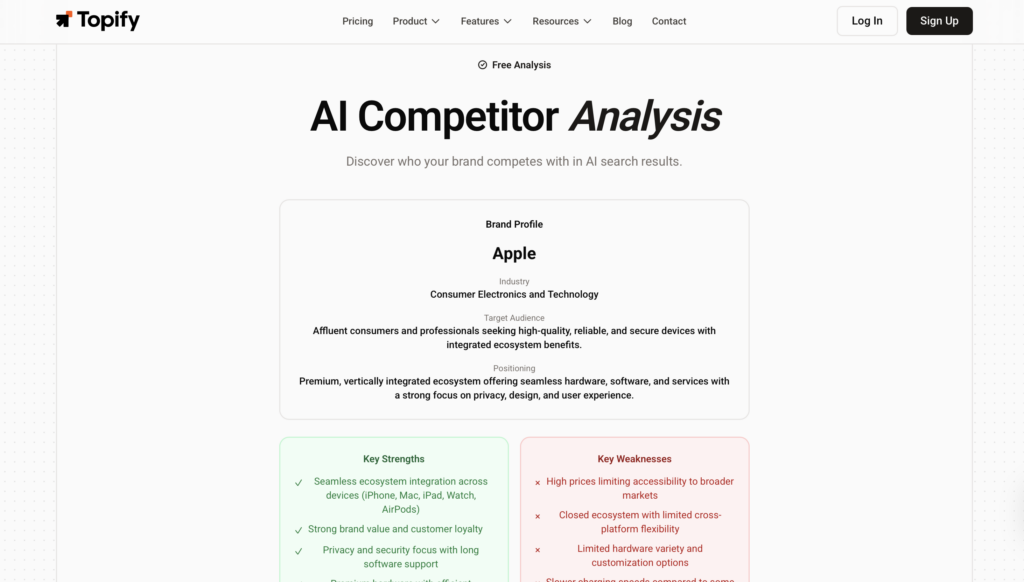
GEO Score Checker
Research from Princeton and Georgia Tech demonstrates that targeted GEO formatting adjustments yield direct visibility lifts:
| GEO Strategy | Visibility Improvement |
|---|---|
| Citing authoritative sources | +40% |
| Adding statistics and data | +37% |
| Including expert quotations | +30% |
| Precise technical terminology | +28% |
These aren’t abstract recommendations. They’re testable, measurable interventions that change whether an AI engine includes your brand in its synthesized response.
On the flip side, GEO doesn’t replace traditional SEO. The two methodologies are complementary. Structured technical SEO serves as the prerequisite baseline for AI crawling and extraction. About 76% of AI Overview citations still pull from pages ranking in Google’s top 10. But ranking alone isn’t enough. If your content isn’t structured for extraction, cited by third parties, and factually dense, the AI will skip it for a better-structured source from page two.
The bottom line: SaaS brands that treat AI search visibility as a measurable channel today will have a meaningful head start by the end of 2026. The ones still relying solely on organic traffic dashboards are optimizing for a funnel their buyers have already left.
Start with a baseline. Topify’s free GEO Score Checker evaluates your site’s technical AI-readiness, the Brand Sentiment Checker measures how AI platforms describe your brand, and the AI Visibility Checker shows your actual mention frequency across ChatGPT, Gemini, and Perplexity.
Conclusion
The migration of SaaS buyers from Google to generative AI engines isn’t a future trend. It’s a structural shift happening now. With zero-click searches crossing 60% globally and 94% of B2B buyers integrating LLMs into procurement research, measuring marketing performance through organic traffic and link clicks alone is a strategic liability.
Being absent from AI-generated recommendations means your brand is excluded from the buyer’s consideration set before a sales rep is ever contacted. The SaaS companies that win in this environment won’t be the ones with the highest domain authority. They’ll be the ones whose brands appear, get cited, and get recommended when a buyer asks an AI engine for advice.
Track it. Optimize it. Done.
FAQ
What is AI search visibility?
AI search visibility measures how frequently and favorably your brand is mentioned, cited, or recommended in answers generated by AI platforms like ChatGPT, Gemini, Perplexity, and Google AI Overviews. It evaluates the quality of recommendations, ordinal placement in synthesized lists, and the AI’s sentiment toward your brand, which is fundamentally different from traditional search rankings.
How much SaaS traffic is shifting from Google to ChatGPT?
Gartner projected a 25% drop in traditional search volume by 2026 due to AI adoption. Informational queries, the backbone of SaaS content marketing, are experiencing traffic declines of 15% to 40% as AI Overviews and chatbots resolve intent directly. The traffic that does arrive from AI search tools is pre-qualified, converting at up to 23 times the rate of traditional organic search.
Can Google Analytics track AI search traffic?
No. GA4 can’t track interactions within closed AI chat sessions because no page load is triggered on your website. When a user clicks a citation link, the referral data is often stripped, causing GA4 to misclassify the visit as “Direct” traffic. This creates a measurement blind spot for SaaS marketing teams relying on traditional analytics.
How can I check if my brand appears in ChatGPT?
Manual spot-checking across various prompts is possible but highly inefficient and fails to account for regional differences and model updates. Topify automates this process by querying actual AI engines in real time, providing automated reports of mention frequency, recommendation position, and sentiment score across multiple platforms.
What’s the difference between SEO and GEO?
SEO focuses on positioning web pages at the top of organic search results to drive clicks, prioritizing signals like domain authority, keyword volume, and backlinks. GEO (Generative Engine Optimization) focuses on optimizing content so it gets selected, synthesized, and cited by AI engines. GEO prioritizes semantic clarity, factual density, structured data, and off-site brand mentions.
<div data-topify-widget=”report-generator”></div>

