

Your brand ranks #1 on Google. You’ve got the backlinks, the traffic, the domain authority. But when someone asks ChatGPT “what’s the best tool for [your category],” your name doesn’t come up once.
That’s not an SEO problem. That’s an AI search visibility problem, and it’s a different fight entirely.
The Part Google Analytics Won’t Show You
Traditional SEO metrics, clicks, rankings, organic sessions, are built around one assumption: users visit your website. But AI search doesn’t work that way.
When someone asks Perplexity or Gemini a question, they get a synthesized answer. No blue links. No need to click. The AI pulls from multiple sources, generates a response, and the user moves on.
Google Analytics sees none of that. Your brand could be mentioned in hundreds of AI answers every day, or completely absent, and your dashboard wouldn’t tell you either way.
That’s the gap most marketing teams still can’t see.
So What Does “AI Search Visibility” Actually Mean?
At its core, AI search visibility measures how often your brand appears in AI-generated answers, and how well it appears, across platforms like ChatGPT, Gemini, and Perplexity.
It’s not about ranking. It’s about being cited, recommended, and described accurately when a user’s question is relevant to what you do.
Three dimensions define it:
1. Mention Rate: Did AI Bring Up Your Brand at All?
Mention rate tracks what percentage of relevant prompts actually produce a response that includes your brand name. If someone searches “best project management software” and you never appear, you’re functionally invisible on that search path, regardless of your Google ranking.
2. Position: Where in the Answer Do You Show Up?
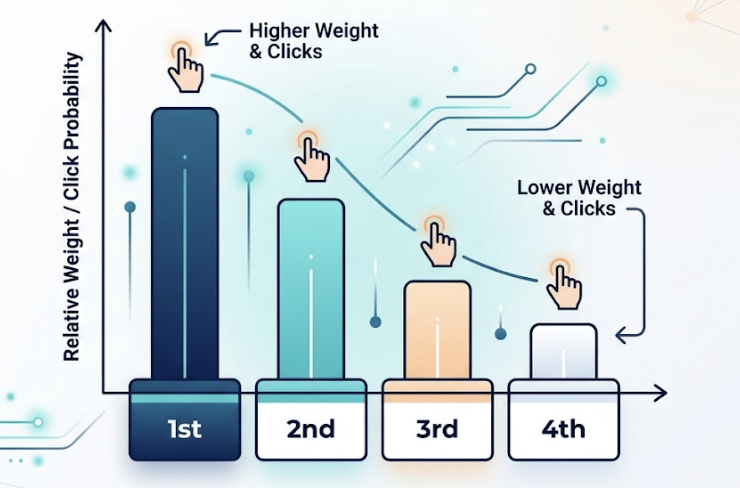
Not all mentions are equal. Research from Princeton University shows that sources appearing earlier in AI-generated answers carry significantly more weight and drive higher click probability. One way to quantify this is through Position-Adjusted Word Count (PAWC), which assigns higher mathematical weight to brands mentioned earlier in a response. Showing up third in a list is very different from being the first brand an AI recommends.
3. Sentiment: What Is AI Actually Saying About You?
AI doesn’t just mention brands. It describes them. The difference between “an industry leader known for reliability” and “a complex tool with a steep learning curve” can shift user decisions before they ever visit your site. Sentiment analysis tracks the qualitative framing AI uses when your brand comes up.
Why “Being on the Internet” Isn’t Enough Anymore
Here’s what many marketers get wrong: they assume that if their content exists, AI will find it and use it.
AI models don’t crawl the web the way Google does. They select sources based on trust, structure, and multi-source verification. A brand with a solid website but minimal third-party coverage often loses out to a smaller competitor that’s been written about in industry publications, cited in research, and discussed in forums.
In AI search, presence without authority doesn’t convert into visibility.
The 5 Signals AI Uses to Decide Who Gets Mentioned
Research published at ACM KDD 2024, led by teams from Princeton, Georgia Tech, the Allen Institute for AI, and IIT Delhi, identified clear structural patterns in how generative engines select sources. Some of these findings are worth knowing directly.
1. High-authority domains with earned media coverage. AI models strongly prefer sources that have already been cited by others. Your own website, however well-written, ranks lower in trust than a mention in a respected industry publication. Earned media, coverage you didn’t pay for, is the signal AI weighs most.
2. Structured, extractable content. AI systems need to parse your content quickly. Clear H1-H3 heading hierarchies, short paragraphs (typically under 60 words), and schema markup make your content machine-readable. Pages that AI can’t cleanly parse often don’t get extracted at all.
3. Consistent brand narrative across platforms. If your pricing, product description, or value proposition differs between your website, your G2 profile, and your LinkedIn page, AI models pick up on the inconsistency. Lower confidence means lower citation rates. High-visibility brands maintain what researchers call a stable “digital fingerprint” across every touchpoint.
4. Real community discussion. Authentic user conversations on platforms like Reddit have become a core trust signal. Studies show brands with active, positive community discussions are cited by AI engines more than 3 times as often as brands with little or no community presence. This isn’t a coincidence. AI is trained to weight real-world usage signals heavily.
5. Competitive share of voice. AI answers typically recommend only 3 to 5 brands. That makes AI search visibility a zero-sum game. Every mention your competitor earns in a given prompt category is one you didn’t. Tracking where your competitors show up, and where you don’t, is how you find the gaps worth closing.
The data backs this up: adding statistics to content can lift AI visibility by up to 40%, while including expert quotations pushes that to 41%. These aren’t marginal improvements.
You Can’t Improve What You Can’t See
This is where tracking becomes non-negotiable.
Topify approaches this by simulating real user prompts across ChatGPT, Gemini, and Perplexity at scale, then converting the results into structured metrics your team can actually act on. Seven core metrics form the tracking layer: Visibility Score, Sentiment Score, Position Rank, AI Volume (prompt search frequency), Intent classification, Source Analysis (which domains AI cites in your category), and CVR (Conversion Visibility Rate, an estimate of how likely an AI mention leads to brand engagement).

The goal isn’t to watch a dashboard. It’s to identify exactly which prompt categories your brand is missing from, and why, so you can fix it.
AI Search Visibility vs. Traditional SEO: Side by Side
These two disciplines aren’t competing with each other. They’re operating on parallel tracks, and you need both.
| Dimension | Traditional SEO | AI Search Visibility |
|---|---|---|
| Core goal | Rank in SERP, drive clicks | Get cited and recommended in AI answers |
| User interaction | Clicks to your website | Consumes synthesized answer, often without clicking |
| Success metric | Rank, CTR, organic traffic | Mention rate, sentiment score, position rank |
| Content focus | Keyword density, backlinks | Fact density, structural clarity, cross-platform consistency |
| Key technology | Crawlers, PageRank | RAG retrieval, semantic entity extraction |
| Competition type | Linear ranking (page 1 vs 2) | Narrative authority (cited vs ignored) |
SEO builds the foundation. AI search visibility is where the next layer of brand discovery is being decided right now.
Where to Start If You’re New to This
You don’t need a full GEO strategy on day one. Three steps get you to a baseline fast.
Step 1: Build a prompt map. Instead of keywords, think in questions. What does your target user actually ask an AI when they’re researching your category? Map out 5 to 10 prompts across informational (“what is [topic]?”), comparison (“which tool is better for [use case]?”), and solution-oriented (“how do I [achieve outcome] without [constraint]?”) intent types. Google Search Console’s long-tail queries and Reddit threads in your category are good starting points.
Step 2: Run a baseline test. Open ChatGPT, Gemini, and Perplexity in private browsing. Ask those prompts. Record whether your brand appears, where it appears, and how it’s described. Be honest about what you find.
Step 3: Track it consistently. A one-time test tells you where you stand today. Tools like Topify automate this across platforms and over time, so you can measure whether your content and distribution changes are actually improving your position in AI answers.
Conclusion
Gartner projects that traditional search traffic will decline by 25% by 2026, as users shift toward conversational AI interfaces. That’s not a prediction about the distant future. It’s describing something that’s already happening in your category.
AI search visibility isn’t a trend to watch. It’s a metric to measure and a position to defend. The brands building that tracking layer now are the ones that will be cited, recommended, and chosen when AI becomes the default starting point for most purchasing decisions.
The question isn’t whether AI search matters for your brand. It’s whether your brand shows up when it does.
FAQ
Is AI search visibility the same as GEO?
They’re related but distinct. AI search visibility is the metric: how often and how well your brand appears in AI answers. GEO (Generative Engine Optimization) is the practice: the strategies and tactics you use to improve that metric. Think of GEO as the discipline, and AI search visibility as the scoreboard.
Which AI platforms should I track first?
Start with ChatGPT (broadest general-purpose user base), Perplexity (research-oriented users who go deep on topics), and Gemini (tightly integrated with Google’s ecosystem). These three cover the majority of AI search behavior across most B2B and B2C categories.
How is AI visibility actually measured?
Core metrics include mention rate (how often you appear across relevant prompts), position (where in the answer you show up), and sentiment (how you’re described). Platforms like Topify combine these into composite scores that track across multiple AI engines simultaneously.
Does my Google ranking affect my AI search visibility?
Sometimes, but not reliably. Research consistently shows a significant “citation gap” between Google’s top-ranked pages and what AI engines actually cite in their answers. AI prioritizes information density, structural clarity, and third-party validation. A page can rank #1 on Google and still be invisible in AI-generated responses.

