

Your team spent two quarters building content, earning links, and pushing rankings up. Then a buyer opened ChatGPT, asked for the best option in your category, and got a tidy list of five names. Yours wasn’t one of them. Nothing in your SEO dashboard explains why, because those tools were built to measure a page’s position, not whether an AI decided to say your name at all. The fix starts with seeing what’s actually being said about you inside the answer.
What an AI Mention Tracking Tracker Actually Tracks
An AI mention tracking tracker is a diagnostic tool that monitors how a brand shows up inside generative AI outputs. It doesn’t watch a results page. It watches the answer itself.
The mechanic is different from rank tracking. A keyword tracker measures your position on a static SERP. An AI mention tracker uses synthetic prompting, querying models like ChatGPT, Gemini, and Perplexity on a schedule with high-intent customer questions, then reading the unstructured response that comes back.
That matters more every quarter. By 2026, 64.82% of Google searches end without a click, which means a growing share of buyers form opinions inside an answer they never leave. If you can’t see that answer, you can’t manage it.
A good tracker reports on four things:
- Presence: how often your brand surfaces for category prompts.
- Narrative context: how the AI frames you, whether as an industry leader, a budget option, or a risky pick.
- Citation authority: which exact URL the model used as its evidence.
- Positioning: where you land in a recommendation, first versus fifth.
Here’s the core distinction. Traditional SEO tracks rank, your slot in a list. AI tracking measures inclusion, whether you exist in the model’s reasoning at all. You can hold position one on Google and be invisible to ChatGPT in the same week.
How Does an AI Mention Tracking Tracker Work
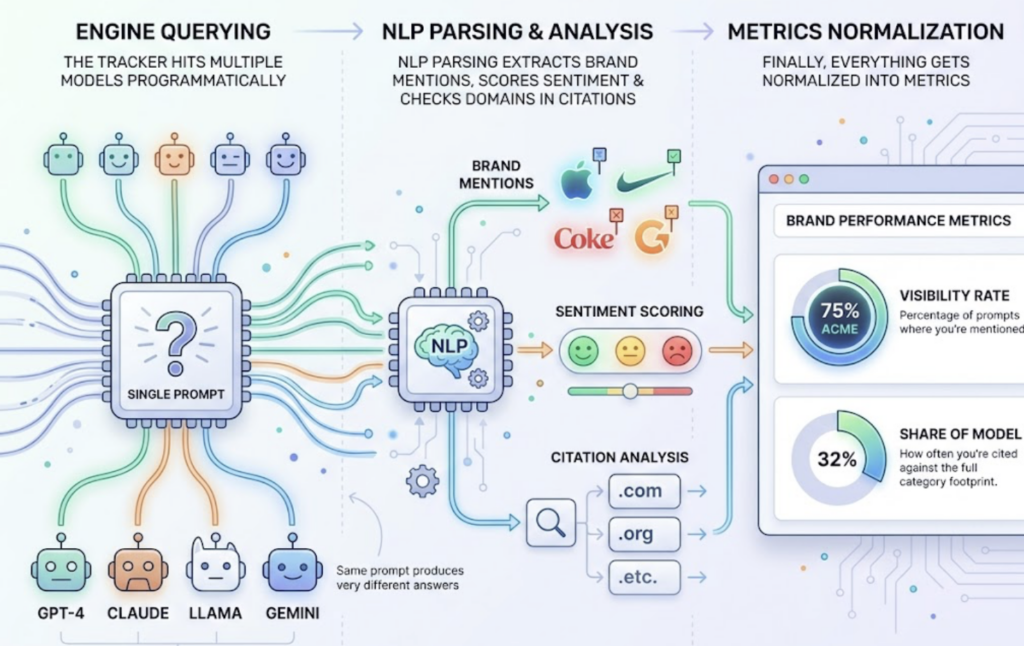
Most AI engines run on retrieval-augmented generation. They pull from different indexes and score sources with different logic, so a tracker can’t just ask once and call it done. It runs a repeatable pipeline.
It starts with canonical prompts. The system fixes a set of questions that mirror real buyer journeys, things like “what is the best CRM for small business,” then reuses them so results stay comparable over time.
Next comes engine querying. The tracker hits multiple models programmatically, because the same prompt produces very different answers depending on who you ask. Then NLP parsing extracts the brand mentions, scores sentiment, and checks which domains appear in the citations. Finally, everything gets normalized into metrics like Visibility Rate, the percentage of prompts where you’re mentioned, and Share of Model, how often you’re cited against the full category footprint.
The reason this has to repeat is volatility. AI platforms cite sources in ways that barely overlap. Only 11% of domainsare cited by both ChatGPT and Perplexity for the same query, and 71% of all cited sources show up on just one platform. A one-off check on a single engine tells you almost nothing.
How to Measure AI Mention Tracking: The Metrics That Matter
Raw mention counts don’t move a strategy. To make the data useful, teams report on a small set of KPIs that track presence, accuracy, and competitive position.
| Metric | What it measures | Why it matters |
|---|---|---|
| Visibility Score | % of tracked prompts where your brand appears | Overall mindshare in AI answers |
| Citation Share | % of category citations your brand captures | A proxy for topical authority in the model’s eyes |
| Position Index | Average placement in AI-generated lists | Signals prominence and trust |
| Sentiment Accuracy | The tone the AI uses to describe you | Early warning for hallucinated or negative claims |
| CVR (AI-referred) | Conversion rate from AI-cited traffic | Ties visibility back to revenue |
Numbers alone won’t survive a leadership meeting, though. Semrush makes the point that you should translate platform data into outcome language: instead of reporting “we appear in 42% of responses for prompt set A,” say “AI now recommends us in nearly half of all answers when someone compares options in our category.” Stakeholders don’t need retrieval mechanics. They need to know whether you’re visible and whether AI describes you the way you want.
A quick checklist for a report worth reading: it should show visibility over time, position against named competitors, the specific URLs being cited, and any sentiment drift. If your dashboard only shows a single mention count, it’s measuring the easy thing, not the useful one.
How to Improve Your AI Mention Rate
Improving visibility is less about writing more and more about writing in a way AI engines can extract and trust. Three levers do most of the work.
First, source and citation optimization. When a competitor gets cited instead of you, find the exact URL the model pulled. If it’s a third-party review site or directory, your job is to improve your presence on that specific page, not just your own domain. The citation often lives somewhere you don’t control yet.
Second, structural extractability. Models favor content that’s dense, well-structured, and easy to parse: clear headers, schema markup, and direct question-and-answer blocks that resolve a prompt in one or two sentences.
Third, prompt coverage. Map your content to intent clusters like “best X for Y,” “alternatives to X,” and “compare X vs Y.” If you’re absent for those prompt types, the AI fills the gap with sources that aren’t.
There’s a timing argument here too. 78% of marketing teams have no AI visibility tracking at all, which leaves a first-mover window for brands that start measuring now. If you want a no-cost way to begin, this list of free GEO tools covers audits and spot checks before you commit to a platform.
Top LLM Rank Trackers and the Best Tools for AI Mention Tracking
The market for trackers splits into single-platform spot checkers and multi-engine monitors. The gap between them is wide, and the wrong choice creates blind spots that look like good news.
Use these dimensions to compare your options:
| Capability | Why it’s non-negotiable |
|---|---|
| Multi-engine coverage | Single-platform tools hide where you’re actually losing |
| Source attribution | Seeing the cited URL lets you reverse-engineer a rival’s visibility |
| Competitive benchmarking | A visibility number means nothing without context |
| Sentiment alerting | Catches hallucinated or negative claims before they spread |
| Position tracking | Tells you if you’re the first recommendation or the footnote |
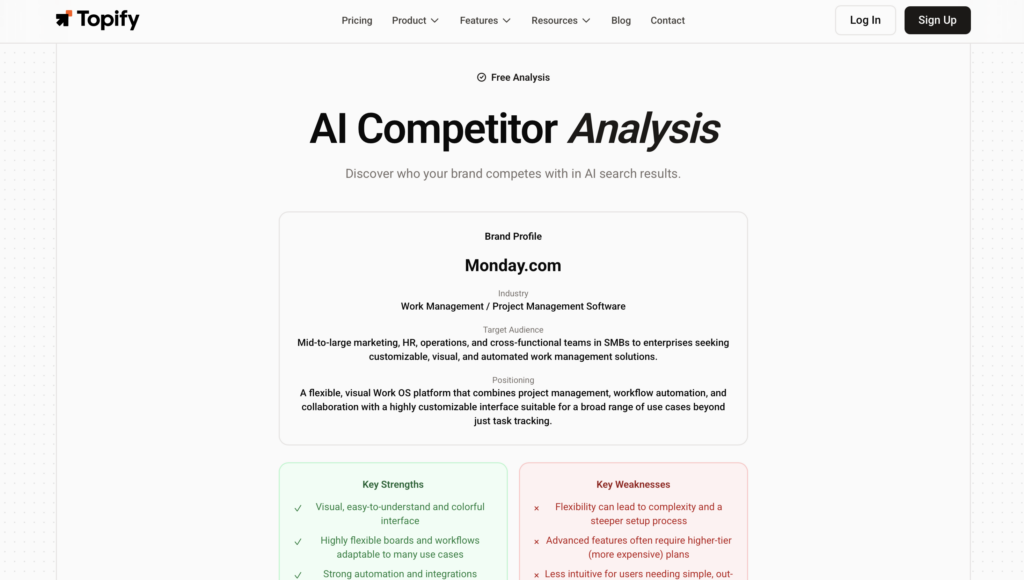
Among the top LLM rank trackers, Topify is built around all five. It tracks brand presence across ChatGPT, Gemini, Perplexity, DeepSeek, and other major engines, so you’re not optimizing for one model while going dark on the rest.
Its Visibility Tracking measures how often you surface for the prompts that matter, while Position Tracking shows where you land relative to competitors in each answer. That second piece is what most rank trackers skip. Knowing you’re mentioned is useful. Knowing you’re mentioned fifth, behind two rivals, is what changes the work.
The Source Analysis feature reverse-engineers citations, showing the exact domains and URLs the models pull from. If a competitor keeps winning a prompt, you can see which page is feeding the model and decide whether to compete for it. Competitor Monitoring runs the benchmarking automatically, and CVR estimates how likely AI-cited visibility is to turn into an actual interaction, which is the metric finance teams care about.
On pricing, Topify starts at $99/month for the Basic plan, covering 100 prompts and tracking across ChatGPT, Perplexity, and AI Overviews. Pro runs $199/month for 250 prompts and more seats, and Enterprise starts at $499/month with a dedicated account manager. You can start with Topify without committing to the top tier and scale once the data proves its value.
Plenty of teams also run general SEO suites with bolt-on AI modules. Those work for a quick pulse check. They tend to fall short on cross-platform depth and source-level attribution, which is exactly where the harder questions live.
Common Mistakes in AI Mention Tracking
The most common mistake is tracking one platform and assuming it represents the rest. With most cited sources appearing on a single engine, ChatGPT data tells you nothing about Perplexity, and a clean report can mask a real problem.
Second, teams watch mention counts and ignore position and sentiment. Being mentioned last, or being called a “budget alternative” when you sell premium, is a visibility problem that a raw count hides.
Third, treating tracking as a one-off audit. Citation patterns shift in weeks, so last month’s snapshot is already stale. Continuous, scheduled tracking is the only version that holds up.
The fourth is measuring yourself in a vacuum. A visibility score with no competitive benchmark is just a number. The question that matters isn’t whether you appear, but whether you appear instead of the rival your buyer is also considering.
Conclusion
The shift from links to answers means your brand is now being described, ranked, and recommended in places your old tools can’t see. An AI mention tracking tracker closes that gap by showing where you appear, how you’re framed, and which sources the models trust to make the call.
Start simple. Pick a tracker that covers multiple engines, set a fixed prompt list that mirrors how buyers actually search, and report on visibility, position, and citations together. The brands measuring this now are building an advantage that gets more expensive to catch later.
FAQ
Q: What is an AI mention tracking tracker?
A: It’s a tool that monitors how often and how favorably your brand appears inside AI-generated answers across platforms like ChatGPT, Perplexity, and Gemini. Unlike a rank tracker, it measures inclusion in the answer rather than position on a results page.
Q: How much does AI mention tracking cost?
A: Pricing varies by platform and prompt volume. Topify starts at $99/month for 100 prompts, with a Pro tier at $199/month and Enterprise from $499/month. Free GEO tools can cover basic spot checks before you commit to a paid plan.
Q: What’s an example of AI mention tracking in action?
A: A SaaS brand sets 50 canonical prompts like “best project tool for remote teams,” runs them weekly across four AI engines, and tracks how often it’s named, where it ranks in each answer, and which review sites the models cite. A drop in mentions traces back to a competitor capturing a key citation source.
Q: What should be on an AI mention tracking checklist?
A: Multi-engine coverage, a fixed canonical prompt set, visibility and position metrics, source-level citation data, sentiment monitoring, and competitor benchmarking. If a tool misses source attribution or only covers one platform, it leaves the most important questions unanswered.

