

Your domain authority is 70. Your keyword rankings look solid. But when a prospect asks ChatGPT, “What’s the best tool in your category?” your brand doesn’t show up. Not on position five. Not mentioned at all.
That’s the gap most SEO teams can’t quantify yet. 80% of the URLs that ChatGPT and other LLMs cite don’t even rank in Google’s top 100 results for the same query. And with ChatGPT now reaching 900 million weekly active users, up 125% from 400 million just a year earlier, the audience your brand is invisible to is growing fast.
Most ChatGPT SEO Rank Trackers Don’t Actually Track Rankings
Search “ChatGPT SEO tool” and you’ll find dozens of platforms marketing themselves as AI-powered SEO solutions. Here’s the problem: the vast majority of them are content generation wrappers. They use OpenAI’s API to draft blog posts or rewrite meta descriptions. They don’t track whether ChatGPT actually mentions your brand when someone asks a relevant question.
That distinction matters more than it sounds.
Traditional SEO rank tracking scrapes a search results page and tells you where your link sits in a list. ChatGPT SEO rank tracking is fundamentally different. There’s no “Page 2” in a generative answer. Your brand is either cited in the response, or it’s completely invisible to the user.
The data backs this up. Pages ranking first on Google capture 27.5% of human clicks but only a 10% citation rate from ChatGPT. Pages buried at position 10, which get a negligible 2.5% of clicks, still manage a 4% ChatGPT citation rate. Google rankings and LLM citations follow different logic entirely.
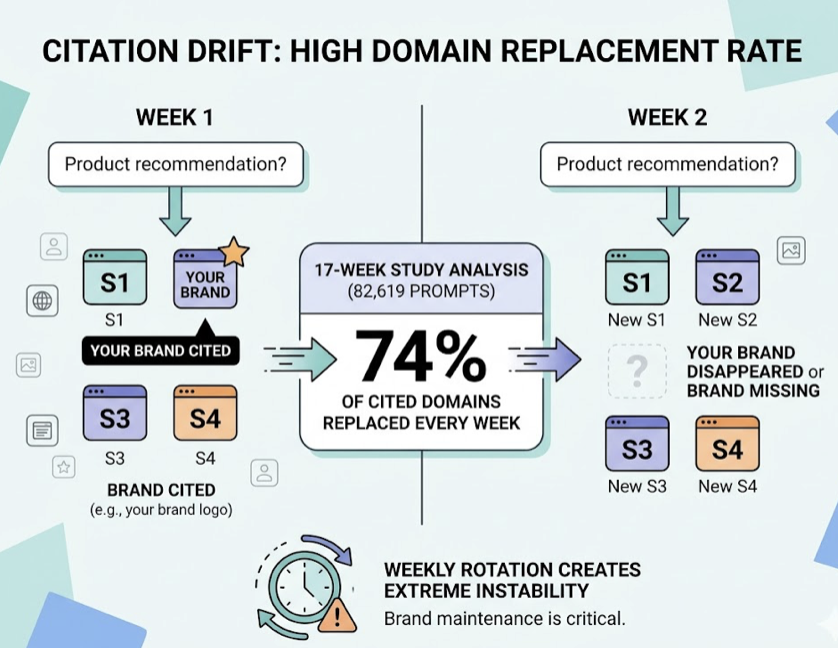
What makes this even harder to manage is citation drift. A 17-week study analyzing 82,619 prompts across six markets found that ChatGPT replaces 74% of its cited domains every single week. The platform typically cites only 3 to 4 sources per response, so that weekly rotation creates extreme instability. If your brand is cited today, it’s statistically likely to disappear from that answer within weeks unless your content is actively maintained.
That’s the core case for dedicated chatgpt seo rank tracking tools: not just knowing you’re visible, but catching the moment you stop being visible before it hits your pipeline.
What Separates a Real ChatGPT SEO Rank Tracking Tool from a Dashboard with AI Labels
Not every platform that claims “AI visibility” is actually measuring what matters. To find the best chatgpt seo rank tracking software, you’ll want to evaluate vendors against five specific capabilities.
AI platform coverage. ChatGPT isn’t the only place your audience searches. Developers use Perplexity and Claude. General consumers hit Google AI Overviews and Gemini. Here’s the kicker: Google AI Mode and ChatGPT Search cite entirely different domains 87.5% of the time for the same prompt. A tool that only covers one platform gives you a dangerously incomplete picture.
Prompt-level tracking. Users don’t type keywords into ChatGPT. They write detailed, multi-constraint prompts like “What’s the best CRM for a 15-person agency that integrates with Slack?” Your chatgpt seo rank tracking software needs to simulate and monitor these natural language queries at scale, not just track static keywords.
Position vs. mention. Being mentioned and being recommended first are very different outcomes. A binary “mentioned / not mentioned” metric misses competitive nuance. The tool should calculate your position rank relative to competitors within each response.
Citation source analysis. Knowing that ChatGPT recommended your brand is the starting point. Understanding why is the optimization lever. The tracker should reverse-engineer the AI’s footnotes to identify which third-party domains (G2 reviews, Reddit threads, niche directories) fed the LLM its information.
Update frequency. With 74% of ChatGPT’s sources rotating weekly, a tool that refreshes monthly is delivering stale data. Daily or weekly tracking is the minimum viable cadence for catching visibility drops before they compound.
One more data point worth noting: over 76% of ChatGPT’s top-cited pages were updated within the last 30 days. Freshness isn’t optional in this space.
#1 Topify: Full-Spectrum ChatGPT SEO Tracking Across 7+ AI Platforms
Topify was built from the ground up as a Generative Engine Optimization platform, not retrofitted from a traditional SEO tool. That architectural difference shows up in how it handles tracking, analysis, and execution.
The platform monitors brand visibility across ChatGPT, Perplexity, Google Gemini, Google AI Overviews, DeepSeek, Doubao, Qwen, and Claude. It translates unstructured LLM responses into four trackable signals:
Visibility Score calculates the percentage of AI responses that mention your brand across category-relevant prompts. The average unoptimized brand sits at roughly 0.3% AI visibility. Optimized brands push that to 12% or higher.
Position Rank maps where your brand lands in the AI’s recommendation sequence. First recommendation versus fourth alternative, tracked over time.
Sentiment Score (0-100) runs secondary NLP processing on the AI’s description of your brand. If ChatGPT mentions you but describes your product as “expensive and difficult to implement,” Topify flags the perception issue so your content team can correct the narrative.
AI Volume estimates monthly query frequency for specific topics across AI platforms, giving you the generative equivalent of traditional search volume.
How Topify Tracks ChatGPT Rankings at the Prompt Level
Unlike keyword-based tools, Topify’s tracking simulates the way real users interact with LLMs. Consider a B2B SaaS company tracking visibility for project management software. Instead of monitoring the keyword “project management,” you’d input prompts like, “Act as a CTO for a 50-person remote agency. What’s the best project management tool that integrates with Slack and GitHub?”
Topify deploys these prompts to ChatGPT, parses the response in real time, extracts recommended entities, maps footnote citations, and plots your positional ranking over time. You can see exactly when your brand dropped out, which competitor replaced you, and which underlying source triggered the shift.
The execution side is where Topify pulls ahead of pure-tracking platforms. Once you spot a visibility gap, the One-Click GEO Execution feature analyzes the URLs that LLMs are currently citing and generates the specific content (comparison tables, structured data, definitional paragraphs) needed to fill the semantic gap. Review it, deploy it, done.
Pricing starts at $99/month for the Basic plan (100 prompts, 9,000 AI answer analyses, 4 projects) and $199/month for Pro (250 prompts, 22,500 analyses). Enterprise plans with managed execution start from $499/month. You can get started here.
#2 to #5: Other ChatGPT SEO Rank Tracking Tools Worth Knowing
While Topify offers the most complete tracking-to-execution loop, several other platforms serve specific use cases well.
#2 Semrush AI Search Visibility Checker. Semrush has integrated AEO tracking into its existing platform, pulling from a database of over 200 million prompts across ChatGPT, Gemini, Perplexity, Copilot, Grok, and AI Overviews. The biggest draw is ecosystem integration: if your team already lives in Semrush for traditional SEO, blending SERP data with AI visibility metrics happens in one workflow. Plans start around $139 to $165/month. The trade-off is that actionable GEO recommendations tend to stay surface-level compared to dedicated platforms.
#3 Profound. An enterprise-grade analytics platform tracking visibility across 10+ LLMs, including ChatGPT, Perplexity, Google AI Mode, Gemini, Copilot, Meta AI, Grok, DeepSeek, and Claude. It offers unique features like prompt fanout analysis and shopping-specific ChatGPT query tracking. Starts at $99/month for ChatGPT-only; multi-engine tracking pushes to $399/month and up. Built for large organizations managing complex, multi-brand data sets.
#4 Peec AI. A streamlined citation tracker focused on ChatGPT, Perplexity, and Google AI Overviews. It delivers polished competitor benchmarking reports and sentiment analysis at an accessible price point (starting at €89/month for 25 prompts). The catch: it’s tracking-only, with no built-in content optimization or GEO execution features.
#5 Athena (AthenaHQ). Designed for marketing agencies offering GEO as a client service. Tracks ChatGPT, Perplexity, AI Overviews, Gemini, Claude, and Grok with an integrated “Action Center” for content briefs and strategic recommendations. Starts at $295/month with no free trial. Lacks prompt volume data, which limits prioritization.
| Platform | Starting Price | ChatGPT Tracking | AI Optimization | Best For |
|---|---|---|---|---|
| Topify | $99/mo | Yes | Full execution and schema | Growth teams, brands |
| Semrush AIO | $139/mo | Yes | Surface-level briefs | Existing Semrush users |
| Profound | $99/mo | Yes | Content agents | Enterprise orgs |
| Peec AI | €89/mo | Yes | None, tracking only | Startups, beginners |
| Athena | $295/mo | Yes | Content briefs | Marketing agencies |
How to Start Tracking Your ChatGPT SEO Rankings Today
You don’t need to overhaul your entire content strategy on day one. Start with these four steps.
Step 1: Map your core prompts. Identify 50 to 100 natural language queries your target buyers would type into ChatGPT. Focus on MOFU, comparative prompts (“Compare pricing and features of Brand X versus Brand Y”) rather than broad informational queries. These high-intent prompts are where visibility translates directly into pipeline.
Step 2: Run a baseline audit. Input those prompts into a tracking platform and categorize the results: prompts where your brand is invisible, prompts where you’re in the volatile citation carousel, and prompts where you’re anchored in the stable core. This baseline tells you exactly where to focus.
Step 3: Set up continuous monitoring. A one-time audit isn’t enough when ChatGPT rotates 74% of its sources weekly. Configure daily or weekly tracking so your team gets alerted the moment your recommendation position slips.
Step 4: Analyze citation sources and act. When visibility drops, dig into which domains the AI started citing instead of yours. If a competitor published a statistics-heavy guide that displaced your content, you’ll know exactly what to build. Research from Princeton, Georgia Tech, and IIT Delhi found that specific GEO methods, like adding statistical data, expert quotations, and answer-first content architecture, can improve AI visibility by up to 40%.
Visitors arriving through AI citations tend to convert at roughly 4x the rate of traditional organic traffic. The ROI case for tracking isn’t theoretical.
For teams looking to audit their current AI visibility without a subscription, Topify’s free GEO tools offer a useful starting point.
Conclusion
The gap between Google rankings and ChatGPT visibility isn’t closing. It’s widening. Gartner projects a 25% decline in traditional search query volume by end of 2026, and the data already shows that 80% of what LLMs cite has nothing to do with your SERP position.
ChatGPT SEO rank tracking isn’t a nice-to-have analytics layer. It’s the only way to know whether nearly a billion weekly users can find your brand when they ask an AI for a recommendation. Pick a tool that tracks at the prompt level, covers multiple AI platforms, and gives you the execution path to act on what the data reveals. The brands that build this feedback loop now won’t just maintain visibility. They’ll compound it.
FAQ
Q: What is ChatGPT SEO rank tracking?
A: It’s the process of monitoring how often and in what position your brand appears in ChatGPT’s generated answers. Unlike traditional SEO, which tracks your link position on a search results page, ChatGPT rank tracking measures AI visibility (share of voice), recommendation position, sentiment (how positively the AI describes you), and citation sources (which websites informed the AI’s answer).
Q: Can you actually track your brand’s position in ChatGPT answers?
A: Yes. GEO platforms like Topify simulate hundreds of industry-relevant prompts against ChatGPT daily, then use NLP to parse the response, extract brand entities, and calculate where your brand landed in the recommendation sequence relative to competitors.
Q: What’s the best chatgpt seo rank tracking software for small teams?
A: Topify ($99/month) tends to offer the strongest balance of prompt-level tracking and built-in GEO execution for small teams. Its One-Click Execution feature helps teams that don’t have dedicated GEO specialists draft the structured content needed to improve rankings. Peec AI (€89/month) is a more affordable, tracking-only option for teams that just need basic citation monitoring.
Q: How often do ChatGPT rankings change?
A: Frequently. A 17-week study of 82,619 prompts found that ChatGPT rotates 74% of its cited domains every week. That means your brand can disappear from a recommendation within days if the underlying content goes stale. Continuous tracking and regular content refreshes (product pages monthly, data guides quarterly) are the only reliable way to maintain stable AI visibility.

