

Your domain authority is solid. Your keyword rankings haven’t budged in months. Then you ask ChatGPT for a recommendation in your own category, and your brand doesn’t appear anywhere in the answer. You run the same prompt again two days later, and this time you’re mentioned, but buried below a competitor you’ve never heard of.
That gap between what Google says about your visibility and what AI actually says about your brand is where most optimization efforts break down. Without a way to measure what’s happening inside generative responses, you’re shipping fixes into a system that can’t tell you if anything changed.
Most AI Answer Optimization Starts Without a Baseline. That’s the First Mistake.
The most common failure in AI answer optimization isn’t bad content or weak authority. It’s skipping the measurement step entirely.
Most teams jump straight into restructuring entity data, updating schema markup, and rewriting product pages for LLM extractability. Three months later, they’ve got no historical data to prove whether any of it worked. That’s not a strategy. It’s guesswork.
The stakes are higher than most realize. Roughly 80% of consumers now rely on AI-generated results for at least 40% of their queries, and 60% of all searches currently end without a single click to a website. When AI overviews appear, organic click-through rates drop by 61%. Operating without a baseline in this environment means you can’t calculate ROI on any optimization campaign, period.
There’s a subtler problem, too. Cross-platform tracking reveals that approximately 73% of AI citations link to a domain without ever naming the brand in the response text. The AI extracts your data but delivers zero brand equity back to you. Without a baseline, you can’t even tell whether your ghost citation rate sits at a manageable 40% or a critical 85%.
The correct starting point is a closed loop: track, optimize, verify. Before rewriting a single page, deploy a ChatGPT rank tracker to calculate your exact probability of inclusion across high-value prompts.
What AI Answer Optimization Actually Means in 2026
AI answer optimization has matured into an independent discipline. It’s no longer a tactical bolt-on to traditional SEO. It requires its own performance indicators, its own technical frameworks, and a fundamentally different understanding of how search works.
Traditional SEO operated on a deterministic model: a query returned a ranked list of documents. The goal was securing a fixed position. AI answer engines work differently. They synthesize answers from multiple sources, evaluate competing claims, and dynamically assemble responses based on probabilistic reasoning. Winning here means engineering content for extractability, verifiability, and contextual clarity.
That shift creates three distinct visibility tiers. At the lowest level, you’re “Mentioned,” where your domain shows up as a citation footnote but your brand name doesn’t appear in the text. The middle tier is “Recommended,” where the AI explicitly names your brand and compares it favorably to alternatives. The top tier is “Top Recommended,” where the AI anchors its entire response around your brand’s expertise.
To navigate these tiers, the industry has moved toward multidimensional tracking. Topify, for example, structures AI answer optimization around several core dimensions: Visibility (how often your brand appears across industry-specific prompts), Position (where you sit in the response hierarchy), Sentiment (whether the AI frames your brand positively or negatively), and Citation Source tracking (which third-party domains the AI trusts as ground truth). Data shows that 85% of AI citations originate from third-party sources like Wikipedia, review platforms, and industry forums, not from a brand’s own domain. Understanding that source stack is where real optimization begins.
The ChatGPT Rank Tracking Problem Nobody Talks About
Here’s the thing most vendor comparisons skip: ChatGPT doesn’t return the same answer twice.
Submit the exact same prompt on a Tuesday, and you might appear as the top recommendation. Run it again Thursday, and you’re gone. That’s not a bug. It’s how LLMs work. Generative models reconstruct responses from scratch each time, shifting citations, reordering recommendations, and adjusting tone based on subtle changes in token probability weights and context windows.
This non-determinism makes traditional rank tracking software useless. Legacy tools that take daily snapshots of a search results page can’t process synthesized text that changes with every query. Expecting 40% to 60% monthly variance in AI citations is standard.
A controlled study on healthcare facility recommendations illustrates the gap perfectly. One institution appeared in 97% of generated answers across a large prompt sample. Sounds dominant. But it was positioned as the top recommendation in only 35% of those responses. High visibility didn’t equal recommendation stability.
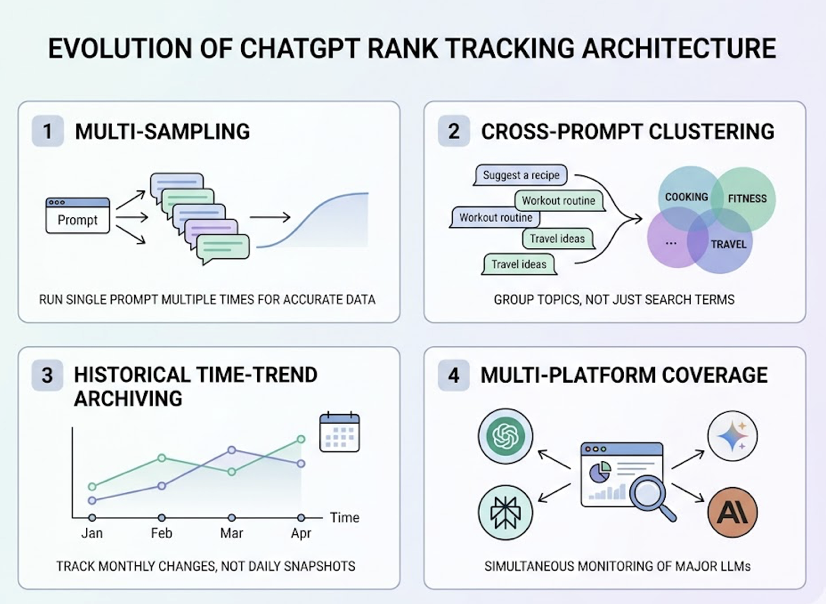
That’s why modern chatgpt rank tracker tools need a fundamentally different architecture. The evaluation criteria for serious chatgpt rank tracking software must include multi-sampling (running the same prompt dozens of times to smooth out noise), cross-prompt clustering (mapping thematic visibility, not just keyword matches), historical time-trend archiving (measuring impact over months, not snapshots), and multi-platform coverage (tracking across ChatGPT, Perplexity, Gemini, and Claude simultaneously).
7 Best ChatGPT Rank Tracking Tools, Compared
The market has expanded fast, but capabilities vary drastically. Some legacy SEO platforms have bolted on rudimentary AI visibility tabs. Purpose-built chatgpt rank tracking software is engineered specifically to parse probabilistic outputs. Here’s how the seven leading tools stack up in 2026.
| Platform | Core Differentiator | AI Platforms Covered | Starting Price | Best For |
|---|---|---|---|---|
| Topify | One-Click Optimization Agents | ChatGPT, Claude, Perplexity, Gemini, AI Overviews | $99/mo | GEO execution and growth teams |
| AthenaHQ | Source Intelligence + Sentiment Parsing | ChatGPT, Gemini, Claude, Perplexity, Copilot | $270-$295/mo | Enterprise PR and brand intelligence |
| Rankability | Agency client reporting + SPI scoring | ChatGPT, Perplexity, Gemini, Grok, Claude | $99-$149/mo | Multi-client SEO agencies |
| Geoptie | Flat-rate multi-prompt scale | ChatGPT, Gemini, Perplexity, Claude, Copilot, Grok | $41-$49/mo | Mid-market agencies managing multiple brands |
| Otterly AI | Large URL audit volumes | ChatGPT, Perplexity, AI Overviews, Copilot, Gemini | $29/mo | Startups entering the GEO space |
| Morningscore | Visual proof screenshots | ChatGPT (primary focus) | $69/mo | Non-technical teams and local businesses |
| Brandi AI | Deep AI Share of Voice tracking | ChatGPT, Gemini, Perplexity, Claude, AI Overviews | ~$350/mo | Enterprise-scale visibility mapping |
Topify: Full-Spectrum AI Answer Optimization + Rank Tracking
Topify stands out because it doesn’t stop at reporting. While most chatgpt rank tracker tools function as diagnostic dashboards, Topify operates as a continuous execution engine, looping multi-sampled tracking data directly into automated optimization protocols.
Starting at $99/month for its Basic tier, the platform tracks across ChatGPT, Perplexity, Google AI Overviews, and the Anthropic Claude family (Haiku, Sonnet, and Opus). Its Position Tracking doesn’t measure static links. It tracks your brand’s relative prominence and recommendation strength within the synthesized text of each AI response.
The Source Analysis layer is where things get tactical. Topify reverse-engineers AI citations to identify the exact third-party domains (specific Reddit threads, Wikipedia articles, review platforms) that foundational models rely on as ground truth. Pair that with AI Volume Analytics, which automatically surfaces high-value conversational prompts real users are typing into LLMs, and you’ve got a prompt discovery engine that goes well beyond traditional keyword volume.
Topify’s most significant differentiator is its One-Click Agent Execution. When the platform identifies a visibility gap, a ghost citation, or an outdated entity narrative, it deploys automated agents to generate deployable fixes. You define the goal, review the strategy, and ship structural content updates without manual workflows. Teams ready to integrate tracking directly into execution can get started at app.topify.ai.
Other ChatGPT Rank Trackers Worth Knowing
AthenaHQ is a premium enterprise platform founded by former Google Search and DeepMind engineers. It differentiates through deep Sentiment Analysis and Source Intelligence, parsing the ratio of positive to negative framing in AI responses and tracing which citations drive outbound clicks. At $270-$295/month, it covers 60+ countries and suits multinational brands monitoring complex share-of-voice metrics.
Rankability is built for SEO agencies managing 5 to 50+ client portfolios. Its proprietary SPI (Search Performance Indicator) scores quantify a brand’s overall health in generative environments, blending traditional metrics with AI rank tracking. White-labeled client reports visualize historical AI ranking shifts. Pricing runs $99-$149/month.
Geoptie targets mid-market agencies with flat-rate pricing starting at $41-$49/month. It tracks across ChatGPT (GPT-4o and GPT-5), Perplexity, Claude, Gemini, Copilot, and Grok. Higher tiers cost significantly less than enterprise competitors, making it a strong fit for teams running high-volume prompt monitoring across multiple brands.
Otterly AI offers an accessible entry point at $29/month, with tracking across ChatGPT, Perplexity, AI Overviews, and Copilot. Its GEO audits allow up to 1,000 URL assessments per month, making it practical for startups exploring AI visibility for the first time.
Morningscore prioritizes visual proof. When it detects a brand mention in ChatGPT, it captures the actual output and highlights the mention in green text. At $69/month, it’s built for non-technical users and agencies needing concrete visual evidence of AI inclusion.
Brandi AI focuses on enterprise-scale AI Share of Voice at roughly $350/month. It measures brand inclusion frequency, prompt-level performance, and citation rates across major platforms, turning fragmented visibility data into actionable roadmaps for CMOs and digital teams.
How to Build an AI Answer Optimization Workflow with Rank Tracking
Having the right chatgpt rank tracking tool is only half the equation. You need a structured workflow that turns data into action.
Step 1: Audit and establish the baseline. Build a canonical prompt matrix crossing your target buyer personas with industry intents (informational, comparative, transactional). Run that library through your tracker’s multi-sampling engine to calculate your exact Share of Voice and baseline recommendation position. Quantify your ghost citation rate from day one.
Step 2: Identify visibility gaps. Isolate the exact prompts where you’re absent or where a competitor holds the top spot. Use Source Analysis to reverse-engineer why. The diagnosis often reveals structural vulnerabilities: 98.8% of local businesses are completely invisible in AI recommendations due to inconsistent entity data across directories.
Step 3: Optimize content for AI extractability. Structure content around “Atomic Facts,” self-contained sentences of 6-20 words that tie your brand name directly to a proprietary insight. Testing shows branded atomic facts survive LLM summarization 3x more often than sprawling prose. Inject Organization and Article JSON-LD markup. Keep content fresh: data not updated within 30 days suffers a 3.2x citation penalty.
Step 4: Monitor citation velocity. There’s always a lag between publishing optimized content and seeing it reflected in AI responses. Use automated recurring monitoring to track how quickly the AI integrates your updates. Flag anomalies like model updates or competitor GEO campaigns immediately.
Step 5: Iterate and expand. GEO isn’t set-and-forget. As user queries grow more complex, your prompt library must expand to capture new long-tail intents. Route tracking data back into the optimization loop. Validate whether ghost citations converted into named brand recommendations. Scale what works.
Free vs Paid: What the Best Free ChatGPT Rank Tracker Tool Can and Can’t Do
Free tools serve a purpose, but their limitations are architectural, not just cosmetic.
A typical free chatgpt rank tracker runs a single, real-time query and parses the immediate response for brand mentions. That’s useful for a quick pulse-check. It’s statistically meaningless for long-term reporting, given the 40-60% variance in generative outputs. Free tiers also restrict you to a single AI platform, cap your prompt count, and don’t store historical data. Without archiving, you can’t graph trends or prove campaign ROI.
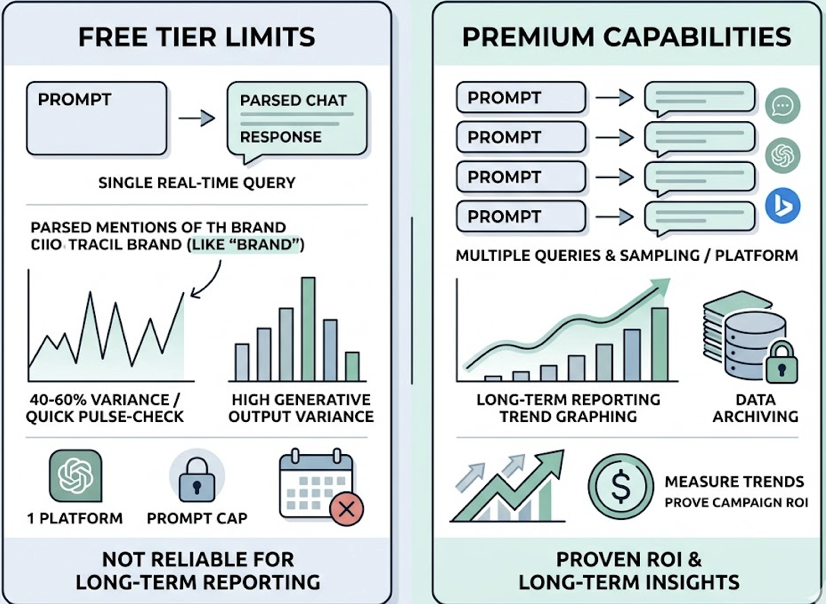
Paid chatgpt rank tracking software operates on a different plane entirely. Market data puts the average cost of professional tracking tools at roughly $337/month, with the strongest value-to-feature ratios in the $79-$149 range. At that tier, platforms like Topify ($99/month Basic) offer automated recurring checks, variance-aware multi-sampling, simultaneous competitor tracking, and cross-platform monitoring across GPT-4o, Claude, Gemini, and Perplexity.
The real gap is in actionability. Paid tools reverse-engineer citation sources, parse contextual sentiment, and provide execution workflows that suggest structural fixes. Free tools can’t do any of that.
If you’re evaluating budget before committing, starting with a free GEO score check gives you a foundational read on your current standing. But scaling AI answer optimization to a defensible, repeatable process requires the historical depth and cross-platform coverage that only paid infrastructure delivers.
Conclusion
Operating in generative search without a measurement baseline is flying blind. Traditional metrics like page position, backlink velocity, and organic CTR are no longer reliable proxies for whether AI actually recommends your brand.
AI answer optimization is a continuous cycle: track your visibility, diagnose gaps, optimize for extractability, monitor citation velocity, and iterate. The brands that build this loop into their workflow will establish durable authority inside LLMs. The ones still relying solely on legacy SEO will find themselves increasingly invisible to the next generation of search users.
Start by picking a chatgpt rank tracker that matches your scale, establish that baseline, and treat every data point as fuel for the next optimization cycle.
FAQ
Q: What is AI answer optimization?
A: AI answer optimization (also called GEO or AEO) is the process of structuring your brand’s digital content and entity data so that LLMs like ChatGPT, Perplexity, and Gemini can extract, verify, and cite your brand in their synthesized responses. It focuses on information density, schema structuring, and contextual relevance rather than traditional link-based ranking.
Q: How does a ChatGPT rank tracker work?
A: A ChatGPT rank tracker establishes a set of predefined prompts and queries the ChatGPT API on a recurring, automated schedule. Advanced trackers use repeat multi-sampling to smooth out LLM variability. The software then parses each response using natural language processing, detecting brand mentions, analyzing sentiment, tracking competitor recommendations, and identifying which external URLs the AI cited.
Q: Can I track my brand’s ranking in ChatGPT for free?
A: Yes. Several platforms offer a best free chatgpt rank tracker tool that lets you run singular live queries to check if your brand appears in a specific AI response. Topify and Geoptie both provide free GEO score checks. That said, free tools generally lack automated recurring tracking, multi-prompt scaling, and historical variance smoothing, all of which are necessary for professional-grade GEO campaigns.
Q: How often should I check my AI search rankings?
A: At minimum, weekly. Weekly automated checks let you identify reliable visibility trends while filtering out daily hallucinatory noise and model drift. For high-stakes brands in competitive categories, daily multi-sampling provides even tighter signal, though that typically requires a paid tier with sufficient API capacity.

