

Your domain authority is solid. Your keywords rank on page one. Your marketing team is confident the top-of-funnel is covered.
Then a prospect opens ChatGPT, asks for the best solution in your category, and the model generates a detailed, multi-paragraph recommendation. Five brands get named. Yours isn’t one of them.
That’s the gap most teams don’t see until it’s already costing them pipeline. Google rankings measure how well a crawler indexes your pages. They say nothing about whether a Large Language Model chooses to mention your brand when a buyer asks a direct question. And with Gartner projecting a 25% decline in traditional search engine volume by the end of 2026, the audience that used to find you through blue links is migrating fast.
Why Google Rankings Don’t Tell You If AI Knows Your Brand
Traditional SEO metrics, like Domain Authority, backlink profiles, and keyword rankings, were built to measure crawler behavior. A search engine retrieves a ranked list of documents matching keyword strings and uses external signals like domain age and inbound links to determine placement. Success means earning a click-through to your website.
AI search works on a completely different architecture. When a user queries ChatGPT or Perplexity, the model doesn’t retrieve a list of links. It accesses foundational training data, queries vector databases for semantic relevance, fetches multiple sources, evaluates them for factual density, and synthesizes a new conversational response. Your brand either gets selected into that response, or it doesn’t. Keyword density alone won’t get you there. The model needs semantic richness, factual grounding, and third-party validation.
The migration numbers make this urgent. By February 2026, ChatGPT reported 900 million weekly active users, up from 300 million in December 2024. Monthly visits stabilized above 5.35 billion, and 92% of Fortune 500 companies actively use the platform. Perplexity AI reached roughly 45 million monthly active users by early 2026, processing about 780 million queries per month.
Here’s what that means in practice: when a buyer gets a full, synthesized answer inside the AI interface, they don’t click through to a traditional search result. If your brand isn’t part of that answer, you’ve effectively disappeared for that segment of the market.
What AI Search Presence Actually Measures
AI search presence is the degree to which a brand gets mentioned, cited, accurately positioned, and recommended within AI-generated answers to relevant queries. It’s a shift from measuring clicks to measuring conversational influence. The discipline built around this measurement is called Generative Engine Optimization (GEO), and the analytical layer supporting it is AI search analytics.
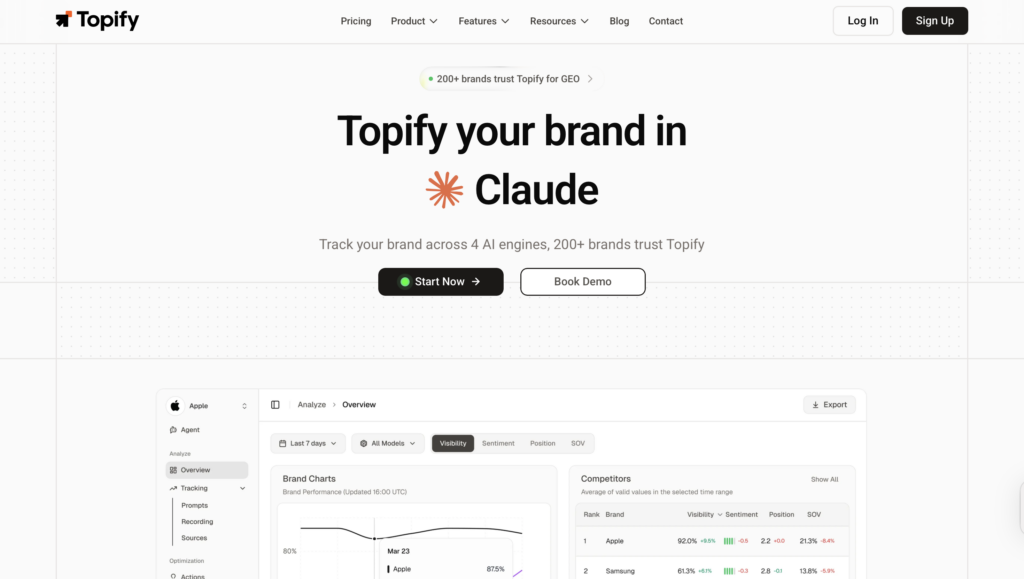
Topify has formalized this into a seven-metric framework that captures the full picture of generative visibility:
Visibility measures the cross-platform mention rate: what percentage of category-level queries include your brand in the output. Sentiment evaluates how the AI frames you, scored on a scale where 50 is neutral. Being mentioned negatively is worse than not being mentioned at all.
Position tracks where your brand lands in comparative lists. Because of the serial position effect in human cognition, appearing as the first recommendation in the opening paragraph carries exponentially more commercial weight than being buried in a list of alternatives. AI Volume measures how many users are actually asking AI platforms about topics relevant to your brand, distinct from traditional search volume.
The deeper differentiators are Source Coverage (which domains the AI cites when discussing your brand), Intent Alignment (whether the AI matches your brand to the correct buyer persona), and Conversion Visibility Rate (CVR), which estimates downstream commercial impact. AI-referred visitors convert at 14.2%, compared to 2.8% from traditional organic search. That’s a 5x difference that most marketing teams aren’t tracking yet.
| Dimension | Traditional SEO | AI Search Presence (GEO) |
|---|---|---|
| Primary Objective | Secure top SERP rankings, drive clicks | Earn mentions, recommendations, and citations inside AI answers |
| Core Measurement | Keyword Rank, DA, CTR | Visibility Rate, Position Index, Sentiment Score, Intent Alignment |
| Algorithmic Focus | Keyword density, crawlability, backlinks | Semantic entity coverage, fact density, RAG authority |
| Content Strategy | Targeting isolated keyword volumes | Semantic mapping for conversational prompts |
| Authority Signals | Inbound links from other websites | Fact-density, structured schema, multi-source consensus |
| Success Output | User clicks through to your website | User receives a trusted recommendation directly from the AI |
5 Signals That Your AI Search Presence Is Weak
Most marketing teams assume their SEO dominance carries over to AI search. It doesn’t. These five signals indicate a systemic gap in your AI visibility strategy.
Signal 1: You’re Missing from Category Recommendations
Open ChatGPT, Gemini, and Claude. Type a broad, early-stage buyer question for your category. If your brand doesn’t appear in the primary recommendation list across multiple generations, the model lacks the semantic associations to connect your brand entity to the category entity. Build a matrix of 10-15 buyer questions and test systematically.
Signal 2: AI Describes Your Brand Wrong
Your brand gets mentioned, but the AI hallucinates your value proposition. A premium enterprise platform gets described as a “budget tool for freelancers.” This means your owned content lacks the structural clarity required for accurate extraction, or outdated external chatter is overpowering your current messaging. Prompt the AI with specific questions about your features and target audience, then compare the output against your positioning documents.
Signal 3: Competitors Dominate the Conversation
AI visibility is functionally zero-sum for Share of Voice. If comparative queries produce multi-paragraph analyses of a competitor’s features while your brand gets a single vague sentence, they’ve built superior AI authority. This typically happens when competitors have denser integrations on review platforms or higher engagement on consensus nodes like Reddit.
Signal 4: AI Never Cites Your Actual Website
The AI recommends your brand but exclusively cites Reddit threads, Wikipedia articles, or review aggregators, never your actual domain. This means your website lacks the answer-first formatting, FAQ structures, or structured data markup needed for RAG ingestion. Test this on Perplexity (which shows sources) with specific factual prompts about your product.
Signal 5: Zero AI Volume on Topics You Own
You launch a major feature. AI analytics register zero related queries. The digital ecosystem doesn’t have enough conversational triggers to prompt user inquiries about it. Cross-reference your product launches against AI prompt volume data. Silence in the AI ecosystem means your top-of-funnel seeding strategy needs immediate recalibration.
How to Build AI Search Presence from Scratch
Fixing these gaps requires a four-step methodology: Audit, Monitor, Optimize, Scale. No shortcuts, no singular patches.
Step 1: Run a Baseline Audit
Before changing anything, establish your current Share of Model. Query your category, brand name, and primary competitors across ChatGPT, Perplexity, Gemini, and Claude using a matrix of early-buyer intent questions. Document where you appear, the sentiment of each appearance, and which third-party URLs the AI cites. If ChatGPT consistently relies on a specific set of Reddit threads to answer category queries, those domains become immediate targets for your digital PR team.
Step 2: Set Up Continuous AI Search Monitoring
Manual audits are static. AI search results are not. A brand’s citation share can sit at 60% one week and collapse to 10% the next if a platform changes its data sourcing, a phenomenon observed when Reddit’s citation share on ChatGPT dropped sharply in late 2025.
This is where AI search intelligence platforms become non-negotiable. Topify automates continuous tracking across the full seven-metric framework, across multiple engines, geographies, and languages. Sudden algorithmic shifts or competitor moves get flagged instantly, not weeks after the damage. Checking these metrics less than bi-weekly leaves your team strategically blind.
Step 3: Optimize Content for AI Extraction
Earning AI citations requires content re-engineered for machine scannability. The foundational GEO study from Princeton University evaluated 10,000 queries and proved that traditional keyword stuffing actively harmed AI visibility, causing a 10% degradation. LLMs prioritize dense, logically structured, well-cited content.
The tactics that actually work:
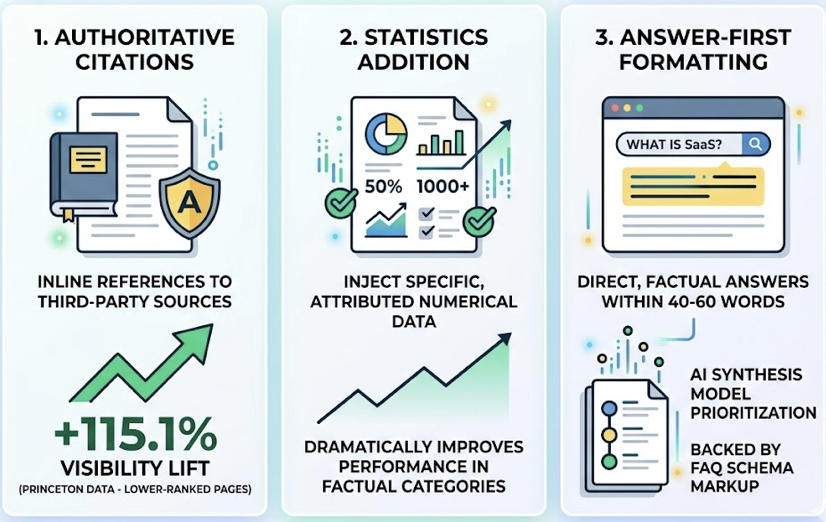
Authoritative citations are the single most powerful lever. Princeton’s data showed a 115.1% visibility lift for lower-ranked pages that added inline references to third-party sources. Statistics addition, meaning specific, attributed numerical data injected into the text, dramatically improves performance in factual categories. Answer-first formattingmatters because AI synthesis models prioritize the top of a document: provide direct, factual answers within the first 40 to 60 words, backed by FAQ schema markup.
Step 4: Scale Beyond Your Own Domain
Optimizing owned content is necessary but not enough. A 2025 University of Toronto study found that AI search engines returned 81.9% earned media compared to just 18.1% brand-owned content. AI engines are trust proxies. They’re inherently skeptical of self-published marketing claims.
The 5W Citation Source Audit of Q1 2026 quantified this further: Wikipedia and Reddit together account for over 25% of all ChatGPT citations in the US, outperforming traditional media outlets. YouTube visibility correlates at 0.737 with overall AI visibility. Scaling means establishing active presences on Reddit, review platforms like G2 and Capterra (which provide a 3x multiplier to citation rates), and YouTube, then extending that optimized presence across multiple AI platforms simultaneously.
What an AI Visibility Platform Should Track for You
The complexity of multi-engine tracking, regional variation, and real-time RAG volatility makes manual GEO execution unsustainable at scale. Traditional SEO tools weren’t built for this. You need a purpose-built AI visibility platform.
The difference between basic tools and full-stack platforms:
| Capability | Basic AI Visibility Tools | Full-Stack Platforms like Topify |
|---|---|---|
| Tracking Scope | Manual spot-checks, single engine | Automated tracking across 5+ engines |
| Metric Depth | Binary appearance (Yes/No) | 7-metric framework (Visibility, Sentiment, Position, Volume, Mentions, Intent, CVR) |
| Citation Intelligence | Not included | Source Analysis: reverse-engineers exact URLs driving AI citations |
| Competitive Benchmarking | Static, single brand | Dynamic competitor tracking with real-time Share of Voice |
| Actionability | Manual interpretation | One-Click Execution: generates schema-rich content blocks from identified gaps |
Topify’s Source Analysis is the feature that separates tracking from intelligence. Knowing you were mentioned isn’t enough. Topify maps exactly which third-party domains the AI relied on for that mention: a specific Reddit thread, a G2 review, an industry journal. Combined with Competitor Monitoring, if a rival is dominating Share of Voice, you can see exactly which external sources are driving their success and mount a targeted response.
The platform also bridges analytics and execution. When a visibility gap surfaces, Topify’s One-Click Execution generates optimized, schema-rich content blocks (answer-first FAQs, statistics-dense proof points tailored for RAG systems) and pushes them toward your CMS or content pipelines.
On pricing, Topify’s structure reflects how teams actually scale AI search optimization. The Basic plan starts at $99/month, covering ChatGPT, Perplexity, and AI Overviews tracking with 100 prompts and 9,000 AI answer analyses. The Pro plan at $199/month expands to 250 prompts and 22,500 analyses. Enterprise pricing starts at $499/month with custom configuration. This makes continuous daily monitoring, the only real defense against generative engine volatility, financially viable for teams at every stage.
Ready to see where your brand stands? Get started with Topify and run your first AI visibility audit today.
Conclusion
The shift from indexing to conversational synthesis isn’t a future trend. It’s the current state. With ChatGPT at 900 million weekly users and traditional search volume in structural decline, relying on Domain Authority and keyword rankings alone is a direct path to invisibility.
AI search presence is the core of modern top-of-funnel discovery. LLMs favor dense, statistically grounded, structured content. They heavily weight earned media over brand-owned claims. Building presence means auditing your current AI visibility, deploying continuous monitoring across the seven core metrics, re-engineering content for machine extraction, and scaling your footprint on the platforms AI actually trusts. Start the audit. Shift from clicks to citations. The brands that move now will be the ones AI recommends tomorrow.
FAQ
Q: What’s the difference between AI search presence and traditional SEO rankings?
A: Traditional SEO rankings measure how well a web crawler indexes a page and places it within a list of blue links, using keyword matching and backlink profiles. AI search presence measures whether a generative model retrieves your brand’s data, understands its semantic relevance, and actively synthesizes it into a conversational answer. SEO optimizes for human clicks. GEO optimizes for machine extraction and AI citations.
Q: How often should I monitor my brand’s AI search presence?
A: AI models fetch information in real-time through RAG architecture and continuously update their weights, making citation patterns inherently volatile. For priority commercial topics, tracking should happen daily or at minimum bi-weekly. Monthly or quarterly spot-checks leave teams blind to rapid algorithmic shifts. AI visibility platforms like Topify automate this continuous monitoring across multiple engines.
Q: How much does AI search optimization cost?
A: GEO costs split between software tracking and execution. Entry-level AI visibility tools start around $99/month (Topify’s Basic tier covers 100 prompts with content generation credits). Mid-tier plans run $199/month for expanded prompt tracking and analysis capacity. Enterprise solutions with custom LLM tracking operate on custom pricing from $499/month. Execution costs depend on internal resources needed to restructure content and the PR investment required to earn third-party citations on trusted platforms like Reddit, G2, and industry publications.
Q: Which AI platforms should I track for AI search presence?
A: At minimum, monitor ChatGPT (the volume leader at 900M weekly active users), Perplexity (the leading dedicated AI search engine at 45M MAU), Google’s Gemini and AI Overviews, and Anthropic’s Claude. If your brand operates globally or targets Asian markets, track regional LLMs like DeepSeek, Doubao, and Qwen. Topify covers all major platforms in a single dashboard.

