

Your first ChatGPT ads campaign has been live for six weeks. OpenAI’s Ads Manager shows healthy impressions and a reasonable engagement rate. Then you open GA4 to check conversions, and the channel barely exists. A few stray sessions, almost no attributed revenue, and a Direct traffic line that’s quietly grown 18% with no explanation. The spend is real. The results probably are too. But nothing in your analytics stack can connect the two.
That gap isn’t a tracking misconfiguration. It’s a structural mismatch between how conversational ads work and how attribution was built.
Your Analytics Stack Was Built for Clicks. ChatGPT Ads Don’t Work That Way
Every legacy attribution model, from last-click to data-driven, rests on one assumption: a click is the gateway to value. A user searches, clicks an ad, lands on your site with a referrer and UTM parameters intact, and the conversion path begins. GA4, MMPs, and marketing mix dashboards all inherit this click-to-convert paradigm.
ChatGPT ads break the assumption at the first step. Since OpenAI began testing ads on February 9, 2026 for US users on the Free and Go tiers, sponsored placements have appeared in labeled boxes beneath conversational answers. The user’s natural next move isn’t a click. It’s another message. They refine requirements, compare options inside the dialogue, and often close the chat entirely before visiting anyone’s website.
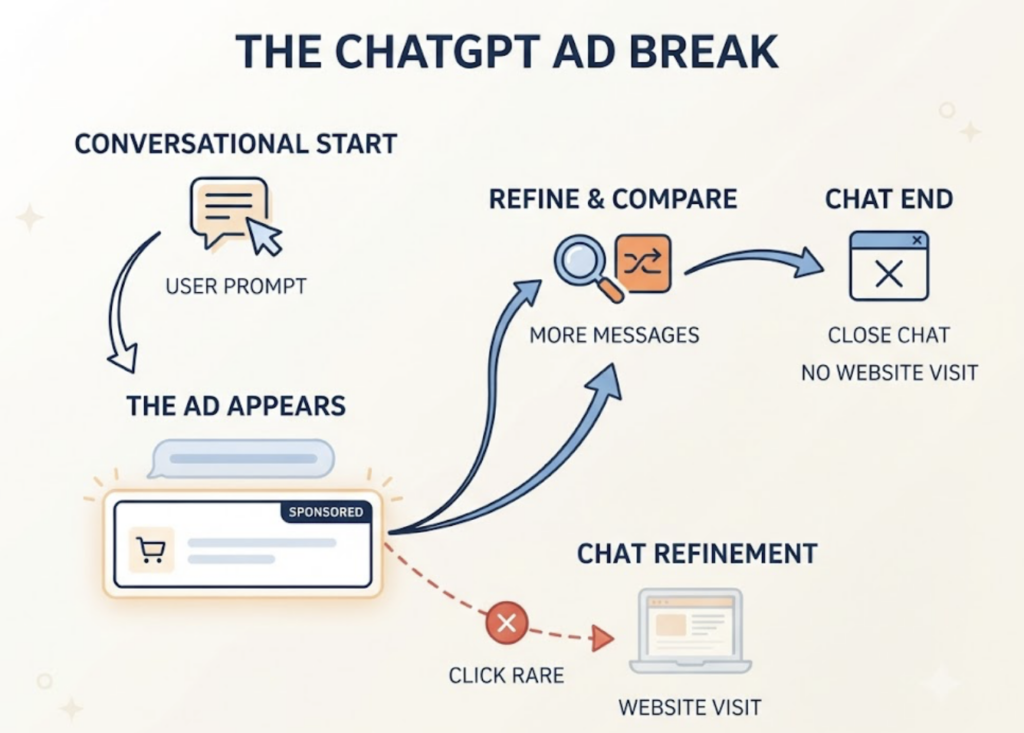
The channel operates on what’s better described as an exposure-to-context paradigm. The ad influences a decision that completes somewhere your pixels can’t see.
Two mechanical failures compound the problem. First, a significant share of AI-referred traffic arrives with no referrer header, so analytics platforms dump it into Direct. Second, UTM passthrough in conversational interfaces is inconsistent, meaning even genuine ad clicks frequently lose their utm_source tagging before landing. Your paid channel data isn’t just incomplete. It’s actively miscategorized.
Where ChatGPT Ads Attribution Breaks: Three Structural Gaps
Gap 1: The Influence Happens Before Any Click Exists
In traditional search, the click starts the decision process. In ChatGPT, the click, if it happens at all, is an optional action at the end of one. The user has already evaluated alternatives, narrowed a shortlist, and formed a preference inside the conversation. By the time they convert, the original ad exposure is untraceable.
This inverts the value of your click data. A 1% CTR on ChatGPT ads doesn’t mean 99% of your spend was wasted. It means 99% of the influence happened in a layer you’re not measuring.
Gap 2: Exposure Without Referral Data
ChatGPT ads behave more like display than search, but with a harsher measurement penalty. Ads are matched to conversation context rather than a persistent user profile, and users routinely see an ad, close the chat, then search your brand name or type your URL directly hours later. Marketers have started calling this Dark Social 2.0: a measurable lift in Direct traffic with no digital breadcrumbs proving causality.
The scale makes it hard to ignore. Independent rollout tracking in late May put sponsored placements in 49% of US ChatGPT responses, up from a limited February pilot. That’s a lot of untagged influence flowing into your Direct bucket.
Gap 3: Paid and Organic Mentions Blur Together
OpenAI’s stated policy is that ads don’t influence the answers ChatGPT gives, and placements are clearly labeled. In practice, users don’t cleanly separate an organic citation from a sponsored box in the same response. Your reporting has to.
Here’s the problem: if ChatGPT was already recommending your brand organically in 30% of relevant conversations, some portion of your “ad-driven” lift would have happened anyway. Without measuring organic AI visibility before and during the campaign, you can’t calculate incrementality. You’re paying for outcomes you may have been getting for free.
That’s the number most teams running ChatGPT ads today genuinely cannot produce.
What the Ads Manager Shows You, and What It Hides
OpenAI moved fast on the buying side. By May 2026, advertisers had access to a self-serve Ads Manager with CPC and CPM bidding and no minimum spend, a sharp drop from the $60 CPM premium placements of the February launch window. The measurement side hasn’t kept pace.
| Metric Layer | Legacy Search/Social | ChatGPT Ads Today | What’s Missing |
|---|---|---|---|
| Visibility | Keyword rankings | Impressions | Brand share of voice across AI answers |
| Interaction | CTR with full click path | CTR, roughly 0.68% to 1.57% in early reports | Influenced non-click intent |
| Attribution | Last-click, UTM, data-driven models | None to limited API-based | Assisted conversion mapping |
| Pricing efficiency | CPC tied to conversion value | CPM/CPC | ROAS at the conversation level |
Read the right column carefully. Every missing layer sits between exposure and conversion, exactly where conversational ads do their work. Impressions tell you the ad ran. Nothing tells you what it changed.
Measuring the Missing Layer: AI Visibility as Your Attribution Baseline
If clicks can’t carry attribution for this channel, something else has to. The most workable answer emerging in 2026 is treating organic AI visibility as the baseline against which paid activity gets measured.
The logic is straightforward. Before spending, you establish how often your brand appears in ChatGPT responses across the prompts that matter to your category, in what position, and with what sentiment. During and after the campaign, you track the delta. Visibility movement that correlates with spend fluctuations, cross-referenced against your Direct traffic lift, becomes your incrementality estimate. It’s not perfect attribution. It’s evidence, which is more than the current setup gives you.
This is where a dedicated measurement layer earns its place. Topify tracks brand presence across ChatGPT, Gemini, Perplexity, and other AI platforms through seven metrics, and four of them map directly onto the gaps above. Visibility Tracking establishes the organic baseline that makes incrementality math possible. Position Tracking shows whether your brand’s placement within answers is shifting, which matters when sponsored boxes and organic mentions coexist in the same response. Source Analysis reveals which domains AI cites when recommending your category, so you can see whether your ad landing pages and your cited content are pulling in the same direction. And CVR, Topify’s Conversion Visibility Rate, estimates how likely an AI answer is to push a user toward brand interaction, which is the closest available proxy for the influenced-but-unclicked intent that CTR ignores.
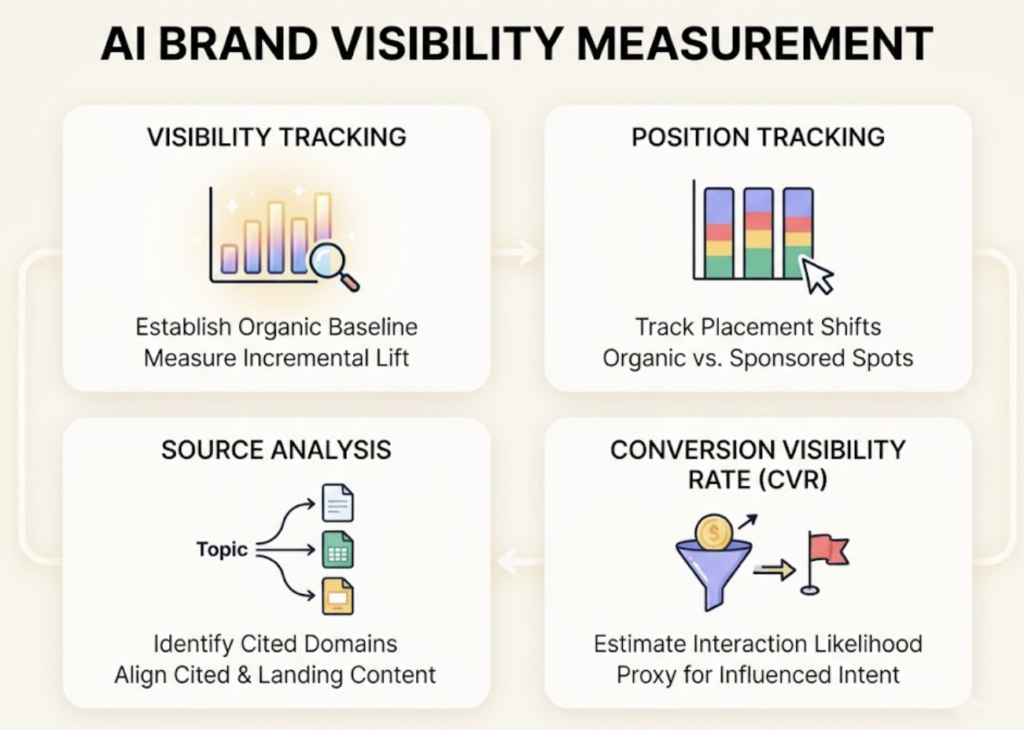
In practice, the workflow looks like this: a performance team maps 100 high-intent prompts before launch, records a 22% organic mention rate, runs six weeks of ChatGPT ads, and watches visibility climb to 31% while branded search volume rises in parallel. That 9-point delta, tied to spend timing, is a defensible incrementality story to bring to a CMO. A curated set of free GEO tools can handle a first-pass baseline check before committing to a full monitoring setup.
A Practical ChatGPT Ads Measurement Setup for 2026
You can build a workable framework in three steps, none of which require waiting for OpenAI to ship better attribution APIs.
Step 1: Calibrate a 30-day baseline before aggressive spend. Map your brand’s organic presence across high-intent AI conversations for a full month. Frequency, position, and sentiment all matter, because a campaign that lifts mentions but degrades sentiment isn’t a win.
Step 2: Run synthetic attribution. Use Direct traffic lift as your secondary proxy, but never in isolation. Cross-reference it against the visibility delta from your AI monitoring data. When both move together with spend, you have a causal argument. When Direct rises but visibility doesn’t, look for another explanation before crediting the ads.
Step 3: Unify the reporting. Combine Ads Manager output (impressions, spend, CTR) with visibility trends into a single “total AI-influenced reach” view. Reporting CPC-based conversions alone will systematically understate the channel and get your budget cut for the wrong reason.
Teams that get started with baseline tracking before their first major flight tend to have an easier time defending the spend later, simply because they have a before-and-after comparison competitors lack.
Conclusion
The attribution gap in ChatGPT ads won’t close on its own. Conversational interfaces structurally separate exposure from conversion, and no amount of UTM discipline fixes a channel where the decisive influence happens before any click. The teams getting ahead of this aren’t waiting for perfect tracking. They’re building an organic AI visibility baseline, measuring deltas against spend, and reporting influence instead of just clicks. Set up the baseline before your next campaign flight, not after the CMO asks a question your dashboard can’t answer.
FAQ
Q: Can you track ChatGPT ads conversions in GA4?
A: Only partially. Clicks with intact UTM parameters will attribute normally, but referral stripping and non-click influence mean most of the channel’s impact lands in Direct or organic buckets. GA4 alone will significantly undercount ChatGPT ads performance.
Q: How do you measure ChatGPT advertising ROI without click attribution?
A: Establish an organic AI visibility baseline before spending, then track the visibility delta and Direct traffic lift against spend timing. The correlation between these signals serves as your incrementality estimate.
Q: What’s the difference between paid and organic visibility in ChatGPT?
A: Organic visibility is when ChatGPT mentions or recommends your brand within its answer content. Paid placement is a labeled sponsored box beneath the answer. OpenAI states ads don’t influence answer content, so the two layers move independently and need separate measurement.
Q: Should brands run ChatGPT ads if attribution is this limited?
A: The reach case is strong, with sponsored placements now appearing in roughly half of US responses. The practical approach is to run the channel with a measurement framework built for it, rather than skipping it or flying blind.

