

Your team probably has one playbook for AI search. As of February 2026, you need two. Within nine days of each other, the two most-watched AI answer engines made opposite bets: OpenAI switched ChatGPT ads on for millions of free users, while Perplexity shut its ad program down for good. Same market, same month, contradictory conclusions about what users will tolerate.
If you’re deciding where next quarter’s visibility budget goes, this isn’t trivia. It determines which platforms you can pay your way into, and which ones you can only earn your way into.
One Month, Two Opposite Bets on the Future of AI Search
The timeline is unusually compressed. ChatGPT ads went live on February 9, 2026, for Free and Go tier users. Nine days later, on February 18, Perplexity confirmed it was discontinuing the ad experiments it had been running since late 2024.
That leaves the three dominant AI search platforms running three different commercial models. ChatGPT now mixes ad revenue with tiered subscriptions. Perplexity is pure subscription plus enterprise sales. Google keeps extending its existing ad infrastructure into AI Overviews and AI Mode.
The scale on each side is real. ChatGPT’s ad program reportedly reached $100M in annualized revenue within two monthson the back of 800M+ weekly active users, with OpenAI targeting $2.5B annually. Perplexity walked away from monetizing 780 million monthly queries through ads.
These aren’t two isolated product decisions. They’re two live experiments on the same question: how much commercial influence can an answer engine carry before users stop believing it?
Why Perplexity Walked Away From Ad Revenue
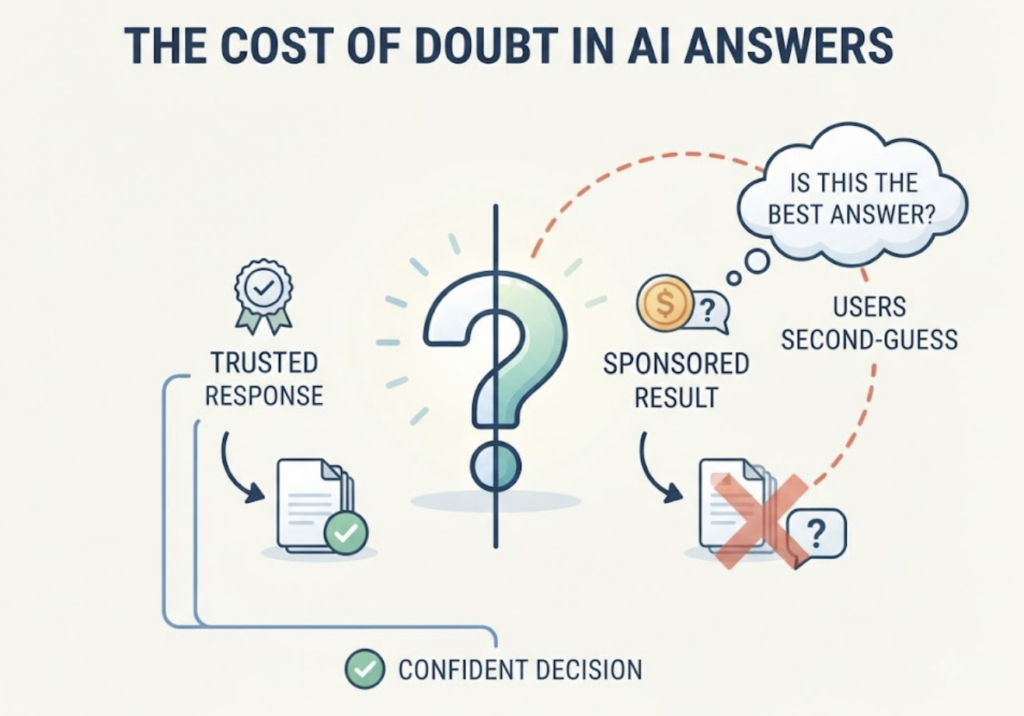
Perplexity’s stated reason is blunt. One executive told the Financial Times that with ads, “a user would just start doubting everything.” The company’s position is that perception matters as much as fact: even clearly labeled sponsored placements can make users second-guess whether they got the best possible answer.
The experiment also never scaled. Fewer than 0.5% of brands that applied to advertise were ever admitted, and Taz Patel, the executive leading the ads effort, left before the program wound down.
The replacement model is already producing numbers. Perplexity reached roughly $200M in annual recurring revenue by late 2025 and is now targeting $500M in annualized subscription revenue, selling $20 to $200 per month plans to finance professionals, lawyers, doctors, and executives who pay specifically for answers that nobody sponsored.
That last detail matters more than the revenue figure. Perplexity is deliberately concentrating the buyers most brands want to reach inside a platform where placement can’t be bought.
Inside ChatGPT Ads: How OpenAI Structured the Opposite Bet
OpenAI’s implementation is designed to look nothing like old search ads. Sponsored results appear in clearly labeled, visually separated boxes below the organic answer, never inside the response text. OpenAI states that ads don’t influence what ChatGPT actually says, and targeting runs on conversation topics, chat history, and prior ad interactions.
The commercial mechanics moved fast. ChatGPT ads launched as a managed service with roughly $60 CPMs and $200k minimums, then shifted to a self-serve CPC model with $3 to $5 bid floors by May 2026 to open up inventory. In three months, it went from exclusive brand program to something closer to a performance channel.
Here’s the structural catch: paying subscribers on Plus, Pro, Business, Enterprise, and Education tiers see no ads at all. The users who pay for ChatGPT, disproportionately professionals with buying authority, sit entirely outside the ad inventory.
And user sentiment is not neutral. An Ipsos survey found that 63% of users say ads in AI search results make them trust those results less. OpenAI is betting that clean labeling and answer-integrity guarantees can hold that skepticism at bay while ad spend scales.
The Two-Tier Split: Where Your Buyers Actually Are
Put the two bets side by side and a two-track market emerges.
| Ad-Supported Tier | Trust-First Tier | |
|---|---|---|
| Platforms | ChatGPT Free/Go, Google AI Overviews and AI Mode | Perplexity, Claude, ChatGPT paid tiers |
| Monetization | CPM/CPC ads plus subscriptions | Subscriptions and enterprise sales |
| How brands get in | Paid placement plus organic citation | Organic citation only |
| Typical intent | General discovery, transactional queries | Deep research, professional decisions |
The money is flowing toward the ad side. US advertisers are projected to grow AI search ad spend from $1B in 2025 to $25.9B by 2029, around 13.6% of all search ad spending.
But the audience quality skews the other way. The trust-first tier concentrates high-intent professional users, Perplexity’s paying researchers, Claude’s ad-free user base, and every ChatGPT subscriber, into environments with zero paid slots. If you sell to CFOs, general counsel, physicians, or technical decision-makers, a large share of their AI queries happen where no ad budget can follow.
One more wrinkle: even inside ChatGPT, ads don’t touch the organic answer. Buying placement gets you a labeled box below the response. It doesn’t change whether the model mentions your brand in the answer itself. Organic authority drives the actual recommendation in both tiers.
What ChatGPT Ads Mean for Your GEO Strategy
The practical conclusion is that “AI search” is no longer one channel. It’s two channels with different economics, and organic citation is the only asset that works in both.
That makes measurement the first move, not media buying. Before committing spend to ChatGPT ads, you need a baseline: how often do AI engines already mention your brand, in what position, with what sentiment, and citing which sources? Most teams can’t answer any of those four questions today.
This is where a dedicated tracking layer earns its place. Topify monitors brand visibility across ChatGPT, Perplexity, Gemini, and other major AI platforms, scoring seven metrics including visibility, sentiment, position, and mentions. In practice, that means you can see whether Perplexity’s ad-free answers recommend you or your competitor, and whether your ChatGPT organic presence justifies layering paid placement on top. Its Source Analysis goes a step further by reverse-engineering the exact domains and URLs each AI engine cites, so you know which third-party sites function as gatekeepers for your category. If you want to gauge your starting point before committing to a platform, Topify’s free GEO tools cover the initial audit at no cost.
The point isn’t tooling for its own sake. It’s that ad decisions made without an organic baseline are guesses with a budget attached.
Playbook: Winning Both Tracks Without Betting on One
A workable dual-track approach looks like this.
Measure your organic citation share first. Track how often you appear in AI answers across both tiers for your priority prompts. This number is your universal currency; it counts on Perplexity, on Claude, and in ChatGPT’s organic answers where ads can’t reach.
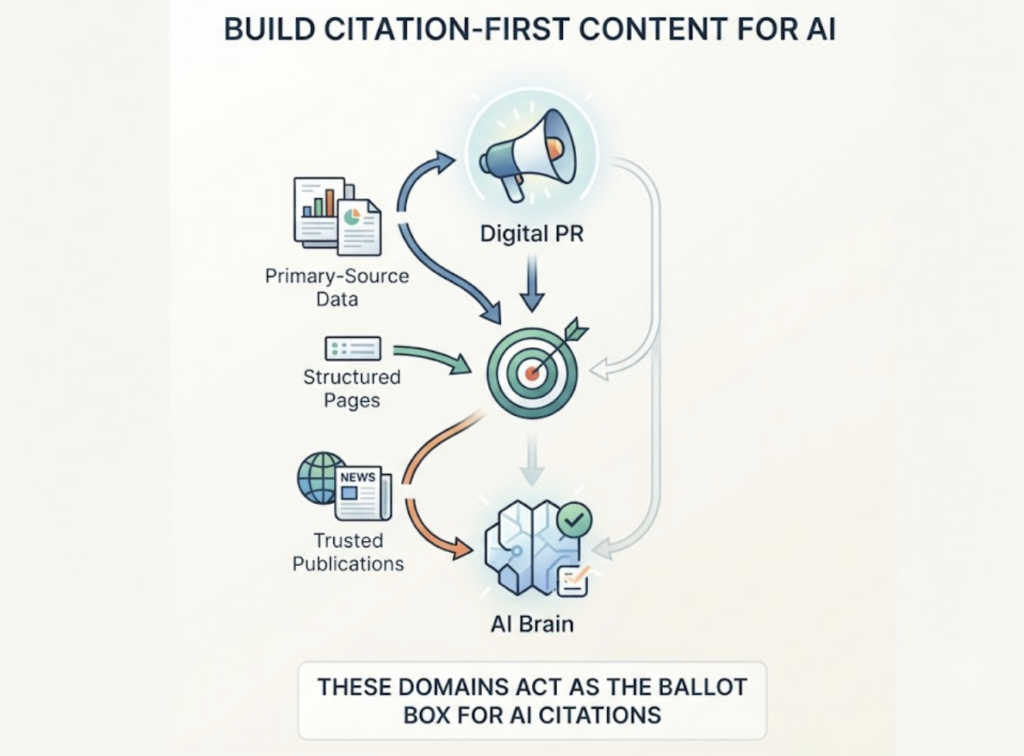
Build citation-first content for the trust tier. AI engines in the ad-free tier cite what their retrieval systems judge authoritative. That tends to mean primary-source data, structured pages that extraction systems can parse, and third-party coverage in publications those engines already trust. Digital PR that earns mentions on the domains your Source Analysis flags is worth more here than any on-page tweak, because those domains are effectively the ballot box for who gets cited.
Test ChatGPT ads small and compare honestly. The self-serve CPC model lowers the entry cost. Run a contained test and measure it against the cost of earning equivalent organic mentions, not against legacy Google benchmarks.
Review monthly, not annually. Competitor benchmarking matters here because AI citation patterns shift every few weeks. A rival gaining citation share in the trust tier won’t show up in your ad dashboard at all.
Conclusion
February 2026 didn’t settle the ads-in-AI debate. It split the market so both answers could coexist. OpenAI is betting that labeled, walled-off ChatGPT ads can monetize scale without burning trust. Perplexity is betting its entire business that they can’t.
Brands don’t get to pick a winner. Your buyers are already spread across both tiers, and the only visibility asset that transfers between them is organic citation. Start by measuring where you stand on each track, then decide whether ad spend adds to that foundation. Buying placement is optional. Being cited isn’t.
FAQ
Q: Does ChatGPT show ads to all users?
A: No. ChatGPT ads appear only for Free and Go tier users. Plus, Pro, Business, Enterprise, and Education subscribers see an ad-free experience, which means paying professional users sit outside the ad inventory entirely.
Q: Why did Perplexity remove ads?
A: Perplexity concluded that ads erode trust even when clearly labeled, with executives arguing users need to believe they’re getting the best possible answer. The company shifted to a pure subscription and enterprise model targeting $500M in annualized revenue.
Q: Can you buy placement in Perplexity or Claude answers?
A: No. Neither platform sells ad placement, so the only way to appear in their answers is organic citation, earned through authoritative content and coverage on sources their retrieval systems trust.
Q: How do you track brand visibility across ad-free AI search engines?
A: Use an AI visibility platform that queries engines like Perplexity and ChatGPT at scale and reports mention frequency, position, sentiment, and cited sources. That baseline shows where you’re already visible organically and where paid or earned efforts should focus.

