


You’ve got a dashboard tracking your brand’s mentions in ChatGPT. Maybe a spreadsheet logging Perplexity citations. Your team pulls the numbers every month, nods at the charts, and moves on. Three quarters later, the data hasn’t changed anything. Your competitors still show up first, your visibility score hasn’t moved, and the CMO is asking why all that tracking didn’t translate into results.
That’s the gap most marketing teams fall into. Collecting AI visibility data isn’t the same as having an AI visibility analytics strategy. Only 16% of brands actively track their AI search presence today. Among those that do, the vast majority are recycling traditional SEO frameworks that weren’t built for generative engines. The shift from passive tracking to strategic execution requires a different foundation: the right metrics, the right AI visibility analytics tool, and a reporting cadence fast enough to keep pace with models that rewrite their citation sources every few weeks.
Most Brands Confuse AI Tracking with AI Strategy. Here’s the Difference.
Traditional SEO is deterministic. You optimize a page, earn backlinks, track keyword rankings. The inputs and outputs follow a predictable logic. Generative Engine Optimization (GEO) doesn’t work that way. AI answer engines use probabilistic reasoning: they pull from training data, query vector databases for semantic relevance, evaluate source authority, and synthesize a direct response. The signals that matter are fundamentally different.
Here’s one data point that illustrates the disconnect. Roughly 60% of citations in Google AI Overviews come from URLs that don’t even rank in the top 20 organic search results. That means your entire SEO ranking infrastructure can be strong, and AI engines will still bypass you for sources that carry more entity-level authority.
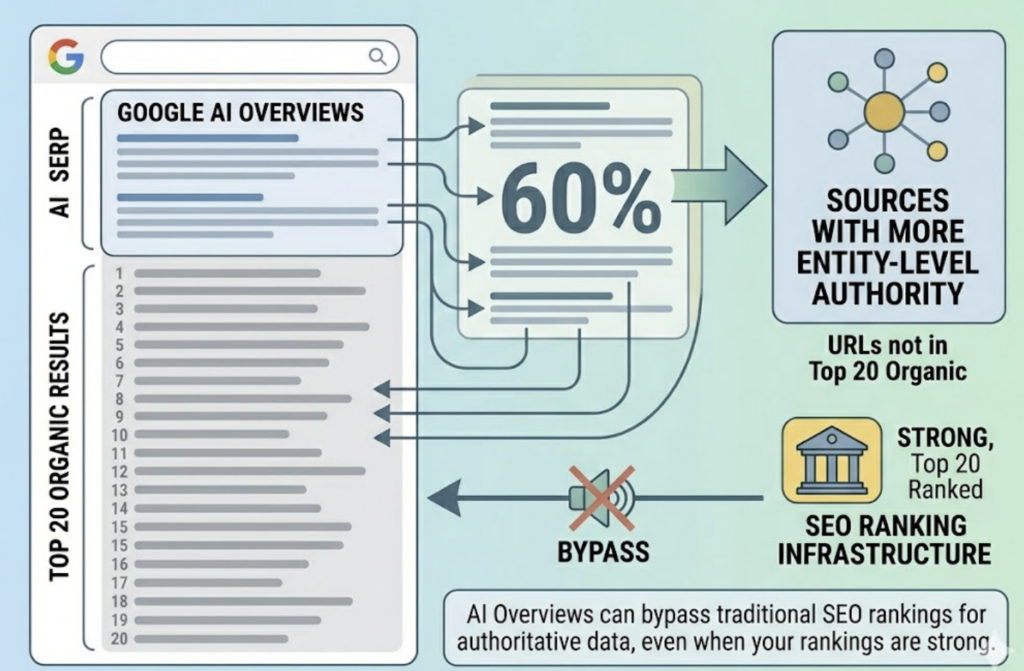
The result? Organic click-through rates on AI-triggered queries have dropped from 1.76% to 0.61%, a 62% decline. Brands that treat their AI visibility analytics dashboard as just another SEO report are optimizing for a system that no longer drives the majority of discovery behavior.
A real strategy does three things legacy tracking can’t: it defines which metrics actually reflect generative influence, it connects those metrics to execution workflows, and it runs at a cadence that matches how fast AI models shift their citation patterns.
The 7 Metrics Your AI Visibility Analytics Dashboard Needs to Track
A complete AI visibility analytics strategy measures conversational influence from the initial prompt to the final conversion. The seven-metric framework, as operationalized by platforms like Topify, covers the full spectrum.
Visibility Rate tracks how often your brand appears in category-level AI responses, not just branded queries. A brand might have 90% visibility when someone searches its name, but near-zero for non-branded prompts like “best workflow automation tool for enterprise finance.” Topify data shows the average e-commerce brand sits at a 0.8% visibility rate, while leaders command 6.2%. In SaaS, the average is 2.1% and leaders reach 11.8%.
That gap is the total addressable market you’re losing.
Sentiment Score evaluates how AI frames your brand on a 0-to-100 scale. High visibility with low sentiment is worse than invisibility. If an AI engine relies on outdated forum data and describes your product as “overpriced compared to competitors,” that narrative actively deters conversions.
Position Rank captures where your brand lands in the synthesized response. First position captures disproportionate trust and click-through due to the primacy effect. Third position is a footnote.
AI Search Volume measures how many users query generative platforms about topics in your category. This diverges significantly from traditional keyword volume because conversational prompts are longer, more specific, and structured as problem statements rather than keyword fragments.
Brand Mentions and Source Citations track which external domains AI models reference when constructing answers about your brand. An Ahrefs study of 75,000 brands found a 0.664 correlation between external web mentions and visibility in Google AI Overviews. Traditional backlinks? Only 0.218. Third-party mentions are the new machine reputational vote.
Intent Coverage maps your presence across the buyer journey: informational (“what is X”), comparative (“X vs Y”), and transactional (“best pricing for X”). Many brands achieve strong informational visibility but disappear entirely on comparative and transactional prompts where purchase decisions happen.
Conversion Visibility Rate (CVR) bridges generative presence and revenue. AI-referred visitors convert at 14.2%, compared to 2.8% for standard organic search. They also spend 68% more time on-site. If you’re invisible on transactional queries, you’re missing the highest-converting traffic channel available today.
Which Metrics to Prioritize Depends on Your Business Goal
You don’t optimize all seven simultaneously. That diffuses resources.
For brand awareness, narrow the focus to Visibility Rate and AI Volume. Maximize how often your entity gets extracted across high-demand conversational prompts.
For competitive defense, shift weight to Position Rank and Brand Mentions. Reverse-engineer the third-party URLs driving a competitor’s primary recommendation slot and systematically acquire presence on those citation nodes.
For conversion optimization, prioritize CVR, Intent Coverage, and Sentiment Score. A sentiment drop on transactional prompts, like an AI surfacing old customer complaints during a pricing comparison, will sever the conversion pathway instantly.
How to Choose an AI Visibility Analytics Platform
Evaluating an AI visibility analytics software stack requires scrutiny across four dimensions: multi-platform AI coverage, metric depth, competitive benchmarking, and the presence of an execution layer.
Platform coverage matters because user bases are fragmented. ChatGPT commands over 80% of the AI chatbot market, but Perplexity dominates academic and technical research, DeepSeek serves as a primary gateway in Asian markets, and Google AI Overviews intercept standard browser behavior. An AI visibility analytics solution that only tracks one platform leaves blind spots.
The most severe differentiator, though, is the execution layer. Most AI visibility analytics software functions as an observation deck: it identifies gaps but relies entirely on manual intervention to fix them.
| Platform | AI Engine Coverage | Primary Strength | Known Limitation | Best For |
|---|---|---|---|---|
| Topify | ChatGPT, Perplexity, Gemini, DeepSeek, AI Overviews | Seven-metric framework + One-Click GEO Execution | Not suited for passive-only reporting teams | End-to-end strategy from insight to execution |
| Profound | ChatGPT natively; multi-engine at Enterprise tier | Conversation Explorer with 400M+ real interactions | Pure intelligence layer, no execution features | Enterprise brands needing deep passive intelligence |
| Quattr | Multi-engine + Google Search Console | GIGA agent for CMS-ready HTML generation | High complexity, custom enterprise pricing | Large B2B SaaS with massive content repositories |
| Semrush AI Toolkit | Core engines + AI Overviews | Distinguishes brand mentions from cited page attribution | Anchored to traditional SEO workflows | SEO teams transitioning into GEO |
| Scrunch AI | Core engines (AXP Focus) | Persona-based monitoring across user types | $250/mo entry cost limits mid-market access | Brand safety and hallucination monitoring |
For teams that need to move from data to action without a data science team in between, Topify’s architecture stands out. Its system continuously analyzes visibility data to generate prioritized, AI-driven action feeds, and its citation mapping lets you reverse-engineer exactly which third-party URLs are driving competitor visibility.
Building Your AI Visibility Analytics Strategy in 4 Steps
Step 1: Define the Tracking Perimeter
Don’t track every conceivable query. Identify your “Golden Query” set: the 20 to 50 high-value prompts with strong commercial intent that align with your ideal customer profile.
Traditional keyword research tools can’t do this because they measure search engine indexing, not conversational language. Topify’s High-Value Prompt Discovery automates this scoping by scoring prompts on four weighted factors: AI Query Volume (30%), Visibility Gap (25%), Commercial Intent (25%), and Content Readiness (20%). This narrows the perimeter to prompts with the highest downstream conversion probability.
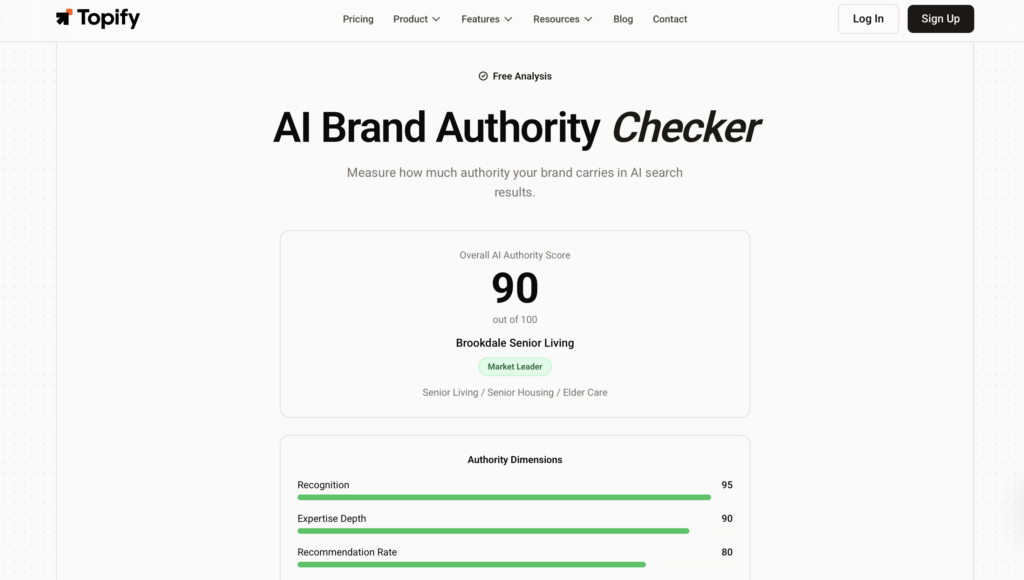
A good starting point for teams without a paid tool: Topify’s free GEO audit tools can give you an initial visibility snapshot before you commit to a full platform.
Step 2: Establish the Baseline
Run your Golden Prompts across ChatGPT, Perplexity, Gemini, and Claude. Record the current visibility score, position rank, and sentiment for each platform. This is your Share of Model.
During this phase, audit your entity infrastructure. AI systems build knowledge graphs that associate companies with expertise signals. If your brand is described inconsistently across your website, LinkedIn, Google Business Profile, and industry directories, the model interprets that ambiguity as a lack of authority. Inconsistency breaks AI entity recognition.
Step 3: Set Competitor Benchmarks and Map Citations
Generative search is zero-sum. Your visibility gain displaces a competitor. Configure your AI visibility analytics system to track rivals across the same Golden Query set.
This step relies heavily on citation mapping. A Q1 2026 audit found that Wikipedia and Reddit together account for over 25% of all ChatGPT citations in the US. Review platforms like G2 and Capterra provide a 3x multiplier to citation rates. By identifying exactly which domains cite your competitors, you establish precise targets for digital PR and content syndication.
Step 4: Set the Execution and Reporting Cadence
Static monthly reports are obsolete before they reach an executive desk. AI models update retrieval databases and shift context windows continuously.
Daily or weekly analytics are the minimum functional frequency. More importantly, reporting must be linked to execution. When a visibility gap shows up in a weekly review, the workflow should dictate an immediate response. Topify’s One-Click Execution closes this gap: when the platform detects a drop, its AI agent generates a prioritized action feed and lets the team deploy the fix instantly.
What Breaks Most AI Visibility Analytics Systems After 90 Days
Most teams that deploy an AI tracking strategy see it break within the first quarter. The failure is almost never technological. It’s methodological.
Treating GEO as a one-time checklist. Deploying FAQ schema and formatting content as “answer-first” can yield initial visibility gains within 30 to 60 days, but the effect decays fast. Research shows 65% of AI bots prioritize pages updated within the past year, and 79% reference content refreshed within two years. Princeton data reveals that keyword stuffing degrades AI visibility by 10%, while inline citations boost it by 115.1%. Publish-and-forget strategies always lose to teams that continuously refresh.
Ignoring the external source stack. The University of Toronto found that AI search engines return 81.9% earned media compared to only 18.1% brand-owned content. One B2B SaaS company wrote six extensive blog posts and got zero AI citations. When they shifted to securing 12 third-party mentions through newsletters, podcasts, and reviews, their AI-sourced demo bookings jumped from 7% to 19%. A Stacker pilot across 87 stories achieved a 239% median citation lift through syndication alone.
Dashboard paralysis. Teams review dashboards weekly but deploy zero content updates or PR initiatives. The fix is straightforward: connect your analytics directly to an execution layer. Topify’s automated action feed forces the transition from observation to deployment.
| Health Check | Failure Indicator | Corrective Action |
|---|---|---|
| Citation Volatility | 40%+ drop in source frequency over 30 days | Launch external PR syndication targeting high-cited domains |
| Sentiment Decay | Score falls below 50 | Audit negative mentions; update owned content with corrected facts |
| Intent Misalignment | High informational visibility, zero transactional | Deploy pricing schema and comparative content |
| Freshness Penalty | Steady month-over-month position decline | Refresh core pages; update statistics to trigger re-indexing |
| Entity Ambiguity | Visibility drops across multiple platforms simultaneously | Clean up entity profiles across Wikipedia, LinkedIn, Google Business |
Conclusion
Collecting AI visibility data and having an AI visibility analytics strategy are two different things. The gap between them is execution.
A durable strategy rests on three pillars: a seven-metric framework that captures the full generative influence spectrum, an AI visibility analytics platform capable of multi-engine tracking and automated optimization, and a reporting cadence measured in days rather than months. The starting point is defining your golden query perimeter, establishing the baseline Share of Model, and running the first cycle of optimization. For teams ready to close the gap between tracking and action, Topify provides the infrastructure to move from raw data to measurable results.
FAQ
Q: What is an AI visibility analytics strategy?
A: It’s a systematic framework for monitoring, measuring, and actively influencing how often and how positively your brand appears in AI search engines like ChatGPT, Gemini, and Perplexity. It goes beyond passive tracking by combining a multi-metric dashboard with continuous competitor benchmarking and an execution protocol that optimizes content for language model extraction.
Q: What’s the best AI visibility analytics tool for tracking brand visibility in ChatGPT?
A: Topify is a strong option for tracking ChatGPT visibility alongside other generative platforms. It combines a seven-metric framework with a One-Click Execution layer, so teams can track visibility and deploy optimizations from the same dashboard. Profound offers deep conversation data for enterprise intelligence, while Semrush provides a familiar interface for SEO teams transitioning into GEO.
Q: How often should you review your AI visibility analytics dashboard?
A: Weekly at minimum. Research shows that 40% to 60% of cited sources in AI responses change month to month. Monthly reviews miss algorithmic shifts, sentiment decay, and competitor displacement events. Daily monitoring is ideal for brands in competitive categories.
Q: Can you track brand visibility across multiple AI search platforms at once?
A: Yes. Modern AI visibility analytics platforms like Topify natively track performance across ChatGPT, Perplexity, Gemini, Google AI Overviews, and regional platforms like DeepSeek. This consolidated, cross-platform view is necessary because a brand can dominate one engine while remaining invisible on another due to differing citation sources.

