

Your brand ranks on page one for every target keyword. Your Brandwatch dashboard shows steady sentiment. Then a prospect asks ChatGPT, “What’s the best tool for [your category]?” and gets five recommendations. You’re not on the list.
The gap between what traditional monitoring tools see and what AI search engines actually recommend is where brands are losing deals they never knew existed. And with over 56% of global search volume now flowing through AI answer engines, that gap is growing every quarter.
Most AI Brand Monitoring Tools Were Built for a World That No Longer Exists
Traditional brand monitoring platforms like Brandwatch and Brand24 were designed to crawl social media posts, news articles, blogs, and forums. They track Share of Voice, backlinks, and post-discovery sentiment. That model worked when Google’s blue links were the primary discovery channel.
It doesn’t work for AI search.
ChatGPT, Perplexity, and Gemini don’t crawl pages and rank them. They synthesize answers from diverse sources using Retrieval-Augmented Generation (RAG), pulling from reviews, forums, podcasts, and structured data. The output isn’t a list of links. It’s a conversational recommendation, often with a ranked shortlist of brands.
That’s a fundamentally different monitoring challenge.
Traditional tools capture what people say about your brand after they’ve found you. An AI brand monitoring tool captures whether AI recommends your brand before the user even visits a website. 65% of informational queries now resolve without a single click, which means the AI’s answer is the entire user experience for most discovery moments.
Top AI Brand Monitoring Tools in 2026: A Side-by-Side Look
Here’s how the leading ai rank trackers compare across the dimensions that matter most for brand monitoring:
| Tool | AI Platforms Covered | Brand Mention Tracking | Position Tracking | Sentiment Analysis | Competitor Monitoring | Starting Price |
|---|---|---|---|---|---|---|
| Topify | ChatGPT, Gemini, Perplexity, DeepSeek, Doubao, Qwen + more | Yes (Share of Model) | Yes | Yes (0-100) | Auto-detection + benchmarking | $99/mo |
| Profound | ChatGPT, Perplexity | Yes | Limited | Yes (NSS) | Manual setup | Custom pricing |
| OtterlyAI | ChatGPT, Perplexity, Gemini | Yes | Yes | Yes (NSS) | Basic comparison | Custom pricing |
| BrandViz.AI | ChatGPT, Gemini | Yes | No | Limited | No | Free tier available |
| AIOverview.com | Google AI Overviews only | Yes | No | No | No | Free |
The differences aren’t subtle. Platform coverage, automated competitor detection, and the depth of sentiment scoring vary widely, and those gaps determine whether you’re seeing the full picture or just a slice of it.
#1 Topify: Full-Stack AI Brand Monitoring Across Every Major Platform
Where most tools cover two or three AI engines, Topify tracks brand visibility across ChatGPT, Gemini, Perplexity, DeepSeek, Doubao, Qwen, and other regional platforms. For global brands or teams managing multi-market campaigns, that coverage isn’t optional.
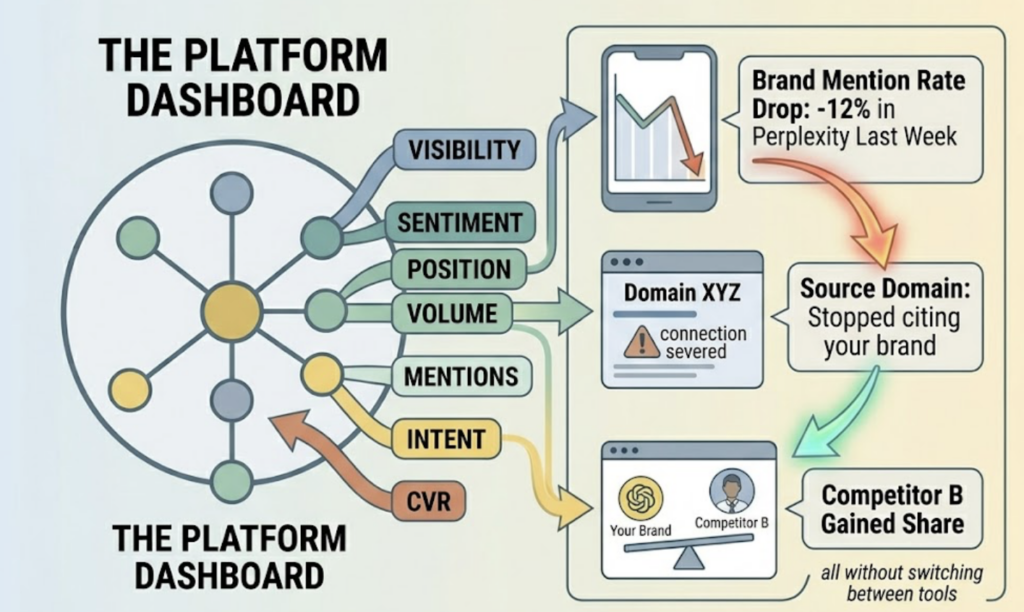
The platform’s core strength is combining seven analytics dimensions into a single dashboard: visibility, sentiment, position, volume, mentions, intent, and CVR (Conversion Visibility Rate). In practice, this means you can see that your brand’s mention rate dropped 12% in Perplexity last week, trace it to a specific source domain that stopped citing you, and identify which competitor gained that share, all without switching between tools.
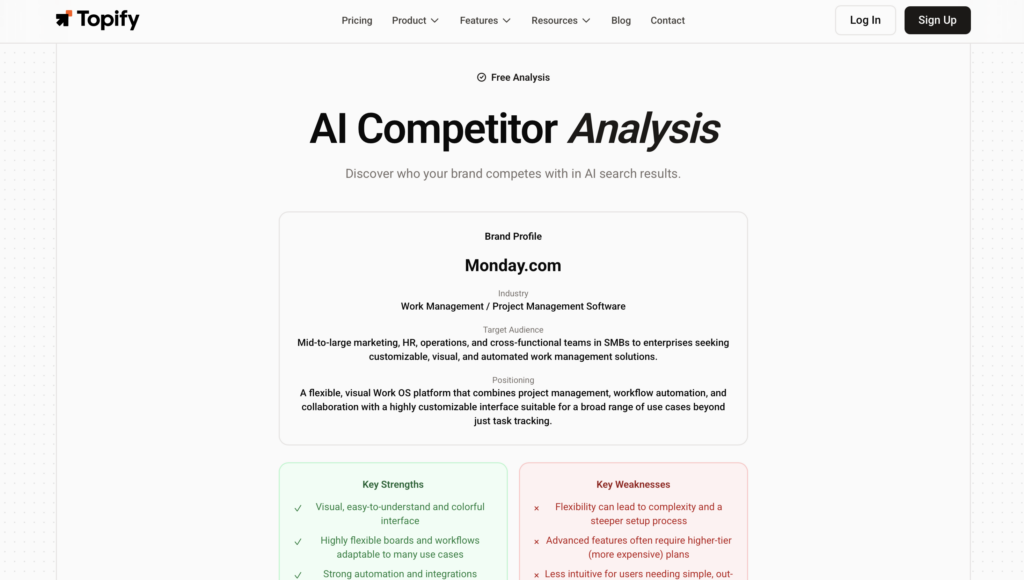
Competitor Monitoring deserves a closer look. Topify auto-detects competitors based on the prompts you’re tracking, so you don’t need to manually build a watchlist. When a new brand starts appearing in AI recommendations for your category, you’ll know.
The Source Analysis feature reverse-engineers the exact domains and URLs that AI platforms cite when generating answers. This is the “new backlink profile” for AI search. If a competitor is being cited from a source you’re not present on, that’s a content gap you can act on.
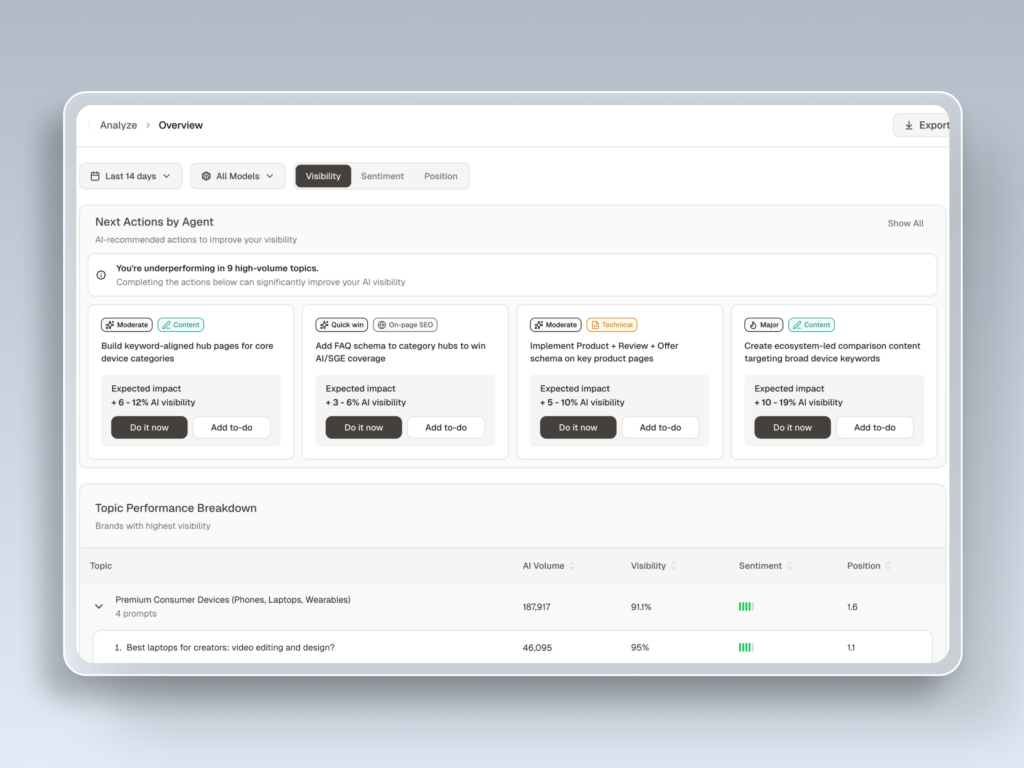
Topify also offers a One-Click Agent: define your optimization goals in plain English, review the proposed strategy, and deploy it with a single click. No manual workflows required.
Pricing starts at $99/mo for the Basic plan (100 prompts, 9,000 AI answer analyses, 4 projects). The Pro plan at $199/mo scales to 250 prompts and 22,500 analyses.
#2 Through #5: Other Best AI Rank Trackers Worth Knowing
Profound focuses on AI citation analysis with a strong emphasis on net sentiment scoring. It covers ChatGPT and Perplexity, and its NSS model measures the emotional context of brand mentions on a -100 to +100 scale. The trade-off: limited platform coverage and no automated competitor detection. It tends to suit teams that prioritize deep sentiment analysis over breadth.
OtterlyAI offers AI visibility tracking across ChatGPT, Perplexity, and Gemini with a technical deep-dive approach to sentiment. Its position tracking and mention frequency tools are solid for teams already familiar with AI monitoring. Competitor comparison is available but requires more manual configuration than Topify’s auto-detection.
BrandViz.AI provides a lightweight entry point for teams just starting with AI brand monitoring. It covers ChatGPT and Gemini with basic mention tracking and a free tier. Position tracking and competitor monitoring aren’t available, so it’s best suited for initial exploration rather than ongoing strategy.
AIOverview.com is a single-purpose tool focused exclusively on Google AI Overviews. It tracks whether your brand appears in Google’s AI-generated summaries. Useful as a supplementary data source, but it doesn’t cover the broader AI search ecosystem where most buyer-intent discovery happens.
How to Pick the Right AI Rank Tracker for Brand Mentions
The “right” tool depends on what you’re trying to monitor and who’s doing the monitoring.
Brand managers typically need breadth: visibility across multiple AI platforms, sentiment tracking, and enough competitor data to report to leadership. Topify’s combination of auto-detected competitors, cross-platform coverage, and CVR scoring fits this profile. The dashboard is built to answer “How are we performing vs. competitors in AI search?” without requiring a data team to interpret the output.
SEO teams expanding into GEO often care most about source analysis. They want to know which domains AI engines are citing, where their content gaps are, and how to build an “AI backlink” strategy. Topify’s Source Analysis and Position Tracking address this directly.
Agencies managing multiple client brands need scalability. Topify’s project-based structure (4 projects on Basic, 8 on Pro) lets agencies run separate monitoring dashboards for each client.
If your only concern is Google AI Overviews and you don’t need cross-platform data, AIOverview.com is a free starting point. But for any team treating AI search as a serious brand channel, a full-stack ai rank tracker for brand mentions is the minimum viable setup.
3 Metrics Your AI Brand Monitoring Tool Must Track (or It’s Missing the Point)
Visibility Score: Are You Even in the Room?
Visibility Score measures how often your brand appears in AI-generated responses for high-intent queries in your category. Think of it as Share of Model, the AI equivalent of Share of Voice.
If your brand doesn’t appear in the initial AI response, you’re effectively invisible. Few users ask follow-up questions to surface more options. The first answer is the shortlist.
Position Rank: Where You Show Up Matters as Much as Whether You Show Up
AI models often present brands in a ranked list or a prioritized narrative. Being mentioned first carries disproportionate weight, similar to “position zero” in traditional SEO but applied to conversational output.
Topify‘s Position Tracking monitors this across platforms, so you can see whether you’re consistently first-mentioned in ChatGPT but buried in Perplexity, and then dig into why.
Sentiment Score: What AI Says About You Shapes How Buyers Perceive You
A brand can be visible and still lose. If ChatGPT describes your product as “budget-friendly” when your positioning is premium, that’s a brand narrative problem happening at scale, in thousands of AI-generated responses per day.
Sentiment Score (often measured on a 0-100 or -100 to +100 scale) quantifies the emotional context of AI mentions. Is your brand described as “reliable” or “outdated”? “Innovative” or “complex”? Tracking this over time reveals whether your content strategy is actually shaping AI perception, or losing ground.
Conclusion
Traditional brand monitoring tools were built to track social chatter and news mentions. They still do that well. But they weren’t designed for a world where over half of search volume runs through AI engines that generate recommendations without ever linking to your website.
An AI brand monitoring tool fills that gap: tracking whether your brand is cited, where it ranks, and how AI describes it to potential buyers. The brands that treat AI monitoring as a core channel, not an experiment, are the ones building the visibility that compounds.
If you haven’t audited your brand’s AI search presence yet, start with Topify and run your first visibility report. The data tends to be clarifying.
FAQ
Q: What’s the difference between traditional brand monitoring and AI brand monitoring?
A: Traditional brand monitoring tracks mentions across social media, news outlets, and forums. AI brand monitoring tracks how AI search engines like ChatGPT, Perplexity, and Gemini recommend, rank, and describe your brand in their generated responses. The key difference is timing: traditional tools capture reactions after discovery, while AI monitoring captures the recommendation layer where buyer shortlists are formed.
Q: How do ai rank trackers for brand mentions actually work?
A: AI rank trackers send structured prompts to AI engines (e.g., “What are the best tools for [category]?”) and analyze the responses for brand presence, position, sentiment, and cited sources. This process runs on a scheduled basis, building a time-series dataset of how your brand’s AI visibility changes over weeks and months.
Q: Can AI brand monitoring tools track competitor mentions too?
A: Yes. Most AI brand monitoring tools include some form of competitor tracking. Topify auto-detects competitors based on the prompts you monitor, so new entrants are flagged automatically. Other tools require you to manually specify competitor names, which means emerging rivals can go unnoticed.
Q: How often should you check your brand’s AI search visibility?
A: Weekly monitoring is the minimum for most brands. AI models update their responses frequently, and a source that cited your brand last month may no longer be referenced. Teams in competitive categories (SaaS, fintech, e-commerce) often benefit from daily tracking to catch visibility shifts early.

