

Your SEO dashboard says traffic is steady. Your domain authority is climbing. Your keyword rankings haven’t budged. But when a potential buyer asks ChatGPT for the best solution in your category, your brand doesn’t show up in the answer. That disconnect isn’t a glitch. It’s a structural blind spot built into every traditional analytics tool on the market. In 2025, 58.5% of U.S. searches ended without a single click to an external website, and AI Overviews alone drove organic click-through rate declines of up to 61% for previously top-ranking pages. The queries didn’t disappear. They moved to places your current stack can’t see.
What AI Visibility Analytics Tracking Actually Measures
AI visibility analytics tracking is a cross-platform methodology designed to monitor, quantify, and analyze how often, and in what context, a brand gets mentioned, recommended, or cited by AI interfaces. That’s a fundamentally different job than what traditional SEO analytics do.
Legacy tools track a URL’s position in a linear index. They report whether a landing page sits at position one or position ten, along with the corresponding impressions and clicks. AI visibility analytics tracking evaluates the presence and framing of a conceptual entity. When a buyer prompts ChatGPT with a complex, natural-language question about the best software for a specific use case, the model doesn’t return a list of clickable links. It generates a narrative answer, synthesizing data from dozens of sources to recommend a curated shortlist.
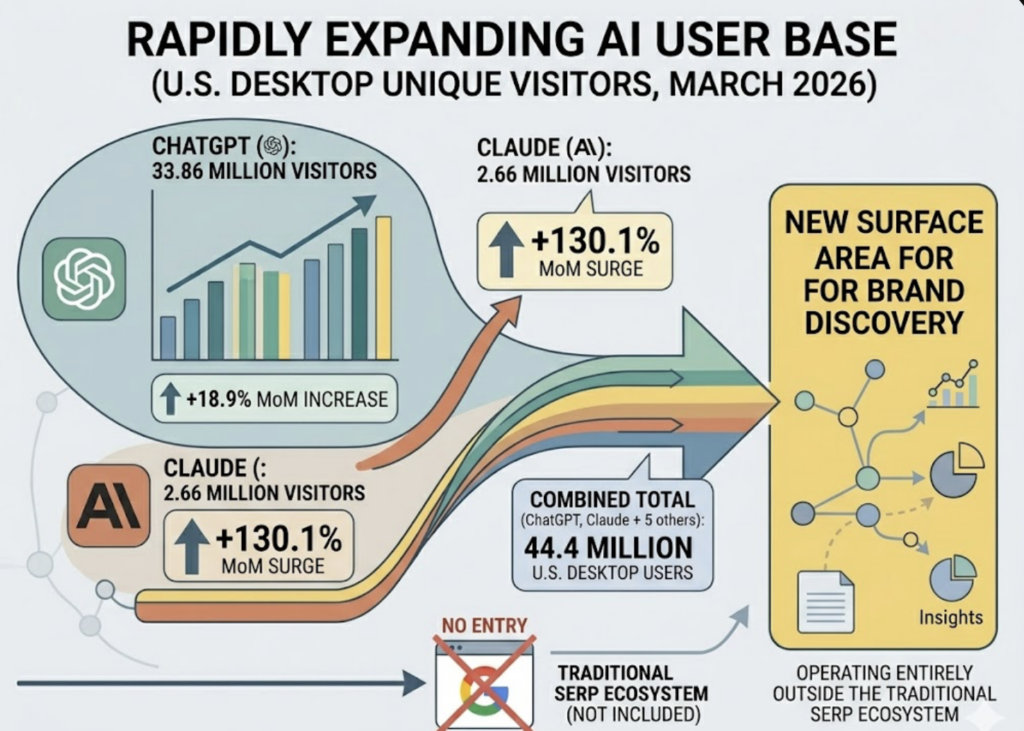
The user base driving this shift is massive and accelerating. By March 2026, Comscore data showed ChatGPT at 33.86 million U.S. desktop unique visitors, an 18.9% month-over-month increase. Anthropic’s Claude surged 130.1% month-over-month to 2.66 million unique desktop users. Across seven major consumer AI chatbot platforms, the combined total reached 44.4 million U.S. desktop users. That’s a rapidly expanding surface area for brand discovery operating entirely outside the traditional Google SERP ecosystem.
Here’s the core problem: up to 93% of AI Mode search sessions end without a website visit. A brand could dominate the conversation inside ChatGPT or Perplexity, heavily influencing buyer shortlists, while traditional analytics dashboards report zero corresponding traffic. The marketing team concludes the campaign is failing. In reality, the campaign is working in a channel their tools can’t measure.
Why Google AI Overviews Trackers Are Only Part of the Picture
When marketing teams search for the best Google AI Overviews trackers, they’re addressing a real and important channel. But they’re inadvertently treating one platform as the whole picture.
Google AI Overviews are undeniably disruptive. Data aggregating 21.9 million queries from early 2026 shows AI Overviews triggering on roughly 25.11% of all search queries, up from the 16% trigger rate in late 2025. For pure informational queries, the trigger rate climbs to 99.9% in some benchmarks. The impact on organic traffic has been severe: AI Overviews reduce organic CTR by 34.5% on average, with certain high-volume queries experiencing drops of up to 64.4%. Since the widespread rollout, 44% of technology brands, 43% of travel and hospitality brands, and 35% of retail e-commerce brands have reported significant traffic declines.
That said, optimizing for and tracking only Google AI Overviews ignores fundamental algorithmic differences across the broader generative ecosystem.
ChatGPT, Perplexity, Gemini, Claude, and DeepSeek each run on distinct retrieval-augmented generation pipelines with independent citation behaviors. A brand might achieve strong visibility in a Google AI Overview because of its legacy domain authority and backlink profile, yet remain completely absent from a ChatGPT recommendation for the exact same query. The reason is structural: Google AI Overviews function largely as a summarization layer for top-ranking web pages, while independent LLMs use multi-stage retrieval systems that don’t adhere to traditional SEO authority metrics.
When a user enters a query into ChatGPT, the system often executes a process called query fan-out, rewriting the single prompt into multiple thematic variations. It retrieves candidate sources, then uses Reciprocal Rank Fusion to merge results, rewarding pages that appear consistently across query variations rather than those ranking highly for just one phrase. Empirical studies found that top-ten Google results previously accounted for 76% of ChatGPT citations. That correlation has dropped to just 38%. And 90% of pages cited by certain AI platforms now rank at position 21 or lower on Google’s traditional index.
A comprehensive analysis of 6.8 million AI citations from 1.6 million responses also revealed that platforms from Google, OpenAI, and Perplexity actively use a consumer’s physical location as a primary context variable for business-related queries. Citation patterns shift significantly based on the geographic origin of the prompt.
Bottom line: a report showing strong visibility on Google AI Overviews while the brand is systematically excluded from ChatGPT and Perplexity is a report with a dangerous blind spot.
The 7 Metrics That Make AI Visibility Analytics Tracking Work
Understanding how AI visibility analytics tracking works requires moving beyond impressions and clicks to a new set of performance indicators. Platforms like Topify organize this intelligence into seven interconnected metrics.
| Metric | What It Measures | Why It Matters |
|---|---|---|
| Visibility Score | Whether the brand appears in a model’s response to a specific prompt | The baseline: does the AI even know you exist for this query? |
| Sentiment Score | How the model describes and frames the brand (0-100 scale) | Inclusion with negative framing can be worse than absence |
| Position Rank | Where the brand appears in the narrative relative to competitors | First mention in the opening paragraph vs. a passing reference at the end |
| AI Volume | Popularity and trending velocity of specific prompts | Prioritize optimization for prompts generating 10,000 monthly inquiries, not 50 |
| Mentions | Frequency, context, and semantic clusters of brand occurrences | Primary recommendation vs. alternative vs. sub-feature mention |
| Intent | The underlying objective of the conversational query | Google AI Overviews trigger at 99.9% for informational intent but just 13.94% for transactional |
| CVR | Downstream conversion attribution from AI visibility | AI-referred traffic converts at rates 31% higher than traditional organic search |
That last metric deserves emphasis. Adobe Digital Insights data shows AI-referred traffic converting 31% higher than non-AI organic traffic, with some technical software sectors seeing four to five times the standard conversion rate. Visibility without attribution is a vanity exercise. CVR connects the tracking data to actual pipeline generation.
The following table maps each traditional SEO metric to its AI visibility counterpart:
| Traditional SEO Metric | AI Visibility Equivalent | Core Distinction |
|---|---|---|
| Search Volume | AI Prompt Volume | Short-tail keywords vs. complex natural language questions |
| URL Ranking (1-10) | Position Rank & Share of Voice | Static placement vs. proportional narrative inclusion |
| Impressions | Visibility Score | Rendering a link vs. active semantic inclusion in a generated answer |
| Click-Through Rate | Citation Frequency / Source Analysis | User clicking a link vs. AI autonomously selecting a brand’s data as evidence |
| Backlink Profile | Entity Association / Co-occurrence | Raw link equity vs. semantic associations on trusted third-party platforms |
| On-Page Keyword Density | Sentiment Score | Keyword placement vs. qualitative framing of the brand by the model |
How to Set Up AI Visibility Analytics Tracking in Practice
For teams looking to build a repeatable strategy for AI visibility analytics tracking, implementation breaks down into four stages.
Step 1: Define the Tracking Scope
Select the platforms to monitor: ChatGPT, Perplexity, Google AI Overviews, Gemini, Claude. Base the selection on target audience demographics and industry adoption rates. Then move beyond short-tail keywords. Curate an expansive library of high-intent prompts that reflect actual user conversations, not fragmented keyword strings.
Topify’s prompt discovery feature analyzes real user interactions to surface the exact questions consumers are asking AI models about a specific category. The tracking scope should also incorporate geographic nuance, since models use physical location to alter citation patterns. Multi-country configurations ensure local search intent is accurately captured.
Step 2: Establish a Generative Baseline
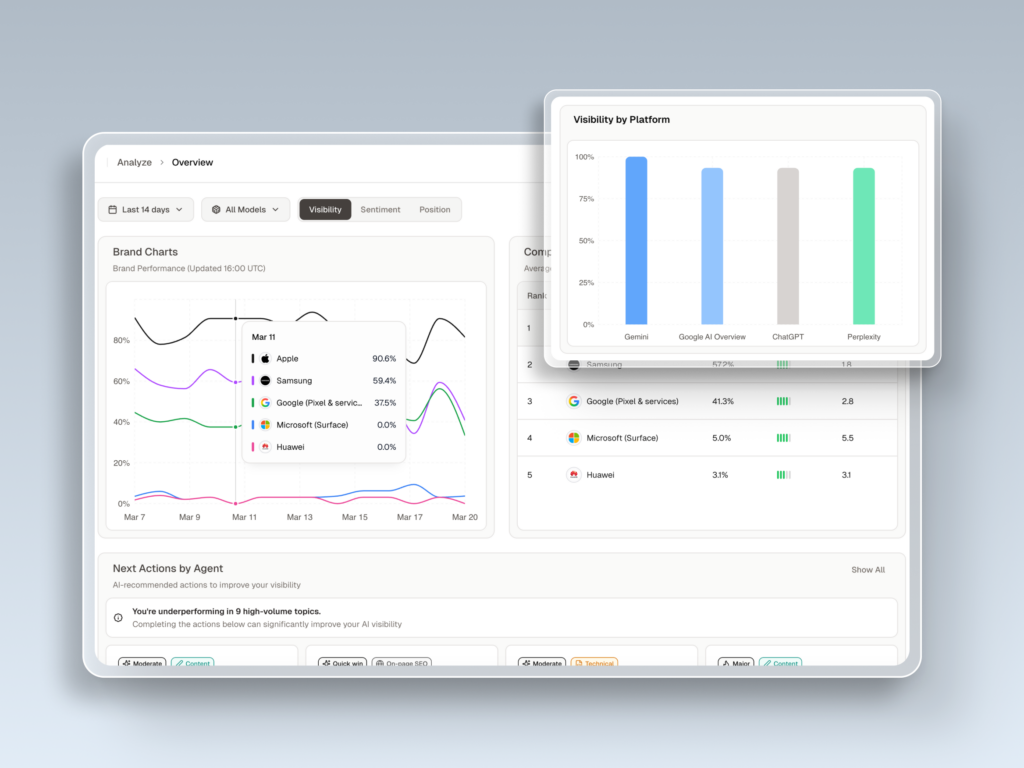
Execute an initial scan across all selected engines to snapshot the brand’s current generative footprint. This baseline reveals the unvarnished truth: Is the brand absent from ChatGPT’s recommendation logic? Is sentiment in Perplexity skewed negative due to a hallucination? Are Google AI Overviews citing the brand’s proprietary research, or pulling exclusively from competitors?
Standard setups typically allocate quotas of 50 to 100 tracked prompts daily, analyzing thousands of AI replies per month to build a statistically significant baseline.
Step 3: Configure Dynamic Competitor Monitoring
In generative search, visibility is effectively zero-sum. A recommendation for a competitor is an active dismissal of your brand. Rather than only tracking known legacy competitors, Topify’s dynamic competitor discovery identifies which new entities the language models are currently favoring. If ChatGPT consistently recommends an unknown startup for a category prompt, the system flags it immediately.
The setup should facilitate side-by-side comparison across visibility, sentiment, and position, allowing teams to reverse-engineer a competitor’s citation profile and identify exactly which directories, review aggregators, or PR placements are feeding the model.
Step 4: Set Reporting Cadence and Action Loops
LLMs are non-deterministic systems subject to continuous micro-updates. A monthly reporting cadence is functionally useless: by the time a visibility drop gets flagged, a competitor has already entrenched their narrative. Weekly or daily reporting is the minimum.
Raw data must flow directly into action. When the analytics platform flags a drop in citations for a core product category, that should trigger an immediate response: generating content briefs, updating AEO content, deploying richer schema markup, or publishing statistically dense research designed to reclaim the model’s attention.
5 Mistakes That Undermine Your AI Visibility Analytics Tracking
Even with the right infrastructure, strategic misalignments can render monitoring efforts ineffective.
1. Only tracking branded prompts. Brand name monitoring is useful for reputation management but completely ignores the primary acquisition mechanism: unbranded, solution-oriented category prompts. If tracking only covers mentions of the exact brand name, the brand stays invisible in the mid-funnel and bottom-funnel comparative queries that drive net-new revenue.
2. Treating visibility as a static metric. The same prompt can yield different brand recommendations on Tuesday than it did on Monday, due to shifts in temperature parameters, retrieval thresholds, or fresh data ingestion. Tracking must be continuous to identify sustained trend lines and smooth out the stochastic noise of generated outputs.
3. Ignoring source and citation analysis. Researchers at Princeton, Georgia Tech, and IIT Delhi demonstrated that specific on-page tactics, including factual statistics, expert quotations, and authoritative source citations, can boost visibility in generative engine responses by 30% to 40%. Without deep source analysis identifying exactly which URLs and domains the model relies on, marketing teams can’t execute targeted optimization. They’re left guessing at causal relationships.
4. Operating in a competitive vacuum. Celebrating a 40% visibility score means nothing if a primary competitor holds 85% for the same prompt cluster. Generative search is comparative synthesis: models actively weigh competing entities against one another. Without continuous competitor benchmarking, an organization can’t detect when it’s being displaced.
5. Disconnecting visibility data from ROI. Tracking holds zero value if it doesn’t drive strategic action. Visibility data must connect to referral traffic, lead velocity, and pipeline generation. Isolated dashboards that never reach revenue operations are budget line items waiting to get cut.
Choosing the Right AI Visibility Analytics Tracking Platform
Selecting the best tools for AI visibility analytics tracking means evaluating platforms against five core dimensions: engine coverage breadth, metric depth, competitor monitoring sophistication, action-to-insight speed, and pricing scalability.
| Feature | Topify | Omnia | Nightwatch |
|---|---|---|---|
| Primary Use Case | Multi-platform tracking, automated content generation, 7-dimensional analytics | Rapid content brief generation and quick-action execution loops | Traditional ranking analysis integrated with AI overview monitoring |
| AI Engines Tracked | ChatGPT, Perplexity, Google AI Overviews, Gemini, Claude | ChatGPT, Perplexity, Google AI Overviews, Google AI Mode | Google AI Overviews, ChatGPT, Gemini, Claude, Perplexity |
| Core Metrics | Visibility, Sentiment, Position, Volume, Mentions, Intent, CVR | Visibility mapping, AI Sentiment, Citation Intelligence | AI Visibility Score, Sentiment, Citations, Local Rankings |
| Execution Capabilities | Built-in AI article generation, AI replies, multi-country benchmarking | Structured content briefs, placement pitch recommendations | Localized ZIP-code tracking, traditional SERP-to-AI data bridge |
| Pricing Entry | $99/mo | €79/mo | $99/mo |
| Team Seats | Unlimited across all commercial tiers | Scales with plan tier | Scales with prompt volume |
Topify’s primary differentiation lies in its seven-dimensional analysis matrix combined with global engine coverage. It doesn’t just flag when a brand is mentioned. It continuously processes generated text to calculate visibility, sentiment, position, volume, mentions, intent, and conversion correlation within a single interface. When a marketing analyst detects a drop in ChatGPT mentions, they can trace that drop to a specific third-party citation that lost authority, then execute a corrective content strategy without switching tools. The built-in one-click agent execution bridges the gap between monitoring a deficit and creating the semantic content required to repair it.
On pricing, Topify’s AI visibility analytics tracking pricing follows a prompt-volume model:
- Starter at $99/mo: 50 daily tracked prompts, 5,000 monthly credits, 15 article generations, tracking across ChatGPT, Perplexity, Gemini, and Google AI Overviews.
- Standard at $199/mo: 100 daily prompts, 12,000 monthly credits, 30 article generations, unlimited team seats.
- Pro and Enterprise from $399/mo: 300+ daily prompts, multi-brand tracking, expanded Claude integration, API access, dedicated support.
Omnia excels at converting tracking data into actionable content briefs for agile growth teams. Nightwatch remains strong for localized, ZIP-code level rank correlation. But for organizations that need comprehensive multi-platform coverage, deep analytics, and execution capability in a single platform, Topify’s pricing-to-feature ratio and unlimited seats make it the strongest option in this category.
Conclusion
The shift from traditional search navigation to generative AI synthesis is the most significant disruption to digital marketing in two decades. Relying on legacy impression shares and organic click-through rates while 58.5% of searches yield zero clicks and AI platforms autonomously recommend competitors to high-intent buyers is a strategy with a clear expiration date.
AI visibility analytics tracking gives marketing teams the ability to measure what their existing tools structurally cannot: how AI models perceive, frame, and recommend their brand. The organizations that build this capability now, establishing baselines, configuring multi-platform tracking, and connecting visibility data to revenue outcomes, will define the competitive landscape for the next several years. The ones that wait will keep optimizing for a channel that’s shrinking while the real conversations happen somewhere their dashboards can’t reach.
Get started with Topify to build your generative baseline today.
FAQ
Q: What is AI visibility analytics tracking?
A: It’s a systematic methodology for monitoring, measuring, and analyzing how often and in what context a brand gets mentioned and recommended by generative AI models like ChatGPT, Perplexity, and Google AI Overviews in response to user prompts. Unlike traditional SEO analytics that track URL positions, it evaluates a brand’s semantic presence within conversational AI outputs.
Q: How does AI visibility analytics tracking work?
A: Tracking platforms continuously query multiple LLM APIs using curated lists of natural-language prompts. They then use NLP to analyze the unstructured conversational output, extracting structured data to score a brand across seven metrics: Visibility, Sentiment, Position, Volume, Mentions, Intent, and CVR.
Q: What’s the difference between AI visibility tracking and traditional SEO analytics?
A: Traditional SEO analytics track URL rankings, impressions, and clicks within a linear search index. AI visibility tracking measures whether a brand entity was synthesized into a conversational answer, evaluates the qualitative tone of that inclusion, and traces the source citations the AI used as evidence. They measure fundamentally different things.
Q: How much does AI visibility analytics tracking cost?
A: Platforms typically operate on a prompt-volume pricing model. Entry-level plans start around $99/mo for fundamental daily monitoring. Mid-market plans range from $199 to $279/mo. Enterprise packages with custom API integrations and multi-brand support scale from $399 to $499/mo and above, depending on tracking volume and seat requirements.

