

You ask ChatGPT for the best tool in your category on Monday and your brand shows up third. You run the same prompt Friday and you’re gone. Nothing changed on your site, so what happened? This is where most teams quit trying to track AI search by hand. The output shifts session to session, platform to platform, and a few manual spot-checks can’t tell you whether a drop is a real visibility problem or just the model being the model. A real AI prompt tracking strategy fixes that by turning scattered observations into a signal you can actually trust.
What an AI Prompt Tracking Strategy Actually Covers
An AI prompt tracking strategy is a repeatable system for monitoring how AI engines respond to the questions your buyers actually ask. Not a one-time audit. A standing process with a fixed set of prompts, a fixed set of metrics, and a fixed schedule.
The reason it’s necessary is non-determinism. LLMs don’t return a stable ranking the way Google does. They behave more like high-dimensional probability functions, so the same query can produce different brand mentions across sessions, platforms, and even back-to-back prompts.
That’s why a screenshot proves nothing. One run is a single sample from a distribution.
Most teams confuse activity with strategy here. Checking ChatGPT now and then is activity. Tracking the same prompt portfolio, on the same cadence, with the same scoring, across every engine your audience uses is a strategy.
How AI Prompt Tracking Works Across ChatGPT, Perplexity, and Gemini
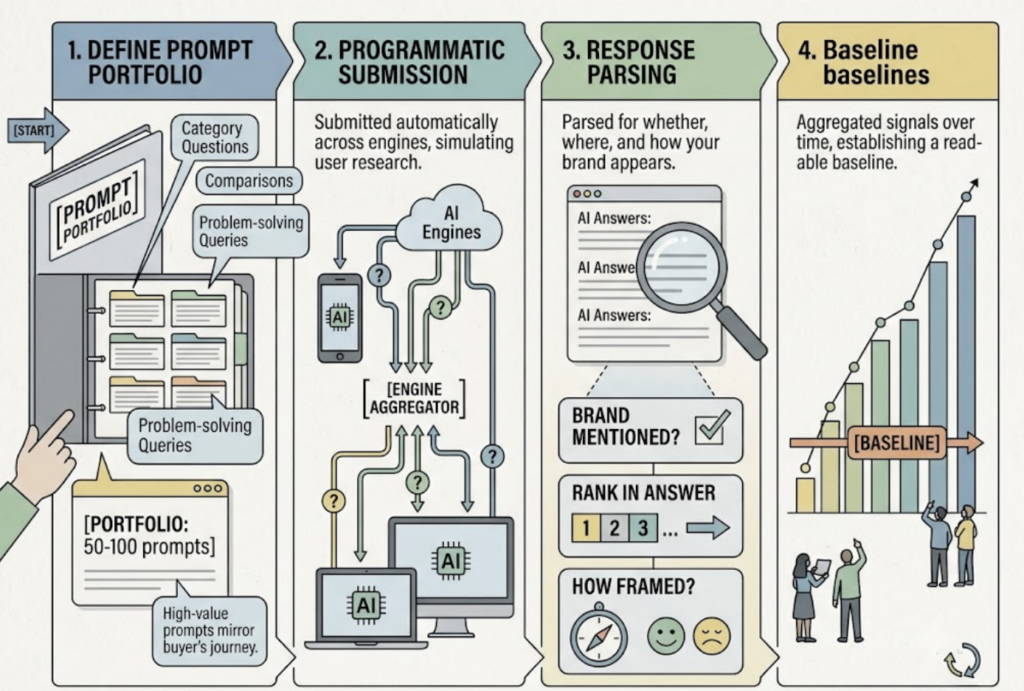
Under the hood, AI prompt tracking runs a four-step loop.
First, you define a prompt portfolio, usually 50 to 100 high-value prompts that mirror the buyer’s journey: category questions, comparisons, and problem-solving queries. Second, those prompts get submitted programmatically across your target engines, simulating how a real user would research. Third, the responses get parsed for three things: whether your brand is mentioned, where it ranks in the answer, and how it’s framed. Fourth, the signals get aggregated over time into a baseline you can read.
Here’s why one engine isn’t enough. ChatGPT, Perplexity, and Gemini each run different retrieval pipelines, different training cutoffs, and different citation logic. Winning on one tells you almost nothing about the others.
Plus, citation sources move fast. The domains AI engines cite can change in up to 74% of cases from one week to the next, which is why a quarterly check misses most of what’s actually happening. If you want to go deeper on the mechanics, this breakdown of how to track AI search visibility and rankings in ChatGPT covers the engine-level differences in detail.
The Four Building Blocks of an AI Prompt Tracking System
A reliable tracking system comes down to four decisions. Get these right and the tooling is just execution.
Choosing the Right Prompts to Track
The biggest lever is prompt selection. Branded prompts like “reviews of [your brand]” feel reassuring but tell you little. The prompts that matter are buyer-intent ones: “What’s the best [category] solution for [problem]?” That’s where a recommendation actually moves a deal.
Setting a Tracking Cadence
AI models refresh their retrieval sources constantly, so cadence is part of the strategy, not an afterthought. Weekly monitoring has become the working standard for catching citation drift before it costs you. Monthly is the floor. Quarterly is mostly theater.
Picking Metrics That Mean Something
Clicks are the wrong compass here. The metrics that map to AI visibility are share of voice (your citations versus competitors’), citation frequency, and sentiment positioning. A brand named warmly and first beats one buried at the bottom of a list.
Closing the Loop: From Data to Action
Tracking earns its keep only when it changes what you publish. If an engine keeps citing a competitor for a specific intent, that’s a content gap, not bad luck. The fix is usually updating the documentation, FAQ schema, or comparison page that should be answering that query.
How to Measure If Your AI Prompt Tracking Strategy Is Working
To know whether your strategy is improving, you measure against a fixed set of dimensions, not a single headline number. The GEO measurement frameworks maturing in 2026 converge on roughly seven.
| Dimension | What it tracks | Why it matters |
|---|---|---|
| Visibility | How often your brand appears | Are you in the conversation at all? |
| Position | Where you rank in the answer | Are you a top-tier recommendation? |
| Sentiment | How you’re framed | Is the portrayal accurate and positive? |
| Citation | Source and link attribution | Do you get the traffic credit? |
| Share of Voice | Your citations vs. competitors’ | Are you winning the category? |
| Intent Mapping | Alignment with the query stage | Are you reaching high-intent buyers? |
| CVR | AI-driven referral conversion | Is the traffic actually closing? |
Sentiment deserves a callout. AI engines sometimes describe brands inaccurately, and correcting AI brand misinformationhas become its own workstream. Tracking sentiment weekly is how you catch a misframe before it spreads across engines.
You improve the strategy by watching these dimensions move together. A rising mention rate with flat position means you’re getting named but not recommended. Rising citations with weak CVR means the traffic isn’t closing. Each gap points to a different fix.
Common Mistakes That Quietly Break Your Tracking
Most failed tracking efforts don’t fail loudly. They drift into noise. Four mistakes account for most of it:
- Tracking prompts that are too broad. A query like “What is AI?” generates noise, not signal. High-intent, decision-stage prompts are where visibility converts.
- Ignoring position. A mention at the tail end of a long answer is worth a fraction of a primary recommendation in the summary. Presence isn’t the same as prominence.
- Using bot logs as a proxy. GPTBot or PerplexityBot hitting your server only means a crawler stopped by. It says nothing about whether your content was deemed answer-worthy enough to cite.
- Optimizing for one engine. Winning ChatGPT while ignoring Perplexity and Google AI Overviews leaves you invisible exactly where a chunk of your buyers are looking, since each engine prioritizes different authoritative sources.
Picking an AI Prompt Tracking Tool, Platform, or Software
Once the strategy is clear, the tool just has to execute it. The selection criteria fall straight out of everything above: multi-model coverage, prompt-level granularity, the full metric set, competitor benchmarking, and a way to turn findings into action.
A capable AI prompt tracking platform should run the same prompt portfolio across ChatGPT, Perplexity, Gemini, and the engines your market actually uses, then score each response on visibility, position, sentiment, and citations in one place. A spreadsheet and a human operator can’t hold that cadence past a handful of prompts.
This is where Topify tends to fit teams running a serious strategy. Its prompt discovery surfaces the high-value queries worth tracking instead of leaving you to guess, and its analytics roll the seven GEO metrics into a single dashboard. In practice, that means a drop in ChatGPT mentions can be traced back to a specific source that stopped citing you, without leaving the tool. Competitor benchmarking shows who the engines recommend instead of you, in real time.
On cost, an AI prompt tracking solution doesn’t have to mean enterprise pricing. Topify starts at $99/month with a 30-day trial covering ChatGPT, Perplexity, and AI Overviews tracking plus 100 prompts, which is enough to run a real portfolio rather than a sample. You can get started without locking into an annual contract.
Your AI Prompt Tracking Strategy Checklist
Here’s a checklist to stand the whole thing up from scratch:
- Inventory. Identify 50+ buyer-intent prompts that drive your pipeline.
- Baseline. Run those prompts once to see who the engines currently cite.
- Tools. Choose a multi-model tracking system that scores the full metric set.
- Integration. Connect findings to your content roadmap: fix the page that should be cited but isn’t.
- Cadence. Schedule weekly automated reports to catch citation drift and competitive shifts.
As for what those prompts look like, a B2B example portfolio might mix “best [category] software for [industry],” “[competitor] alternatives,” “how to solve [specific problem],” and “is [your brand] good for [use case].” The pattern is decision-stage intent, not brand vanity.
Conclusion
The brands winning AI search in 2026 aren’t the ones checking ChatGPT once a month. They’re the ones running a fixed prompt portfolio, on a weekly cadence, scored against metrics that map to real recommendations. Start with your 50 buyer-intent prompts and a baseline run. Once you can see where you stand and where competitors are pulling ahead, the strategy mostly runs itself. The hard part was never the tracking. It was deciding to treat AI visibility as a system instead of a spot-check.
FAQ
Q: What is an AI prompt tracking strategy?
A: It’s a repeatable system for monitoring how AI engines answer the questions your buyers ask. Instead of one-off checks, you track a fixed set of prompts across multiple platforms, on a set schedule, scored against consistent metrics, so you can tell a real visibility trend apart from random model variation.
Q: How do you measure an AI prompt tracking strategy?
A: Measure against a fixed set of dimensions rather than a single number. The common framework covers visibility, position, sentiment, citation, share of voice, intent mapping, and CVR. Reading them together tells you not just whether you’re mentioned, but whether you’re recommended and whether that attention converts.
Q: How can you improve your AI prompt tracking strategy?
A: Tighten prompt selection toward decision-stage intent, raise cadence to weekly, and close the feedback loop. When the data shows a competitor winning a specific query, update the page that should be answering it. Improvement comes from acting on gaps, not just logging them.
Q: How much do AI prompt tracking tools cost?
A: Pricing varies, but it doesn’t require an enterprise budget. Entry-level plans that cover multi-model tracking and a usable prompt count start around $99/month, with trials available so you can validate the data before committing.

