

Your team hit page one for the keywords that matter. Traffic’s up, domain authority’s climbing, and the SEO dashboard looks healthy. Then a prospect opens ChatGPT, types “best [your category] tool,” and reads back a list of five names. Yours isn’t one of them. Worse, when your brand does surface, the model calls it “a budget option” while you sell premium. None of your SEO reports caught this, because they were built to measure links and rankings, not what an AI decides to say about you. That gap is exactly what an AI recommendation tracking tool exists to close.
What an AI Recommendation Tracking Tool Actually Does
An AI recommendation tracking tool monitors how large language models describe, cite, and recommend your brand across AI answers. Not your Google position. What ChatGPT, Perplexity, Gemini, and Claude actually say when someone asks for a recommendation in your category.
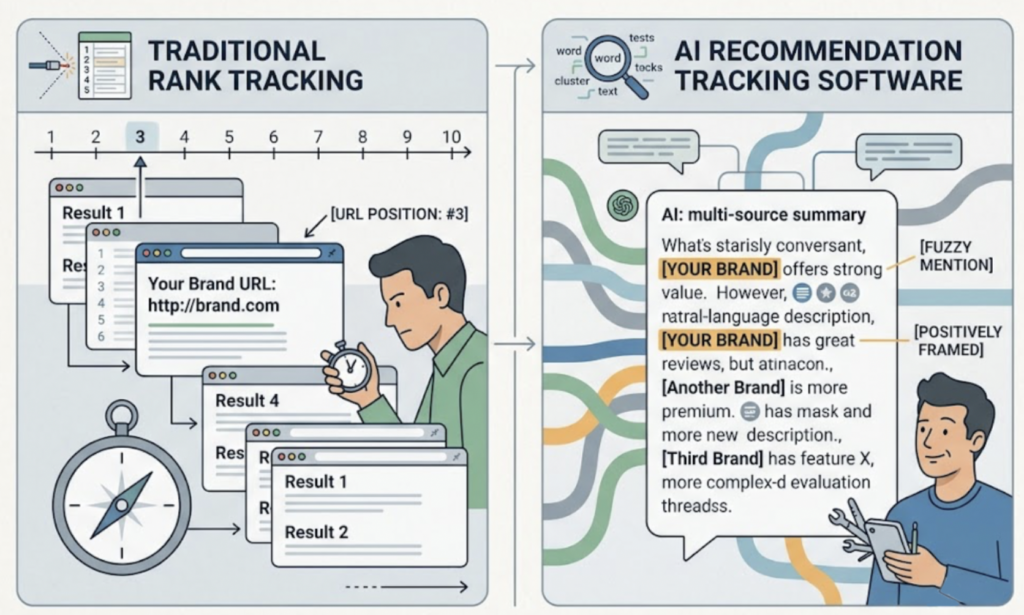
That distinction matters more than it sounds. Traditional rank tracking measures a fixed URL position on a results page. AI recommendation tracking software measures something fuzzier: whether your brand shows up inside a conversational, multi-source summary, and how it’s framed when it does.
It’s also not social listening. Social tools track what people say about you. A recommendation tracking platform tracks the decision-making logic of the AI engine itself: which sources it trusts, which it surfaces, and which it quietly ignores.
Here’s the shift underneath all of it. AI engines don’t rank pages. They cite sources. So the unit you track stops being “keywords” and becomes prompt sets, consistent groups of buyer questions that map to a real research journey.
How AI Recommendation Tracking Works Behind the Scenes
AI search is probabilistic, not deterministic. The same prompt can return different brands depending on model temperature, user context, and whatever the retrieval layer pulled in that day. Run a query once and you’ve got an anecdote, not data.
A working pipeline handles that in four layers.
First, it defines a prompt portfolio, often 50+ high-value buyer prompts like “best [category] for [use case].” Second, it runs those prompts across multiple engines programmatically, since each platform retrieves and weights sources differently. Third, it parses the unstructured answer text to quantify four things: does your brand appear, does the AI cite an owned URL, are you in the summary or buried in a footnote, and is the framing accurate. Fourth, it aggregates all of that into trends over time.
That last step is where the real value sits. AI-cited domains churn fast. Tracking has found that the set of sources an engine references can shift in up to 74% of cases week over week. A single snapshot ages out almost immediately.
The Metrics a Recommendation Tracking Dashboard Should Show You
Counting mentions is where most teams start, and where most teams get stuck. A mention tells you that you showed up. It doesn’t tell you whether you showed up first, whether the model got your positioning right, or whether any of it drove revenue.
A useful AI recommendation tracking dashboard reports across seven dimensions:
| Metric | What it answers |
|---|---|
| Visibility (Share of Voice) | What share of category AI answers include your brand? |
| Positioning | Are you the primary recommendation or a footnote? |
| Sentiment accuracy | Does the AI’s framing match your real positioning? |
| Citation frequency | Does the AI link to you, or to third-party aggregators? |
| Engine consistency | Visible in Perplexity but invisible in Gemini? |
| Intent alignment | Do you show up at the right buyer-journey stage? |
| Referral conversion (CVR) | Do AI-referred visitors actually convert? |
Put together, these turn AI recommendation tracking analytics from a vanity number into a diagnostic. You can see not just that visibility dropped, but on which engine, at which buyer stage, and whether sentiment moved with it. Semrush’s framework for measuring AI search visibility lands in the same place: share of voice and accuracy matter more than raw counts.
A mention you can’t explain isn’t a metric. It’s noise.
Five Mistakes That Make AI Recommendation Tracking Useless
Most failed tracking setups fail the same handful of ways.
Watching one engine. Living inside ChatGPT alone ignores everyone using Gemini or Perplexity, and each pulls from different retrieval signals. Coverage gaps become blind spots.
Bringing 2012 SEO to a 2026 problem. Over-optimizing for keyword density actively hurts AI visibility. LLMs reward factual clarity and clean semantic structure, not repetition.
Checking once a month. Given how fast cited sources churn, monthly snapshots are stale before you read them. Weekly, sometimes daily, is the realistic cadence.
Tracking without a fix. Monitoring that doesn’t feed a content roadmap is just anxiety with a dashboard. When the AI skips you, the answer is usually restructuring content or building entity authority, not editing meta tags.
Skipping competitors. Your own trend line means little without context. If your visibility holds at 20% while a rival climbs from 15% to 40%, you’re losing even though your number looks flat.
What to Look For in an AI Recommendation Tracking Platform
Once you’ve decided you need a tool, the selection criteria are fairly consistent. Four things separate a real AI recommendation tracking platform from a glorified spreadsheet:
- Multi-engine coverage across at least ChatGPT, Perplexity, Gemini, and Claude.
- Crawler and agent analytics, so you can see how AI systems actually access your site.
- An actionability layer, with specific content workflows to close the gaps tracking surfaces.
- Competitive benchmarking against your top three rivals.
The 2026 tools landscape has several credible options, each leaning a different direction.
| Tool | Strength | Best fit |
|---|---|---|
| Topify | Seven-metric analytics plus one-click execution across major engines | Teams that want tracking and the fix in one place |
| Profound | Deep enterprise analytics, broad engine coverage | Large enterprises with analyst capacity |
| AthenaHQ | Brand integrity and hallucination monitoring | Brands worried about misportrayal |
| Frase | Monitoring tied to content drafting | Content-led teams |
| Semrush AI Toolkit | AI tracking inside an existing SEO suite | Teams already on Semrush |
Where Topify tends to stand out is the distance between seeing a problem and fixing it. Its Comprehensive GEO Analytics covers seven metrics, visibility, sentiment, position, volume, mentions, intent, and CVR, across ChatGPT, Gemini, Perplexity, DeepSeek, and others, so an AI recommendation tracking system isn’t siloed to one engine. Spot a drop in ChatGPT mentions and you can trace it to the specific source that stopped citing you, then act on it inside the same dashboard. For teams that want one solution to be both the monitor and the remedy, that end-to-end loop is what most pure-analytics tools skip.
How to Improve Where You Land in AI Recommendations
Tracking tells you where you stand. Improving where you land is a separate loop, and it runs on what the tracking surfaces.
The strategy isn’t complicated, but it is iterative. Start by identifying the prompts where you’re absent or misframed. Look at which domains the AI cites instead of you, that’s your real competitive set for that query. Then close the gap by restructuring content for semantic clarity and earning the third-party signals that build entity authority. Re-run the same prompt set and measure the move.
This is where execution speed matters. Topify’s Source Analysis reverse-engineers the exact domains and URLs AI platforms cite, so you know which references to target. Its One-Click Execution turns a stated goal into a deployed strategy without manual workflows. Getting started with a single prompt set on one engine is usually enough to see your baseline.
Track it. Fix it. Re-measure.
What AI Recommendation Tracking Software Costs
Pricing for AI recommendation tracking software usually scales on three variables: how many prompts you track, how many engines you cover, and how many seats and projects you need. That’s why list prices vary so widely. A tool tracking 50 prompts on one engine and one tracking 250 across five aren’t really the same product.
As a reference point, Topify’s plans start at $99/month for Basic (100 prompts, ChatGPT, Perplexity, and AI Overviews tracking, four projects), with a Pro tier at $199/month (250 prompts, eight projects) and Enterprise from $499/month. A 30-day trial covers most of what a team needs to validate a baseline before committing. The pricing detail breaks down research credits and answer-analysis limits per tier.
Conclusion
The brands that win in AI search aren’t always the ones with the best product. They’re the ones who can see what the AI is saying about them and act on it before competitors do. That starts with making the invisible measurable.
If you’re starting from zero, don’t boil the ocean. Pick ten buyer prompts that matter, run them across two engines, and watch for a week. The baseline you get will tell you more about your real AI visibility than any rank report has in years.
FAQ
Q: What is an AI recommendation tracking tool?
A: It’s software that monitors how AI engines like ChatGPT, Perplexity, Gemini, and Claude describe, cite, and recommend your brand. Instead of measuring a URL’s position on a search page, it tracks whether your brand appears inside AI-generated answers and how it’s framed.
Q: What are examples of AI recommendation tracking in practice?
A: A SaaS team running 50 buyer prompts weekly to see if their product appears when AI is asked for “best tools” in their category. An ecommerce brand checking whether AI describes its products accurately. An agency reporting a client’s AI share of voice against three named competitors. In each case, the tool turns scattered AI answers into a measurable trend.
Q: Is there a checklist for choosing an AI recommendation tracking tool?
A: Yes. Confirm it covers at least four engines (ChatGPT, Perplexity, Gemini, Claude), shows how AI crawlers access your site, includes competitive benchmarking, and offers an actionable fix workflow rather than data alone. A tool that only reports without telling you what to change leaves the hardest part to you.
Q: How do I improve my AI recommendation visibility?
A: Find the prompts where you’re missing, study the domains the AI cites instead, then restructure content for clarity and build entity authority through credible third-party signals. Re-run the same prompts to confirm the change. Improvement is a loop, not a one-time fix.

