

Your rank tracker shows green across the board. Position 3 on your money keyword, position 1 on two others, steady for months. Then organic traffic slides anyway, and when a prospect asks ChatGPT for a recommendation in your category, your brand never comes up. The numbers your tool reports and the outcomes your business cares about have quietly stopped matching. Most rank checkers were built to answer one question: where does my page sit on a list of ten blue links? In 2026, fewer and fewer searches end on that list at all.
What a Rank Checker Was Built to Measure
Traditional rank checkers do one job well. They crawl Google’s results page, map a keyword to a URL position from 1 to 100, and assume that position predicts traffic.
That assumption held for a long time. In a ten-blue-links world, position 1 captured most of the clicks, and every step down the page cost you something measurable. The entire practice of shopping for the best rank checker rested on a clean chain: higher rank, more clicks, more traffic.
The chain still works. It just covers a shrinking slice of how people actually find answers now.
The Best Rank Checker Still Can’t See AI Answers
Here’s the structural problem. A rank checker reads a list. AI answers aren’t lists.
When ChatGPT, Perplexity, or a Google AI Overview responds, there’s no page two and no position 7. There’s a synthesized answer that mentions a few brands, cites a few sources, and leaves out everything else. Your rank tool has no field for “mentioned” or “cited,” so the entire AI layer is invisible to it.
The traffic data shows the gap first. By 2026, 64.82% of Google searches end without a click, up from roughly 50% in 2019. When an AI Overview is present, that zero-click rate jumps to 83%, and inside Google’s AI Mode it reaches 93%. The most recent SparkToro analysis puts US zero-click at 68.01% in early 2026, a 7.56-point jump in two years.
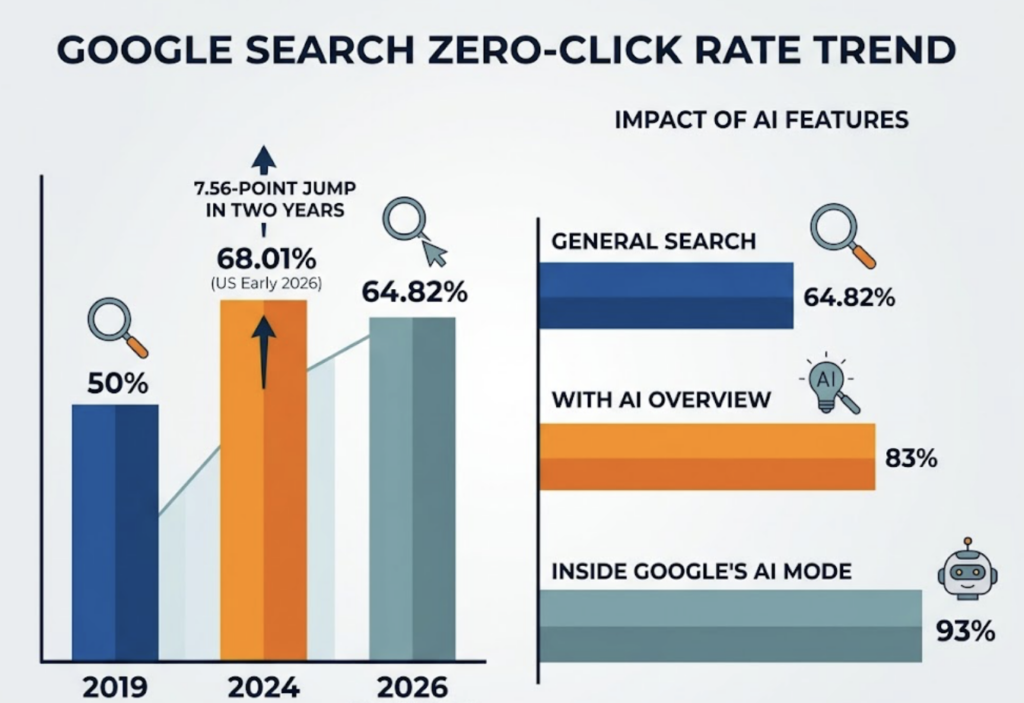
So the best rank checker can still confirm you’re position 1. It can’t tell you whether the answer box above you already gave the user what they came for. When AI Overviews appear, organic click-through on top pages drops anywhere from 18% to 61% depending on query and industry.
Ranking first on a page nobody scrolls to is a hollow win.
Position 1 in Google Isn’t Position 1 in ChatGPT
The deeper issue is that rankings and AI citations have come apart. They’re now two different coordinate systems.
An Ahrefs study of millions of AI Overview URLs found that the share of citations coming from top-10 organic pages fell from about 76% to 38% between mid-2025 and early 2026. Separate analysis shows 75% of AI citations pull from sources outside Google’s results entirely, and on some platforms the overlap drops below 10%.
Translation: a page can sit at position 1 in Google and never surface in a ChatGPT or Perplexity answer. The signals that earn a top rank and the signals that earn a citation aren’t the same.
That matters more because the traffic AI sends tends to be worth more. Visitors arriving through ChatGPT convert at 15.9% versus 1.76% for Google organic, since the AI has already framed your brand as the answer before the click happens.
Rankings get you into the room. Citations decide who gets recommended.
What SEO Teams Track Instead of Rankings in 2026
Smart teams aren’t throwing out rankings. They’re adding a second layer of metrics that measure answer authority rather than link position.
The shift looks like this:
| Old Metric | New Metric | What It Captures |
|---|---|---|
| Keyword Rank | Visibility Score | How often your brand is mentioned across AI answers |
| Backlink Count | Citation Authority | How often LLMs cite you as a trusted source |
| Page CTR | Conversion Visibility Rate | How likely an AI response is to drive brand interaction |
| Position 1 | Recommendation Rank | The order your brand appears in AI recommendations |
| Domain Authority | Entity Trust Score | How consistently your brand reads across the web and AI training data |
The pattern is consistent. Every old metric measured your spot on a list. Every new one measures whether the answer engine knows you, trusts you, and names you. Those are the questions a rank checker was never designed to ask.
This is also why “rank checker” feels like the wrong term for 2026. The work hasn’t disappeared. The unit of measurement has changed from position to presence.
Tracking AI Visibility Without Throwing Out Your Rank Data
The practical move isn’t replacing your rank checker. It’s running a dual stack: keep the rank tool for navigational and transactional queries, and layer on a platform that can see the synthesis layer your rank tool is blind to.
For teams making that shift, Topify tracks brand presence across ChatGPT, Gemini, Perplexity, Google AI Overviews, and other engines at the prompt level. Instead of a keyword and a position, you get a clear read on where you’re mentioned, where you’re cited, and where a competitor is named in your place.
In practice, that means you can watch your ChatGPT mention rate drop on a high-intent prompt, then trace it to the exact source the model started citing instead of you. Its competitor benchmarking reverse-engineers why a rival is being recommended, and its source analysis shows the precise domains AI platforms pull from, so you know whether the gap is a Reddit thread, a G2 listing, or a media mention.
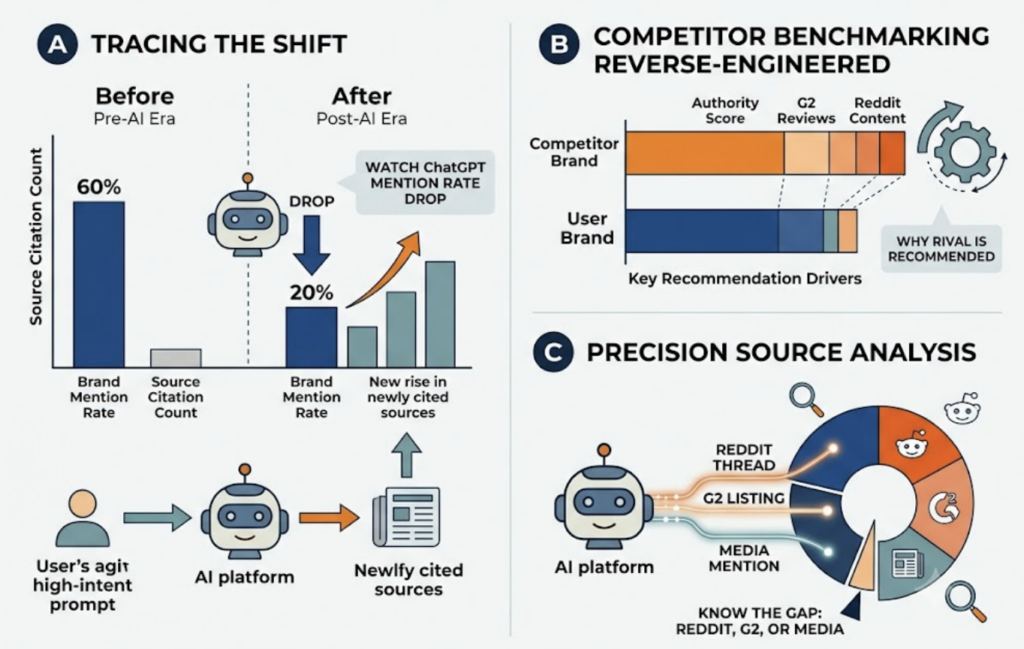
Two things separate this from passive monitoring. First, prompt discovery surfaces “dark queries,” high-volume AI research prompts that have no equivalent traditional search volume, which gives early movers a content opening rank tools can’t see. Second, the execution layer lets you state a goal in plain English and deploy the suggested fix in a click, rather than handing your team another dashboard to interpret.
The point isn’t that rankings are dead. It’s that they’re now one signal among several, and the others need their own instrument.
Where to Start If Rankings Are Your Only Signal
If your current visibility report is built entirely on rank data, three steps close most of the gap.
Run a baseline visibility audit first. Pick the conversational, high-intent prompts buyers actually type into AI tools in your category, and check whether your brand shows up at all. This is the AI-search equivalent of your first rank report, and it usually reframes the conversation fast.
Next, close the citation gap. Find which third-party sources, like Reddit, G2, or industry media, the AI cites in place of your domain, and prioritize earned visibility on those specific platforms.
Then optimize for extractability. AI systems weight the first portion of a page heavily when choosing what to quote, so lead high-value pages with a clean, two-to-three-sentence answer before the supporting detail. When you’re ready to baseline your own brand, you can get started with Topify on the prompts that matter most to your pipeline.
Conclusion
“Rank checker” isn’t wrong, exactly. It’s incomplete. Position on a results page still matters for the queries that end in a click, but a growing majority of searches now resolve inside an answer your rank tool can’t read. The teams pulling ahead in 2026 didn’t abandon rank tracking. They stopped treating it as the whole picture and added a layer that measures whether AI engines mention, cite, and recommend them. Start with a visibility baseline, find the citation gaps, and build your reporting around presence, not just position.
FAQ
Is rank tracking still worth it in 2026?
Yes, for navigational and transactional queries where users still click through to a destination. The limitation is that rank tracking only measures position on Google’s results page, which now accounts for a shrinking share of total search behavior. Pair it with AI visibility tracking rather than relying on it alone.
What should I track instead of keyword rankings?
Track AI visibility (mention frequency across AI answers), citation authority (how often LLMs cite you), recommendation rank (your order in AI recommendations), and sentiment. These measure answer authority, which is what determines whether AI engines surface your brand.
Why does my page rank first on Google but not appear in ChatGPT?
Because AI engines select sources using different signals than Google’s organic ranking. Only about 38% of AI Overview citations now come from top-10 organic pages, and on some platforms the overlap is below 10%. A top rank no longer predicts a citation.
Rank tracker vs AI visibility tool: do I need both?
Most teams do. A rank tracker answers “where does my page sit on the SERP,” while an AI visibility tool answers “do the answer engines name my brand.” They measure different surfaces, so the two together give a complete view of discovery.

