

Your CMO forwards a Slack message: a prospect asked ChatGPT for the best option in your category, and a competitor came back first. So you open ChatGPT, type the same prompt, and get a slightly different answer. You try again an hour later, and it shifts again. One screenshot tells you nothing about whether your brand is gaining ground or losing it. Checking AI search by hand falls apart the moment you need to prove a trend instead of a single moment.
Why Manual Checks Aren’t an AI Search Monitoring Strategy
Most teams start the same way. Someone types a category question into ChatGPT, screenshots the answer, and pastes it into a deck. It feels like monitoring. It isn’t.
AI responses are non-deterministic. The same prompt returns different answers depending on the user’s location, their search history, the specific model version (GPT-4o behaves differently from Claude 3.5), and the system context wrapped around the query. A single capture is a snapshot of one roll of the dice, not a measurement.
Then there’s the funnel you can’t see. Enterprise buyers increasingly run their early research inside chat interfaces, in a zero-click environment where no analytics tag ever fires. Manual snapshots are a weak proxy for what’s actually happening in that conversation.
The deepest flaw is the missing trend line. A screenshot from today says nothing about whether your brand is gaining or losing authority over the following weeks. An AI search monitoring strategy is the opposite of a spot check: longitudinal, reproducible, and built to show direction rather than a single moment.
That’s the gap most brands still can’t see.
What Brand Visibility in AI Search Actually Means
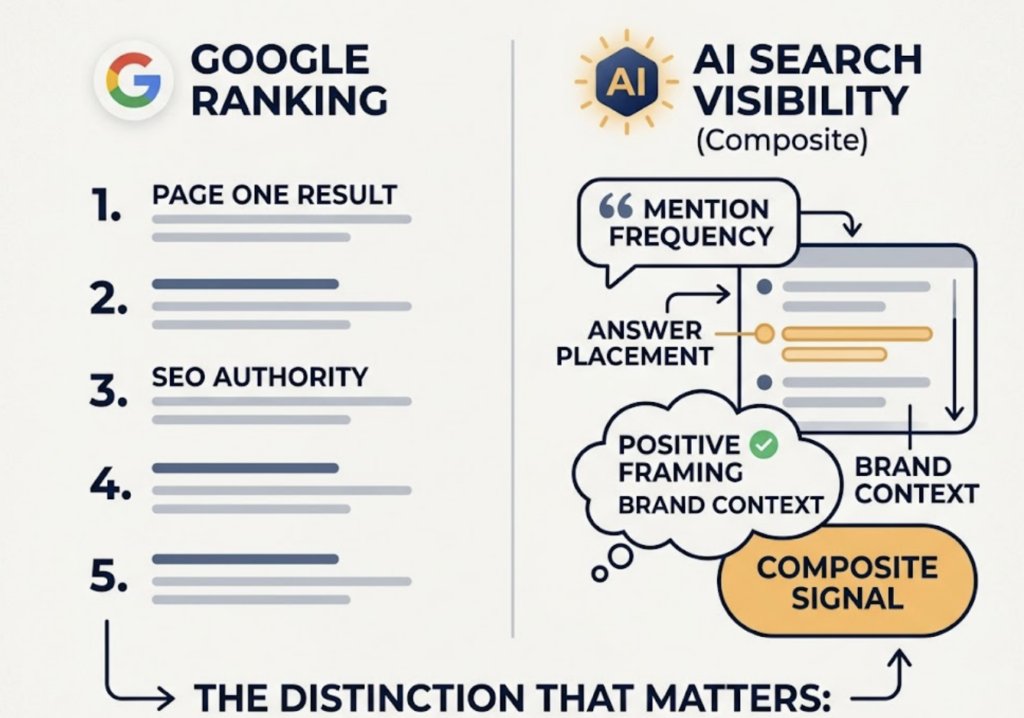
Brand visibility in AI search isn’t the same thing as a Google ranking, and treating them as interchangeable is where most strategies go wrong.
In traditional SEO, visibility means a position on a results page. You rank #3, you get a slice of clicks. In AI search, there’s no list of ten blue links to climb. The model synthesizes an answer, and your brand is either part of that synthesis or it’s absent.
| Dimension | Traditional SEO | AI Search |
|---|---|---|
| Primary metric | SERP ranking, positions 1 to 10 | Brand presence, mentioned or not |
| User path | Click through to your site | Conversational discovery and synthesis |
| Visibility unit | Links and snippets | Citations, mentions, and sentiment |
| Value driver | Backlinks and domain authority | Semantic clarity and source authority |
Here’s the distinction that matters: ranking and mention are not the same signal. A page can rank well in Google and still never get mentioned when someone asks Perplexity for a recommendation in your category. Brand visibility in AI search is a composite of how often you’re mentioned, where in the answer you appear, and how the model frames you.
The Five Signals a Monitoring Strategy Should Track
A monitoring strategy is only as good as the signals it captures. Five dimensions matter most.
Mention Frequency and Share of Model
This is the foundation. Across a defined set of category prompts, what percentage return a mention of your brand versus a competitor’s? Visibility frameworks from groups like Adobe and Semrush describe a version of this as “share of model,” your slice of the AI’s attention. Track it across platforms, not one.
Position and Sentiment in AI Answers
Not all mentions carry equal weight. Being the first brand named in an answer is worth far more than a closing footnote. Layer sentiment on top: does the model frame you as the category leader, a neutral option, or a budget fallback? Negative sentiment bias is the risk most teams never check for.
Citation Sources Behind the Answers
Every AI answer is built on sources. Knowing which URLs the model cites, your own pages versus third-party publications, tells you where your authority actually lives. If the model keeps citing a competitor’s blog for a query you should own, that’s a content gap with a name and address.
Two of these signals get ignored most often: citation pathing and prompt-level coverage across the buyer journey. Sentiment and prominence reveal the quality of brand visibility in AI search, not just its presence.
Turning Brand Visibility Data Into Action
Monitoring that doesn’t change anything is just expensive watching. The point is the loop from insight to action.
Start with content gaps. When citations for a high-intent query consistently point to someone else’s page, that’s your signal to build something deeper and more authoritative on that exact topic. The data tells you where, so you stop guessing.
Then there’s authority building. If AI systems lean on third-party sources like G2 or industry reports instead of your own site, the fix isn’t more blog posts. It’s PR and partner relationships with the high-authority domains the models already trust.
Finally, close the feedback loop on sentiment. A persistent gap between how the model describes you and how you position yourself usually traces back to messaging that isn’t machine-readable. Tighten the metadata, sharpen the value proposition, then re-measure.
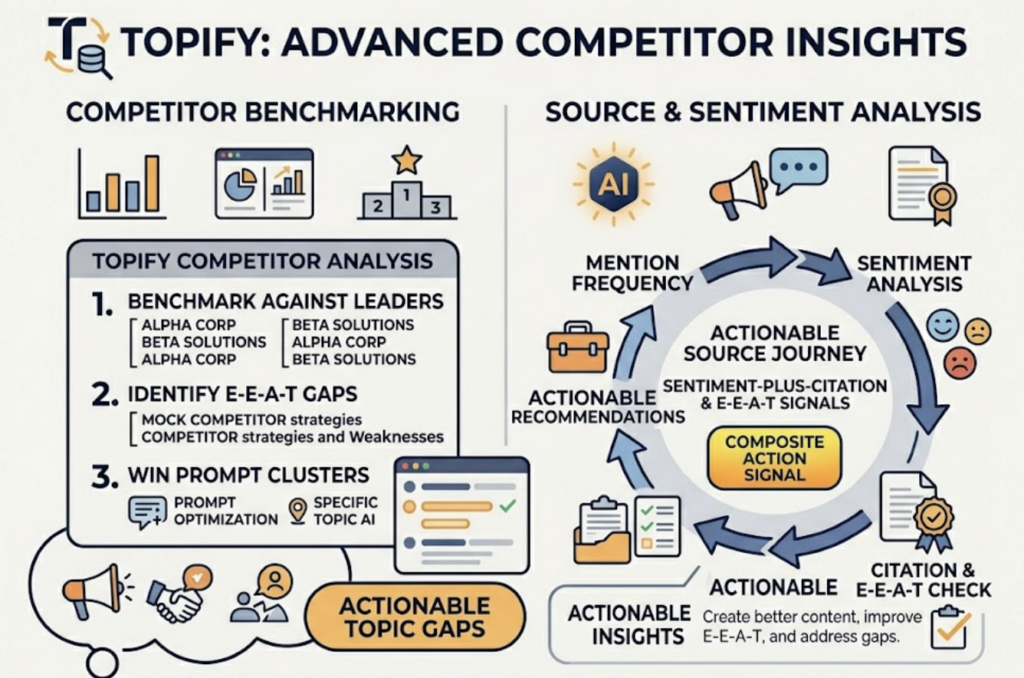
This is where a unified view earns its keep. For teams tracking brand visibility across multiple AI platforms, Topify tends to stand out by combining visibility, sentiment, position, and citation data into one place through its Comprehensive GEO Analytics. In practice, that means you can watch your ChatGPT mentions drop, trace it to a source that stopped citing you, and decide what to fix, all without stitching together four separate exports.
Choosing Tools for Your AI Search Monitoring Strategy
The tooling market has filled up fast, and most options look similar on a landing page. The differences show up in what they actually measure.
Four criteria separate a real monitoring tool from a keyword tracker with new branding.
| Criterion | What weak tools do | What a real monitoring tool does |
|---|---|---|
| Engine coverage | Track only ChatGPT | Cover ChatGPT, Gemini, Perplexity, Claude, and more |
| Response capture | Flag “mentioned or not” | Store full raw responses for historical analysis |
| Analysis depth | Count mentions | Categorize sentiment and identify the exact cited URLs |
| Actionability | Hand you raw data | Recommend specific fixes, like missing E-E-A-T signals |
Multi-engine coverage comes first. A tool that only watches ChatGPT misses Gemini, Perplexity, and Claude, and those models pull from divergent training data, so single-platform tracking gives you a partial picture at best. Topify covers ChatGPT, Gemini, Perplexity, DeepSeek, and others in one workspace.
Full-response capture is the next filter. Tools that only flag “mentioned or not” throw away the context you need later. Storing raw responses is what makes historical sentiment and citation analysis possible at all.
The last two criteria, sentiment-plus-citation analysis and actionability, are where most tools stop short. Raw data is easy. Telling you which page is missing E-E-A-T signals, or which competitor is winning a specific prompt cluster, is the hard part. Topify’s competitor benchmarking and source analysis are built around that step, turning the monitor into something your team can act on rather than just read.
How to Know Your Strategy Is Working
A monitoring strategy needs a cadence and a scoreboard, or it quietly becomes a dashboard nobody opens.
On cadence, two rhythms work well together. Run a deep-dive audit monthly across your full prompt set, and monitor your core category prompts weekly so you catch sharp movements before they calcify.
On benchmarks, three numbers tell most of the story. Track citation share against your top competitors on a rolling 90-day window, watch your sentiment scores move from neutral toward recommended, and correlate visibility spikes with branded search and high-intent direct traffic to connect AI visibility back to revenue signals.
Track it. Trace it. Act on it.
Conclusion
The screenshot-in-a-Slack-message approach falls apart the moment someone asks whether your brand is trending up or down. An AI search monitoring strategy answers that question, not with one capture, but with a repeatable system that tracks mention frequency, position, sentiment, and citations across every model your buyers use. Start by defining the prompts that matter to your category, pick a tool that captures full responses across multiple engines, and set a weekly-plus-monthly cadence. The brands winning AI visibility aren’t checking by hand. They’re measuring, and acting on what they measure. You can get started with Topify to put that loop in place.
FAQ
Q: How is AI search monitoring different from traditional rank tracking?
A: Rank tracking measures your position on a results page for a keyword. AI search monitoring measures whether and how your brand appears inside a synthesized answer, across mention frequency, position within the response, sentiment, and which sources the model cites. A brand can rank well in Google and still go unmentioned in AI answers.
Q: How often should I run brand visibility checks in AI search?
A: A practical cadence is weekly monitoring of your core category prompts plus a deeper monthly audit across your full prompt set. AI answers shift as models update and citation patterns change, so anything less frequent risks missing trends until they’ve already cost you ground.
Q: What are good Promptmonitor alternatives for tracking brand visibility across AI assistants?
A: When evaluating Promptmonitor alternatives for brand visibility across AI assistants, weigh four things: how many engines the tool covers (ChatGPT, Gemini, Perplexity, Claude), whether it stores full raw responses, whether it analyzes sentiment and citations rather than just flagging mentions, and whether it turns data into specific actions. Platforms like Topify are built around multi-engine coverage and citation-level analysis rather than single-platform mention flagging.
Q: Which metrics matter most in an AI search monitoring strategy?
A: Five signals carry the most weight: mention frequency (share of model), position or prominence within the answer, sentiment accuracy, citation sources, and prompt-level coverage across the buyer journey. Mention frequency and citation pathing tend to be the highest-leverage places to start.

